2026 Tampon Lawsuit: Strategic Guide for Mass Tort Firms
August 20, 2026 by Mohr Marketing
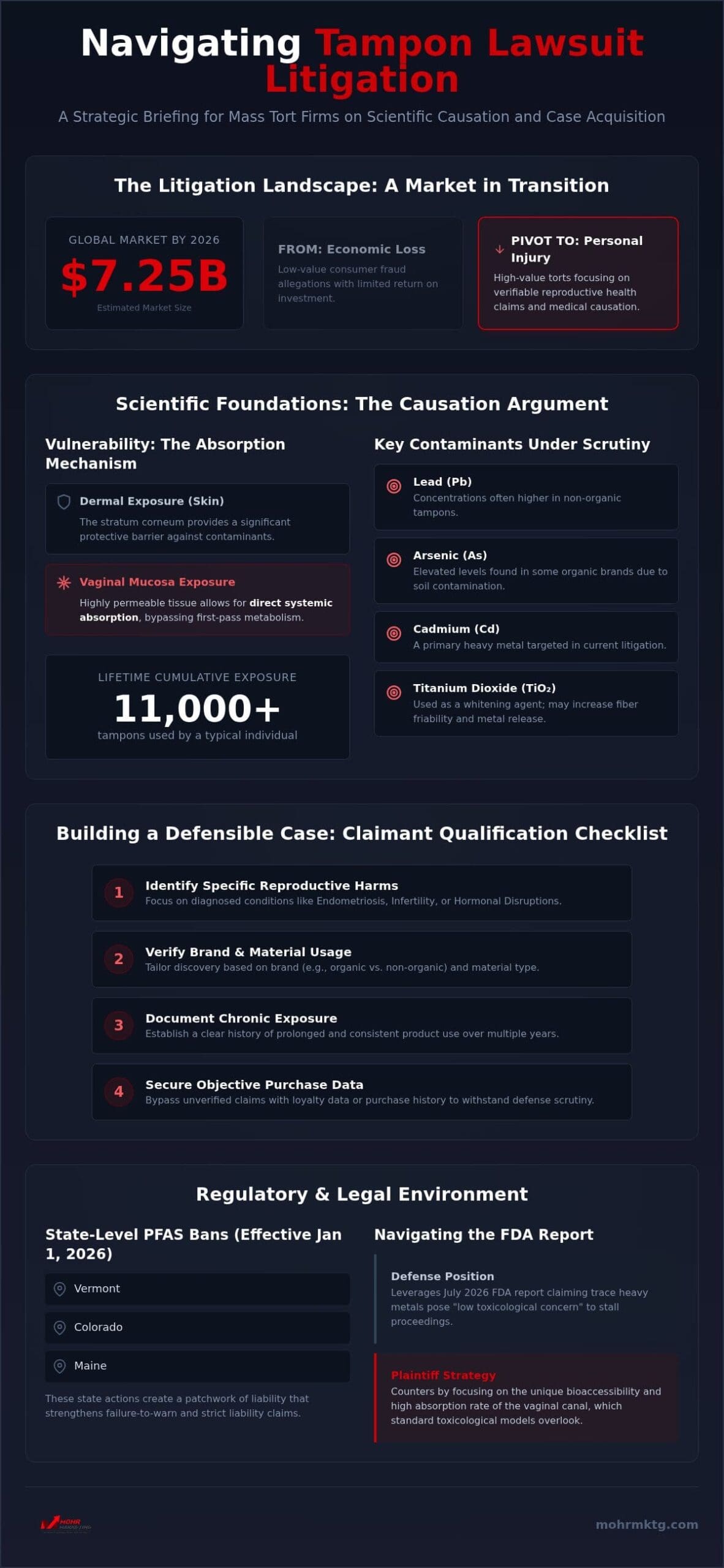
While the global tampon market reaches an estimated $7.25 billion in 2026, the legal landscape is pivoting toward a high-stakes battle over medical causation and consumer transparency. You’ve likely seen the July 2026 FDA report claiming trace heavy metals pose low toxicological concern, a finding that defense counsel is already leveraging to stall proceedings. For mass tort firms, the challenge isn’t finding claimants; it’s filtering through the noise of low-quality leads to find cases that actually meet rigorous qualification criteria for tampon lawsuit litgation.
We understand that inconsistent lead quality and rising acquisition costs in a crowded market are draining your firm’s resources. This guide provides the technical and strategic clarity required to master the scientific foundations of heavy metal exposure and deploy a scalable case acquisition model. You’ll learn to navigate the shifting liability theories following the 2026 PFAS bans in Vermont and Maine while optimizing your marketing spend for higher ROI. We’ll break down the discovery progress in lead cases like Barton v. Procter & Gamble and provide a blueprint for securing high-intent, signed retainers that withstand defense scrutiny.
Key Takeaways
- Identify high-value litigation opportunities by analyzing the shift from economic loss class actions to personal injury mass torts.
- Master the medical foundations of vaginal tissue permeability and heavy metal bioaccessibility to build a defensible causation case.
- Optimize your tampon lawsuit litgation strategy by focusing on recoverable medical damages instead of low-value consumer claims.
- Implement a 5-point qualification checklist to filter inquiries and verify brand usage with objective purchase data.
- Scale your case volume efficiently using a performance-based acquisition model that provides verified, fully executed signed retainers.
The Evolution of Tampon Litigation: 2026 Market Analysis
The 2026 landscape of tampon lawsuit litgation has reached a pivotal juncture. While a July 2026 FDA report published in Toxicological Sciences suggested that trace heavy metals in menstrual products present a “low toxicological concern,” plaintiffs’ firms are finding success by pivoting away from economic loss class actions toward personal injury mass torts. This shift is strategic. High-value reproductive health claims offer a much higher ROI than simple consumer fraud allegations. Success now depends on a firm’s ability to navigate these scientific contradictions while securing claimants with verifiable medical causation.
Historical Context: From 2024 Studies to 2026 Realities
The current litigation surge stems from a 2024 University of California, Berkeley study that identified sixteen different heavy metals in popular tampon brands. By 2026, this scientific spark has evolved into a complex regulatory environment. State-level actions in Vermont, Colorado, and Maine have already banned intentionally added PFAS as of January 1, 2026, creating a patchwork of liability that firms are now exploiting. Understanding the History of Tampon Safety and Regulation is essential for firms to frame these cases within the broader context of systemic industry oversight failures. Public awareness has moved beyond general concern to specific demands for transparency, which significantly increases the intent and reliability of potential claimants.
Current Litigation Trends and MDL Status
As of August 2026, Procter & Gamble remains the primary target in several active cases, including Barton v. The Procter & Gamble Company and Foster v. The Procter & Gamble Company. These cases utilize theories of failure to warn and strict liability. While a formal Multi-District Litigation (MDL) hasn’t yet been established, the denial of P&G’s motions to dismiss in July 2026 signals a move toward consolidation. Firms must recognize that this litigation follows a trajectory similar to the talcum powder and chemical hair straightener torts. The focus is narrowing on specific reproductive harms, such as endometriosis, infertility, and hormonal disruptions. Success in this landscape requires bypassing unverified aggregator data. You need to focus on claimants who can provide clear brand usage verification through loyalty data or purchase history. This precision is what separates scalable growth from wasted marketing spend.
Scientific Foundations: Heavy Metals and Vaginal Absorption
Vaginal tissue isn’t a simple barrier. Unlike dermal exposure, where the stratum corneum provides significant protection, the vaginal mucosa is highly permeable and richly vascularized. This allows for direct systemic absorption of contaminants, bypassing first-pass metabolism. In the context of tampon lawsuit litgation, this biological vulnerability is the cornerstone of causation arguments. While total metal content is a starting point, litigation success hinges on proving bioaccessibility, the actual amount of metal that leaches into the body during use.
Recent 2026 filings highlight a range of contaminants, specifically lead, arsenic, and cadmium. Data from ongoing discovery in cases like Barton v. Procter & Gamble suggests that non-organic tampons frequently show higher lead concentrations. Conversely, some organic brands have shown elevated arsenic levels, likely due to soil contamination in organic cotton farming. These discrepancies mean your firm must tailor its discovery requests based on the specific brand and material type used by the claimant. Understanding FDA Tampon Safety Regulations is critical for identifying where manufacturers failed to meet Class II medical device standards for material purity.
The Mechanism of Toxic Exposure
Chronic use creates a cumulative exposure profile that traditional toxicological models often overlook. A typical user may use over 11,000 tampons in a lifetime, keeping the tissue in near-constant contact with potential leachable metals. Titanium dioxide, often used as a whitening agent, is under scrutiny in 2026 as a potential catalyst that may increase the friability of fibers, leading to higher metal release. Proving direct causation remains a scientific hurdle; however, the shift toward focusing on the unique absorption rates of the vaginal canal provides a stronger path than broad environmental exposure claims. If your firm needs assistance qualifying these high-intent claimants, you can speak with our intake specialists.
Reproductive Health Complications in Litigation
The legal focus has sharpened on specific reproductive harms, including endometriosis and infertility. Heavy metals like cadmium are known endocrine disruptors that can mimic estrogen, potentially fueling the growth of endometrial tissue. Vaginal bioaccessibility is defined as the fraction of a substance that dissolves in vaginal fluid and becomes available for absorption through the highly permeable vaginal mucosa into the systemic circulation. Current 2026 medical evidence is increasingly linking this localized toxic load to hormonal disruptions that manifest as severe reproductive pathology. Firms that build their cases on these specific physiological links, rather than general “toxicity,” are seeing better results in the early phases of tampon lawsuit litgation.
Defining Recoverable Damages: Personal Injury vs. Economic Loss
The financial viability of tampon lawsuit litgation depends on how your firm categorizes damages. While economic loss class actions provide a high-volume intake stream, personal injury torts represent the high-margin segment of your portfolio. Economic loss claims argue that consumers paid a premium for “safe” or “organic” products they wouldn’t have purchased if heavy metal presence were disclosed. Conversely, personal injury claims seek compensation for tangible reproductive harm. Successful firms in 2026 are diversifying their approach, using class action settlements to fund the more intensive medical causation work required for personal injury litigation.
Medical damages in current filings include costs for fertility treatments, surgery for endometriosis, and long-term hormonal therapy. Punitive damages are also becoming a central focus. If discovery proves that manufacturers were aware of metal leaching but chose not to update warning labels, the potential for significant awards increases. Citing FDA research on tampon safety helps establish the baseline for what manufacturers should have known regarding material purity and the risks of cumulative exposure.
Criteria for High-Value Personal Injury Claims
To build a defensible mass tort case, you must prioritize specific diagnoses. We recommend focusing on infertility, endometriosis, and ovarian pathologies. General “toxic exposure” without a clinical diagnosis won’t withstand defense scrutiny in the current litigation environment. Documented product usage is equally critical. You need to verify that the claimant used the specific brand for a significant duration, often years, to establish a cumulative toxic load. Prioritize medical causation over simple purchase history to ensure you’re acquiring mass tort signed cases that hold value through the discovery phase.
The Class Action Path: Economic Loss and Deceptive Marketing
Economic loss claims focus on deceptive marketing, particularly regarding “organic” and “all-natural” labeling. While the per-claim value is lower, these cases are easier to qualify and settle in broad consumer classes. The 2026 regulatory shift, including state-level PFAS bans in Vermont and Maine, provides fresh leverage for these claims. A balanced portfolio uses these high-volume inquiries to maintain cash flow while your team builds the more complex personal injury files. This strategy ensures you don’t over-rely on a single litigation outcome while maximizing your firm’s market share in the evolving menstrual product space.
High-Conversion Intake: Qualifying Tampon Litigation Claimants
The speed-to-lead framework is the only way to maintain a competitive advantage in 2026. Because the market for tampon lawsuit litgation is increasingly saturated, a lead that sits for more than five minutes is effectively lost to a competitor. Your intake team must function as a precision filter. They need to move beyond general inquiries and focus on high-intent claimants who possess the medical documentation necessary to withstand a motion to dismiss. Success requires a rigorous, data-driven approach to qualification that prioritizes case quality over raw volume.
Use this 5-point qualification checklist to standardize your intake process:
- Targeted Brand Usage: Confirm the claimant used specific brands cited in 2026 filings, such as Tampax Pearl or Radiant, for a significant period.
- Exposure Duration: Establish a minimum usage threshold, typically five or more years of consistent monthly use.
- Clinical Diagnosis: Verify a specific medical diagnosis, such as endometriosis, infertility, or ovarian pathology, documented by a healthcare provider.
- Purchase Verification: Ensure the claimant can provide objective proof of purchase through loyalty apps, bank statements, or digital receipts.
- Exclusionary Screening: Identify and exclude claimants with pre-existing genetic conditions or reproductive injuries that predated their product use.
The Mechanics of Mass Tort Intake
Intake professionals must ask granular questions to build a defensible file. Instead of asking “did you use tampons,” ask “which specific brand and absorbency did you purchase most frequently between 2018 and 2026?” You must also screen for medical causation early. Ask if the claimant has had a laparoscopy or specific fertility testing that confirms the diagnosis. Preliminary record review is essential at this stage to confirm that the pathology aligns with heavy metal exposure theories. To understand how these efficiencies impact your bottom line, review The ROI of Legal Intake Services to optimize your conversion rates.
Overcoming Common Intake Objections
Reproductive health is a sensitive topic that requires a professional yet direct communication style. When claimants express privacy concerns, explain that specific medical details are required to link their injury to the product’s toxic load. If a claimant lacks immediate receipts, instruct them on how to download purchase histories from Amazon, Target, or CVS loyalty portals. This digital paper trail is often more reliable than physical receipts. For dual-brand users, your team must determine which brand accounted for the majority of use. Documenting the primary brand is vital for apportioning liability correctly during the discovery phase of tampon lawsuit litgation.
Scaling Case Acquisition with Mohr Marketing’s Turnkey Ecosystem
Traditional lead acquisition in tampon lawsuit litgation is often a race to the bottom characterized by unverified data and high churn. Most firms rely on aggregators who sell the same low-intent inquiries to multiple buyers. This creates a bottleneck in your intake department and inflates your cost per case. Mohr Marketing eliminates this friction by providing a turnkey ecosystem that delivers fully executed signed retainers. Our “Pay-Per-Signed-Case” model shifts the financial risk from your firm to our marketing engine. We prioritize transparency and mechanical accuracy, ensuring every inquiry meets the 2026 qualification standards discussed in previous sections.
Our approach bypasses inefficient intermediaries. We own the full stack of the acquisition funnel, from high-intent search marketing to professional legal intake services. This control allows us to maintain a compliance-first strategy that adheres to the latest 2026 advertising regulations. We don’t just find people; we verify their medical history and product usage before they ever reach your desk. This rigorous verification process ensures that your marketing spend is directed toward high-value reproductive health claims rather than unvetted consumer inquiries.
Why Signed Retainers Outperform Standard Leads
Raw leads require a massive internal infrastructure to convert. Your staff spends hours chasing claimants who may not even remember filling out a form. This leads to “intake fatigue” and missed opportunities. By choosing Mass Tort Signed Cases, you bypass the initial struggle. Fully executed retainers have significantly higher conversion rates because the claimant has already committed to the legal process. You receive a complete file ready for the discovery phase of tampon lawsuit litgation, allowing your attorneys to focus on litigation rather than lead management.
The Mohr Marketing Advantage: Precision and Transparency
With over 30 years of industry experience, we understand the volatility of the mass tort market. We don’t hide behind vague metrics or flowery promises. Our communication is characterized by a “straight-talk” philosophy that prioritizes your firm’s ROI. We monitor market shifts, such as the July 2026 FDA report findings, to adjust our targeting and maintain lead quality. This proactive leadership ensures your firm stays ahead of the competition and scales effectively in a crowded legal market.
Scale your tampon litigation practice with Mohr Marketing
Dominating the 2026 Tampon Litigation Market
Success in the 2026 legal landscape requires a strategic transition from broad consumer class actions to high-value personal injury torts. Firms must prioritize medical causation and verifiable brand usage to navigate the scientific complexities of heavy metal bioaccessibility effectively. By implementing a rigorous intake framework, you ensure that every case in your portfolio possesses the clinical documentation required to withstand aggressive defense challenges. Mastering the evolving tampon lawsuit litgation landscape is a matter of mechanical precision and strategic case selection rather than raw lead volume.
Mohr Marketing provides the competitive advantage necessary to scale your practice with confidence. Our turnkey intake and verification ecosystem leverages 30 years of industry expertise to provide direct access to fully executed signed retainers. We eliminate the inefficiencies of traditional lead aggregators, allowing your team to focus on high-stakes litigation rather than administrative overhead. It’s time to replace inconsistent lead quality with a scalable, performance-based acquisition model.
Take the lead in this emerging mass tort and build a sustainable, high-ROI practice today.
Frequently Asked Questions
What are the primary health complications cited in the 2026 tampon lawsuits?
Reproductive pathologies such as endometriosis, infertility, and ovarian pathologies are the primary health complications cited in 2026 filings. While early litigation focused on economic loss, current personal injury torts emphasize the systemic absorption of lead and arsenic through permeable vaginal tissue. These claims link chronic heavy metal exposure to endocrine disruption and long term reproductive damage. Firms must prioritize claimants with documented clinical diagnoses to ensure case viability during the discovery phase.
How does the 2024 UC Berkeley study impact current tampon litigation?
The 2024 UC Berkeley study serves as the foundational evidence for current tampon lawsuit litgation by documenting sixteen different heavy metals in popular brands. This research shifted public perception and provided the initial basis for failure to warn allegations. Although the July 2026 FDA report suggests low toxicological concern, the Berkeley findings continue to drive discovery regarding manufacturer knowledge and the long term effects of cumulative vaginal exposure to cadmium and lead.
What brands are currently named as defendants in tampon heavy metal cases?
The Procter & Gamble Company is the primary defendant in the most significant 2026 filings, including the Barton and Otkina cases. Litigation specifically targets the Tampax Pearl and Radiant product lines, alleging undisclosed lead content. Additional class actions filed in mid 2026, such as Lopez v. Procter & Gamble, have expanded the scope to include various feminine hygiene products. Firms should focus their acquisition strategies on claimants with verifiable usage of these specific brands.
Can a firm still qualify claimants for economic loss if no physical injury is present?
Firms can qualify claimants for economic loss based on deceptive marketing and the “organic” or “natural” price premium consumers paid under false pretenses. Litigation argues that manufacturers failed to disclose the presence of heavy metals, effectively devaluing the product. While personal injury cases offer higher per case value, economic loss classes provide a high volume stream of inquiries that are often easier to settle. This approach targets the financial damage caused by undisclosed contaminants.
What is the “speed-to-lead” requirement for converting mass tort inquiries?
The speed-to-lead requirement for mass tort inquiries is typically under five minutes to maintain competitive conversion rates. In the high stakes environment of 2026, claimants often submit inquiries to multiple firms simultaneously. Our intake ecosystem emphasizes immediate response to capture high intent inquiries before they’re lost to competitors. Rapid engagement isn’t just about speed; it’s about establishing professional authority and securing the claimant’s trust during their initial search for legal representation.
How does Mohr Marketing verify the intent of tampon litigation leads?
Mohr Marketing verifies the intent of inquiries through a rigorous turnkey intake ecosystem that filters out low quality aggregator data. We use a series of targeted questions to confirm brand usage, exposure duration, and the presence of documented medical diagnoses. This process ensures that every file we deliver is a high intent inquiry or a fully executed signed retainer. Our 30 years of experience allow us to identify and eliminate unverified leads early.
Is there a statute of limitations for filing a tampon heavy metal claim in 2026?
The statute of limitations for filing a claim in 2026 depends on specific state laws and the discovery rule regarding when the claimant became aware of the harm. Because heavy metal litigation is a relatively new field, many states may measure the filing deadline from the publication of the 2024 Berkeley study or the date of a specific medical diagnosis. Your firm should conduct a detailed review of state specific statutes to ensure timely filing.
What is the difference between a lead and a signed retainer in mass tort marketing?
A lead is a raw inquiry that requires significant time and resources for your intake team to qualify and convert. Conversely, a signed retainer is a fully executed legal contract where the claimant has already agreed to representation. Mohr Marketing specializes in providing signed retainers to eliminate intake fatigue for your staff. This model allows your firm to skip the initial filtering process and move directly into the litigation and discovery phases.

Recent Posts
- Auto Accident Lead Generation: Build a Verified Case Pipeline in 2026
- Car Accident Case Acquisition: Strategic Law Firm Guide
- In-House vs. Outsourced Law Firm Marketing in 2026
Categories
- AI and Lead Generation
- Business Financing
- Call Verified MVA Leads
- Car Accident Help
- Car Accident Settlements
- Claimant Funding
- Compliance Program
- EMS-EMT Reports
- Geotargeting
- Google Maps Ranking
- Healthcare Practice Growth
- Law Firm Growth
- Law Office Operations
- Lead Generation
- Lead Generation For Attorneys
- Lead Generation For Chiropractors
- Lead Generation For Criminal Attorneys
- Lead Generation For D&A Treatment Centers
- Lead Generation For DUI Attorneys
- Lead Generation For Eye Doctors
- Lead Generation For Family Law Practices
- Lead Generation For PI Law Firms
- Lead Generation For Plastic Surgeons
- Leads For Healthcare Professionals
- Leads For Insurance Industry
- Legal Leads
- Legal Marketing
- Legal Updates
- Mass Tort Leads
- Medicare and Medicaid Leads
- Merchant Funding Leads
- Mold Leads
- Online Marketing Strategies
- Pre-Settlement Funding
- Signed MVA Cases
- Tort Updates
- Truck Accident Leads and Signed Cases
- Truck Accident Settlements
- Web Design