Tampon Mass Tort: A Professional Guide to Litigation Trends and Case Acquisition
September 15, 2026 by Mohr Marketing
The global tampon market is estimated at $7.25 billion in 2026, yet a landmark University of California, Berkeley study revealed sixteen heavy metals, including lead and arsenic, in these essential products. This scientific foundation has shifted the legal landscape from low-value consumer fraud claims to high-stakes personal injury tampon mass tort litigation. You’re likely facing the high cost of lead acquisition and the frustration of low-quality inquiries that fail to meet rigorous clinical standards. Chasing unverified data is a drain on your firm’s resources and momentum.
You recognize that a successful case hinges on clear medical causation and high-intent claimants. This guide delivers the strategic framework required to identify high-value cases and implement a scalable acquisition funnel. We’ll examine the 2026 litigation trends, including the pre-trial discovery in federal class actions and the specific reproductive health diagnoses that define a viable claim. Prepare to move beyond raw inquiries and secure the signed retainers necessary for national scaling.
Key Takeaways
- Analyze the biological link between heavy metal exposure and reproductive disorders to build a stronger case for medical causation.
- Identify the specific brand usage and clinical diagnosis requirements that define a high-value claimant for your firm.
- Optimize your firm’s budget by pivoting from social media scraping to an intent-based model for the tampon mass tort.
- Deploy rigorous verification and fraud filtering protocols to eliminate the friction of low-quality inquiries and invalid data.
- Adopt a performance-based acquisition framework to secure verified, signed retainers and scale your caseload efficiently.
Understanding the Tampon Mass Tort: Emerging Litigation and Health Risks
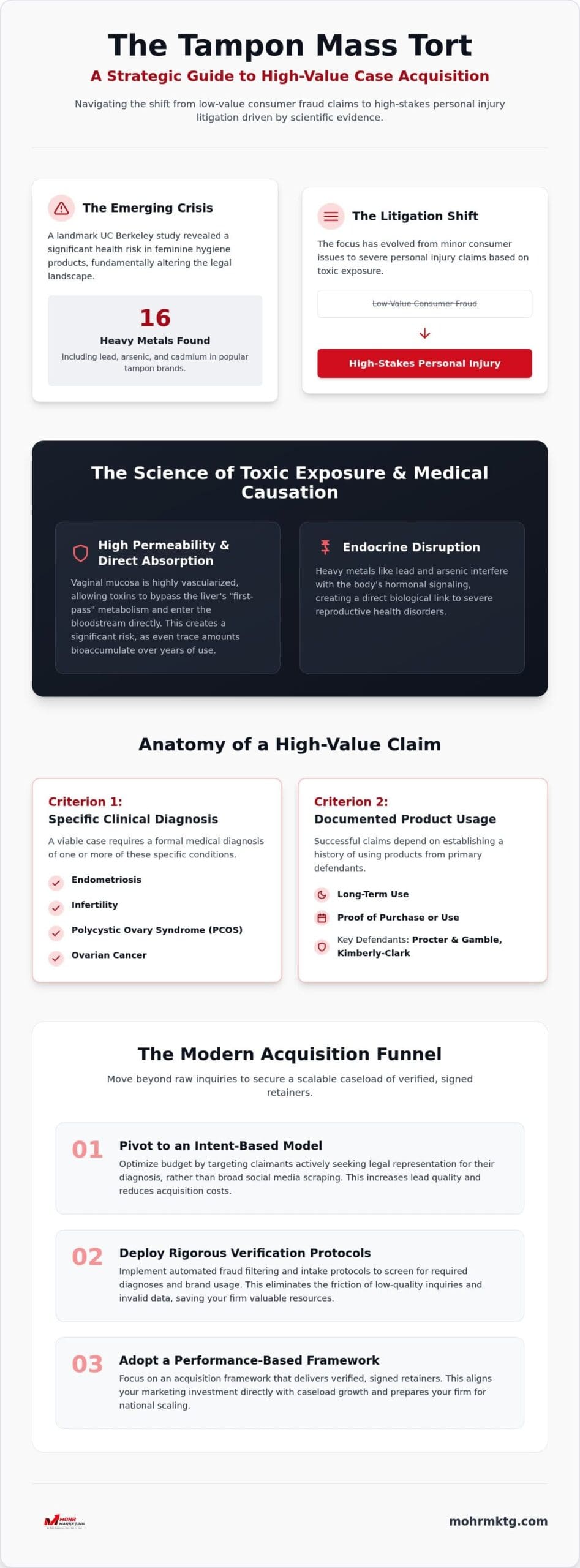
The tampon mass tort represents a significant shift in feminine hygiene litigation. While early legal actions focused on economic loss and consumer fraud, the current landscape is defined by personal injury claims involving toxic heavy metal exposure. This litigation gained momentum following a 2024 University of California, Berkeley study that identified sixteen heavy metals, including lead, arsenic, and cadmium, in popular tampon brands. Unlike previous disputes over labeling, these cases allege that manufacturers failed to warn consumers about the presence of systemic toxins that pose severe risks to reproductive health.
Primary defendants include industry giants like Procter & Gamble and Kimberly-Clark, along with various organic brand retailers. The legal theory has evolved from simple class action structures to high-value mass torts as attorneys identify claimants with medically diagnosed conditions like endometriosis and infertility. Understanding the History of Tampon Safety and Litigation is essential to recognize how this tort mirrors the trajectory of talc and chemical hair straightener cases. It’s no longer just a consumer protection issue; it’s a high-stakes personal injury battle grounded in toxicological data.
The Catalysts of 2026 Litigation
Several factors accelerated this tort’s growth in early 2026. In July 2026, federal courts denied motions to dismiss filed by Procter & Gamble in cases such as Barton v. The Procter & Gamble Company. This ruling allowed discovery to proceed, signaling a green light for firms to scale their acquisition efforts. Additionally, state-level bans on intentionally added PFAS in Vermont, Colorado, and Maine became effective on January 1, 2026. These regulatory shifts provide a stronger legal basis for claims of negligence and strict liability. This tort is gaining momentum faster than traditional talc cases because the scientific link to heavy metal contamination is more recent and precisely documented in peer-reviewed literature.
Key Chemicals of Concern
The biological risk centers on the high permeability of vaginal tissue. Unlike dermal exposure, the vaginal mucosa allows for direct systemic absorption of heavy metals and “forever chemicals” without the “first-pass” metabolism that occurs with ingestion. Lead and arsenic exposure are linked to disrupted hormonal balance and reproductive organ damage. Beyond heavy metals, the presence of PFAS in product liners has become a focal point of 2026 litigation. Firms must focus on mass tort signed cases that emphasize these specific toxicological links. Documenting the duration of use and specific brand exposure is critical to ensuring the viability of the claimant’s medical history during the discovery phase.
The Science of Toxic Exposure: Heavy Metals and Reproductive Health
The scientific core of the tampon mass tort rests on chronic exposure to heavy metals and their cumulative impact on the female reproductive system. Lead, arsenic, and cadmium are known endocrine disruptors that interfere with delicate hormonal signaling. Litigation focuses on severe health outcomes, specifically endometriosis, infertility, polycystic ovary syndrome (PCOS), and ovarian cancer. While consumers often assume “organic” brands are safer, the 2024 Berkeley study confirmed that heavy metals were present in both traditional and organic products. This suggests that soil contamination and manufacturing processes introduce toxins regardless of the “natural” label. Because these metals bioaccumulate, decades of monthly use result in a toxic load that the body cannot easily clear.
Vaginal Permeability and Toxic Absorption
The vaginal mucosa is highly vascularized and significantly more permeable than standard skin. This physiological trait allows chemicals to enter the bloodstream directly, bypassing the liver’s filtration process. Current FDA Tampon Regulation focuses primarily on sterilization and the prevention of Toxic Shock Syndrome (TSS). It doesn’t account for the long-term leaching of heavy metals into the systemic circulation. Vaginal permeability refers to the high rate at which the vaginal mucosa absorbs systemic toxins directly into the bloodstream without first-pass hepatic metabolism. Because of this direct pathway, even trace amounts of metals pose a significant risk over time.
Establishing Medical Causation
Proving a direct link between product use and a specific diagnosis is the most rigorous requirement in the tampon mass tort. Firms must secure comprehensive medical records that document the onset of symptoms and the clinical diagnosis of reproductive disorders. Success in these cases requires testimony from expert witnesses in toxicology to explain the bioaccumulation process and gynecologists to verify the injury’s severity. Proving causation is difficult in early-stage litigation because defense counsel often leverages the July 2026 FDA report, which downplays the risks of trace heavy metals, to stall proceedings. You need a strategic partner to help you identify high-intent claimants who meet these strict medical criteria. If you’re looking to build a viable portfolio, it’s time to discuss your acquisition strategy with an industry expert.
Defining Case Criteria for High-Value Tampon Litigation
Identifying high-value claimants in the tampon mass tort requires a rigorous screening process that prioritizes medical evidence over raw inquiry volume. Your firm must look beyond generic complaints to find specific markers of toxic exposure and long-term injury. High-value cases are characterized by a combination of documented brand loyalty, chronic usage, and severe clinical diagnoses. Without these baseline requirements, firms risk wasting resources on inquiries that will fail during the discovery phase. Documentation is everything. The goal isn’t just to find users but to find victims with clear medical causation.
Primary Qualification Factors
The foundation of a viable claim is the ability to prove exposure to specific product lines. Current litigation focuses heavily on Tampax Pearl, manufactured by Procter & Gamble, and Kotex, produced by Kimberly-Clark. A claimant must demonstrate a minimum usage period, typically several years of consistent product use, to establish the bioaccumulation of heavy metals. Demographically, the most relevant claimants are women within reproductive age ranges who used these products consistently between 2000 and 2024. Chronic exposure is the primary driver of liability in these cases.
Primary criteria for your intake team should include:
- Brand Identification: Specific confirmation of using Tampax, Kotex, or identified organic brands.
- Usage Threshold: A documented history of monthly use over a period of five years or more.
- Clinical Diagnosis: A formal medical diagnosis of ovarian cancer, endometriosis, or infertility.
Secondary Health Indicators
While primary diagnoses drive the core value of a case, secondary indicators often distinguish a standard claim from a high-value settlement. Hormonal imbalances and recurring reproductive issues strengthen the argument for systemic toxic exposure. Surgical interventions, such as laparoscopies for endometriosis or full hysterectomies, significantly increase the case’s potential ROI. Much like high-value mold case acquisition, the focus must remain on the severity of the exposure and the permanence of the resulting damage. Cases involving permanent loss of fertility or invasive surgeries are the highest priority for national scaling.
Exclusion criteria are equally vital for maintaining a profitable portfolio. You should generally avoid cases where the claimant cannot identify a specific brand or where the duration of product use was sporadic. Pre-existing reproductive conditions that predated product use often result in low-ROI outcomes. By filtering for these variables early, you ensure your intake efforts are concentrated on cases with the highest likelihood of success. Don’t chase every lead; chase the cases that meet the clinical threshold.
Strategic Acquisition: Navigating the Competitive Mass Tort Landscape
Competition for high-value claimants in the tampon mass tort is driving acquisition costs to record levels. Many firms currently rely on social media scraping, which frequently results in low-quality inquiries and invalid data. Success in this landscape requires a shift toward efficiency and rigorous verification. You must move away from broad-audience interruption and focus on capturing specific intent. Following a proven Mass Tort Lead Generation roadmap ensures your firm scales without the friction of middlemen or reseller markups.
Intent-Based Search Strategy
Targeting specific search queries yields claimants who are already investigating the link between their diagnosis and product use. These individuals demonstrate much higher intent than those who click on a passive social media advertisement. Educational content plays a vital role in this journey. By providing clear information on heavy metal exposure and reproductive health, you establish authority before the intake call even begins. This model filters out casual inquiries and focuses your budget on individuals with documented medical histories. Real search intent produces a cleaner path from inquiry to signed case.
Optimizing the Intake Funnel
Speed-to-lead is the defining metric for success in 2026. Industry data confirms that responding to a potential client in under five minutes is essential to maintain a competitive edge. Your intake funnel must be optimized for both speed and precision. This involves using Scammer Scrub™ fraud filtering technology to remove invalid entries before they reach your team. During the initial call, your team must confirm specific brand usage, duration of exposure, and the date of medical diagnosis. These critical data points determine if a case meets the threshold for high-value litigation.
A professional intake team is necessary for high conversion rates for tampon mass tort cases. While AI can assist in the initial scrub, verifying complex medical details requires a human touch. This ensures that your firm only processes cases that have a high probability of success during the discovery phase. Eliminating inefficient intermediaries and focusing on verified, signed cases is the most direct path to national scaling. High-stakes professionals value this level of procedural precision because it protects resources and accelerates growth.
Scaling Your Caseload with Verified Tampon Mass Tort Leads
Transitioning from raw inquiry data to a high-volume portfolio requires a model that emphasizes quality over quantity. Mohr Marketing, LLC provides a turnkey ecosystem designed to deliver mass tort signed cases directly to your firm. This direct-to-firm approach eliminates the markups and data degradation common with third-party resellers. With over 30 years of industry experience, we understand that success in the tampon mass tort isn’t about how many people you talk to; it’s about how many qualified retainers you secure. Our model removes the administrative burden of intake, allowing your partners to focus on litigation strategy.
The Value of Fully Executed Retainers
Signed retainers are the gold standard for sustainable firm growth. When you purchase raw leads, your staff spends hundreds of hours chasing unverified data and filtering out low-intent inquiries. This results in high churn and a low return on investment. Our model shifts the burden of verification to our ecosystem, delivering only those cases that have already passed our rigorous screening protocols. The ‘Pay-Per-Signed-Case’ advantage allows law firms to eliminate financial risk by paying only for retainers that meet strict, pre-verified clinical criteria. This ensures your capital is deployed only toward assets with a high probability of successful recovery.
Ensuring Compliance and Quality
Case integrity is a non-negotiable requirement for high-stakes litigation. We utilize Scammer Scrub™ fraud filtering technology to identify and eliminate invalid inquiries, social media scrapers, and duplicate entries. This technology ensures that every case we deliver is unique and backed by a legitimate claimant. Every potential tampon mass tort case undergoes a multi-step verification process to confirm brand usage and medical diagnosis dates. This procedural precision protects your firm’s reputation and ensures your discovery phase is as efficient as possible.
Maintaining compliance with state bar and UCPMP mandates is a core component of our operation. We manage the complexities of legal marketing regulations so you don’t have to. This transparency builds trust and ensures that your acquisition strategy remains beyond reproach. By establishing a cleaner path from intent to intake, you position your firm as a leader in this emerging tort. Secure your competitive advantage by moving away from raw data and toward a results-oriented acquisition framework.
Secure Your Competitive Advantage in Tampon Litigation
The 2026 legal landscape for the tampon mass tort requires a transition from passive lead acquisition to a verified, intent-based model. Success depends on isolating cases with documented heavy metal exposure and clinical reproductive health diagnoses. You’ve analyzed the scientific link between vaginal permeability and toxic absorption; now you must apply that data to your intake criteria. Chasing raw social media leads is a liability that drains your firm’s resources and stalls national growth.
Mohr Marketing offers a cleaner path from intent to intake. We leverage Scammer Scrub™ fraud filtering and 30 years of legal marketing expertise to deliver verified inquiries and signed retainers. By eliminating inefficient intermediaries, you secure a direct-to-firm advantage that ensures every case meets rigorous mandates. Stop managing raw data and start litigating high-value cases with procedural precision.
Position your firm at the forefront of this emerging litigation and build a high-ROI portfolio with confidence.
Frequently Asked Questions
What is the current status of the tampon heavy metal litigation?
Litigation is actively progressing through the discovery phase. In July 2026, federal courts denied motions to dismiss in cases like Barton v. The Procter & Gamble Company. This allows plaintiffs to move forward with evidence gathering. Additionally, state-level bans on PFAS in menstrual products took effect on January 1, 2026, in several states. Firms are now scaling acquisition efforts as the scientific foundation for these claims strengthens.
Which brands are involved in the tampon mass tort?
The primary defendants include major manufacturers like Procter & Gamble (Tampax) and Kimberly-Clark (Kotex). However, the 2024 Berkeley study identified heavy metals in sixteen different brands, including several marketed as organic or natural. This broad involvement means that brand identification is a critical component of the intake process. Claimants must be able to specify which product lines they used consistently to establish a viable claim for the tampon mass tort.
What are the primary health conditions linked to toxic tampons?
Litigation focuses on severe reproductive health outcomes caused by the systemic absorption of heavy metals. The most common diagnoses include endometriosis, infertility, and ovarian cancer. Other conditions like polycystic ovary syndrome (PCOS) and permanent hormonal imbalances are also being scrutinized. Because vaginal tissue is highly permeable, these toxins enter the bloodstream directly. This bypasses the liver’s filtration, leading to significant bioaccumulation and long-term reproductive organ damage.
How do I qualify a claimant for a tampon injury case?
Qualifying a claimant requires meeting three strict criteria: brand identification, duration of use, and a medical diagnosis. You must confirm the use of targeted brands like Tampax or Kotex for a minimum of five years. The claimant must also provide medical records documenting a diagnosis of a reproductive disorder that occurred after the period of use. Excluding cases with pre-existing conditions or sporadic usage ensures your firm maintains a high-ROI portfolio.
What is the difference between a raw tampon lead and a signed case?
A raw lead is simply inquiry data that hasn’t been vetted for accuracy or medical criteria. In contrast, a signed case is a fully executed retainer from a claimant who has already passed rigorous screening. Mohr Marketing focuses on delivering signed retainers to eliminate the administrative burden of intake. This model ensures your firm only pays for converted opportunities ready for litigation rather than chasing unverified contact information.
How much does it cost to acquire a signed tampon mass tort retainer?
Acquisition costs vary based on market competition and the specific criteria required by your firm. While we don’t provide fixed pricing here, our performance-based model ensures that you only pay for cases that meet your pre-defined qualification standards. This approach eliminates the financial risk associated with traditional pay-per-lead models. By focusing on high-intent search traffic rather than social media scraping, we maintain a more efficient and cost-effective acquisition funnel for the tampon mass tort.
Is there a multidistrict litigation (MDL) for tampon cases yet?
As of August 2026, a formal MDL for tampon cases has not yet been established. However, there’s a clear trend toward consolidation as individual lawsuits move forward in federal courts. For example, the Otkina v. Procter & Gamble Co. class action in the Northern District of Illinois is currently in the pre-trial discovery phase. Attorneys are structuring these cases to follow the successful trajectories of previous toxic torts like talcum powder.
How does Mohr Marketing verify the intent of tampon tort claimants?
We use a turnkey marketing and intake ecosystem to capture high-intent search traffic. Our Scammer Scrub™ technology filters out fraudulent entries and social media scrapers before they ever reach the intake stage. Following this, our professional intake team conducts a detailed interview to confirm brand loyalty and clinical diagnosis dates. This multi-layered verification process ensures that every signed retainer we deliver represents a legitimate claimant with a genuine intent to litigate.

Recent Posts
- Tampon Mass Tort: A Professional Guide to Litigation Trends and Case Acquisition
- Personal Injury Intake Services: A 2026 Guide to High-Conversion Case Acquisition
- Using EMS Reports to Find and Qualify Personal Injury Clients
Categories
- AI and Lead Generation
- Business Financing
- Call Verified MVA Leads
- Car Accident Help
- Car Accident Settlements
- Claimant Funding
- Compliance Program
- EMS-EMT Reports
- Geotargeting
- Google Maps Ranking
- Healthcare Practice Growth
- Law Firm Growth
- Law Office Operations
- Lead Generation
- Lead Generation For Attorneys
- Lead Generation For Chiropractors
- Lead Generation For Criminal Attorneys
- Lead Generation For D&A Treatment Centers
- Lead Generation For DUI Attorneys
- Lead Generation For Eye Doctors
- Lead Generation For Family Law Practices
- Lead Generation For PI Law Firms
- Lead Generation For Plastic Surgeons
- Leads For Healthcare Professionals
- Leads For Insurance Industry
- Legal Leads
- Legal Marketing
- Legal Updates
- Mass Tort Leads
- Medicare and Medicaid Leads
- Merchant Funding Leads
- Online Marketing Strategies
- Pre-Settlement Funding
- Signed MVA Cases
- Tort Updates
- Truck Accident Leads and Signed Cases
- Truck Accident Settlements
- Web Design