Outsource Legal Intake: A Strategic Framework for Case Acquisition in 2026
July 12, 2026 by Mohr Marketing
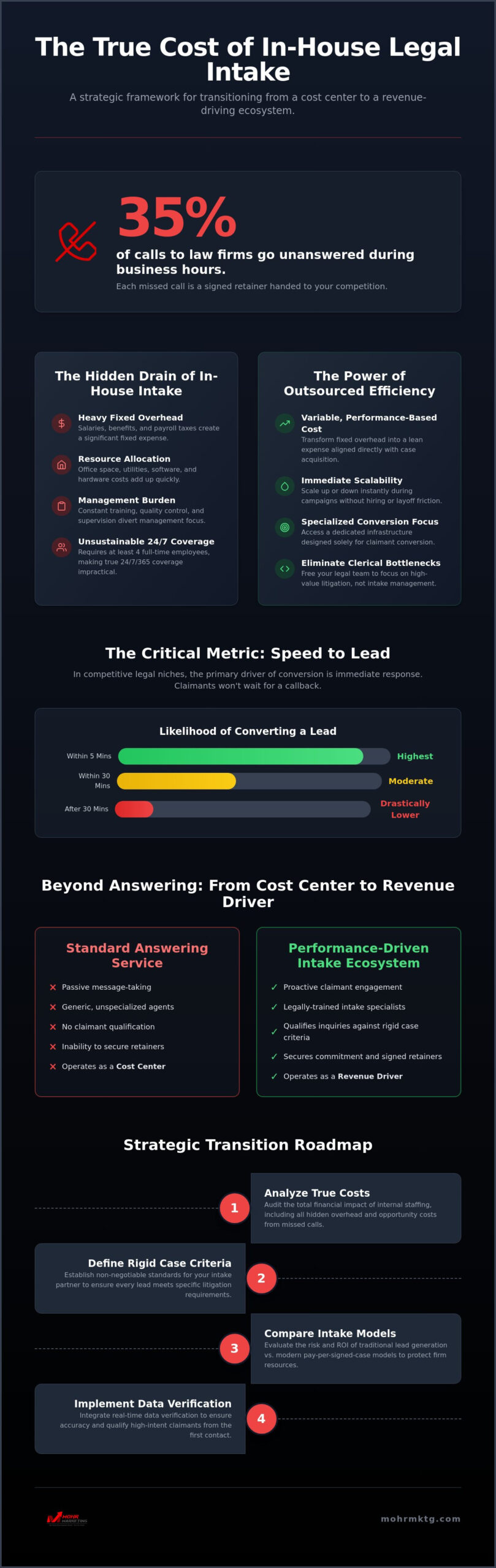
Thirty-five percent of calls to small and mid-sized law firms go unanswered during standard business hours. If you’re relying on an overstretched in-house team, you aren’t just losing calls. You’re handing signed retainers to your competitors. High staff turnover and the inability to maintain 24/7 coverage create friction that erodes your marketing ROI. You likely recognize that managing a call center isn’t your core competency. Yet, the decision to outsource legal intake often feels risky due to concerns over lead quality and data security.
Stop managing people and start managing performance. This guide provides a strategic framework to eliminate the overhead of internal staffing while maximizing conversion rates through a specialized intake ecosystem. You’ll learn how to transition from a reactive answering model to a proactive, data-driven acquisition strategy. We will examine the 2026 requirements for 24/7 coverage, the economic shift toward predictable costs per case, and the rigorous verification processes required to secure high-volume signed retainers. It’s time to replace internal inefficiencies with a streamlined, results-oriented engine for growth.
Key Takeaways
- Analyze the true cost of internal staffing by identifying the revenue lost to missed opportunities during peak and off-peak hours.
- Learn how to outsource legal intake by transitioning from a reactive answering service to a performance-driven ecosystem.
- Compare the risk distribution between traditional lead generation and the modern pay-per-signed-case model to protect your firm’s resources.
- Use a structured implementation roadmap to audit conversion leaks and define rigid case criteria for your intake partners.
- Understand the role of data-driven verification in ensuring every retained case meets your specific litigation requirements.
The Economic Case for Outsourcing Legal Intake
Managing an in-house intake department is often a hidden drain on firm resources. Most partners focus on the base salary of an intake specialist but ignore the cumulative burden of benefits, payroll taxes, and office square footage. When you choose to outsource legal intake, you transform these heavy, fixed overhead costs into a lean, variable expense. This shift allows for immediate scaling during high-volume campaigns without the friction of hiring or the risk of layoffs during slower periods. It’s a strategic move that aligns your expenses directly with your case acquisition goals.
Specialized outsourcing providers operate on a performance-based model that internal departments can’t match. By utilizing Legal Process Outsourcing (LPO), you gain access to a dedicated infrastructure designed for one purpose: conversion. This removes the “clerical” bottleneck from your firm, allowing your legal team to focus on litigation while the intake ecosystem handles the high-volume screening required for modern mass tort and personal injury practice.
Calculating In-House Overhead vs. Outsourced Efficiency
Internal screening requires constant training and management oversight to ensure quality. This bandwidth is better spent on high-value litigation tasks. Achieving true 24/7/365 coverage with internal staff requires at least four full-time employees to cover rotations, weekends, and holidays. For most firms, the payroll alone makes this model unsustainable. You aren’t just paying for the hours they work; you’re paying for the management time required to supervise them.
Use this checklist to audit your current intake spend:
- Total annual salary and benefits for all intake personnel.
- Cost of specialized software licenses and hardware.
- Management hours spent on training and quality control.
- Real estate costs and utilities allocated to the intake department.
- Employee turnover costs, including recruitment and onboarding.
Opportunity Cost: The Price of a Missed Call
The financial impact of a missed call is often greater than the cost of the marketing that generated it. In competitive niches, the “speed to lead” metric is the primary driver of conversion. High-intent claimants are often in distress and will call the next firm on the list if they aren’t greeted by a live, qualified professional immediately. They won’t wait for a callback on Monday morning.
Research indicates that firms responding within five minutes are significantly more likely to convert a lead compared to those that wait even thirty minutes. This is why the ROI of legal intake services is measured by more than just saved salary. It’s measured by the capture of high-value cases that would otherwise go to your competitors. Every missed call represents a lost retainer and a wasted marketing dollar. Outsourced models ensure your firm is always “on,” providing the immediate response required to secure a signed retainer before the claimant moves on.
Performance-Driven Intake: Beyond the Standard Answering Service
A standard answering service is a cost center. A legal intake ecosystem is a revenue driver. When you outsource legal intake to a specialized partner, you aren’t just buying minutes on a phone. You’re deploying a sophisticated infrastructure that integrates marketing intent, advanced technology, and human authority. This ecosystem ensures that the first point of contact does more than record a message; it qualifies the inquiry against rigid legal standards and secures the claimant’s commitment.
Modern intake requires a blend of empathy and clinical precision. High-stakes litigation, such as medical malpractice or mass torts, demands an immediate projection of professional authority. Claimants are often in crisis. They need to feel heard, but they also need to know they are speaking with a firm that possesses deep insider knowledge. Specialized intake teams use calibrated scripts that mirror the firm’s expertise, ensuring the claimant feels they have already begun the process of seeking justice.
The Role of High-Intent Data Verification
There’s a critical distinction between a caller and a qualified claimant. Intake professionals use real-time data verification to bridge this gap. This process involves cross-referencing claimant statements with available databases to confirm details like accident locations, medical provider history, or product exposure dates. Verifying these facts during the initial call prevents your legal team from wasting hours on “no-go” inquiries that lack merit or fail to meet jurisdictional requirements.
Compliance is non-negotiable. Every interaction must adhere strictly to state laws and ABA bar mandates, including rules regarding confidentiality and the supervision of non-lawyers. A performance-driven partner understands these regulatory boundaries. They ensure that every data point collected is secure and that the screening process remains ethically sound. This rigorous approach protects your firm’s reputation while filtering for the highest-value cases. Refining these protocols ensures your firm captures every viable opportunity. You can consult with our team to evaluate your current screening efficiency.
Specialized Screening for Complex Litigation
Generic answering services fail at complex litigation because they lack the technical vocabulary to screen for specific medical or toxic tort criteria. For example, securing mesothelioma leads requires an intake specialist who understands the nuances of asbestos exposure sites and latency periods. A generalist will miss these cues, resulting in lost opportunities or a backlog of unqualified leads.
The qualification barrier is the primary filter for firm growth. By establishing strict “knock-out” questions, specialized intake teams act as a surgical filter. They identify high-intent claimants who meet your specific litigation requirements before the lead ever reaches your desk. This precision allows your firm to scale its caseload without increasing its administrative burden.
Evaluating Outsourced Intake Models: Lead vs. Signed Case
Choosing to outsource legal intake requires a critical evaluation of how you pay for results. The industry has moved beyond the traditional Pay-Per-Lead (PPL) model, which often delivers high-volume but low-quality inquiries. In a PPL framework, your firm carries the financial burden of “no-go” inquiries. You pay for the data even if the caller doesn’t meet your litigation criteria. The modern Pay-Per-Signed-Case (PPSC) model shifts this risk back to the provider. It represents the highest level of intake maturity, where you only invest in fully qualified, retained clients.
Transparency is the primary benefit of performance-based acquisition. When you outsource legal intake using a signed-case model, your cost per case becomes predictable. You eliminate the guesswork associated with internal conversion rates. This allows for precise financial planning and more aggressive scaling in competitive markets. If an intake partner fails to deliver a signed retainer, they don’t get paid. This incentive structure ensures that every inquiry is handled with maximum urgency and precision, forcing a focus on quality over quantity.
The Advantages of Signed Retainer Services
A fully executed retainer is the ultimate deliverable for a growth-oriented law firm. It signifies that the claimant has been vetted, qualified, and has legally committed to your representation. This model eliminates the labor-intensive “chase” phase where your internal team spends days attempting to contact and sign a lead. By securing mass tort signed cases, you ensure your attorneys spend their time on case files, not administrative outreach. It’s the most efficient path to increasing your firm’s inventory without increasing its headcount.
Risk Management and Compliance in Case Acquisition
National case acquisition requires strict adherence to evolving regulatory standards and bar mandates. You must ensure your partner follows TCPA guidelines and specific state requirements regarding solicitation. Data security is equally vital. Handling medical history or accident specifics requires HIPAA-compliant protocols and robust encryption to protect sensitive claimant information. For a deeper dive into these requirements, review the Mass Tort Lead Generation Roadmap to understand the essential compliance pillars for 2026. Maintaining these standards is not just about security; it’s about protecting your firm’s license and reputation while you scale.
Implementation Roadmap: Transitioning to an External Intake Partner
Transitioning to an external partner requires more than a signed contract. It demands a mechanical alignment between your firm’s litigation standards and the intake team’s execution. If you fail to build a rigorous framework, you’ll simply move your internal inefficiencies to an external vendor. Success depends on a structured, five-step implementation roadmap designed to protect your ROI.
- Step 1: Audit current conversion rates. Identify exactly where you’re losing leads. Is it after-hours? Is it during the initial screening call? Pinpoint these leak points before you outsource legal intake.
- Step 2: Define case criteria. Establish rigid “knock-out” questions. These are the non-negotiable triggers that determine if an inquiry moves forward or is rejected immediately.
- Step 3: Establish data protocols. Ensure your partner can deliver lead data directly into your CRM in real time. Manual data entry is a point of failure you can’t afford.
- Step 4: Launch a pilot program. Don’t move your entire firm at once. Start with a high-intent campaign, such as MVA or a specific mass tort, to test the partner’s conversion efficiency.
- Step 5: Refine the feedback loop. Schedule weekly reviews between your firm’s partners and the intake management team. Use these sessions to sharpen scripts based on the quality of the cases being signed.
Defining Your Case Acquisition Criteria
Translating complex legal requirements into actionable intake scripts is the most critical phase of the transition. You shouldn’t settle for simple volume; you need high-intent signals that indicate a viable case. For example, when targeting police-report-backed MVA cases, the intake script must verify the existence of the report and the severity of the injuries during the first interaction. This level of detail ensures your firm only receives inquiries that have already passed a significant evidence threshold. Clear criteria prevent your attorneys from wading through “maybe” cases and focus their energy on “must-file” litigation.
Integrating Outsourced Intake with Your CRM
Technical integration must be frictionless. When you outsource legal intake, the “speed to lead” remains the dominant metric for success. Your intake partner must provide immediate notification for hot transfers and real-time data syncing. This allows for a seamless hand-off from the intake specialist to your legal team. A delay of even ten minutes in data transfer can result in a claimant losing interest or seeking another firm. Your CRM should be the single source of truth, updated instantly as the intake specialist qualifies the claimant and secures the signature. To begin building this integrated acquisition engine, you should contact our strategy team for a technical audit.
The Mohr Marketing Ecosystem: Precision Case Acquisition
High-stakes litigation demands a partner who understands the mechanics of conversion. When you outsource legal intake to Mohr Marketing, you aren’t just hiring a service; you’re deploying a turnkey case acquisition ecosystem. This system is built to handle the complexities of Mass Torts, Personal Injury, and Medical Malpractice with surgical precision. We remove the administrative burden from your firm, allowing your attorneys to focus exclusively on the legal work that generates revenue. Your firm exists to litigate, not to manage phone banks.
Our approach is rooted in 30 years of industry experience. This legacy informs every script, every verification protocol, and every signature request. We don’t just deliver data; we deliver fully vetted, retained clients ready for your legal team. We operate as a strategic partner, protective of your resources and aggressive in pursuing your firm’s expansion. This alignment ensures that our goals are identical to yours: acquiring the highest quality cases with maximum efficiency. We don’t settle for surface-level lead generation; we focus on the final executed retainer.
Verified Inquiries and Fully Executed Retainers
The core of our philosophy is a Pay-Per-Results model. You shouldn’t pay for the “chase” or for inquiries that don’t meet your litigation criteria. For example, our process for acquiring truck accident signed cases involves immediate verification of police reports and injury severity during the initial contact. We don’t stop at the initial call. Our intake specialists manage the relationship until the retainer is fully executed and delivered to your CRM. Our turnkey model provides a direct path to growth by eliminating inefficient intermediaries and the friction of managing multiple third-party lead brokers. This streamlined process ensures that every marketing dollar is tied directly to a tangible, signed case.
Scaling Your Firm Nationally with Confidence
Scaling a law firm traditionally requires a massive increase in headcount and overhead. Our ecosystem changes that dynamic. You can enter new mass torts or expand your personal injury practice nationally without hiring a single new staff member. We provide the infrastructure needed to handle high-volume inquiries 24/7, ensuring no opportunity is missed. This includes specialized niches such as high-value mold case acquisition, where technical knowledge is essential for proper qualification. We handle the heavy lifting of marketing and intake, so your firm remains lean and profitable. Stop managing people and start managing your firm’s growth. To begin your transition to a performance-based acquisition model, contact Mohr Marketing to scale your case acquisition today.
Strategic Case Acquisition for 2026 and Beyond
Transitioning to an external intake ecosystem is no longer a cost-saving tactic; it’s a competitive necessity. Firms that continue to manage internal departments face rising overhead and the constant threat of missed opportunities. By choosing to outsource legal intake, you shift the focus from managing staff to managing performance. You replace unpredictable conversion rates with a scalable, data-driven engine that delivers fully executed retainers. This move converts heavy fixed costs into variable expenses that align directly with your firm’s growth.
Mohr Marketing brings 30+ years of industry experience to your firm’s expansion strategy. Our turnkey ecosystem for mass torts and personal injury eliminates inefficient intermediaries, providing a direct path to high-value litigation. We operate on a performance-based signed retainer model, ensuring you only pay for fully executed cases, not just leads. This framework de-risks your marketing spend and provides a clear path to market leadership in 2026. Secure your firm’s future by prioritizing precision and conversion efficiency over simple call volume.
Scale your firm with verified, high-intent signed cases from Mohr Marketing
Frequently Asked Questions
What is the difference between a legal answering service and outsourced legal intake?
A legal answering service is a reactive clerical function that simply records messages. In contrast, when you outsource legal intake, you deploy a proactive conversion engine. This ecosystem uses specialized scripts and data-driven verification to qualify inquiries against your firm’s specific litigation criteria, ensuring that only high-value cases move forward to the signing phase.
How do legal intake companies ensure compliance with state bar rules?
Professional providers maintain strict adherence to ABA Model Rules and evolving state bar mandates. This includes rigorous training on Rule 1.6 regarding claimant confidentiality and Rule 5.3 concerning the supervision of non-lawyers. Every interaction is designed to be non-deceptive and compliant with solicitation regulations, protecting your firm’s license while you scale your caseload.
Can an outsourced intake team sign retainers on behalf of my law firm?
Yes, specialized intake partners use your firm’s approved electronic signature platforms to secure fully executed retainers in real time. This process captures high-intent claimants at their peak moment of interest. By securing the signature immediately after qualification, you eliminate the “chase” phase and prevent viable cases from contacting your competitors.
What are the common pricing models for outsourcing legal intake?
The industry primarily utilizes pay-per-call, pay-per-lead, and pay-per-signed-case models. The pay-per-signed-case model is the most strategic for growth-oriented firms. It shifts the financial risk of unqualified inquiries to the provider, ensuring your marketing budget is spent exclusively on retained clients rather than raw data or unanswered calls.
How does outsourcing legal intake improve my law firm’s ROI?
Outsourcing improves ROI by converting fixed internal overhead into a variable, performance-based expense. It captures the 35 percent of calls that typically go unanswered during business hours and provides 24/7 coverage for after-hours leads. This immediate response time significantly increases your lead-to-retainer conversion rate, maximizing the value of every marketing dollar spent.
Will I lose control over the claimant experience if I outsource?
You maintain total control by defining the rigid case criteria, “knock-out” questions, and the authoritative tone the team must adopt. A strategic partner acts as a seamless extension of your firm. Because the scripts are calibrated to your specific litigation standards, the claimant receives a consistent, professional experience that reflects your firm’s expertise.
What technology is required to integrate an outsourced intake partner?
Success requires a CRM system that supports real-time data integration via API or webhooks. This technical alignment ensures a frictionless hand-off where claimant data, call recordings, and signed retainers sync instantly to your internal systems. Real-time notifications for hot transfers allow your legal team to prioritize high-value files without manual data entry delays.
How do I measure the success of an outsourced legal intake provider?
The primary metrics for success are your cost per signed case and the conversion rate from inquiry to retainer. You should also evaluate the “speed to lead” performance and the accuracy of the data verification process. A successful provider will deliver a predictable volume of qualified, signed cases that meet your firm’s specific jurisdictional and medical requirements.

Recent Posts
- Real-Time Legal Leads: How to Evaluate Speed, Quality, and Fit in 2026
- Commercial Vehicle Accident Client Acquisition: A Law Firm’s 2026 Guide
- Mass Tort Claimant Acquisition: A Practical Framework for Law Firms
Categories
- AI and Lead Generation
- Business Financing
- Call Verified MVA Leads
- Car Accident Help
- Car Accident Settlements
- Claimant Funding
- Compliance Program
- EMS-EMT Reports
- Geotargeting
- Google Maps Ranking
- Healthcare Practice Growth
- Law Firm Growth
- Law Office Operations
- Lead Generation
- Lead Generation For Attorneys
- Lead Generation For Chiropractors
- Lead Generation For Criminal Attorneys
- Lead Generation For D&A Treatment Centers
- Lead Generation For DUI Attorneys
- Lead Generation For Eye Doctors
- Lead Generation For Family Law Practices
- Lead Generation For PI Law Firms
- Lead Generation For Plastic Surgeons
- Leads For Healthcare Professionals
- Leads For Insurance Industry
- Legal Leads
- Legal Marketing
- Legal Updates
- Mass Tort Leads
- Medicare and Medicaid Leads
- Merchant Funding Leads
- Mold Leads
- Online Marketing Strategies
- Pre-Settlement Funding
- Signed MVA Cases
- Tort Updates
- Truck Accident Leads and Signed Cases
- Truck Accident Settlements
- Web Design