Legal Lead Quality vs. Quantity: Optimizing Your Firm’s ROI in 2026
June 24, 2026 by Mohr Marketing
Your firm is likely hemorrhaging capital on a volume-first strategy that prioritizes junk leads over actual signed retainers. The debate regarding legal lead quality vs quantity has reached a critical breaking point in 2026. Chasing the cheapest leads often results in a failing strategy where high costs per acquisition and intake team burnout erode your bottom line. You understand the frustration of an intake department exhausted by dead leads while your pipeline forecasting remains an educated guess at best.
We will show you how to balance lead volume with rigorous verification to maximize signed cases and eliminate intake waste. By shifting your focus from raw numbers to verified intent, you can secure a higher conversion rate from inquiry to retainer and establish a predictable ROI on your marketing spend. This article provides a strategic framework for optimizing your intake process. We examine the impact of new regulations like California’s SB 37 and explain how a streamlined, quality-focused ecosystem allows your firm to scale aggressively without the friction of inefficient intermediaries.
Key Takeaways
- Define the critical difference between raw inquiry volume and high-intent prospects who meet specific medical and geographic criteria.
- Identify the hidden operational costs of chasing low-quality leads, including intake team burnout and wasted CRM resources.
- Master the legal lead quality vs quantity balance by shifting from a raw inquiry model to a verified lead system for predictable ROI.
- Execute a high-impact audit of your current lead pipeline by mapping channel-specific conversion rates and identifying intent gaps.
- Leverage a turnkey intake ecosystem to secure signed retainers while navigating complex bar mandates and advertising regulations.
Defining Legal Lead Quality vs. Quantity in 2026
The conflict between legal lead quality vs quantity determines the survival of your firm’s ROI. Lead quantity is the raw volume of inquiries entering your intake pipeline, typically through broad-match digital advertising. In 2026, this metric is often a liability. AI-driven lead spam has evolved, allowing bad actors to flood CRMs with synthetic inquiries that appear legitimate but possess no legal standing. High quantity without verification creates a massive operational burden that slows down your entire organization.
True quality involves prospects who meet rigid medical, geographic, and statute-of-limitation criteria. A “wide net” strategy is fundamentally flawed for high-stakes practice areas like medical malpractice or mass torts. These cases require specific injury markers that broad advertising cannot isolate. Effective lead generation today focuses on search intent. For example, firms seeking mesothelioma leads must rely on real search data rather than passive social media scrolls to find claimants with actionable histories. This precision ensures your marketing dollars target individuals who actually have a case to pursue. Mohr Marketing, LLC identifies this intent-first approach as the only sustainable path to growth in a saturated market.
The Metrics of High-Intent Inquiries
You must distinguish between a vanity click and a qualified inquiry with specific legal intent. Search-based intent signals a proactive claimant. Someone searching for “Camp Lejeune criteria” is far more valuable than a user who clicked a flashy social media ad while distracted. The “Ready-to-Hire” threshold is the gold standard. It defines a prospect who’s already self-qualified through your screening questions and is prepared to sign a retainer. This reduces the friction between the initial inquiry and the actual case filing, allowing your firm to scale without adding unnecessary headcount to the intake department.
The Quantity Trap: Why More Isn’t Always Better
“Pipeline Inflation” is a silent killer of firm profitability. It occurs when high lead volume creates a facade of growth while masking a stagnant conversion rate. This junk volume dilutes your resources. Your intake team burns out chasing numbers that never pick up the phone. Even worse, your most expensive attorneys lose time reviewing summaries for cases that should’ve been filtered out at the source. National campaigns often hit a point of diminishing returns. At this stage, the overhead of managing a massive, unverified list erases the potential profit from the few quality cases hidden within the noise. Stop measuring success by the number of calls and start measuring it by the number of viable files.
The Hidden Costs of a Volume-First Legal Strategy
Volume is a vanity metric that frequently masks operational rot. When you prioritize raw numbers, you overwhelm your intake department with noise. The choice between legal lead quality vs quantity isn’t just a marketing preference; it’s a critical financial decision. Every minute your team spends on a “junk” lead is a minute stolen from a high-intent claimant. This inefficiency creates a bottleneck where high-value cases are lost because your intake specialists were occupied with unqualified callers.
The true cost of a lead extends far beyond the initial acquisition price. You must factor in the hourly rate of your intake staff, CRM overhead, and the technical resources required for persistent follow-up. Chasing unverified inquiries also triggers brand erosion. When your team calls prospects who don’t meet criteria or never expressed genuine interest, it creates negative interactions. These interactions damage your firm’s reputation in a market where trust is the primary currency. Optimizing your intake funnel requires a shift toward high-intent verification. You can consult with our team to audit your current lead flow and identify where your budget is being wasted.
Quantifying Intake Team Burnout
Psychological fatigue is a reality when 90% of incoming leads are non-starters. Intake professionals lose their edge when they expect every call to be a dead end. This burnout leads to a measurable decrease in speed-to-lead for quality prospects. If your team is wading through a sea of “junk,” they won’t reach a high-value claimant within the critical 60-second window. To understand your true performance, use this framework to calculate your Real Cost Per Signed Case:
- Total Marketing Spend + Total Intake Labor Costs
- Add CRM and Automation Overhead
- Divide by Total Signed Retainers
Data Pollution in Your Legal CRM
Low-quality leads distort your marketing analytics. If a channel delivers 500 inquiries but zero cases, a volume-centric report might still label it as “successful” based on a low cost-per-lead. This leads to poor budget allocation where you continue to fund failing campaigns. “Dirty data” ruins your automated nurturing sequences. Sending generic content to unverified contacts increases your spam score and ensures your emails never reach the inbox of legitimate prospects. Rigorous data hygiene serves as the foundation for 2026 legal marketing ROI by ensuring budget is allocated only to channels that yield verified retainers.
Evaluating the Quality Standard: Leads vs. Signed Retainers
The traditional pay-per-click (PPC) model is a relic of an era when digital competition was low and claimant intent was easier to capture. In 2026, firms that continue to pay for raw inquiries are essentially subsidizing their marketing vendor’s learning curve. Evaluating the legal lead quality vs quantity dynamic requires a fundamental shift from counting inquiries to counting contracts. You shouldn’t pay for the opportunity to pitch; you should pay for the result.
The Raw Lead Model is high-risk. You pay for the inquiry regardless of the outcome or qualification. This often leads to a “race to the bottom” where vendors prioritize volume over validity. Conversely, the Verified Lead Model introduces a preliminary screening layer. These prospects are vetted against basic criteria, ensuring your team isn’t chasing non-responsive or unqualified inquiries. However, the Signed Retainer Model represents the ultimate quality standard. It moves the financial risk from the law firm to the marketing partner. Performance-based models are rapidly replacing traditional PPC for national firms because they align incentives with actual case filings.
Why Signed Retainers Are the Gold Standard
A raw lead is just a phone number; a signed retainer is a client. Utilizing signed retainers eliminates the “no-show” risk that plagues traditional intake departments. Your team stops chasing people who won’t answer the phone and starts working on litigation-ready files. Verification is the key differentiator here. For example, police-report backed MVA cases provide immediate, objective proof of loss and liability. Receiving a fully documented file allows your attorneys to skip the discovery phase of intake and move straight to legal strategy. This procedural precision is what separates high-growth firms from those struggling with administrative bloat.
Comparing ROI Across Acquisition Models
Don’t be fooled by the low entry cost of raw leads. A lead with a low price point that converts at 1% is far more expensive than a signed retainer that is ready for filing. The signed case model simplifies firm accounting and growth forecasting. You know exactly what your cost-per-client is before you even launch a campaign. This predictability is essential for scaling mass tort lead generation. Mohr Marketing, LLC utilizes this model to ensure that capital is deployed only toward verified assets. High-conversion value outweighs low-cost volume every time. If your current model doesn’t provide a clear path to a signed case, you’re not marketing; you’re gambling with your firm’s future.
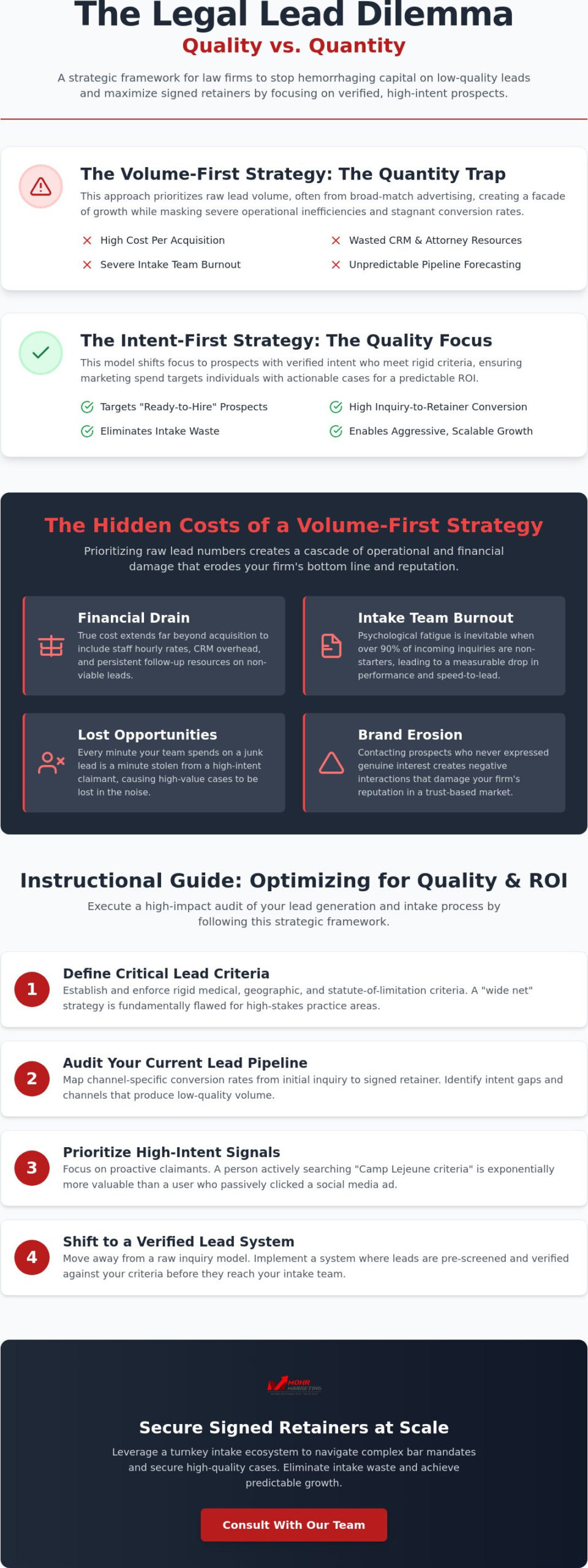
Instructional Guide: How to Audit Your Legal Lead Quality
A rigorous audit is the only way to stop capital leaks in your marketing budget. You cannot improve what you do not measure with precision. Follow this five step process to evaluate whether your current providers are delivering actual value or just inflated numbers. This framework allows you to see past vanity metrics and confront the reality of your legal lead quality vs quantity balance.
- Step 1: Map your Lead-to-Retainer conversion rate. Segment your CRM data by specific marketing channel and vendor. Calculate the exact percentage of inquiries that result in a fully executed retainer. If a channel provides 1,000 leads but only five cases, the acquisition cost is irrelevant because the intake waste is unsustainable.
- Step 2: Review call recordings to identify the Intent Gap. Listen to the first 60 seconds of initial intake calls. Determine if the caller understands why they are being contacted. If your team spends the first minute explaining the legal nature of the call, the vendor’s ad copy is likely deceptive or incentivized.
- Step 3: Audit the verification criteria. Demand a written list of the qualifying questions used by your providers. For complex litigation, “Are you injured?” is insufficient. You require specific medical markers and exposure dates.
- Step 4: Calculate total labor cost. Total the hours your intake specialists spend chasing a specific lead source. Multiply this by their hourly rate and add it to the lead price. This reveals the true cost of signing a single case from that volume.
- Step 5: Reallocate budget. Shift your capital away from broad-match aggregators. Move toward high-intent search channels and performance-based partners who align with your firm’s growth targets.
Auditing Verification Criteria for Complex Torts
High-value litigation requires technical precision during the screening phase. For example, mesothelioma real search intent must be backed by documented “Usage and Exposure” history. Your lead file should indicate the presence of pathology reports or specific medical records before it reaches your desk. If your provider cannot confirm these details, they are selling you a raw inquiry, not a qualified case. You can contact us today to implement a more rigorous verification standard for your mass tort campaigns.
Identifying “Red Flag” Lead Sources
Spotting incentivized leads is critical for protecting your firm’s reputation. These are inquiries generated by offering rewards or sweepstakes entries rather than genuine legal assistance. Watch for shared lead aggregators who sell the same inquiry to five different firms simultaneously. This creates a “race to the phone” that burns out your staff and annoys the prospect. Cut any lead source that consistently yields an inquiry-to-retainer rate of less than 5%.
The Mohr Marketing, LLC Ecosystem: Quality at Scale
Mohr Marketing, LLC solves the legal lead quality vs quantity dilemma by replacing fragmented vendors with a turnkey intake ecosystem. Most firms struggle because they buy leads from one source and use a separate, uncoordinated team for intake. This misalignment creates the “intent gap” that erodes profitability. We eliminate this friction by owning the entire process from the first search click to the signed retainer. Our transparent, data-driven strategy focuses exclusively on litigation-ready claimants. With 30+ years of industry experience, we possess the deep insider knowledge required to navigate evolving bar mandates and advertising compliance. This expertise transforms your firm from a frustrated lead chaser into a systematic case closer.
A professional support system must do more than just generate calls. It must filter out the noise that causes intake fatigue. We provide a bridge between marketing spend and signed cases by integrating rigorous verification directly into the acquisition funnel. This ensures that your most expensive resources, your attorneys, only review files with a high probability of successful litigation. By centralizing these operations, we provide a level of procedural precision that traditional lead aggregators cannot match. Your firm gains the ability to forecast growth with mechanical accuracy rather than relying on the unpredictable nature of raw inquiry volume.
Our Multi-Layered Verification Process
Our process relies on a dual-layer approach to ensure quality. We combine digital intent verification with manual screening to ensure every inquiry meets your specific criteria. Our team verifies medical history, exposure dates, and geographic requirements before a lead is ever delivered. This is how we deliver truck accident signed cases that are ready for immediate filing. A performance-based partnership ensures our goals remain perfectly aligned with yours. You only pay for results. This structure allows for aggressive national scaling without the financial risk of unverified volume. It’s a strategic move that protects your capital while pursuing expansion.
Eliminating the Intermediary for Better ROI
Eliminating inefficient intermediaries is the fastest way to improve your ROI. When you work directly with an agency that owns both the marketing and the intake funnel, you reclaim control over your pipeline. Traditional lead brokers often buy and resell inquiries, adding a markup while diluting the quality. Direct-to-firm models significantly improve lead exclusivity and contact speed. You no longer compete with multiple firms for the same claimant’s attention. This streamlined path to success removes the administrative bloat that kills profitability and ensures your firm is the first and only point of contact for high-value cases.
The 2026 legal market leaves no room for inefficient marketing spend. You must choose between managing a sea of junk leads or closing a steady stream of verified cases. Scale your firm with Mohr Marketing, LLC’s verified lead solutions to secure a dominant market position. Our ecosystem is built for firms that value tangible outcomes over vanity metrics. Stop chasing numbers and start closing cases with a partner who understands the mechanics of legal growth.
Secure Your Firm’s Competitive Advantage in 2026
The 2026 legal market demands a decisive shift from vanity metrics to procedural precision. You’ve recognized how raw volume erodes your ROI through intake fatigue and systemic data pollution. Successfully balancing legal lead quality vs quantity is no longer optional; it’s the primary differentiator between firms that scale and those that stagnate. By auditing your current pipeline and adopting performance-based models, you eliminate the friction between an initial inquiry and a fully executed retainer.
Mohr Marketing provides the strategic partnership required to expand with confidence. Our 30+ years of legal marketing expertise and turnkey intake ecosystem ensure you receive litigation-ready files rather than unverified phone numbers. We utilize direct, performance-based acquisition models that align our incentives with your firm’s growth targets. You don’t have to tolerate a junk lead cycle that drains your staff and your budget. It’s time to demand a higher standard of verification from your marketing partners to ensure every dollar spent targets a viable case.
Stop chasing leads and start signing cases with Mohr Marketing. Your firm possesses the expertise to win high-stakes cases; we provide the verified opportunities to prove it.
Frequently Asked Questions
What is the ideal lead-to-case conversion rate for a personal injury firm?
The ideal lead-to-case conversion rate for a personal injury firm targeting high-intent search leads typically ranges between 15% and 20%. While broad-match social media leads often convert at less than 5%, verified inquiries from search-based sources provide a much higher yield. You should track this metric by specific channel to identify where intake resources are being wasted on non-viable inquiries.
Is it better to buy exclusive leads or shared leads for mass torts?
Exclusive leads are the superior choice for mass tort campaigns because they eliminate the race to the phone against competing firms. Shared leads are often sold to multiple firms simultaneously, which decreases the likelihood of a successful contact and creates a poor experience for the claimant. Investing in exclusivity ensures your intake team is the only point of contact, significantly increasing your signed retainer rate.
How does lead quality impact the cost-per-signed-case (CPSC)?
Lead quality directly dictates your cost-per-signed-case by reducing the labor and administrative overhead required to filter through junk volume. When evaluating legal lead quality vs quantity, remember that a low cost-per-lead is irrelevant if the conversion rate is poor. High-quality, verified leads require fewer intake hours and fewer follow-up attempts, which lowers the total capital expenditure needed to secure a single signed case.
Can a high volume of low-quality leads actually hurt my firm’s SEO?
A high volume of low-quality leads can indirectly damage your firm’s SEO by negatively impacting user signals and brand reputation. If a marketing vendor uses deceptive ads to generate volume, users may bounce quickly from your landing pages or leave negative reviews. Search algorithms prioritize helpfulness and authority, so associations with misleading content can lead to a decline in organic search rankings over time.
What are the most important verification criteria for MVA leads in 2026?
The most important verification criteria for MVA leads include the presence of a police report, confirmed insurance coverage, and immediate medical treatment. In 2026, rigorous screening must also verify that the claimant was not at fault and that the statute of limitations has not expired. These data points ensure that your firm only pursues cases with clear liability and measurable damages, protecting your resources from non-viable files.
How do performance-based marketing models ensure compliance with state bar mandates?
Performance-based models ensure compliance by aligning the marketing vendor’s incentives with the delivery of legitimate, transparent results. Since the vendor is only compensated for signed cases or verified inquiries, they’re less likely to use deceptive tactics that could trigger bar grievances. This structure encourages a focus on the legal lead quality vs quantity balance, prioritizing adherence to strict advertising regulations like California’s SB 37.
What is an “Intake Ecosystem” and why does my firm need one?
An intake ecosystem is a unified system that integrates lead acquisition with rigorous, multi-layered screening and verification. Your firm needs this ecosystem to bridge the gap between a raw inquiry and a signed retainer. By centralizing these operations, you eliminate the friction of managing multiple vendors and ensure that every prospect meets your specific litigation criteria before they reach your legal team.
How can I tell if my lead provider is using unethical “incentivized” ads?
You can identify unethical incentivized ads by monitoring for high bounce rates and callers who are confused about why they’re being contacted. If prospects mention rewards, sweepstakes, or gift cards, the provider is likely using bribe tactics to inflate volume. Reviewing call recordings is the most effective way to spot these red flags, as legitimate claimants will have a clear understanding of their legal needs from the start.

Recent Posts
- High-Quality Mold Leads: Scale Your Toxic Tort Practice
- Scaling Your Firm with High-Quality Mold Case Leads
- The Hidden Risks of Cheap Personal Injury Leads: A Law Firm’s Guide to Quality Acquisition
Categories
- AI and Lead Generation
- Business Financing
- Call Verified MVA Leads
- Car Accident Help
- Car Accident Settlements
- Claimant Funding
- Compliance Program
- EMS-EMT Reports
- Geotargeting
- Google Maps Ranking
- Healthcare Practice Growth
- Law Firm Growth
- Law Office Operations
- Lead Generation
- Lead Generation For Attorneys
- Lead Generation For Chiropractors
- Lead Generation For Criminal Attorneys
- Lead Generation For D&A Treatment Centers
- Lead Generation For DUI Attorneys
- Lead Generation For Eye Doctors
- Lead Generation For Family Law Practices
- Lead Generation For PI Law Firms
- Lead Generation For Plastic Surgeons
- Leads For Healthcare Professionals
- Leads For Insurance Industry
- Legal Leads
- Legal Marketing
- Legal Updates
- Mass Tort Leads
- Medicare and Medicaid Leads
- Merchant Funding Leads
- Online Marketing Strategies
- Pre-Settlement Funding
- Signed MVA Cases
- Tort Updates
- Truck Accident Leads and Signed Cases
- Truck Accident Settlements
- Web Design