Improving Law Firm Marketing ROI: A Practical Measurement Framework
October 20, 2026 by Mohr Marketing
Recent legal industry research found that 60% of law firms did not answer prospective clients’ phone calls in mystery-shopper evaluations. That gap illustrates why improving law firm marketing ROI requires more than counting clicks, calls, or form submissions. Activity matters when it creates qualified opportunities that become signed cases and collected fees.
Marketing spend can be difficult to trace through that full path. Website traffic may rise while lead quality stays flat, and channel reports may use different attribution rules. The central question is straightforward: which investments are producing worthwhile returns, and where are opportunities being lost?
This framework connects campaign costs to qualified inquiries, signed retainers, and net fees collected. It explains how to set consistent measures, compare channels based on case outcomes, and identify intake or attribution gaps that distort results. Track not only where an inquiry originated, but also whether it was valid, reachable, appropriate for the practice, and retained. The result is a defensible basis for deciding what to continue, adjust, or stop, grounded in evidence rather than surface-level activity.
Key Takeaways
- Improving law firm marketing ROI starts with defining measurable outcomes and distinguishing each stage from visibility to collected revenue.
- Build a consistent tracking process that connects campaign costs, inquiry sources, qualification, and case progress.
- Compare SEO, paid advertising, referrals, and lead acquisition using shared criteria such as intent, timing, attribution, and case fit.
- Audit records and follow-up processes to find measurement gaps and intake bottlenecks that may affect campaign results.
- Assess how direct-to-firm delivery, verification, fraud filtering, and reporting can support your measurement framework.
What Improving Law Firm Marketing ROI Actually Means
Marketing activity measures what a campaign does; marketing return measures the business outcomes attributable to its investment. For a law firm, that means tracing marketing costs through a path from visibility to inquiries, qualified opportunities, signed cases, and ultimately collected revenue. Each stage answers a different question. Impressions show exposure. Inquiries show response. Qualification and signed cases indicate whether that response fits the firm’s practice. Collections show whether the work generated realized revenue.
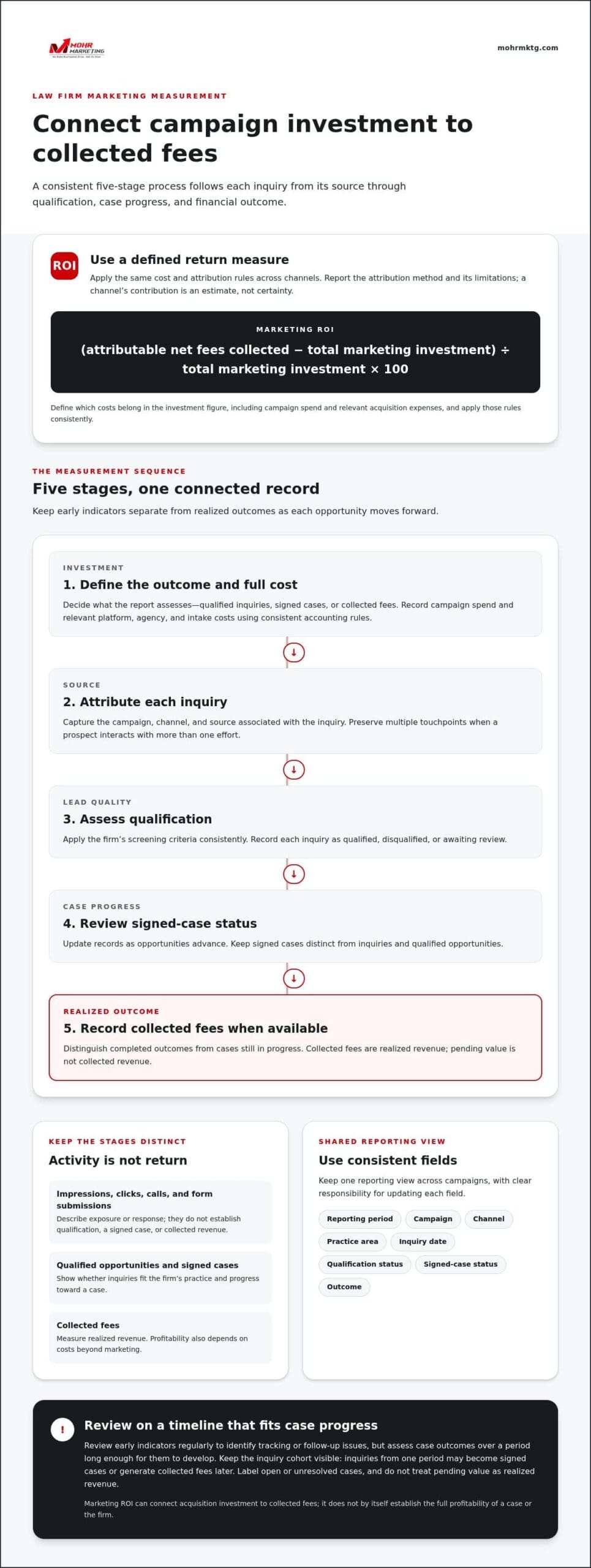
A practical starting formula is: Marketing ROI = (attributable net fees collected − total marketing investment) ÷ total marketing investment × 100. Define which costs belong in the investment figure, such as campaign spend and related acquisition expenses, then apply the same rules across channels. The concept of return on marketing investment (ROMI) distinguishes revenue attributed to marketing from revenue that might have occurred without it. Attribution is an estimate, so report the method and its limitations rather than presenting a channel’s contribution as certain.
Which outcomes should a law firm count?
Track outcomes as stages, not interchangeable totals. Inquiries are leading indicators: they can show whether a campaign is generating response, but they do not establish case fit or financial return. A qualified opportunity has passed the firm’s defined screening criteria. A signed case is a later milestone, while collected fees provide a realized revenue measure. For a motor vehicle accident (MVA) inquiry, for example, assess documentation, qualification, and case progression against the firm’s own criteria.
Choose measures that reflect the practice area and the time required for intake and case progression. A firm with a longer case timeline should not judge a recent campaign solely by fees already collected. Review earlier indicators alongside mature outcomes, and label cases that remain open or unresolved. This prevents reports from treating pending value as realized revenue.
Keep revenue and profitability distinct. Collected fees measure income received from cases; profitability also depends on costs beyond marketing, including the resources required to handle and resolve matters. Marketing ROI can show whether acquisition investment is associated with collected fees, but it does not by itself establish the full profitability of a case or the firm.
Why traffic and lead volume can misstate marketing performance
Impressions, clicks, calls, and form submissions describe campaign activity. They can help diagnose reach or response, but none alone confirms that an inquiry is qualified, becomes a signed case, or produces collected revenue. High volume can conceal poor fit; lower volume may still warrant attention if the opportunities progress. Do not label a channel successful or unsuccessful using one metric. Compare its costs, lead quality, case outcomes, and reporting period against consistent criteria.
For improving law firm marketing ROI, follow each opportunity beyond the first response and keep its source connected to its outcome. That makes measurement useful for decisions, not just reporting.
Build a Law Firm Marketing ROI Measurement Framework
A useful framework connects campaign investment to the progress and outcomes recorded by the firm. Keep the process consistent across campaigns so you can compare results without treating incomplete attribution as certainty. Use the following sequence to create a practical foundation for improving law firm marketing ROI.
- Define the outcome. Decide what the report is meant to assess, such as qualified inquiries, signed cases, or collected fees. Keep early indicators distinct from final outcomes.
- Track the full investment. Record campaign spend and relevant platform, agency, and intake costs using the same accounting rules across channels.
- Attribute each inquiry. Capture the campaign, channel, and source associated with an inquiry. Preserve multiple touchpoints when a prospect interacts with more than one effort.
- Assess qualification. Apply the firm’s screening criteria consistently, then record whether each inquiry is qualified, disqualified, or awaiting review.
- Review case progress. Update records as opportunities advance to signed cases and, when available, collected fees. Distinguish completed outcomes from cases still in progress.
Use one shared reporting view with fields for reporting period, campaign, channel, practice area, inquiry date, qualification status, signed-case status, and outcome. Assign responsibility for updating each field. A report with clear ownership is more useful than a sophisticated dashboard built on inconsistent records.
Choose a reporting period that reflects the firm’s intake and case timelines. Review early indicators regularly to find tracking or follow-up issues, but assess case outcomes over a period long enough for them to develop. Keep the cohort visible: inquiries received in one period may become signed cases or generate collected fees later. Any ROI formula is a planning and comparison tool, not a guaranteed forecast or universal standard. Document the costs and outcomes it includes.
Choose the right metrics for each stage
At the campaign level, track investment and inquiries first, then add qualification and signed-case status as records mature. Calculate cost per qualified inquiry or cost per signed case only when the underlying spend and outcome data are complete and consistently defined. Marketing analytics is most useful when it connects activity with results, as outlined in Harvard Business School’s framework for marketing analytics. If one case has several touchpoints, note that limitation rather than assigning full credit to each channel.
Create reliable attribution from inquiry to case
Use consistent campaign identifiers in marketing reports and intake records. Reconcile those records with the firm’s case-status data on a regular schedule, resolving missing sources, duplicate entries, and status differences before comparing performance. Attribution is evidence-informed, not perfectly precise: a prospect may encounter several channels before contacting the firm, and records may not capture every interaction. State the method used and apply it consistently.
If your firm needs to align campaign delivery and intake data with this framework, discuss your measurement priorities with Mohr Marketing.
Compare Marketing Channels Without Relying on Budget Percentages
A fixed budget percentage cannot show whether a channel is producing the right opportunities for a specific practice. Compare channels using the same outcome stages and reporting window, then account for differences in intent, timing, attribution, and case fit. This keeps the analysis focused on evidence from your firm rather than unsupported industry-wide ROI rankings.
Use a shared comparison view. Treat the following descriptions as factors to assess, not universal results: performance varies with the firm’s practice area, targeting, intake process, and case timeline.
| Channel | Intent and timing | Attribution considerations | Case-fit question |
|---|---|---|---|
| SEO | Organic discovery may build over time; assess both early engagement and later inquiries. | Record landing page, referral source, and relevant organic search data where available. | Do the inquiries align with the firm’s practice and screening criteria? |
| Paid advertising | Can capture active searches or prompt responses; review campaign timing and inquiry progression. | Use campaign identifiers and connect tracked inquiries to intake and case records. | Do the resulting opportunities meet the firm’s case criteria? |
| Referrals | Timing and intent depend on the referring relationship and the prospect’s needs. | Record the referral source consistently, even when the referral began through another touchpoint. | Are referred matters suitable for the firm’s practice and capacity? |
| Lead acquisition | Evaluate the delivery and intake timeline alongside the prospect’s stated need. | Preserve source and delivery details, then reconcile them with firm records. | Does each opportunity meet documented qualification standards? |
Once your comparison criteria are set, a measurable acquisition strategy can be evaluated in terms of source, qualification, and case progression, rather than volume alone.
How to evaluate channels on equal terms
Compare equivalent cohorts over the same reporting window, while allowing for differences in how quickly each channel may produce mature outcomes. Apply the same qualification definitions and document follow-up practices. If one channel receives faster intake attention, note that operational difference before attributing a higher signed-case rate to the marketing source. Cost per inquiry and cost per signed case answer different questions; do not use them interchangeably.
When a budget benchmark is less useful than firm data
Fixed percentages cannot account for a firm’s objectives, practice mix, qualification rules, or case cycle. Use historical results to establish context, not as a promise that future campaigns will perform the same way. For a practice-area-specific example of planning acquisition, review this mass tort lead generation roadmap. Keep its context distinct from other practice areas.
To improve law firm marketing ROI, use the comparison to guide a decision: maintain a channel, adjust its targeting or intake process, or collect more data before changing investment. Reassess after the same outcome stages have been recorded across channels.
Improve Law Firm Marketing ROI by Finding Measurement and Conversion Gaps
A weak result in a campaign report does not always mean the campaign is the problem. Missing source data can obscure which channel generated an inquiry. Duplicate records can inflate volume. Slow follow-up or inconsistent screening can reduce conversion after a prospect arrives. Audit each handoff before changing spend to locate whether the issue sits in marketing, intake, qualification, or reporting.
Audit tracking before changing campaign spend
Review inquiry records from source through case status. Check for a source, campaign identifier, timestamp, and current qualification status. Then test whether staff apply the same definitions of a qualified inquiry, signed case, and attributed source. If a field is blank or definitions vary, document the gap first. Incomplete data is a limitation, not proof that a channel underperforms.
- Find missing sources. Compare intake records with campaign reports and flag inquiries that have no traceable channel or campaign.
- Remove duplicate records. Identify repeated submissions or contacts so they are not counted as separate opportunities without review.
- Review unqualified inquiries. Group disqualifications by reason, such as practice-area mismatch or failure to meet the firm’s screening criteria. Separate patterns that may point to targeting issues from individual cases.
- Complete outcome records. Check whether qualified inquiries have updated statuses, including whether they progressed to a signed case or remain open.
Keep a record of the issue, its likely owner, and the corrective step. This creates a clean basis for analysis and prevents a budget decision from masking a tracking failure.
Interpret conversion data without overclaiming
Once records are reviewed, separate marketing quality from downstream conversion. A pattern of inquiries outside the firm’s practice focus may justify reviewing targeting or messaging. Relevant inquiries that are not reached or followed through point instead to intake procedures. If inquiries meet screening criteria but do not progress, review qualification standards and the case-handling process before assigning the result to the channel. The ROI of legal intake services is tied to this downstream conversion stage, which campaign-level reporting alone may not explain.
Compare like with like: the same practice area, similar campaign objective, and consistent definitions. Review trends across reporting periods, but interpret small samples cautiously. Longer case cycles can also mean that a recent cohort has not reached a final outcome. Record those limits alongside the results. Do not treat a change in tracking, follow-up, or qualification as proof of a specific future result.
Use the diagnosis to choose a measured adjustment. Refine audience targeting or messaging when inquiry fit is the issue. Repair source tagging when attribution is incomplete. Address intake follow-up when qualified prospects stall after contact. Reassess budget only after records are reliable enough to support a channel comparison. This disciplined process supports improving law firm marketing ROI without promising what the data cannot establish.
Use a Data-Driven Partner to Put Marketing ROI Into Practice
A partner should fit the measurement framework your firm has established, not replace it with disconnected activity reports. Assess how opportunities are delivered, what verification or fraud review is applied, and how campaign information can be compared with your own intake and case records. The objective is a clear path from acquisition source to outcome, with reporting limits stated plainly.
Mohr Marketing provides direct-to-firm lead generation and intake services for law firms. Its delivery model avoids reseller markup, and Scammer Scrub™ fraud-filters every delivery. Its leads are signed, police-report verified, and include a signed retainer. AI-driven WebTracker® captures high-intent prospects at the moment of search. Mohr Marketing reports serving over 1,000 law firms and having 50+ active tort campaigns. These details provide concrete points to assess against your firm’s objectives, but do not establish a specific return.
What to assess in an acquisition and reporting model
Before evaluating an acquisition model, define what your team needs to measure. Consider how inquiries are qualified, how consent documentation is handled where relevant, and how suspected fraudulent submissions are reviewed. Then establish which campaign and outcome fields will be available for your internal analysis. Clear definitions matter: your team needs to know how sources, qualification, and case status are recorded before comparing performance.
Align the campaign structure with the firm’s practice areas and target outcomes. For example, if signed cases are a key measure, determine how a delivered opportunity can be tracked through intake and recorded case status. Mass Tort Acquisition is one model to evaluate against that outcome, using the firm’s criteria and reporting process. Keep measurement definitions consistent, even when campaigns differ.
Turn the framework into a measured next step
Prepare a concise summary before discussing a potential partnership: the outcomes the firm wants to measure, practice areas in scope, current source-tracking gaps, and the point where prospects most often stop progressing. Include how your firm defines a qualified opportunity and a signed case. This gives both sides a practical basis for discussing campaign structure, verification, and reporting fit.
Improving law firm marketing ROI depends on accurate measurement and a disciplined review of what happens after an inquiry arrives. A focused discussion can assess how Mohr Marketing’s direct-to-firm acquisition model fits your framework. Treat it as an evaluation of alignment, not a promise of lead volume, signed cases, or financial results. The firm remains responsible for its own outcome analysis and advertising compliance.
Make Your Next Marketing Decision Measurable
The next step in improving law firm marketing ROI is to turn your findings into a focused decision. Select one campaign or intake gap, define the change you will make, and set a review point that allows relevant outcomes to emerge. Keep the evaluation criteria consistent so your team can distinguish a real performance shift from incomplete records or changing case timelines.
A disciplined measurement process gives your firm a stronger basis for adjusting investment. It also creates a clearer working conversation with a marketing partner: which practice areas matter, what outcomes count, and what evidence will inform the next decision. No framework can guarantee a financial result, but a consistent process can make decisions more accountable.
Start with the evidence you have, identify what is missing, and build from there. Each measured decision can bring your marketing strategy into sharper focus.
Frequently Asked Questions
How do law firms calculate marketing ROI?
Compare the fees collected from cases attributed to marketing with the total marketing investment, then express the difference relative to that investment. Before calculating, decide which campaign and related acquisition expenses to include, and use the same rules across channels. If fees have not yet been collected, mark that cohort as pending rather than treating expected fees as realized return.
What is a good marketing ROI for a law firm?
There is no single ROI figure that defines success for every firm. A useful target depends on practice area, case economics, operating costs, time to resolution, and the firm’s growth objectives. Set a baseline from your own mature campaign data, then evaluate whether results support the intended business goal. Treat prior performance as context, not a guarantee that a new campaign will produce the same return.
Which marketing metrics should a law firm track?
Track measures that help locate friction, not just campaign activity. Alongside inquiries and signed cases, monitor source completeness, duplicate records, qualification reasons, contact outcomes, and case status. For example, a rise in inquiries paired with more practice-area mismatches may point to a targeting issue. Consistent definitions and records make these measures useful for deciding whether to adjust messaging, intake, or campaign settings.
How can a law firm measure ROI when cases take months to resolve?
Use inquiry cohorts and track their movement over time. A cohort groups prospects by when or through which campaign they entered, allowing the firm to see which are still under review, signed, active, or associated with collected fees. Report pending cases separately from completed outcomes. This preserves visibility into early campaign performance without counting projected case value as revenue already received.
Should law firms measure cost per lead or cost per signed case?
Measure both when the records support them. Cost per lead helps assess the expense of generating inquiries, while cost per signed case connects acquisition spend to a later conversion milestone. Neither measure explains performance alone: a low lead cost may accompany poor qualification, while signed-case cost can be misleading if case statuses are incomplete. Use both to identify where a campaign or intake process needs closer review.
Can a law firm attribute a signed case to more than one marketing channel?
Yes. A prospective client may encounter several channels before contacting the firm, so the record can preserve multiple touchpoints. Decide whether your analysis reports the first known source, the last known source, or a multi-touch view, and label that method clearly. Avoid assigning full credit to every channel in a way that inflates total attributed results. Consistent rules make comparisons more interpretable, even when attribution remains imperfect.
How often should a law firm review its marketing ROI?
Review operational indicators often enough to catch tracking or intake problems promptly, then assess ROI on a schedule suited to the firm’s case timelines. A campaign report can be reviewed before all cases mature, but label those results as provisional. Revisit the same cohorts as their statuses change, and use a consistent reporting cadence so short-term fluctuations do not drive unsupported budget decisions.

Recent Posts
- Improving Law Firm Marketing ROI: A Practical Measurement Framework
- 4 Ways to Assess Unqualified Legal Leads and Their Costs
- Real-Time Legal Leads: How to Evaluate Speed, Quality, and Fit in 2026
Categories
- AI and Lead Generation
- Business Financing
- Call Verified MVA Leads
- Car Accident Help
- Car Accident Settlements
- Claimant Funding
- Compliance Program
- EMS-EMT Reports
- Geotargeting
- Google Maps Ranking
- Healthcare Practice Growth
- Law Firm Growth
- Law Office Operations
- Lead Generation
- Lead Generation For Attorneys
- Lead Generation For Chiropractors
- Lead Generation For Criminal Attorneys
- Lead Generation For D&A Treatment Centers
- Lead Generation For DUI Attorneys
- Lead Generation For Eye Doctors
- Lead Generation For Family Law Practices
- Lead Generation For PI Law Firms
- Lead Generation For Plastic Surgeons
- Leads For Healthcare Professionals
- Leads For Insurance Industry
- Legal Leads
- Legal Marketing
- Legal Updates
- Mass Tort Leads
- Medicare and Medicaid Leads
- Merchant Funding Leads
- Mold Leads
- Online Marketing Strategies
- Pre-Settlement Funding
- Signed MVA Cases
- Tort Updates
- Truck Accident Leads and Signed Cases
- Truck Accident Settlements
- Web Design