4 Ways to Assess Unqualified Legal Leads and Their Costs
October 19, 2026 by Mohr Marketing
An unqualified legal lead isn’t automatically a lost opportunity. To decide what to do with unqualified legal leads, compare each inquiry with your firm’s ideal client profile, identify why it falls short, then choose whether to follow up, correct the information, or close it out. The right action depends on fit, intent, timing, and data quality.
It’s easy to treat every lead that isn’t ready to hire as wasted spend. But a prospect who needs more time is different from one whose matter falls outside your practice areas. Treating both the same way can waste intake time or overlook future potential.
This guide explains what makes a legal lead unqualified and how to assess it against your firm’s client criteria. You’ll also learn four practical ways to review lead quality, decide what happens next, and account for the staff time and follow-up that contribute to lead costs.
Key Takeaways
- Separate prospects who need more time from inquiries that fall outside your practice area or lack essential case information.
- Set clear qualification criteria around matter type, jurisdiction, urgency, and readiness so intake decisions are consistent.
- Compare each inquiry with your ideal client profile before deciding whether to nurture it, redirect it, or close it out.
- Assess the full cost of poor-fit leads by accounting for staff time, follow-up, and lead management, not just acquisition spend.
- Use structured intake and human review to improve lead assessment and focus resources on stronger opportunities.
1. What are unqualified leads?
An unqualified lead is an inquiry that doesn’t currently meet a firm’s case, client, or timing criteria. That label describes the fit today, not the prospect’s future potential. Someone who isn’t ready to hire may still become a qualified client later, while a matter outside the firm’s practice area may never fit.
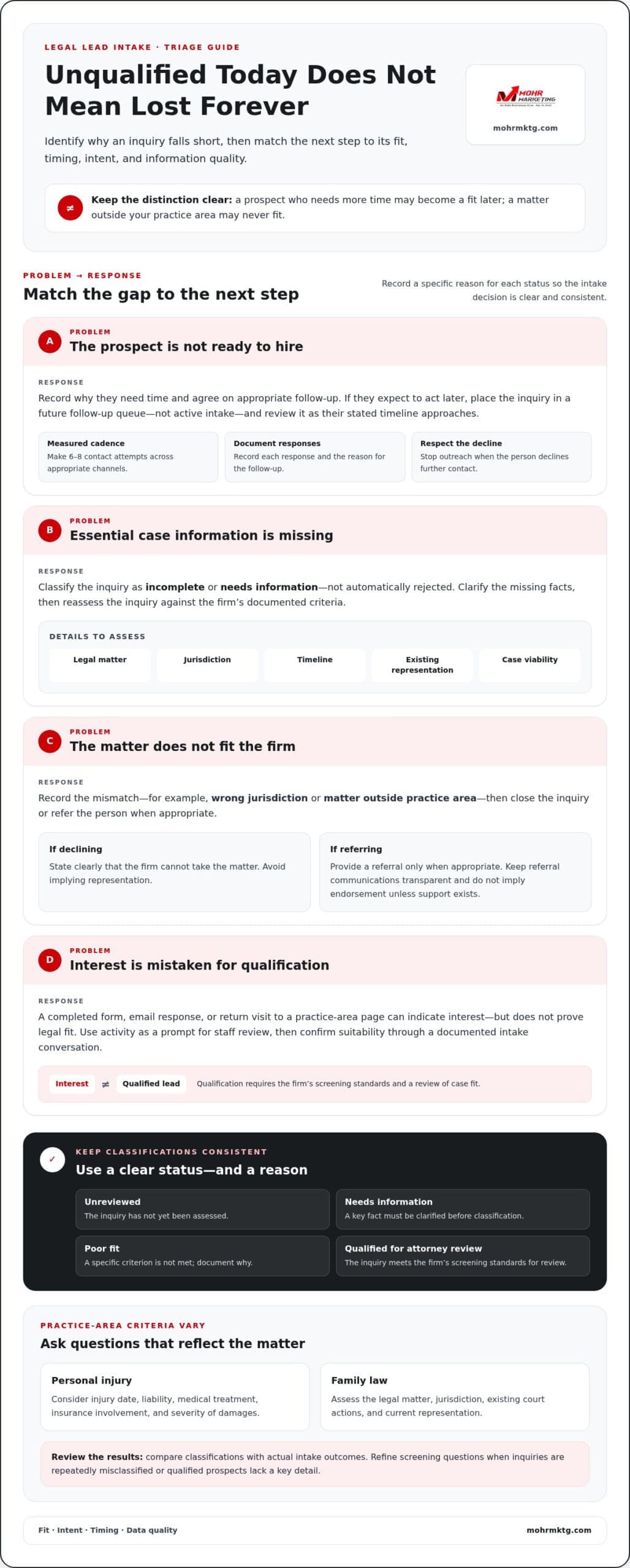
When a prospect says they need time, record the reason and agree on an appropriate follow-up. A short email sequence can answer common questions and keep the firm visible without pressuring the prospect. Use a measured cadence: make 6-8 contact attempts across appropriate channels, record each response, and stop outreach when the person declines further contact.
Separate immediate readiness from longer-term potential. Someone who expects to act in six months may belong in a future follow-up queue, not an active intake queue. Review the file as their stated timeline approaches and ask whether their situation has changed. This distinction helps preserve promising inquiries without treating every contact as an active case.
Use behavior as a prompt for review, not proof of legal fit. If a prospect revisits a practice-area page, replies to an email, or completes an intake form, flag the activity for a staff member. Website, email, and social media analytics can help indicate interest, but an intake conversation must still establish whether the matter meets your firm’s criteria.
When a legal lead is unqualified, record the specific reason, such as a practice-area mismatch, missing information, or timing. Then choose whether to follow up, close the inquiry, or refer the person when appropriate. In a polite decline, say clearly that the firm can’t take the matter, avoid implying representation, and provide a referral only when appropriate.
What ethical rules apply to referring legal leads in the United States? Legal lead-generation efforts should comply with advertising regulations set by the American Bar Association and state bar associations. Keep referral communications transparent and avoid presenting a referral as an endorsement unless the firm can support that statement.
Can law firms keep or share contact information from unqualified leads, and what privacy rules apply? Limit access to staff who need the information, honor requests to stop contact, and don’t share details without an appropriate basis or permission. How long should firms retain these records? Apply a written retention schedule that accounts for the inquiry’s purpose, consent, and applicable privacy obligations.
Classify inquiries consistently, especially when the matter type changes the screening questions. For example, record truck accident inquiries separately from other injury matters and apply relevant truck accident case criteria before routing follow-up.
2. Defining unqualified leads
Lead generation creates inquiries; qualification determines whether a prospect fits a firm’s criteria. Keep those steps separate in intake records. A completed form shows interest, not case suitability. Someone seeking help with a matter outside the firm’s practice areas may be a valid lead but remain unqualified for that firm.
Define qualification using observable case requirements, not an intake worker’s impression. Assess the legal matter, jurisdiction, timeline, existing representation, and case viability. If a key detail is missing, classify the inquiry as incomplete rather than rejecting it. That distinction tells staff what to clarify.
A qualified legal lead is actively seeking a lawyer, fits the attorney’s practice area, and has the resources to hire representation. The definition combines intent, legal fit, and practical ability. A prospect can show strong interest but still fail a required case criterion. An incomplete inquiry may merit review after staff gather the missing facts.
Use a consistent status system so each record shows its current position. For example, label inquiries “unreviewed,” “needs information,” “poor fit,” or “qualified for attorney review.” Add a brief reason, such as “wrong jurisdiction” or “matter outside practice area.” These labels help staff distinguish a disqualifying mismatch from unanswered questions.
Apply criteria specific to the practice area. For personal injury, intake may consider the injury date, liability, medical treatment, insurance involvement, and severity of damages. For family law, staff may assess the legal matter, jurisdiction, existing court actions, and current representation. A single universal checklist can miss these differences and misclassify prospects.
Separate marketing engagement from readiness to hire. Someone who completes an information-request form or subscribes to emails has interacted with marketing materials. That alone doesn’t establish that the person meets the firm’s criteria. A sales-qualified lead must also satisfy the firm’s screening standards, applied through a documented conversation.
Review classifications against actual intake outcomes. If “needs information” records regularly prove outside the target practice area, refine the questions that identify matter type and jurisdiction. If qualified prospects repeatedly lack a key detail, add that question to the intake process. A clear definition makes lead generation easier to assess and follow-up more consistent. Firms refining their intake workflow can discuss legal intake needs.
For a DME inquiry, a raw or unqualified DME lead consists of the person’s name, contact information, and stated interest in purchasing a particular product. That record captures identity and interest, but it doesn’t establish whether the prospect meets a firm’s criteria. Apply the same documented review before treating the inquiry as qualified.
3. Comparing leads with an ideal customer profile
An ideal client profile turns a firm’s target into specific screening criteria. For each inquiry, compare the matter type, jurisdiction, legal timeline, case requirements, and readiness to proceed. Distinguish requirements that determine eligibility from preferences that help prioritize work. A required-criterion mismatch may disqualify the lead; a missing detail calls for follow-up.
Build the profile around the cases the firm intends to handle, not assumptions about a prospect. An injury firm might target matters involving a particular type of accident, actionable liability, and documented treatment. The profile should also identify where the firm can act and what facts intake needs before attorney review. Make each criterion clear enough for staff to apply consistently.
Ask intake questions that establish the legal matter, where and when it occurred, whether a court deadline or action is pending, and whether another attorney represents the prospect. Then ask practice-specific questions, such as what treatment followed an injury or what court action is underway in a family matter.
Compare each answer with the profile and record the result by criterion. A prospect may match the practice area but fall outside the firm’s jurisdiction. That is a fit issue, not incomplete information. If the location is missing, ask for it before deciding. This approach keeps qualification tied to evidence.
Use three practical outcomes: matches the target, needs clarification, or does not match. Don’t let one strong signal, such as a detailed inquiry, override a required mismatch. Likewise, don’t reject a potentially qualified lead because a nonessential preference is absent. A documented comparison explains why staff advanced, paused, or closed an inquiry.
How can law firms reduce the number of unqualified leads? Align lead-generation messaging and intake forms with the profile. State the practice area and relevant case types clearly, then ask focused questions about matter, location, timing, and representation. Review inquiries that repeatedly miss the target; adjust the form or campaign language to address the source of the mismatch.
Compare the profile with intake outcomes. If inquiries often fail the same jurisdiction or case-type criterion, make that requirement more visible before submission. If qualified prospects frequently need to clarify a key fact, add a direct question. These changes can attract more suitable prospects without treating lead volume as a substitute for fit.
4. Costs of unqualified leads
The acquisition price is only the first cost to measure. Each unqualified lead may also require intake review, repeated outreach, data entry, and lead management. Track those costs separately so a low initial acquisition cost doesn’t disguise the staff effort required to process poor-fit inquiries.
Use a simple calculation for a sample cohort. These figures illustrate a cost model, not a price for any legal lead service.
Acquisition cost alone can’t show which group uses resources more efficiently. Include the additional work required to assess, contact, and manage every inquiry before comparing performance.
Staff time can outweigh the initial spend. Track time spent on screening, follow-up, and record maintenance, then compare it with the number of qualified leads.
Repeated contact adds effort. A law firm may need to send several emails to a subscriber before learning what the prospect wants. Record the time and channel used for each attempt. That helps show whether email, phone outreach, or another channel is consuming staff capacity without clarifying fit or readiness.
To measure costs consistently, define a reporting period and use the same categories across every lead source. Include acquisition, intake handling, follow-up, and ongoing lead management. Then compare qualified and unqualified leads from the same channels. A uniform method can reveal whether the main cost comes from poor targeting, incomplete information, or manual processing.
Use the findings to make a specific adjustment. If staff spend substantial time resolving missing details, revise the intake questions. If a channel repeatedly produces poor-fit inquiries, review its targeting and message. After making a change, recalculate using the same cost categories to see whether the effort per qualified opportunity has shifted.
5. How should law firms define and qualify a legal lead?
A legal lead is an inquiry, not a signed client. Lead generation attracts prospects; qualification determines whether an inquiry fits the firm’s legal criteria, practice areas, and business goals. Define those criteria before intake begins. A qualified lead generally aligns with the firm on matter fit, interest, and resources to pursue representation.
Build a screening framework around the legal matter. Check practice-area fit, jurisdiction, timeline, existing representation, and case viability. Then assess urgency and readiness to proceed. A prospect with a relevant matter but no clear timeline may need further discussion; repeated follow-up won’t make a matter outside the firm’s practice area a fit.
Tailor questions to the case type. For a personal injury inquiry, intake may assess the injury date, liability, treatment, insurance involvement, and damages. For medical malpractice, relevant details may include the medical condition, physician contact information, current treatment, and insurance information. Consistent questions help staff identify facts that need attorney review.
Use a lead-capture form to collect basic contact details and relevant screening information. Ask for the prospective client’s first and last name, email address, and phone number, then add questions tied to the firm’s practice. A form can flag missing answers, but staff should clarify important details in a conversation rather than relying only on online activity.
Standardize how the intake team records decisions. Use clear outcomes such as “ready for attorney review,” “more information needed,” or “outside criteria.” Train staff to apply the same standards and document the reason for each classification. Technology can route inquiries, standardize questions, and prioritize urgent matters, but it supports rather than replaces human judgment.
Measure the process using intake performance and conversion outcomes. Review whether inquiries classified as qualified reach attorney review, and identify recurring reasons for rejection. If staff disagree about a criterion, clarify its definition and update the screening procedure. Regular review helps refine questions without lowering case standards to increase lead volume.
Strong qualification combines clear criteria, trained intake staff, consistent conversations, and ongoing performance measurement. Document the reason for each inquiry’s status so the firm can distinguish missing information from a genuine mismatch. That discipline directs attention to prospects whose needs and case facts align with the firm.
An operational definition can distinguish a qualified legal lead from a sales-qualified lead. A qualified legal lead is someone actively searching for a lawyer, suited to the attorney’s practice area, and financially capable of hiring legal representation. A sales-qualified lead meets additional criteria set by sales staff to indicate a greater likelihood of becoming a client. Lead-capture forms can ask screening questions, while intake staff verify responses and assess fit rather than treating form completion as proof of qualification.
Screen inquiries for urgency, practice-area fit, financial eligibility, location, duplicates, and whether a lead is exclusive or shared. Check whether legal deadlines allow action, case-specific requirements are met, and the prospect is ready to proceed. Clear criteria, trained intake staff, standardized questions, performance tracking, and technology that supports consistent evaluations help make decisions repeatable. Revisit criteria when evaluations vary, keeping the firm’s target practice areas and case requirements central.
Mohr Marketing: Personal Injury Leads
Mohr Marketing provides Personal Injury Leads for law firms seeking inquiries aligned with their practice focus. When your intake criteria are clear but your pipeline needs relevant opportunities, these leads can complement your qualification process. Mohr Marketing also offers Motor Vehicle Accident (MVA) Leads, Signed Retainers, and Legal Intake Services.
Use the criteria in this guide to assess incoming inquiries: practice-area fit, jurisdiction, case details, and readiness to proceed. Legal Intake Services support firms that need help managing and evaluating inquiries, while Signed Retainers may suit firms seeking cases with a signed retainer. Match the offering to your intake capacity and case-selection strategy.
Contact Mohr Marketing to discuss your firm’s legal lead needs.
Turn Lead Review Into a Stronger Intake Process
A clear policy for handling unqualified legal leads turns individual intake decisions into a repeatable process. Use patterns in your records to refine screening questions, identify gaps in campaign targeting, and decide where staff effort is best spent. Review those choices regularly as your firm’s practice priorities and case criteria evolve.
That discipline also keeps lead evaluation connected to business goals. Mohr Marketing offers Mass Tort Leads for firms pursuing that practice area, alongside Personal Injury Leads and Motor Vehicle Accident (MVA) Leads. The next step is a conversation about your firm’s focus and lead needs.
With clear criteria and consistent review, your firm can make deliberate decisions about every inquiry and build a more focused intake operation.
Frequently Asked Questions
What are unqualified leads?
Unqualified leads are inquiries that lack a reliable path to attorney review or don’t meet the firm’s selection standards. An inquiry may include a disconnected phone number, duplicate an existing record, or describe a matter the firm doesn’t handle. Distinguishing bad data from poor legal fit matters: staff can correct a contact error, while a practice-area mismatch usually calls for a different outcome.
Why is lead qualification important for law firms?
Lead qualification helps a law firm direct attorney and intake capacity toward inquiries that fit its work. It also makes campaign review more useful: comparing inquiries by source and intake outcome can reveal whether a channel attracts relevant matters or produces repeat mismatches. If one source regularly generates duplicate records, the firm can address the data issue instead of treating every duplicate as a new prospect.
How can law firms nurture unqualified leads who may need legal help later?
Segment future follow-up by why the inquiry isn’t ready, then send information relevant to that situation. Someone waiting for a decision may benefit from a concise explanation of the firm’s intake process, while someone gathering records may need a reminder of what information to prepare. Use a reply or renewed inquiry to prompt staff review, update the prospect’s status, and determine whether further outreach is appropriate.
When should a law firm refer an unqualified lead to another attorney or legal aid organization?
Consider a referral when the matter falls outside the firm’s practice area or jurisdiction, and provide one only when appropriate.

Recent Posts
- 4 Ways to Assess Unqualified Legal Leads and Their Costs
- Real-Time Legal Leads: How to Evaluate Speed, Quality, and Fit in 2026
- Commercial Vehicle Accident Client Acquisition: A Law Firm’s 2026 Guide
Categories
- AI and Lead Generation
- Business Financing
- Call Verified MVA Leads
- Car Accident Help
- Car Accident Settlements
- Claimant Funding
- Compliance Program
- EMS-EMT Reports
- Geotargeting
- Google Maps Ranking
- Healthcare Practice Growth
- Law Firm Growth
- Law Office Operations
- Lead Generation
- Lead Generation For Attorneys
- Lead Generation For Chiropractors
- Lead Generation For Criminal Attorneys
- Lead Generation For D&A Treatment Centers
- Lead Generation For DUI Attorneys
- Lead Generation For Eye Doctors
- Lead Generation For Family Law Practices
- Lead Generation For PI Law Firms
- Lead Generation For Plastic Surgeons
- Leads For Healthcare Professionals
- Leads For Insurance Industry
- Legal Leads
- Legal Marketing
- Legal Updates
- Mass Tort Leads
- Medicare and Medicaid Leads
- Merchant Funding Leads
- Mold Leads
- Online Marketing Strategies
- Pre-Settlement Funding
- Signed MVA Cases
- Tort Updates
- Truck Accident Leads and Signed Cases
- Truck Accident Settlements
- Web Design