How to Improve Law Firm Lead Conversion Rates: The 2026 Strategy Guide
July 27, 2026 by Mohr Marketing
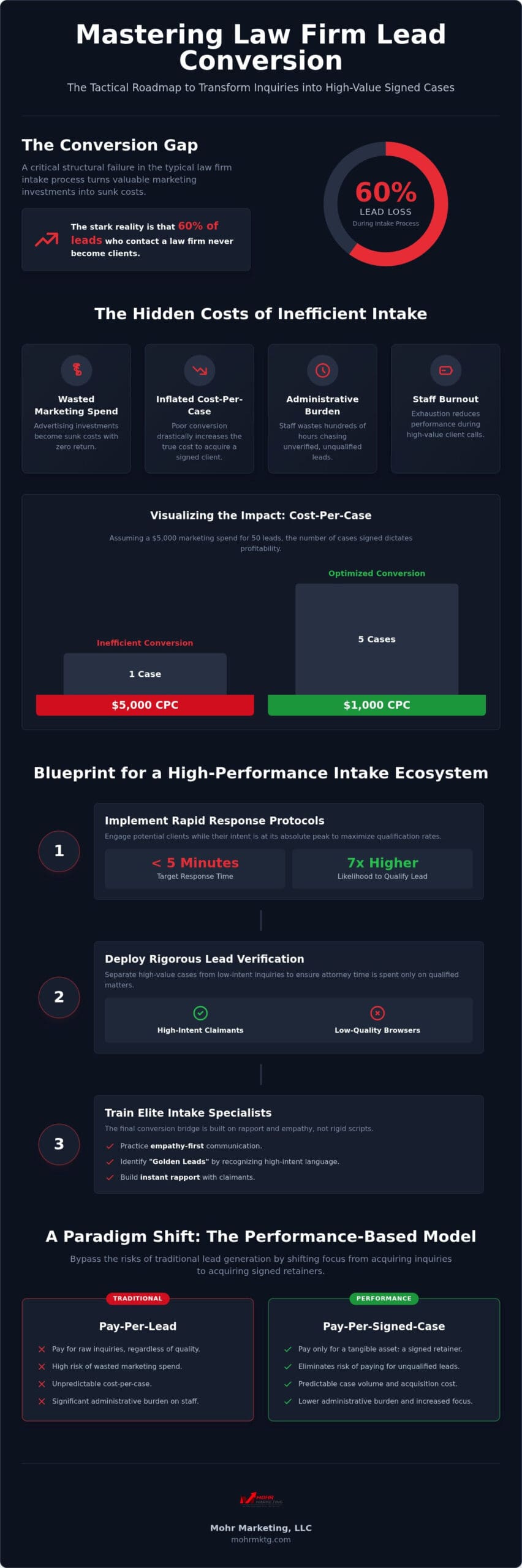
Statistics confirm that 60% of leads who contact a law firm never become clients, with the majority of that loss occurring during the intake process. It’s a structural failure that turns expensive marketing into a sunk cost. You’re likely experiencing the frustration of a high cost per acquisition while your staff misses high-value calls or wastes time on low-quality inquiries. Improving law firm lead conversion rates requires a shift from passive lead chasing to aggressive outcome acquisition. If you’re tired of underwhelming ROI from paid search, you need a system that prioritizes procedural precision over raw volume.
This guide provides the tactical roadmap to master the intake and verification processes required to transform raw legal inquiries into high-value signed cases. You’ll learn how to implement a turnkey intake ecosystem that removes friction and filters out noise. We’ll examine the specific verification markers that ensure your attorneys only spend time on qualified matters. By following this 2026 strategy, you can secure predictable case volume and a lower administrative burden on your firm.
Key Takeaways
- Identify the structural failures in your current intake process that cause 60% of leads to vanish before signing.
- Construct a turnkey intake ecosystem that combines rapid response with rigorous data verification to secure high-value cases.
- Deploy the “Double-Dial” strategy and source audits as tactical steps for improving law firm lead conversion rates.
- Distinguish between high-intent search inquiries and low-quality leads to ensure your attorneys’ time isn’t wasted.
- Explore the performance-based model of acquiring signed retainers to bypass the risks of traditional lead generation.
The Conversion Gap: Why Law Firm Marketing Fails at Intake
In the legal industry, a lead is not a result. It is a possibility. Most firms confuse inquiry generation with case acquisition. They pay for a phone call or a form submission and call it a success. This is a mistake. True lead conversion is the distance between a raw inquiry and a signed retainer. If you are focused on improving law firm lead conversion rates, you must stop measuring clicks and start measuring contracts. A lead that does not qualify is a liability, not an asset.
High-volume marketing often suffers from “leaky bucket” syndrome. You pour capital into aggressive advertising, only to watch potential revenue drain away through inefficient intake. Standard web marketing frequently targets broad demographics, attracting low-intent claimants who are browsing rather than seeking immediate representation. By applying rigorous lead management methodologies, firms can separate the high-stakes cases from the tire-kickers. Instead of buying raw data, savvy firms are moving toward mass tort signed cases to ensure every dollar spent results in a tangible asset.
The Cost of Poor Conversion in 2026
Low conversion rates do more than waste your marketing budget. They skew your true Cost Per Case (CPC). If you spend $5,000 to get 50 leads but only sign one, your CPC is $5,000. If you sign five, it drops to $1,000. The hidden cost lies in the administrative burden. Your intake staff spends hundreds of hours chasing unverified leads that will never qualify. This creates an emotional toll. It leads to burnout and decreased performance during high-stakes calls. When your team is exhausted by low-quality inquiries, they lack the sharpness required to close a high-value client.
Identifying Your Firm’s Specific Bottlenecks
Efficiency dies in the hand-off. Audit your current response time immediately. While some suggest a 15-minute window is sufficient, the reality of 2026 demands faster action. Firms that respond within five minutes see significantly higher retention than those that wait. Analyze your call abandonment rates during peak advertising hours. If your intake team is overwhelmed during a high-traffic search period, you’re lighting money on fire. Evaluate the data transfer between your marketing source and your CRM. Friction here leads to lost opportunities. A broken process is more expensive than any marketing campaign.
Constructing a High-Performance Legal Intake Ecosystem
A CRM alone is not a strategy. It’s a tool. To succeed in 2026, firms must build a comprehensive ecosystem that integrates cutting-edge technology with elite human performance. This isn’t just about managing data. It’s about creating a seamless environment where inquiries are met with immediate, high-impact action. Improving law firm lead conversion rates depends on your ability to synchronize your marketing spend with real-time intake execution. If your marketing creates demand that your intake cannot fulfill, you’re subsidizing your competitors’ growth. You need a system that captures, qualifies, and converts without friction.
Responsiveness is the baseline. In a national legal market, potential claimants expect 24/7 availability. Research indicates that 42% of potential clients who contact a firm never hear back in a reasonable timeframe. This represents a massive loss of capital. Your system must trigger an immediate response because firms that contact an inquiry within one hour are seven times more likely to qualify that lead. However, speed must be tempered with precision. A transactional, script-heavy approach often alienates high-value claimants who are navigating personal crises. Empathy-first communication secures the retainer where a rigid script fails. Integrating CRM triggers with real-time delivery ensures your team strikes while the intent is highest.
The Human Element: Training for High-Intent Conversion
Your staff must be more than order-takers. They must be specialists. Training your team to identify “Golden Leads” involves teaching them to recognize high-intent language and urgency over casual browsing. The role of intake specialists is to build rapport instantly, particularly with mass tort claimants who may be hesitant or overwhelmed. This human connection is the final bridge to a signed case. Firms that prioritize this specialized training often see a significant lift in their mass tort signed cases compared to those using generic call centers.
Technology Stack: CRM and Automation Essentials
Automation should enhance human efforts, not replace them. In 2026, automated SMS follow-ups are mandatory. Text messaging has a significantly higher open rate than email or phone calls. Use it to verify contact details or send immediate links to e-retainers. This closes the gap between the initial inquiry and the legal commitment. Your tech stack should also provide granular tracking of lead source data. This allows you to optimize your budget toward the channels that actually convert. If you’re ready to stop chasing leads and start signing cases, you can request a consultation to audit your intake process.
Speed vs. Quality: The Lead Verification Protocol
The legal industry is currently obsessed with “speed to lead.” While response time is a critical factor, rushing to contact a fraudulent or duplicate inquiry is a strategic failure. Speeding to a bad lead only wastes your firm’s resources faster. True success in improving law firm lead conversion rates comes from a rigorous verification protocol that filters out noise before it ever reaches your intake team. You don’t need a higher volume of calls. You need a higher concentration of qualified claimants who meet your specific litigation criteria.
High-intent inquiries are the gold standard for conversion. There is a fundamental difference between a user actively searching for legal help on Google and a user passively clicking an ad while social media browsing. Search intent signals an immediate, self-identified need. Social media browsing often captures “tire-kickers” with low commitment or people who don’t actually meet case requirements. A multi-point verification process is essential to eliminate the duplicate claims and fraudulent data that plague high-volume campaigns. Consider the performance of verified inquiries in Mass Tort campaigns. Raw leads often show a qualification rate of less than 15%. In contrast, inquiries that have undergone multi-point verification, including checks for previous filings, medical proof, and statute of limitations, often yield qualification rates exceeding 40%.
Verification Criteria for High-Value Torts
Establishing strict case criteria is the first step in protecting your firm’s time and capital. For complex litigation, you cannot rely on broad, unvetted inquiries. We focus on Mesothelioma leads built on real search intent to ensure the claimant has a documented history of exposure and diagnosis. Similarly, for motor vehicle accidents, utilizing police-report backed MVA cases provides a layer of objective verification that raw web leads cannot match. This precision ensures your attorneys only spend their billable hours reviewing matters with a high probability of settlement.
Filtering for Scalability
Managing national lead volumes requires a “qualification engine” rather than a simple answering service. In 2026, AI-driven pre-screening allows for immediate filtering at scale without sacrificing accuracy. These systems verify contact information and basic eligibility markers in seconds. This automation ensures strict compliance with state bar mandates regarding solicitation and data privacy. By the time a lead reaches your staff, it has already passed through multiple quality checkpoints. This structural approach is the most effective way of improving law firm lead conversion rates across high-stakes mass tort and personal injury practices.
Step-by-Step Guide: Optimizing Your Conversion Funnel
Optimizing your funnel is a mechanical process. It requires identifying points of friction and applying specific remedies. If you are serious about improving law firm lead conversion rates, you must move beyond general follow-up. You need a structured, aggressive roadmap. Follow these five steps to re-engineer your intake performance and maximize the value of every inquiry.
- Step 1: Audit Lead Sources. Analyze historical performance based on signed retainers, not just inquiry volume. Identify which channels produce the highest-intent claimants. Fire vendors delivering high-volume, low-intent inquiries that waste your staff’s time.
- Step 2: Implement the “Double-Dial” Strategy. If an initial contact is missed, call back immediately. This tactic significantly increases connection rates by bypassing spam filters and signaling urgency to the claimant.
- Step 3: Deploy an Omni-channel Sequence. Use a combination of calls, SMS, and email. In 2026, text messaging is the most effective way to maintain engagement. Statistics show SMS has a significantly higher response rate than traditional voice calls for initial touchpoints.
- Step 4: Centralize Intake Data. Every inquiry must live in a single CRM. Disparate spreadsheets lead to lost leads and inconsistent follow-up. This “single source of truth” allows for accurate performance tracking across the firm.
- Step 5: Refine Scripts based on Data. Review recorded calls monthly. Identify where potential clients lose interest or where objections are handled poorly. Adjust your messaging to address those specific friction points.
The 24-Hour Closing Window
The first 24 hours determine 80% of your conversion success. If a claimant isn’t signed within this window, the probability of closing drops precipitously as they lose interest or contact a competitor. When a lead “goes dark” after the initial contact, you must re-engage using high-value information. Don’t just ask if they’re ready to proceed. Provide a status update or a brief explanation of a critical legal step. For high-stakes matters like truck accident signed cases and verified transfers, the competition is fierce. You cannot afford to let 24 hours pass without a commitment. Your follow-up sequence must be relentless during this critical phase.
Measuring What Matters
Data-driven firms ignore vanity metrics like “cost-per-click.” Focus on three specific KPIs: Time to First Call, Inquiry-to-Qualified ratio, and Qualified-to-Signed ratio. These numbers tell the true story of your intake health. While the average inquiry-to-client conversion rate for law firms is 14%, top-performing firms reach 40% to 50% by mastering these metrics. Use your “Lead-to-Retainer” ratio to hold your marketing vendors accountable. If the ratio is poor, the problem is either the lead quality or your internal process. The Conversion Threshold for mass torts is the specific percentage of qualified inquiries that must result in a signed retainer to ensure the campaign’s financial viability and maintain a competitive cost-per-acquisition.
The Performance Alternative: Pay-Per-Signed-Case
Traditional lead generation is often a gamble. You pay for the opportunity to work, not the work itself. For many firms, the internal struggle to manage intake leads to a high Cost Per Case despite a low Cost Per Lead. The performance alternative is the “Zero-Waste” model. In this framework, you bypass the volatility of raw inquiries and focus exclusively on case acquisition. By purchasing signed retainers, you eliminate the risk of poor internal intake and staff inefficiency. This is the most direct path toward improving law firm lead conversion rates because the conversion step is handled by specialists before the file reaches your desk.
Comparing the ROI of lead generation versus case acquisition reveals a stark difference in predictability. Lead generation requires constant oversight, staff training, and technological maintenance. These hidden costs are often omitted from the initial marketing budget. Case acquisition offers a fixed cost for a guaranteed asset. This model allows your firm to scale nationally without the massive capital expenditure required to build or expand an internal call center. You pay for the outcome, not the attempt. It transforms marketing from a speculative expense into a predictable acquisition cost, which is essential for improving law firm lead conversion rates at scale.
Why Signed Retainers Are the Ultimate Conversion Hack
The mechanics of Mass Tort Signed Cases are designed for maximum efficiency. A provider handles the entire funnel: from the high-intent search query to the multi-point verification and the final execution of your firm’s retainer agreement. You receive a fully vetted client who is ready for litigation. This model allows your attorneys to focus on their core competency: practicing law. By outsourcing the conversion process to a turnkey ecosystem, you remove the administrative friction that typically stalls growth. It’s a strategic shift from being a marketing-first firm to a litigation-first firm.
Partnering for Growth
Success in a performance-based model requires a partner with deep insider knowledge. You should select a provider with 30+ years of legal marketing expertise to ensure compliance and quality. Transparency is non-negotiable. Your partner must provide data-driven results that prove the value of every signed retainer delivered. This level of precision protects your resources while aggressively pursuing firm expansion. It ensures you don’t waste time on inquiries that lack the necessary medical or exposure proof to reach a settlement.
Scale your firm with Mohr Marketing, LLC’s signed case solutions.
Secure Your Firm’s Competitive Advantage in 2026
The legal market in 2026 doesn’t reward firms that simply collect data. It rewards those that master the mechanics of the signed retainer. You’ve seen how structural intake failures and unverified inquiries drain your capital. By implementing a turnkey ecosystem and rigorous verification protocols, you transform your firm into a high-performance acquisition engine. It’s the only sustainable path for improving law firm lead conversion rates while maintaining a competitive cost per case.
Leveraging 30 years of industry experience ensures your firm stays ahead of technological shifts and market volatility. Whether you optimize your internal funnel or transition to a performance-based model, the objective remains the same: eliminate friction and secure high-value matters. Don’t let your marketing spend subsidize your competitors’ growth because of a slow response or poor data filtering.
Your firm’s expansion is no longer a matter of chance. It’s a matter of procedural precision. Success is within reach when you stop gambling on raw inquiries and start investing in verified outcomes. Take control of your case volume today.
Frequently Asked Questions
What is a good lead conversion rate for law firms in 2026?
A competitive inquiry-to-client conversion rate for top-tier law firms ranges between 40% and 50%. While the legal sector average sits closer to 14%, elite firms achieve these higher benchmarks by implementing rigorous intake protocols. Focusing on high-intent inquiries is the most effective strategy for improving law firm lead conversion rates and maximizing marketing ROI.
How quickly should my firm respond to a new mass tort lead?
You should aim for a response time of five minutes or less. Statistics indicate that firms responding to an inquiry within one hour are seven times more likely to qualify that lead than those who wait. In the competitive mass tort landscape, speed is the primary factor that prevents potential claimants from contacting a rival firm.
Can I outsource my entire intake process to improve conversion?
Yes, outsourcing to a turnkey intake ecosystem is a proven method for increasing efficiency. Specialized legal intake services manage the entire funnel, from the first touchpoint to multi-point verification and retainer execution. This model allows your attorneys to focus on litigation while experts handle the high-volume mechanical tasks required to sign cases.
What is the difference between pay-per-lead and pay-per-signed-case?
Pay-per-lead models charge for raw contact data, regardless of whether the inquiry qualifies or signs. Pay-per-signed-case models, or signed retainers, charge only for fully executed contracts. This performance-based approach eliminates the financial risk of poor internal intake and ensures your firm only pays for verified, high-value assets rather than speculative inquiries.
How does lead verification impact my cost per signed retainer?
Rigorous lead verification lowers your cost per signed retainer by eliminating unqualified or fraudulent claims before they reach your staff. Without this filter, your team wastes hundreds of billable hours on “tire-kickers” who don’t meet case criteria. Verification ensures your resources are concentrated on inquiries with a high probability of settlement.
Does using SMS really improve law firm conversion rates?
SMS is a critical tool for improving law firm lead conversion rates in 2026. Text messaging features significantly higher open and response rates than email or traditional voice calls. It allows for immediate re-engagement and provides a frictionless path for claimants to submit medical proof or execute e-retainers directly from their mobile devices.
What are the most common reasons legal leads fail to convert?
The primary reasons for conversion failure are slow response times and inadequate follow-up. Research shows that 42% of potential clients never hear back from a firm after their initial inquiry. Additionally, 60% of leads are lost during the intake step due to rigid scripts that fail to build rapport or address the claimant’s urgency.
Is it better to have an in-house intake team or use a service?
The choice depends on your firm’s infrastructure and growth goals. In-house teams provide direct control but require massive investment in 24/7 staffing and training. Using a specialized service grants you immediate access to 30 years of industry experience and a turnkey ecosystem, allowing you to scale national campaigns without increasing your fixed administrative overhead.

Recent Posts
- Exclusive vs Shared Legal Leads: Compare Costs and Competition
- Attorney Search Engine Marketing: Do It Yourself or Hire Help
- Improving Law Firm Marketing ROI: A Practical Measurement Framework
Categories
- AI and Lead Generation
- Business Financing
- Call Verified MVA Leads
- Car Accident Help
- Car Accident Settlements
- Claimant Funding
- Compliance Program
- EMS-EMT Reports
- Geotargeting
- Google Maps Ranking
- Healthcare Practice Growth
- Law Firm Growth
- Law Office Operations
- Lead Generation
- Lead Generation For Attorneys
- Lead Generation For Chiropractors
- Lead Generation For Criminal Attorneys
- Lead Generation For D&A Treatment Centers
- Lead Generation For DUI Attorneys
- Lead Generation For Eye Doctors
- Lead Generation For Family Law Practices
- Lead Generation For PI Law Firms
- Lead Generation For Plastic Surgeons
- Leads For Healthcare Professionals
- Leads For Insurance Industry
- Legal Leads
- Legal Marketing
- Legal Updates
- Mass Tort Leads
- Medicare and Medicaid Leads
- Merchant Funding Leads
- Mold Leads
- Online Marketing Strategies
- Pre-Settlement Funding
- Signed MVA Cases
- Tort Updates
- Truck Accident Leads and Signed Cases
- Truck Accident Settlements
- Web Design