High Volume Personal Injury Leads: Strategies for Scalable Case Acquisition in 2026
June 12, 2026 by Mohr Marketing
Generating high volume personal injury leads is a liability if your intake ecosystem cannot convert inquiries into signed retainers within sixty seconds. Most firms chase vanity metrics while their cost-per-acquisition climbs and their staff drowns in unqualified noise. You’ve likely experienced the frustration of an inconsistent lead flow that makes it impossible to forecast growth. It’s a common bottleneck that separates stagnant practices from those that dominate their market.
Success in 2026 requires a shift from passive lead buying to aggressive, verified acquisition. This guide teaches you to master the mechanics of scaling your personal injury practice through high-intent lead generation and precision intake systems. We’ll examine the transition toward tracking cost-per-signed-case and demonstrate how to eliminate inefficient intermediaries. You’ll learn the exact steps to build a predictable, high-ROI stream of claimants that reduces administrative friction and secures your competitive advantage.
Key Takeaways
- Implement a systematic, multi-channel acquisition strategy to secure high volume personal injury leads that prioritize high-intent criteria over broad search terms.
- Audit lead sources by demanding full transparency into the claimant’s journey and enforcing real-time delivery standards to ensure data freshness.
- Compare pay-per-lead and pay-per-signed-case models to identify which performance structure best aligns with your firm’s financial growth goals.
- Establish a specialized intake ecosystem designed to contact inquiries within minutes, preventing lead decay and maximizing conversion rates.
- Utilize turnkey, data-driven acquisition solutions to scale operations nationally while reducing the administrative burden on your internal staff.
The Evolution of High Volume Personal Injury Leads in 2026
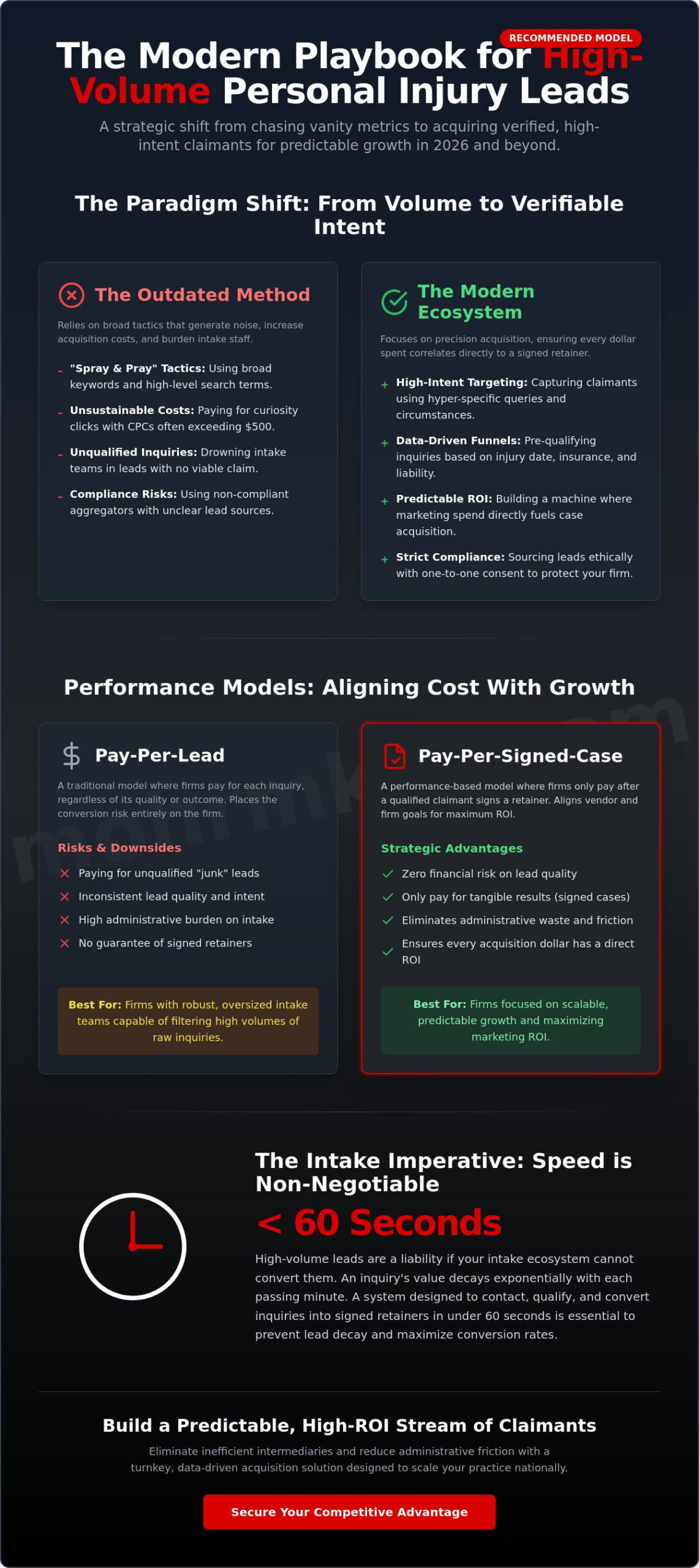
High-volume lead generation in 2026 is no longer a game of simple visibility. It’s a rigorous, multi-channel acquisition strategy designed to identify and capture claimants at the exact moment of need. Traditional “spray and pray” tactics, which rely on broad awareness and high-level search terms, have become financially unsustainable. With Google Ads CPCs for personal injury keywords often exceeding $500 in major markets, firms can’t afford to pay for curiosity clicks that don’t convert. Waste is the enemy of scale.
Scaling a practice requires moving beyond the “more is better” mindset. You need a turnkey ecosystem that filters out the noise. This system must handle the complexities of national growth by delivering high volume personal injury leads that meet strict qualification criteria before they ever reach your intake team. The goal is to build a predictable machine where every dollar spent on marketing correlates directly to a signed retainer. This transition from broad search to narrow, high-intent criteria is what separates market leaders from firms that are simply burning through their marketing budget.
The Shift from Quantity to Intent
Consumer search behavior has evolved significantly. Claimants now use hyper-specific queries related to their unique circumstances rather than generic terms. They look for specific injury types or procedural guidance. High-intent inquiries come from individuals ready to sign a retainer, while curiosity clicks come from those merely researching their options. Data-driven funnels act as the first line of defense. These funnels use conditional logic to verify the injury date, insurance status, and liability factors. This ensures every personal injury lawyer in your firm only speaks with qualified prospects who have a viable claim.
Why 2026 Demands Stricter Compliance
The regulatory environment in 2026 is unforgiving. Updated TCPA regulations have heightened the requirements for one-to-one consent, making broad, multi-seller consent forms a liability. You can’t rely on the legacy lead-buying models that prioritize volume over legality. State bar mandates now require clear, transparent documentation of how a lead was generated. Using non-compliant aggregators who hide their sources puts your license and your firm’s reputation at risk. Compliance isn’t a hurdle; it’s a competitive advantage. It ensures your high volume personal injury leads are sourced ethically, protecting your firm from litigation while maintaining a steady flow of high-quality cases.
Verifying Quality: How to Audit Your Lead Sources
Acquiring high volume personal injury leads requires more than just a budget; it demands a rigorous auditing process. You must demand total transparency in the claimant’s journey. If a provider cannot show you the exact creative, landing page, and form submission timestamp, you are likely buying recycled data. Real-time delivery is the only acceptable standard for volume. Leads that sit for even an hour lose value exponentially as claimants continue their search for representation.
Implementing a rigorous verification protocol is essential to protect your firm’s ROI. This protocol must eliminate fraudulent entries and duplicate inquiries before they reach your intake team. Verified inquiries are data points that have passed both automated and human screening. This dual-layer approach ensures that you aren’t paying for bots or curiosity seekers who have no intention of pursuing a claim.
The Anatomy of a Verified Inquiry
A high-quality inquiry must contain complete contact information and meet your specific case criteria. First, verify the ‘statute of limitations’ status for every lead. For example, in California, the statute of limitations for personal injury is two years; inquiries beyond this window are worthless. Second, ensure the claimant is not already represented by counsel. Paying for a lead that is already signed elsewhere is a direct drain on your resources. If you are struggling to maintain this level of scrutiny, you can consult with an expert to refine your verification parameters.
Detecting and Eliminating ‘Junk’ Leads
High-volume data sets often contain red flags that your systems must catch. Look for patterns like multiple submissions from the same IP address or nonsensical contact names. These are indicators of bot activity or click farms. Use IP tracking and sophisticated bot detection tools within your legal funnels to block these entries at the source. Finally, establish a tight feedback loop with your provider. If a specific batch of high volume personal injury leads results in a high percentage of “wrong numbers” or “no injuries,” report it immediately. Continuous optimization is the only way to maintain lead quality as you scale. Understanding how leading personal injury lead generation companies structure their verification protocols can help you set the right benchmarks when evaluating any provider.
Performance Models: Pay-Per-Lead vs. Pay-Per-Signed-Case
Choosing between performance models determines the trajectory of your firm’s growth. Traditional lead acquisition often places the entire financial risk on the law firm. In a pay-per-lead (PPL) model, you pay for the opportunity to convert an inquiry. If that inquiry is poor, your cost-per-acquisition (CPA) skyrockets. Conversely, the pay-per-signed-case model aligns the agency’s incentives with your bottom line. You only pay for results. This shift in accountability ensures that the provider is as invested in the case quality as you are.
The integration of fully executed retainers into your practice radically alters your cash flow dynamics. Instead of funding a massive intake department to chase cold inquiries, you receive litigation-ready files. This efficiency allows your attorneys to focus on case value rather than administrative follow-ups. You eliminate the “leaky bucket” syndrome where high-potential cases are lost due to slow response times or intake fatigue. Receiving cases that are ready for immediate filing accelerates your timeline to settlement and improves overall firm liquidity.
The ROI of Signed Retainers
Intake is an expensive hurdle that many firms underestimate. By purchasing signed retainers, you bypass the labor costs associated with screening, follow-ups, and document collection. This provides “conversion certainty” that raw high volume personal injury leads cannot match. For instance, mesothelioma leads require hyper-specific criteria that are difficult to verify through standard digital ads. Performance models handle this complex verification for you, delivering a fixed cost-per-case that simplifies your financial forecasting.
When to Choose Pay-Per-Lead
There are specific scenarios where pay-per-lead is the superior choice. If your firm maintains a large, 24/7 internal intake team, you may prefer a constant stream of raw high volume personal injury leads to keep staff fully utilized. To succeed here, you must calculate a precise break-even lead price. Use your historical conversion data to determine the maximum you can pay while maintaining profitability. In this framework, exclusivity is mandatory. Never pay for shared leads; they are a direct path to wasted spend and staff frustration. Your provider must guarantee that the inquiry is delivered to your CRM in real-time, without being sold to a competitor simultaneously. Firms that want to move beyond raw data and implement a true qualified legal lead generation strategy will find that isolating high-intent claimants before they reach intake is the most effective way to control cost-per-signed-case.
Operationalizing Intake for High-Volume Success
Acquiring high volume personal injury leads is only half the battle. To scale, you must build a specialized intake ecosystem that prevents budget waste. Many firms treat intake as a secondary administrative task, but this approach is fatal in a competitive market. Intake is the mechanical bridge between a marketing expense and a billable case. Speed to contact is the most critical variable in this equation. Inquiries go cold in minutes, not hours. Any delay in your response time is a direct subsidy to your competitors.
Data validity must be integrated into your workflow. For MVA cases, utilize police-report-backed data to verify accident details before your team picks up the phone. This protocol ensures your staff prioritizes claimants with documented liability. Your intake response must also remain active 24/7/365. Accidents don’t happen on a schedule. If you fail to capture an inquiry at 2:00 AM, that claimant will sign with the first firm that answers. Consistency is the foundation of volume.
The ‘Speed to Lead’ Critical Window
There’s a massive drop-off in conversion after the first five minutes. Industry data shows that contacting a lead within one minute increases the chances of conversion by 391%. You must implement automated SMS and email triggers for immediate engagement. These triggers should fire the second a lead enters your CRM. For high volume personal injury leads, live transfers are the superior choice. They connect high-intent claimants directly to your specialists, removing the friction of a callback and securing the retainer while intent is at its peak.
Training Your Team for High-Intent Conversion
Your intake staff needs a script that balances empathy with rigorous qualification. For high-stakes litigation like truck accident cases, specialists must identify key markers such as commercial insurance limits and injury severity immediately. Don’t leave these conversations to chance. Monitor call recordings to identify friction points where prospects drop off. Use these insights to refine your scripts and eliminate gaps in your conversion funnel. If your current intake process isn’t converting your marketing spend, you should optimize your intake ecosystem today.
Scalable Growth with Mohr Marketing, LLC’s Turnkey Solutions
Understanding the mechanics of acquisition is only the first step toward dominance. To achieve true scale, your firm must leverage a proven engine that has been refined over decades. Mohr Marketing, LLC provides over 30 years of industry experience in legal lead acquisition. We don’t just provide data; we provide a transparent, data-driven ecosystem designed for national scaling. By eliminating inefficient intermediaries, we connect your firm directly with high-intent claimants. This direct line ensures that your marketing dollars aren’t diluted by markups or recycled inquiries.
The primary advantage of a turnkey solution is the ability to focus on your practice while we handle the mechanics of acquisition. Managing high volume personal injury leads requires constant technical oversight and creative optimization. Our team monitors the performance of every funnel in real-time. We ensure that the inquiries reaching your intake team are fresh and qualified. You gain the benefit of a sophisticated marketing department without the overhead of building one in-house. This allows you to allocate your internal resources toward litigation and settlement while we maintain the steady flow of new cases.
The Mohr Marketing, LLC Advantage
Our proprietary verification process is the cornerstone of our success. We don’t rely solely on automated filters. Every inquiry undergoes rigorous screening to ensure it meets the specific quality markers your firm requires. We offer the flexibility of both Pay-Per-Lead and Pay-Per-Signed-Case options. This allows you to choose the risk profile that fits your current growth stage. This flexibility extends to specialized litigation as well. Whether you are targeting standard motor vehicle accidents or high-value mold cases, our systems are built to identify and capture the most profitable claimants in those niches.
Take the Next Step Toward National Scaling
Success in 2026 requires a cold, analytical look at your current marketing performance. You should begin by conducting a strategic audit of your current acquisition costs. Compare your cost-per-signed-case against industry benchmarks to identify where your budget is leaking. If your current provider cannot offer the transparency or the high volume personal injury leads you need to grow, it’s time to upgrade your infrastructure. Contact Michael Mohr directly for a professional consultation on custom funnel development tailored to your firm’s specific geographic and case-type goals. It is time to stop chasing inquiries and start signing cases. You can scale your firm with Mohr Marketing, LLC and secure your position as a market leader today.
Secure Your Competitive Advantage in the 2026 Legal Market
Dominating the legal landscape requires an aggressive departure from legacy lead-buying habits. You’ve seen that volume without verification is a liability that drains firm resources and compromises intake efficiency. Success now hinges on your ability to implement a precision-based ecosystem that converts high volume personal injury leads into signed retainers in real-time. By prioritizing high-intent inquiries and performance-based models, you secure a predictable path to expansion that minimizes financial risk while maximizing claimant quality.
Sustainable growth depends on a partnership built on transparency and mechanical accuracy. Mohr Marketing, LLC delivers over 30 years of specialized experience to help your firm navigate these market shifts. We provide the exclusive, real-time verified inquiries and turnkey intake solutions necessary to maintain a leadership position. Stop settling for inconsistent lead flow and start building a scalable litigation machine. It’s time to Secure High-Intent Personal Injury Cases Today. Your firm has the legal expertise; we provide the strategic engine to drive your national growth.
Frequently Asked Questions
What is the difference between an inquiry and a qualified personal injury lead?
An inquiry is a raw data submission that lacks verification. It often includes curiosity seekers or individuals who don’t meet your specific case criteria. A qualified lead is a prospect who has passed through rigorous filters. These filters verify the injury date, liability, and insurance status to ensure the claimant is a viable fit for your firm.
How do you ensure that high-volume leads are TCPA compliant?
Compliance is maintained through documented one-to-one consent at the point of lead capture. Each inquiry includes a digital audit trail that proves the claimant explicitly opted in to be contacted by your firm. We utilize trusted certificates and real-time verification to ensure all acquisition activities adhere to the latest federal regulations and state bar ethics mandates.
Why is ‘speed to lead’ so important in personal injury marketing?
Speed is the primary factor in conversion because claimant intent decays rapidly. Research indicates that contacting a prospect within one minute increases conversion chances by nearly 400 percent. If your intake team waits even ten minutes to respond, the claimant has likely already contacted a competitor. Rapid engagement secures the retainer before the prospect continues their search.
Can I buy signed retainers instead of just raw lead data?
Yes, you can acquire signed retainers to bypass the intake hurdle entirely. This model delivers fully executed legal agreements from pre-screened claimants. It is a highly efficient way to manage high volume personal injury leads because it eliminates the need for your staff to chase inquiries. You receive litigation-ready files that allow your attorneys to focus on case value immediately.
What should a firm look for in a personal injury lead generation agency?
A firm should prioritize transparency, industry experience, and real-time delivery standards. Demand an agency that provides clear audit trails for every lead’s journey from click to contact. Look for partners who offer flexible performance models and possess the technical infrastructure to scale your acquisition efforts nationally without compromising on data freshness or compliance.
How does a performance-based marketing model reduce risk for my law firm?
Performance-based models shift the financial risk of non-converting inquiries from the firm to the agency. You only pay for specific outcomes, such as a verified inquiry or a signed case. This alignment of goals ensures the provider is incentivized to maintain high quality standards. It transforms your marketing spend from an unpredictable overhead cost into a predictable investment in growth.
Is it better to generate leads in-house or outsource to a specialized agency?
Outsourcing is more effective for firms targeting national scale. Generating high volume personal injury leads in-house requires a massive investment in technology, creative optimization, and 24/7 intake staff. A specialized agency provides an immediate turnkey solution. This allows you to leverage expert infrastructure and proprietary verification processes without the administrative burden of managing a complex marketing department.
How do you verify that a claimant isn’t already represented by another attorney?
Representation status is verified through direct screening questions during the intake process. Every claimant is asked explicitly if they have already hired legal counsel for their injury. This step is a mandatory part of our verification protocol. It prevents ethics violations and ensures your firm doesn’t waste resources on prospects who are already signed with another attorney.

Recent Posts
- Personal Injury Intake Services: A 2026 Guide to High-Conversion Case Acquisition
- Using EMS Reports to Find and Qualify Personal Injury Clients
- The Strategic Value of EMS-EMT Accident Reports in Car Accident Lawsuits
Categories
- AI and Lead Generation
- Business Financing
- Call Verified MVA Leads
- Car Accident Help
- Car Accident Settlements
- Claimant Funding
- Compliance Program
- EMS-EMT Reports
- Geotargeting
- Google Maps Ranking
- Healthcare Practice Growth
- Law Firm Growth
- Law Office Operations
- Lead Generation
- Lead Generation For Attorneys
- Lead Generation For Chiropractors
- Lead Generation For Criminal Attorneys
- Lead Generation For D&A Treatment Centers
- Lead Generation For DUI Attorneys
- Lead Generation For Eye Doctors
- Lead Generation For Family Law Practices
- Lead Generation For PI Law Firms
- Lead Generation For Plastic Surgeons
- Leads For Healthcare Professionals
- Leads For Insurance Industry
- Legal Leads
- Legal Marketing
- Legal Updates
- Mass Tort Leads
- Medicare and Medicaid Leads
- Merchant Funding Leads
- Online Marketing Strategies
- Pre-Settlement Funding
- Signed MVA Cases
- Tort Updates
- Truck Accident Leads and Signed Cases
- Truck Accident Settlements
- Web Design