Exclusive vs Shared Legal Leads: Compare Costs and Competition
October 25, 2026 by Mohr Marketing
Distribution is the defining difference in the exclusive vs shared legal leads comparison. An exclusive lead goes to one law firm; a shared lead goes to two or more. That affects how many firms may contact the same prospect, but neither option guarantees a signed case.
A lead sent to one firm typically means less direct competition for that inquiry. But distribution alone doesn’t determine value. Verification, response speed, and follow-up all influence whether an inquiry becomes a client.
This comparison explains how exclusive and shared leads differ in distribution, competition, intake verification, and potential conversion rates. It also shows how to assess their costs without relying on price per lead alone. Compare the full process: who receives the inquiry, how ready the prospect is to speak, and how effectively your team handles it. These criteria can help identify the model that fits your firm’s intake capacity and growth goals.
Key Takeaways
- Compare how each lead type is distributed to understand how many firms may be contacting the same prospect.
- Assess total acquisition performance by tracking cost per signed case, not just cost per lead.
- Use intake questions to clarify exclusivity, verification, and how the inquiry was collected.
- Match lead volume and competition to your firm’s capacity to respond and follow up consistently.
- Review distribution, intake, and conversion together before choosing a lead model for your growth goals.
Exclusive vs shared legal leads: what is the difference?
The main difference is distribution: an exclusive legal lead goes to one firm, while a shared lead goes to multiple firms. That choice affects direct competition, lead costs, and the intake work involved in turning an inquiry into a signed case.
Cost per Signed Case
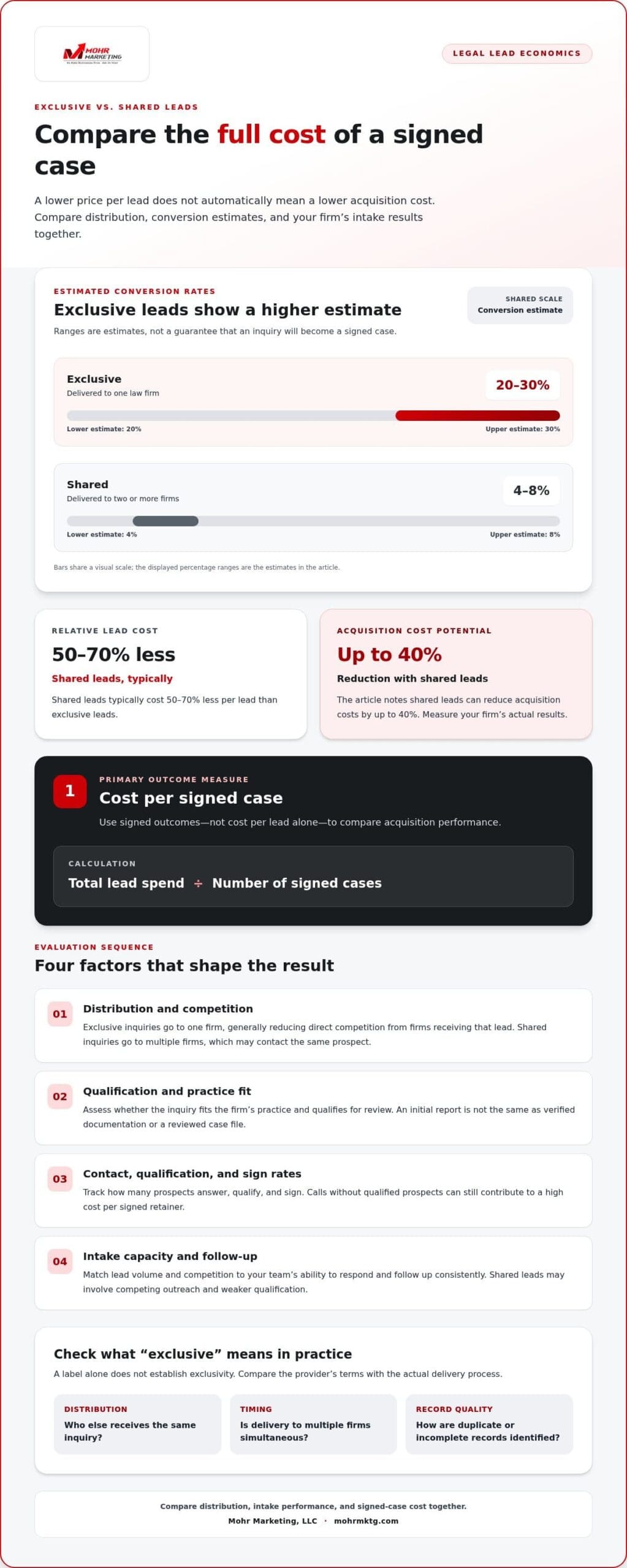
Cost per signed case connects lead spending to signed outcomes: divide total lead spend by the number of signed cases. Exclusive leads may cost more per lead, yet their estimated conversion rate is 20-30%, compared with 4-8% for shared leads. Shared leads can reduce acquisition costs by up to 40%, so firms should compare actual signed-case costs rather than assume either model wins.
Contact and sign rates help explain the results. Track how many prospects answer, qualify, and sign. A lead that generates calls but few qualified prospects can still result in a high cost per signed retainer.
Lead Value and Shared-Lead Tradeoffs
Shared leads typically cost 50-70% less per lead than exclusive leads and may be available in higher volume. That lower entry cost can help a firm test demand or maintain a steady intake pipeline. The tradeoff is competition: multiple firms may contact the same prospect, and shared-lead quality varies by provider.
Exclusive leads reduce direct competition from firms receiving the same inquiry, but a higher lead cost raises the stakes for each intake opportunity. The most valuable legal lead is one that fits the firm’s practice, qualifies for review, and can be handled effectively, not simply the lead with the lowest price.
| Lead type | Distribution | Relative lead cost | Competition | Conversion estimate |
|---|---|---|---|---|
| Exclusive | One firm | Higher | Lower direct competition from firms receiving the same lead | 20-30% |
| Shared | Multiple firms | Typically 50-70% less | Higher, because firms may pursue the same prospect | 4-8% |
Choosing Between Lead Types
Choose based on intake capacity, practice fit, and measured cost per signed case. Exclusive leads may suit firms seeking less direct competition; shared leads may suit teams able to manage more inquiries and follow up quickly. Shared leads can involve competing outreach, weaker qualification, and payment for inquiries that do not sign.
Which legal leads are most valuable? Leads that match the firm’s practice, qualify for intake, and produce signed cases at a sustainable acquisition cost. How should a firm choose? Compare contact, qualification, and sign rates alongside total spend. For a truck-accident example, firms can track truck-accident signed cases and verified call-transfer leads as distinct intake outcomes.
Exclusive and shared lead definitions
An exclusive legal lead is delivered to one law firm. A shared legal lead is delivered to two or more firms, sometimes at the same time. The distinction describes distribution, not case merit: an exclusive inquiry may still lack a viable injury claim, while a shared inquiry may fit a firm’s personal injury practice. Set the terms before purchasing. Ask whether “exclusive” means delivery to one firm, how the provider defines a lead, and whether the same report or contact can be resold.
Screen each accident inquiry using consistent intake questions. Record when the incident occurred, what injury the person reports, and what they say about fault. Distinguish the prospect’s account from verified documentation: an initial report is not a reviewed case file. For example, an inquiry about a recent collision with a described injury needs different follow-up from one with no clear accident date or injury details. Apply the firm’s own case criteria before treating either as qualified.
Provider verification should clarify how an inquiry was generated, what information was collected, and how distribution works. Ask how many firms may receive one shared lead and how duplicates or incomplete records are identified. Shared-lead marketplaces may distribute the same claimant record to three, four, or five firms. Most reputable providers distribute shared leads to two to four competing firms, while distribution to more than three to four firms is a warning sign identified in market guidance.
Lead purchasing can complement SEO and other marketing rather than replace it. SEO helps a firm attract people researching legal help; purchased leads add inquiries through a separate acquisition channel. Track each source separately in intake records, then compare qualification and signed-case outcomes. This shows whether a campaign brings prospects who match the firm’s practice, rather than judging performance by inquiry volume alone.
ABA Model Rule 7.2(b) generally prohibits paying others to recommend a lawyer’s services, while Comment 5 permits payments for client-lead generation under specified conditions. ABA Model Rule 7.1 bars false or misleading communications; Rule 5.4 bars fee sharing with nonlawyers and interference with professional judgment. Rule 7.3 restricts live person-to-person solicitation for pecuniary gain. Firms should structure marketing and intake processes around applicable professional-conduct requirements. To discuss a lead-generation approach for your practice, contact the team.
Auditing exclusivity with intake questions
Use intake records to test whether “exclusive” means one firm receives the inquiry. Ask who else receives the same lead, whether distribution is simultaneous, and how duplicate records are handled. Compare the answers with the contract and delivery logs. A label alone does not establish exclusivity; the distribution terms and actual handoff do.
Measure response speed before increasing lead volume. The research guidance recommends texting within 15 minutes and emailing within an hour as parts of a multi-touch follow-up sequence. It also recommends four to six follow-up attempts when a prospect misses the first call. Record each attempt in the CRM, including its time, channel, outcome, and next action. That record lets attorneys distinguish a weak inquiry from an intake process that did not reach it promptly.
Use a short intake checklist for every legal lead:
- Confirm the provider’s definition of exclusive and the maximum distribution count.
- Record delivery time, first call, first response, and whether the prospect answered.
- Capture qualification status, the next follow-up, and the final signed or declined outcome.
- Compare the provider’s stated terms with the contract and the CRM record.
Staffing depends on inquiry volume, coverage, and follow-up discipline. The research guidance says firms running high-volume programs should consider a 24/7 answering service for evenings and weekends. A two-attorney office can manage 10-15 exclusive leads per month with proper follow-up, according to the same market guidance. Treat that figure as an operational example, not a universal staffing formula. Track unanswered calls and pending tasks to see where the intake team needs coverage.
Process matters. Use a script that starts by listening to the prospect’s needs, then captures key facts and explains the next step. Use the CRM to assign ownership, flag unanswered inquiries, and keep consistent records. Software does not replace trained staff or timely responses.
Review performance by channel and lead type. A study of more than 1,300 law firm websites found that 25% responded to online inquiries within five minutes, while 39% took more than two hours or did not respond. Those figures highlight why intake speed belongs in the audit alongside exclusivity. Compare first-response time, qualified inquiries, and signed cases before changing the contract or adding volume.
Competition and conversion rates
Shared-lead competition starts as soon as multiple law firms receive the same inquiry. Each firm must make contact, assess qualification, and earn the prospect’s confidence before another attorney does. One estimate places exclusive legal lead conversion at 18-25%, compared with 3-8% for shared leads or cold traffic. These rates are benchmarks, not a substitute for tracking your own signed-case outcomes.
Speed can shape the contest. Attorneys are advised to contact shared leads within one to five minutes; the chance of contact drops sharply after the first five minutes. Even a 60-second delay may allow the prospect to speak with a competitor first. A firm’s lead generation process therefore needs clear assignment, prompt calling, and accurate time tracking.
Contact is only the first measure. Track the full path from delivery to retained client: answered calls, qualified prospects, consultations, and signed cases. For example, if 20 inquiries produce several conversations but few qualified matters, review screening and practice fit. If qualified prospects answer but do not sign, examine follow-up and intake conversations. This separates lead-source performance from process gaps.
- Response: Record delivery and first-contact times for every shared inquiry.
- Qualification: Track which prospects meet the firm’s case criteria.
- Outcome: Compare signed cases with total leads and total acquisition spend.
Rapid follow-up also affects qualification. Firms that contact prospects within one hour are seven times more likely to qualify leads than firms that wait longer. Real-time delivery increases the likelihood of converting a lead into a paying client by 50%. These findings make speed a measurable part of competition, not merely an intake preference.
Build a response workflow before adding shared-lead volume. Assign each inquiry to an intake owner, log the first call, and schedule the next attempt if the prospect doesn’t answer. For shared web leads, a recommended sequence is to call first, text only if the claimant agreed to texts and doesn’t answer, then call again within the first hour. A consistent process lets firms compare channels by retained matters, not activity alone.
Review results by lead type and intake stage. If shared inquiries generate answers but few signed cases, investigate qualification and follow-up before changing lead sources. If prospects are not reached promptly, address staffing and assignment delays first. Cost per lead matters, but the stronger measure is how efficiently each source produces a signed case.
How shared and exclusive legal leads are distributed
Distribution determines who receives an inquiry and when the law firm can respond. An exclusive lead is routed to one firm; a shared lead may reach competing firms from the same source. That difference shapes the initial advantage, but the delivery label alone doesn’t show the full process. Map the inquiry from its origin through routing, delivery, and intake assignment.
Start with the source. A prospect may submit an online form or inquire through another channel. The provider captures the information, applies its distribution rules, then sends the record to the purchasing firm or firms. Ask whether distribution happens simultaneously or in stages, and whether the same inquiry can be offered again later. These details affect how quickly a prospect may hear from other firms.
Separate exclusivity from lead quality. Delivery to one firm reduces competition from other recipients of that record, but doesn’t establish that the prospect is qualified or ready to proceed. For example, an exclusive inquiry may contain incomplete contact details, while a shared inquiry may clearly describe the person’s needs. Review the intake record and the provider’s screening steps independently.
Before buying, match the provider’s distribution description to its contract and delivery records. Ask for the definition of “exclusive,” the maximum recipient count for shared inquiries, and the process for duplicate or resold records. Then use this audit sequence:
- Save the original delivery time and source with each lead record.
- Compare those details with the provider’s stated routing terms.
- Record when the intake team receives and assigns the inquiry.
- Flag duplicate contact details or prospects who report prior calls.
- Compare signed outcomes by source and distribution type.
This process shows where the advantage is gained or lost. A delay between provider delivery and intake assignment can slow the firm’s response, even when the lead is exclusive. With shared distribution, overlapping outreach can make the prospect less receptive. Track each handoff separately so results reflect both lead generation and the firm’s intake execution.
Use the results to set purchasing rules. If duplicate records or unclear routing recur, review the contract terms before increasing volume. If distribution is clear but few inquiries qualify, examine screening criteria and source fit. A practical comparison of exclusive and shared legal leads starts with the actual route each inquiry takes, then measures whether it produces qualified conversations and signed cases.
Mohr Marketing: Personal Injury Leads
Mohr Marketing helps law firms build their intake pipeline with Personal Injury Leads and Motor Vehicle Accident (MVA) Leads. When your team needs support beyond inquiry generation, Legal Intake Services can help manage intake, while Signed Retainers offer another option for firms seeking signed cases.
Choose the offering that fits your practice area and intake model. For example, a firm handling collision claims may consider MVA Leads alongside its existing follow-up process. Plan how your team will assign, screen, and track new opportunities against signed outcomes.
Contact Mohr Marketing to discuss lead options for your firm.
Make Your Next Lead Decision Measurable
Choosing between exclusive and shared legal leads is a strategic decision, not a permanent commitment. Set a clear evaluation method before changing your mix: define which matters fit your practice, assign intake ownership, and review outcomes against your firm’s capacity. This gives your team a practical basis for refining its approach as case priorities and workload change.
Mohr Marketing offers Mass Tort Leads, Personal Injury Leads, and Motor Vehicle Accident (MVA) Leads for firms assessing opportunities across these practice areas. Align the lead category with your firm’s focus, then consider how your intake process will handle incoming inquiries.
Start with a focused conversation about the lead strategy that fits your firm’s objectives and intake model.
A disciplined evaluation gives your team a clearer path to sustainable growth.
Frequently Asked Questions
What should I look for in a lead generation provider?
Look for reporting that lets your team audit lead outcomes, not just delivery volume. Useful fields include campaign source, date received, qualification status, and final intake result. Ask how corrections are handled when a record contains an error and whether your team can export its performance data. These details help distinguish campaign results from changes in staffing, case criteria, or intake procedures.
How do exclusive leads reduce overall marketing costs?
They can reduce waste if your firm spends less time pursuing prospects already being contacted through the same campaign. To assess that effect, compare a defined group of leads across acquisition and handling costs, including staff time and unsuccessful follow-up. Track whether the inquiries fit your practice, too. Less duplicated outreach only improves the budget if the resulting matters justify the spend.
How do you verify exclusivity in a lead contract?
Review the contract for a clear remedy if delivery terms are breached. It should explain how your firm reports a disputed lead, what records support the review, and how the provider resolves the issue. Check whether the agreement defines exceptions, such as a prospect who independently contacts the firm through another channel. This makes exclusivity easier to assess when records overlap or a prospect describes earlier outreach.
How does a shared lead change your intake speed and script?
It makes the opening of the conversation more important. Confirm the prospect’s immediate concern before asking questions already covered in the inquiry form. If the person says another firm has called, acknowledge that calmly and focus on what they still need. Keep the script flexible: its purpose is to guide a useful conversation, not force every prospect through identical wording.
How many firms call the same person, and why does it matter?
The number depends on the campaign’s distribution terms, so the campaign record should identify the recipient limit. That information helps intake staff interpret a prospect’s comment that “several firms” have called, rather than treating it as a new inquiry. It also helps managers distinguish multiple firms’ outreach from repeated internal calls, which require different adjustments to campaign settings and staff procedures.
What is the typical conversion rate for exclusive leads?
There is no single rate that applies across every firm and practice area. The figure changes with the conversion point being measured: a qualified conversation, consultation, signed retainer, or another outcome. Before comparing results, define the numerator and denominator consistently. For example, don’t compare one campaign’s signed retainers with another campaign’s answered calls and call both figures conversion rates.
What is an exclusive legal lead?
An exclusive legal lead is a prospect inquiry assigned to one law firm under the campaign’s distribution terms. For reporting, label it by campaign and date received, then preserve its original record separately from later communications. That distinction helps a firm identify whether a later inquiry is a new prospect action or follow-up tied to the same marketing source.
What is a shared legal lead?
A shared legal lead is an inquiry made available to multiple law firms under a distribution arrangement. Firms should distinguish the original inquiry from each recipient’s separate intake record. For example, if a prospect submits another form later, record it as a new interaction and link it to the earlier history. This preserves the timeline without counting every contact as a separate person.

Recent Posts
- Exclusive vs Shared Legal Leads: Compare Costs and Competition
- Attorney Search Engine Marketing: Do It Yourself or Hire Help
- Improving Law Firm Marketing ROI: A Practical Measurement Framework
Categories
- AI and Lead Generation
- Business Financing
- Call Verified MVA Leads
- Car Accident Help
- Car Accident Settlements
- Claimant Funding
- Compliance Program
- EMS-EMT Reports
- Geotargeting
- Google Maps Ranking
- Healthcare Practice Growth
- Law Firm Growth
- Law Office Operations
- Lead Generation
- Lead Generation For Attorneys
- Lead Generation For Chiropractors
- Lead Generation For Criminal Attorneys
- Lead Generation For D&A Treatment Centers
- Lead Generation For DUI Attorneys
- Lead Generation For Eye Doctors
- Lead Generation For Family Law Practices
- Lead Generation For PI Law Firms
- Lead Generation For Plastic Surgeons
- Leads For Healthcare Professionals
- Leads For Insurance Industry
- Legal Leads
- Legal Marketing
- Legal Updates
- Mass Tort Leads
- Medicare and Medicaid Leads
- Merchant Funding Leads
- Mold Leads
- Online Marketing Strategies
- Pre-Settlement Funding
- Signed MVA Cases
- Tort Updates
- Truck Accident Leads and Signed Cases
- Truck Accident Settlements
- Web Design