Ethical Legal Advertising: 2026 Compliance Guide
August 2, 2026 by Mohr Marketing
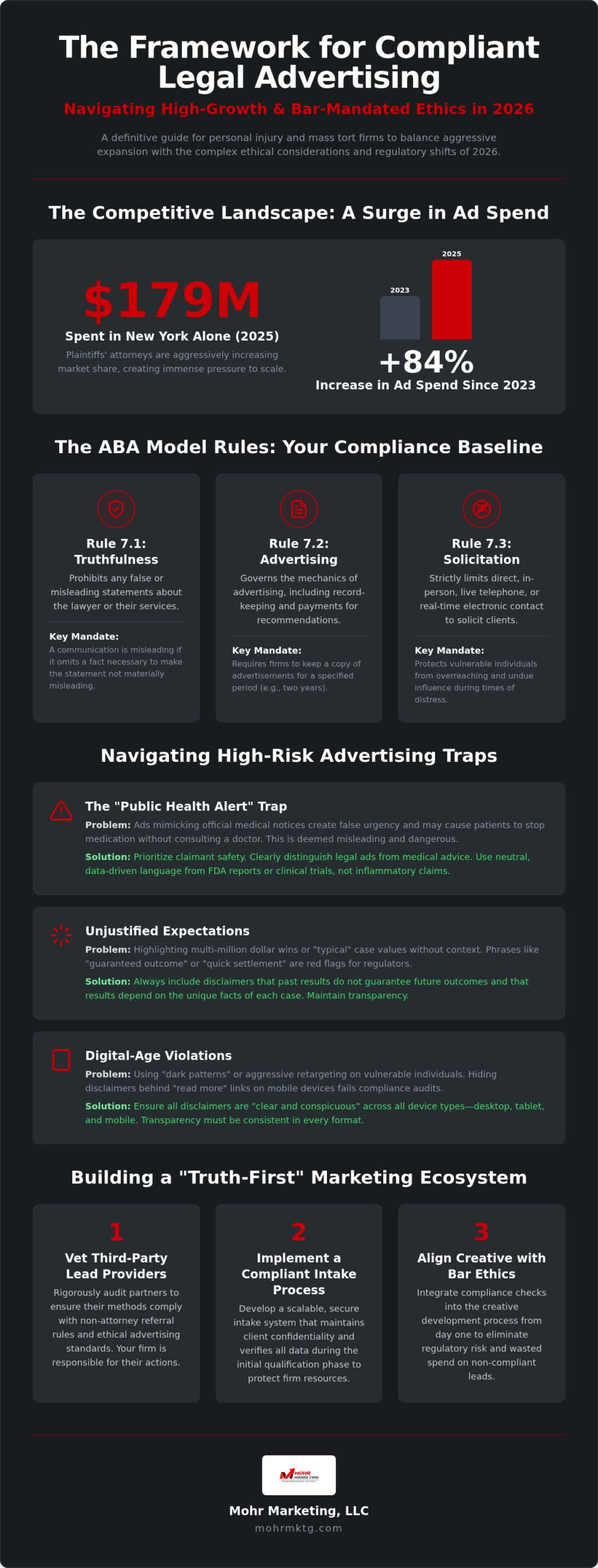
In 2025, plaintiffs’ attorneys in New York alone spent nearly $179 million on local legal service ads, an 84% increase since 2023. This aggressive push for market share often creates a dangerous disregard for regulatory boundaries. You likely feel the pressure to scale your firm’s caseload while fearing the professional and financial fallout of a non-compliant campaign. Balancing aggressive growth with complex ethical considerations in legal advertising isn’t just a hurdle; it’s a strategic necessity for long-term survival in the personal injury and mass tort sectors. Mohr Marketing, LLC provides the definitive framework to ensure your expansion remains both aggressive and compliant.
This guide provides a definitive roadmap to master the intersection of high-volume growth and bar-mandated ethics. You’ll learn how to navigate the 2026 regulatory shifts, including California’s SB 37 office disclosure mandates and Alabama’s new licensure requirements. We’ll outline specific criteria for vetting third-party lead providers and implementing scalable, ethical intake processes that eliminate regulatory risk and protect your firm’s resources.
Key Takeaways
- Identify the core principles of truthfulness and non-deception mandated by ABA Model Rules 7.1 through 7.3 to establish a 2026 compliance baseline.
- Avoid the “Public Health Alert” trap by balancing aggressive claimant awareness with rigorous scientific accuracy to prevent regulatory scrutiny.
- Navigate the complex ethical considerations in legal advertising when utilizing third-party lead generation and signed retainer models to ensure compliance with non-attorney referral rules.
- Secure your firm’s reputation by integrating a turnkey intake ecosystem that maintains client confidentiality and verifies data during the initial qualification phase.
- Implement a “Truth-First” marketing strategy that aligns creative development with bar-mandated ethics to eliminate regulatory risk and non-compliant lead waste.
The Regulatory Framework: Defining Ethical Legal Advertising in 2026
High-stakes legal advertising requires more than a creative eye; it demands rigorous adherence to bar-mandated standards. The core principle remains absolute: all communications regarding legal services must be truthful and non-deceptive. This isn’t a suggestion. It’s the baseline for every campaign targeting high-value cases. Since the 1970s, the history of legal advertising regulations has shifted from total prohibition to a “truth-first” requirement that protects consumers from predatory practices.
The American Bar Association (ABA) Model Rules 7.1 through 7.3 serve as the national blueprint. While state bars in New York and Alabama have recently updated their specific codes as of 2026, these ABA rules dictate the fundamental boundaries of ethical considerations in legal advertising. Rule 7.1 prohibits false or misleading statements. Rule 7.2 governs the mechanics of advertising and record-keeping. Rule 7.3 strictly limits direct solicitation. You must distinguish between your First Amendment commercial speech protections and your professional conduct mandates. Your license depends on that distinction.
One of the most scrutinized areas of ethical considerations in legal advertising involves settlement values. Stating that a “typical” case is worth a specific six-figure sum without providing clear, localized context is often deemed misleading. Regulators look for transparency. If your ad highlights a multi-million dollar win, it must also clarify that results depend on the unique facts of each case. Success in 2026 requires balancing aggressive growth with a conservative approach to claims.
The Evolution of Rule 7.1: Truthful vs. Misleading
Omitting material facts is just as dangerous as stating an outright lie. If you advertise “No Fee Unless We Win” but fail to mention that the client may still be responsible for court costs, you’ve crossed into unethical territory. Regulators use the “reasonable person” standard to evaluate your ads. They ask: Would a person with average intelligence be deceived by this claim? By 2026 standards, a communication is misleading if it creates an unjustified expectation about results or omits data necessary for an informed decision.
Time, Place, and Manner Restrictions in the Digital Age
Digital platforms introduce new risks through “dark patterns” and aggressive retargeting. Using social media algorithms to repeatedly target vulnerable individuals after a traumatic event can trigger solicitation grievances. You must ensure all disclaimers are “clear and conspicuous” across all device types. A disclaimer that’s visible on a desktop but hidden behind a “read more” link on a smartphone will fail a compliance audit. Ethical growth requires transparency in every pixel of your ad design.
Avoiding Manipulative Claims and the “Public Health Alert” Trap
Mass tort campaigns frequently utilize the “Medical Alert” or “Public Health Warning” aesthetic to capture attention. These ads often mimic official government notices or pharmaceutical recalls. By 2026, regulators have intensified their scrutiny of this “quasi-medical” approach. It’s misleading. It creates a false sense of urgency that can cause patients to stop life-saving medications without consulting a physician. Ethical considerations in legal advertising demand a clear distinction between legal solicitation and medical advice. You must prioritize claimant safety over click-through rates.
Balancing awareness with scientific accuracy is a strategic requirement. The Institute for Legal Reform (ILR) frequently critiques lawsuit ads for fearmongering, noting that exaggerated claims distort public perception of risk. To stay compliant, present FDA data neutrally. Use specific data points from clinical trials or official recalls rather than inflammatory adjectives. Staying on the Ethical Line with Lawyer Advertising requires a commitment to transparency that protects both the firm and the public. Avoid “guaranteed outcomes” or “quick settlement” language. These phrases trigger immediate bar grievances because they suggest results you cannot control.
Best Practices for Mass Tort Creative Assets
Neutrality is your best defense against regulatory friction. Use objective language when describing side effects or product defects. Every pharmaceutical litigation ad must include a prominent disclaimer: “Do not stop taking a prescribed medication without consulting your doctor.” It’s a non-negotiable safety standard. For specialized litigation, such as high-value mold case acquisition, ensure your creative assets rely on factual environmental data rather than speculative health diagnoses. If you need to verify your campaign’s adherence to these standards, connect with our compliance-focused intake team for a tactical review.
The Ethics of Comparative Advertising
Comparative advertising is permitted but carries significant risk. You can ethically compare your firm’s office locations or fee structures to others in the market. You cannot make unsubstantiated comparisons regarding success rates or “prestige.” Avoid claiming to be the “best” or “most successful” firm without empirical data. Every results-based claim requires factual substantiation. Keep your comparisons objective and focus on your firm’s specific procedural advantages, such as your proprietary intake ecosystem or years of industry experience.
Ethical Considerations in Legal Intake and Data Verification
The intake process is your firm’s first line of defense against both regulatory risk and poor lead quality. While marketing efforts attract potential claimants, the qualification phase determines your actual regulatory exposure. Ethical considerations in legal advertising extend far beyond the initial ad click; they permeate the entire “intake ecosystem.” You must maintain absolute client confidentiality from the first point of contact. This duty exists even if a formal retainer is never signed. Failing to secure lead data or allowing unauthorized access to intake logs can lead to severe bar grievances.
Utilizing non-lawyer staff or third-party intake services is a scalable necessity for modern firms. However, these professionals must work under a strict “no-advice” mandate. They can collect data and verify facts, but they cannot interpret the law or predict case values. In 2026, the proliferation of AI-driven intake bots has created a new compliance frontier. If an automated script provides a legal opinion or suggests a specific litigation path, your firm may face charges regarding the unauthorized practice of law. You must audit your automated workflows to ensure they remain purely administrative and don’t stray into legal counsel.
Standardizing the Verification Process
Implementing a rigorous screening process is the only way to ensure claimants meet your specific case criteria. This reduces lead waste and protects your firm from pursuing fraudulent or meritless claims. In the personal injury sector, Police report backed MVA cases serve as the industry’s gold standard for ethical verification. By requiring independent documentation during the intake phase, you demonstrate a commitment to factual accuracy that satisfies both ethical mandates and financial performance goals. This level of verification filters out low-intent noise and focuses your resources on high-value opportunities.
Data Privacy and TCPA Compliance
Your firm must balance the pursuit of high-intent inquiries with a deep respect for consumer privacy rights. This is where legal ethics intersect with federal telemarketing regulations like the TCPA. You must obtain clear, documented consent before using automated systems to contact potential leads. Compliance isn’t just about avoiding federal fines; it’s about building a transparent relationship with the claimant. Prioritizing these privacy safeguards while focusing on conversion efficiency is the most effective way to maximize The ROI of Legal Intake Services. It ensures your growth remains sustainable and shielded from litigation.
The Ethics of Third-Party Lead Generation and Signed Retainers
Outsourcing lead acquisition doesn’t relieve you of professional responsibility. You must navigate the “Non-Attorney Referral” rule with precision. ABA Model Rule 7.2(b) generally prohibits paying someone for recommending your services, but it permits paying the reasonable costs of advertisements. This distinction is critical when evaluating Pay-Per-Lead and Pay-Per-Signed-Case models. Ethical considerations in legal advertising require that these payments represent marketing fees rather than a split of the legal fee. You’re paying for the administrative effort of identifying and qualifying a claimant, not for the “referral” itself. If the fee is contingent on the outcome of the legal matter, you’ve likely violated fee-splitting prohibitions.
Exclusive lead models are ethically superior to shared aggregator models. Shared leads often trigger a “race to the phone” where multiple firms contact a single claimant simultaneously. This creates a high-pressure environment that can border on prohibited solicitation. Exclusive leads allow for a more professional, controlled intake process. These exclusive models mitigate many of the ethical considerations in legal advertising that arise from aggressive, multi-firm solicitation tactics. Your firm has a non-delegable duty to audit all third-party marketing creative. If a lead provider uses deceptive imagery to generate inquiries, your firm bears the regulatory risk. You must verify that all external assets align with your firm’s standards before they go live.
Vetting Your Lead Generation Partner
Your firm needs a rigorous verification checklist for every third-party partnership. Demand transparency. You should know exactly how inquiries are generated and qualified before they reach your desk. Ensure the provider avoids misleading “alert” style ads that mimic official government communications. Utilizing mass tort signed cases with strict criteria ensures your growth is built on a foundation of factual accuracy and bar-mandated compliance. Never accept leads from “black box” sources that refuse to share their creative assets or targeting methods. Ask for documentation on their data privacy protocols and TCPA consent logs to protect your firm’s reputation.
The Signed Retainer Model: Ethical Safeguards
The signed retainer model requires specific ethical safeguards to remain compliant. Claimants must fully understand the scope of the retainer agreement before they sign. You cannot use “bundling” tactics that obscure the specific nature of the legal representation or hide the identity of the law firm. Most importantly, the “independent judgment” of the attorney must remain the final filter. A lead provider can deliver a qualified claimant, but only the lawyer can decide if the case is legally viable. This separation of marketing and legal judgment is the cornerstone of ethical case acquisition. Ensure your retainer agreements are clear, conspicuous, and free of predatory language that could trigger a bar inquiry.
Building a Compliant Marketing Ecosystem for 2026
Scaling a firm in 2026 requires a systemic integration of regulatory standards into your growth engine. You cannot treat compliance as an afterthought or a final hurdle before launch. It must be a foundational element of your creative development pipeline. By embedding ethical considerations in legal advertising into your initial strategy, you eliminate the friction of last-minute revisions and the risk of bar grievances. A compliant ecosystem uses automated checks and human oversight to ensure every ad, landing page, and script remains within the boundaries of truthfulness and non-deception.
The “Truth-First” strategy relies on high-intent search data to drive acquisition. When you target individuals actively searching for specific litigation terms, you reduce the need for the disruptive, clickbait-style tactics that often trigger regulatory scrutiny. This approach prioritizes accuracy over volume. It ensures that the information presented aligns exactly with the claimant’s needs and the firm’s specific case criteria. Leveraging performance-based marketing allows you to focus your budget on verified, high-quality inquiries. This eliminates the ethical waste associated with broad, misleading campaigns that cast too wide a net.
Continuous Monitoring and Auditing
Your digital funnels are not static. Algorithms change, and state bar rules evolve. You must establish a routine audit process for all active campaigns to maintain compliance in real-time. This includes reviewing landing page disclaimers, checking the “clear and conspicuous” nature of all disclosures, and auditing intake recordings. As 45% of legal professionals now use AI daily, you should leverage these tools to monitor your ad copy for prohibited phrases or “quasi-medical” claims. For a detailed implementation strategy, consult our Mass Tort Lead Generation: A Roadmap to Scalable Growth. Proactive monitoring protects your firm’s reputation and ensures your marketing remains a stable asset rather than a liability.
The Competitive Advantage of Ethics
Ethical advertising is a powerful filter for case quality. When you set realistic expectations early, you attract claimants who are more resilient and less likely to drop off during the long litigation cycle. This reduces “churn” and improves the overall health of your docket. Transparency positions your firm as an authority in a market often crowded with manipulative aggregators. High-stakes professionals value efficiency and tangible outcomes; they don’t want to navigate a maze of misleading claims. By prioritizing ethical considerations in legal advertising, you build a brand that is both protective of your resources and aggressive in its expansion. The most successful firms in 2026 use compliance as a growth engine, not a constraint.
Future-Proof Your Firm’s Growth Strategy
Compliance functions as the strategic quality control mechanism for high-stakes expansion. You now possess the framework to navigate the complex ethical considerations in legal advertising by prioritizing truth-first creative and rigorous intake verification. Successful scaling requires auditing every third-party partnership to ensure your professional reputation remains untarnished by deceptive tactics. By moving away from high-pressure solicitation, you attract more resilient claimants and reduce the risk of regulatory friction.
Leverage 30+ years of verified industry expertise to eliminate the high cost of non-compliant lead waste. The turnkey marketing and intake ecosystem at Mohr Marketing, LLC provides the mechanical accuracy required for sustainable growth in a crowded market. Performance-based signed retainer models ensure your investment translates directly into tangible caseload expansion without the risk of manipulative aggregators. This strategic approach removes friction from your business processes and secures your firm’s leadership position for years to come.
The intersection of aggressive growth and bar-mandated ethics is where the most successful firms are built. Take the next step toward a more transparent and profitable future.
Frequently Asked Questions
Is it ethical to use “Pay-Per-Lead” services for mass tort cases?
Yes, utilizing pay-per-lead services is ethical if the fees represent the fair market value of the marketing and administrative work performed. ABA Model Rule 7.2(b) permits lawyers to pay the reasonable costs of advertisements. You must ensure the service doesn’t specifically recommend your firm as superior but instead provides a platform for high-intent inquiries to connect with counsel. The payment shouldn’t be a percentage of the legal fee recovered.
Can a law firm be held liable for misleading ads run by a third-party provider?
Attorneys bear full responsibility for the content of advertisements run on their behalf. You have a non-delegable duty to oversee the conduct of any non-lawyer marketing partner. If a lead generator uses deceptive “Medical Alert” imagery or false settlement claims, your firm faces the regulatory fallout. You must audit all creative assets in your partner’s pipeline to ensure they meet the highest standards of accuracy.
What are the rules regarding “specialist” designations in legal advertising?
You cannot claim to be a “specialist” or “certified” unless you’ve earned a certification from an ABA-approved or state-approved organization. The name of that certifying body must be prominently displayed in the advertisement. Most jurisdictions allow you to state that you “practice in” or “focus on” areas like personal injury or mass torts. This distinction prevents misleading the public about your specific credentials or expertise level.
Are “Public Health Alert” style ads legal under current bar rules?
These ads are only legal if they avoid mimicking official government notices and include mandatory safety disclaimers. Using “Medical Alert” headers to create false urgency is a primary focus of ethical considerations in legal advertising in 2026. You must use neutral language and include a clear directive for patients to consult their doctors before stopping any prescribed medication. Factual accuracy must always override aggressive click-through strategies.
How do I ensure my legal intake process doesn’t violate solicitation rules?
Your intake process must remain purely administrative and responsive to claimant-initiated inquiries. Solicitation rules generally prohibit live telephone or real-time electronic contact for financial gain unless the person is a lawyer or has a prior relationship with the firm. Your intake staff can collect data and verify case criteria, but they shouldn’t provide legal opinions. This separation ensures the intake ecosystem doesn’t constitute the unauthorized practice of law.
What disclaimers are required for mass tort advertising on social media?
Every social media ad must feature a “clear and conspicuous” disclosure stating it is an attorney advertisement. If you mention past successes, you must include a disclaimer that results depend on the unique facts of each case. These disclosures must be visible on all device types without requiring a user to click “see more.” Adhering to these ethical considerations in legal advertising protects your firm from deceptive trade practice allegations.
Can I ethically buy “Signed Retainers” from a marketing agency?
You can ethically acquire signed retainers if the agency acts as an administrative facilitator and you maintain independent legal judgment. The fee paid must be a flat administrative cost for the work of qualifying the lead and facilitating the document. It cannot be a percentage of the eventual settlement. You must review every case to ensure it meets your firm’s standards before the attorney-client relationship is officially established.
How does the TCPA affect legal lead generation and intake calls?
The TCPA requires prior express written consent before you contact potential leads using automated dialing systems or prerecorded voices. Violations can result in statutory damages of up to $1,500 per willful occurrence. Your intake process must document this consent through clear opt-in forms on every landing page. Federal telemarketing compliance is just as vital as bar-mandated ethics for maintaining a sustainable, risk-free growth engine.
Recent Posts
- Mass Tort Digital Marketing Agency
- Personal Injury Signed Retainers: The Strategic Guide to Scalable Case Acquisition in 2026
- Motor Vehicle Accident Leads: A 2026 Guide to High-Intent Case Acquisition
Categories
- AI and Lead Generation
- Business Financing
- Call Verified MVA Leads
- Car Accident Help
- Car Accident Settlements
- Claimant Funding
- Compliance Program
- EMS-EMT Reports
- Geotargeting
- Google Maps Ranking
- Healthcare Practice Growth
- Law Firm Growth
- Law Office Operations
- Lead Generation
- Lead Generation For Attorneys
- Lead Generation For Chiropractors
- Lead Generation For Criminal Attorneys
- Lead Generation For D&A Treatment Centers
- Lead Generation For DUI Attorneys
- Lead Generation For Eye Doctors
- Lead Generation For Family Law Practices
- Lead Generation For PI Law Firms
- Lead Generation For Plastic Surgeons
- Leads For Healthcare Professionals
- Leads For Insurance Industry
- Legal Leads
- Legal Marketing
- Legal Updates
- Mass Tort Leads
- Medicare and Medicaid Leads
- Merchant Funding Leads
- Online Marketing Strategies
- Pre-Settlement Funding
- Signed MVA Cases
- Tort Updates
- Truck Accident Leads and Signed Cases
- Truck Accident Settlements
- Web Design