AFFF Lawsuit Leads for Mass Tort Law Firms
November 2, 2026 by Mohr Marketing
AFFF lawsuit leads are a changing pool, not a fixed count. Availability depends on incoming inquiries and how many match the screening criteria a firm uses. Those criteria may include occupational AFFF exposure between 1960 and 2024, at least 10 exposures, and a qualifying diagnosis at least 6 months after the first exposure.
Lead volume is only one part of the assessment. A large number of inquiries does not necessarily mean a large pool of potentially qualified prospects. To judge whether AFFF lawsuit leads fit your firm’s intake process, consider how exposure history, diagnosis, and timing are documented and evaluated.
This article explains how AFFF lead availability is assessed, which screening criteria may affect qualification, and what to consider when evaluating lead quality. It also outlines how mass tort lead generation and legal intake can help firms manage the process from initial inquiry to a more complete case review.
Key Takeaways
- Assess AFFF lead availability by looking at the flow of inquiries and how closely they align with your firm’s screening criteria.
- Review exposure history, diagnosis, and timing together to identify leads that merit further intake review.
- Use employment and medical records, exposure details, and claimant statements to build a clearer picture of a potential case.
- Distinguish lead qualification from legal evaluation; screening helps organize prospects but does not determine the merits of a claim.
- Align lead generation and intake processes so your team can evaluate inquiries consistently and direct staff time efficiently.
HOW MANY AFFF Leads ARE AVAILABLE?
There is no fixed count of available AFFF prospects. The number changes as inquiries enter screening and firms assess exposure, diagnosis, and case fit. Court filings show the scale of litigation, but they are not a count of leads available for acquisition. As of May 2026, more than 15,200 active personal injury claims were pending in the federal AFFF multidistrict litigation. Nearly 20,000 AFFF lawsuits had been filed overall by that time. Those figures indicate substantial litigation activity, not the number of new or qualified prospects any firm can obtain.
AFFF, or aqueous film-forming foam, is used to fight certain fuel fires. It spreads an aqueous film over hydrocarbon fuel, creating a vapor barrier intended to prevent reignition. Plaintiffs allege contamination involving PFOA and PFOS, two types of PFAS. Exposure may occur through firefighting foam use, contaminated environments, or work involving the foam. Potential exposure settings include military installations, industrial sites, airports, aircraft operations, and training exercises.
Occupational exposure histories can involve more than frontline firefighters. Potentially exposed groups include municipal, airport, and military firefighters, as well as flight-deck workers. Employees who manufactured AFFF, transported foam, or worked at facilities that incinerated it may also have relevant work histories. Circumstances vary: one person may have applied foam during repeated drills, while another handled or transported it in an industrial role. Each account helps clarify where exposure may have occurred.
Community exposure follows a different path. Environmental contamination may affect people who did not work directly with AFFF, including residents near affected sites. Military installations and industrial locations are among the identified exposure settings. For a community inquiry, intake teams can record the person’s residence or other connection to the site, when that connection occurred, and any known contact with contaminated water or soil. These details help distinguish a possible environmental exposure from an occupational history.
Health conditions mentioned in AFFF litigation include kidney cancer, testicular cancer, thyroid cancer, and ulcerative colitis. The first bellwether trials selected in August 2024 focused on claims involving those conditions. The National Cancer Institute released a study in October 2023 linking AFFF exposure and PFAS to thyroid and testicular cancer. These reported links do not establish that exposure caused an individual’s disease. A claim’s factual assessment depends on its own medical and exposure records.
Firefighter claims have drawn particular attention because firefighting work can involve repeated foam use. The Associated Press reported on September 14, 2023, that firefighters feared toxic chemicals in their gear could contribute to cancer cases. That report concerned protective gear, while AFFF claims focus on alleged exposure involving firefighting foam and PFAS. Keep those issues distinct during intake. Record whether the account involves direct foam handling, training exercises, a contaminated environment, or another exposure route.
For an initial review, organize each inquiry around these points:
- Work or community connection: identify the job, site, or environmental setting described.
- Exposure route: note foam use, handling, transport, disposal, or possible environmental contact.
- Health condition: capture the reported diagnosis and relevant medical documentation.
- Timeline: arrange work, site contact, and diagnosis dates for further review.
Thousands of claims and filings show an active litigation landscape, but lead volume depends on inquiry flow and screening standards. Firms evaluating AFFF lawsuit leads should separate raw interest from prospects whose histories contain useful case details. A broader acquisition strategy may also involve truck accident signed cases and verified call-transfer leads, a distinct practice area from AFFF litigation.
AFFF lead qualification criteria
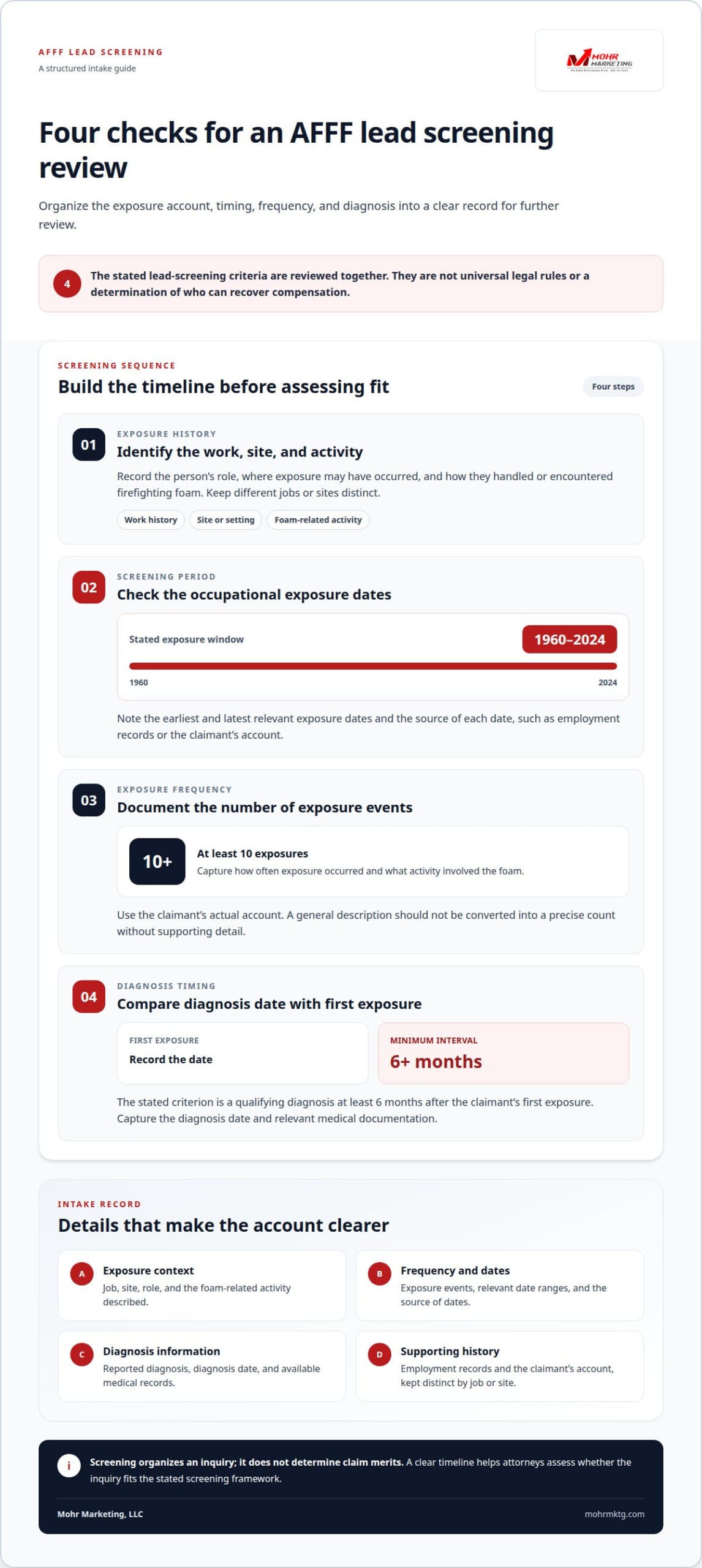
Lead screening turns an initial inquiry into a structured record. For AFFF prospects, the stated criteria include occupational exposure from 1960 through 2024, at least 10 AFFF exposures, and an eligible diagnosis occurring at least 6 months after the claimant’s first exposure. These are lead-provider screening criteria, not universal legal rules or a court finding about who can recover compensation.
Begin with the exposure timeline. Record the person’s work history, when they handled or encountered firefighting foam, and how often exposure occurred. A military employee, for example, might describe repeated contact during service duties. An employee at a manufacturing facility might report handling aqueous film-forming foam during production. Capture specific roles and settings rather than relying only on a general belief that exposure occurred.
Next, compare the reported dates against the lead-screening period. The occupational exposure window listed for these leads runs from 1960 through 2024. Record the earliest and latest relevant exposure dates, then note the source of each date, such as employment records or the claimant’s account. If several jobs or sites are involved, keep each period distinct. A clear timeline helps attorneys assess whether the inquiry fits the stated screening framework.
Frequency is a separate criterion. The lead criteria require at least 10 exposures. Intake should therefore capture how many events the person recalls, how often they occurred, and what activity involved the foam. “Worked around firefighting” provides little detail. “Applied foam during recurring drills” gives a more useful account for follow-up. Don’t convert a vague description into a precise exposure count; document the claimant’s actual response.
Then map the diagnosis date against the first exposure date. The listed standard requires an eligible diagnosis at least 6 months after first exposure. Record both dates and the diagnosis description as reported. Medical records and cancer diagnosis information can support a later review. This timing threshold is a screening measure, not proof that AFFF caused a disease. A lead can meet an initial time-based screen while still requiring substantive legal and medical assessment.
Make each screening criterion traceable to information in the file. A law firm’s intake workflow can organize the record around:
- Identity and work history: capture employers, roles, and relevant service details.
- Exposure account: document foam-related tasks, locations, frequency, and dates.
- Diagnosis record: note the condition and diagnosis date, then identify available medical documentation.
- Supporting sources: list employment records, personal testimony, or witness information that may clarify the account.
This sequence helps distinguish an incomplete inquiry from one that appears to meet the stated lead criteria. For example, a prospect may describe an eligible diagnosis but provide no first-exposure date, job locations, and the claimant’s account of how often foam was encountered. Focused follow-up is needed before the six-month interval can be assessed. Another person may report frequent contact but fall outside the stated occupational period. Applying the criteria makes these gaps visible without treating screening as a final decision on the merits of a case.
Keep lead qualification separate from legal review. The litigation process, available evidence, and claimant’s specific facts can all affect case evaluation. Diagnosis review can separately record whether the reported condition is kidney cancer or testicular cancer, which are diseases that may qualify for AFFF exposure claims. Keeping diagnosis details alongside the exposure chronology gives reviewers distinct information to assess.
A qualifying lead does not promise compensation, prove liability, or establish that manufacturers caused a person’s illness. This possibility should be presented conditionally, not as a guaranteed result of passing an intake screen. It is an inquiry organized against defined intake criteria. For help finding qualified legal professionals for an AFFF claim, individuals can use legal directories or contact a local bar association to seek a professional who can review their individual exposure and diagnosis information. A consistent review process also helps attorneys identify which information is still needed before deciding whether to proceed.
For a structured discussion about your firm’s intake priorities, share your case acquisition goals with Mohr Marketing, LLC.
Legal leads
Legal leads for AFFF litigation need more than a contact record. They should give a law firm enough information to assess potential fit, identify follow-up needs, and route the inquiry for legal review. The federal AFFF products liability litigation is designated MDL No. 2873 and is centralized in the District of South Carolina. That context helps firms understand why consistent intake and organized records matter.
Separate lead screening from case evaluation. Screening records a person’s account and relevant details; attorneys assess the facts, evidence, and applicable legal issues. An inquiry is not a filed lawsuit, and a lead that matches initial criteria does not establish liability or guarantee compensation. Clear labels at each stage help prevent intake teams from treating an unreviewed inquiry as an accepted case.
Build a record that can move through review without losing key details. Intake staff should capture the claimant’s contact information, reported exposure setting, work or community connection, diagnosis, and relevant dates. They should also note whether the inquiry concerns personal injury or water contamination. These categories matter because public water system claims and individual injury claims can follow different litigation paths.
Settlement announcements require similar care. A separate $1.185 billion settlement with DuPont, Chemours, and Corteva received preliminary approval on February 9, 2024. These agreements concern water-system claims and should not be presented as individual personal injury compensation or as proof that a particular claimant qualifies.
Defendant information can help organize an inquiry, but it does not resolve the claim. Companies named in AFFF lawsuits include 3M, DuPont, Chemours, Tyco Fire Products, Chemguard Inc, and ChemDesign Inc. More than 25 companies have been named in U.S. AFFF lawsuits. Record any manufacturer or product name the person identifies, along with the basis for that identification. Do not infer a connection from an employer, worksite, or foam use alone.
Record timing separately. AFFF lawsuit filing deadlines vary by state, and some states may allow only one year after a cancer diagnosis or a loved one’s death to take legal action. The diagnosis date, date of death when applicable, and relevant state connection are therefore important for prompt attorney review. A general national campaign timeline cannot replace an assessment of the individual’s circumstances.
Organized evidence gives attorneys a clearer starting point. A useful intake file can list:
- Medical documentation: diagnosis records and information about the reported condition.
- Exposure details: dates, locations, work activities, and the person’s account of foam contact.
- Employment history: roles, employers, and available records supporting the reported work history.
- Claim category: personal injury, environmental exposure, or a water-system matter.
Keep the distinctions between inquiry, screened lead, attorney review, and filed litigation clear in the workflow. This helps prevent settlement headlines, defendant names, or MDL activity from being mistaken for an individual case outcome. It also gives the firm a consistent way to prioritize follow-up and identify records that may be needed. Move each lead forward based on its documented facts, not assumptions drawn from another claimant’s case.
A complete timing record should include the state connected to the reported exposure and diagnosis, as well as the dates relevant to the person’s account. The AFFF lawsuit filing deadline varies by state, and some states may allow only 1 year after a cancer diagnosis or a loved one’s death to take legal action. Intake staff should flag missing dates and route deadline questions for prompt legal review rather than estimating whether a claim is timely. A documented follow-up process can help attorneys identify what still needs verification without presenting screening as a legal conclusion.
Procedural developments can also inform how a firm organizes inquiries. The court held the initial status conference in the AFFF multidistrict litigation on February 25, 2019. The litigation was assigned to Judge Richard M. Gergel for coordinated discovery and pretrial matters in the District of South Carolina, and the court set July 11, 2025, as the deadline for plaintiffs to submit their reports in the AFFF litigation. Separately, Kidde-Fenwal had been named in more than 4,400 PFAS lawsuits before filing for Chapter 11 bankruptcy in May 2023. Record any reported connection to that company as an allegation requiring review, not as confirmation of a person’s claim. Keeping exposure, diagnosis, defendant, and procedural information distinct helps legal teams assess follow-up needs while preserving the limits of an intake record.
Mohr Marketing, LLC: Personal Injury Leads
Mohr Marketing, LLC provides Personal Injury Leads for firms building their case pipeline, along with Mass Tort Leads for mass tort practices. When inquiry volume creates intake demands, Legal Intake Services can support the process, and Signed Retainers are another case acquisition option. These services can help firms expand acquisition while keeping lead screening distinct from legal review.
For AFFF practices, assess whether your team needs additional mass tort inquiries, intake support, or signed cases. Align the service with your workflow and capacity to review each prospect’s exposure history, diagnosis, and records. Mohr Marketing, LLC also provides Motor Vehicle Accident (MVA) Leads for firms managing multiple practice areas.
Contact Mohr Marketing, LLC to discuss your firm’s lead generation and intake priorities.
Build a More Deliberate Case Acquisition Plan
Strong case acquisition depends on more than increasing inquiry volume. Set a clear handoff from initial intake to attorney review, define the details your team needs early, and keep consistent records for efficient follow-up. This structure helps your firm assess new AFFF lawsuit leads against its actual capacity and practice priorities.
Next, identify where prospects lose momentum. Look for gaps in intake questions, delayed follow-up, or unclear ownership between marketing and legal teams. Addressing these points can make the process more manageable without changing the standards attorneys use to evaluate a potential claim. Focus on a reliable flow of information, not on treating every inquiry as a case.
With a defined process in place, your firm can make more informed decisions about its acquisition strategy and the support needed to carry it out.
A focused next step can help your team move forward with clarity and confidence.

Recent Posts
- AFFF Lawsuit Leads for Mass Tort Law Firms
- Outsourced Legal Intake Services: How Calls, Conflicts and Roles Work
- Streamlining the Legal Retainer Process Through Clear Communication
Categories
- AI and Lead Generation
- Business Financing
- Call Verified MVA Leads
- Car Accident Help
- Car Accident Settlements
- Claimant Funding
- Compliance Program
- EMS-EMT Reports
- Geotargeting
- Google Maps Ranking
- Healthcare Practice Growth
- Law Firm Growth
- Law Office Operations
- Lead Generation
- Lead Generation For Attorneys
- Lead Generation For Chiropractors
- Lead Generation For Criminal Attorneys
- Lead Generation For D&A Treatment Centers
- Lead Generation For DUI Attorneys
- Lead Generation For Eye Doctors
- Lead Generation For Family Law Practices
- Lead Generation For PI Law Firms
- Lead Generation For Plastic Surgeons
- Leads For Healthcare Professionals
- Leads For Insurance Industry
- Legal Leads
- Legal Marketing
- Legal Updates
- Mass Tort Leads
- Medicare and Medicaid Leads
- Merchant Funding Leads
- Mold Leads
- Online Marketing Strategies
- Pre-Settlement Funding
- Signed MVA Cases
- Tort Updates
- Truck Accident Leads and Signed Cases
- Truck Accident Settlements
- Web Design