Attorney Search Engine Marketing: Do It Yourself or Hire Help
October 21, 2026 by Mohr Marketing
You can manage attorney search engine marketing yourself, but Google Ads is only one part of the work. You also need to organize campaigns around your services and markets, send clicks to relevant pages, and track whether inquiries become qualified opportunities. DIY management can make sense if you have the time and skills to handle these tasks consistently.
It’s reasonable to want control over your ad spend and avoid paying for work you can handle in-house. The challenge is that search marketing includes both paid advertising and organic visibility, which require different approaches. This guide explains how attorney search engine marketing builds visibility, how legal ad campaigns are organized, and what to consider before managing Google Ads yourself or bringing in support. It also covers where lead generation and intake services fit when your priority is turning interest into potential cases.
Key Takeaways
- Separate long-term organic visibility from paid campaigns, then decide which approach best fits your firm’s goals and available resources.
- Choose between managing Google Ads yourself and hiring support based on the time and expertise needed to structure, monitor, and refine campaigns.
- Organize campaigns around practice areas and target geography so ads and landing pages match the legal services prospective clients are seeking.
- Assess Google Ads and Microsoft Advertising as distinct channels, and measure performance by the quality of inquiries, not clicks alone.
- When your firm needs support turning interest into potential cases, consider how lead generation, signed retainers, and legal intake services fit your process.
Building law firm visibility and brand credibility
An agency managing attorney search engine marketing should connect search visibility to qualified inquiries, not just traffic. Compare its reporting, legal-sector experience, campaign process, and approach to measuring results. Ask how it separates organic SEO from paid advertising and aligns each activity with your practice areas.
Lead-generation services carry risks when inquiry criteria, sourcing, or handoffs are unclear. You may receive inquiries that do not match your practice, while weak tracking can make it difficult to identify which channel produced them. Define what makes an inquiry relevant and how your intake team will record its outcome.
Build visibility in stages. A newer firm can start with clear service pages, accurate business listings, and useful content that answers prospective clients’ questions. A growing firm can expand coverage across practice areas and markets, then strengthen pages that attract relevant traffic. An established firm can identify gaps in search results and prioritize technical fixes, credible references, and more in-depth content.
SEO supports this work by helping search engines find, understand, and rank your site. Use descriptive title and meta tags, organize pages around specific services, and publish practical material that demonstrates legal knowledge. Keep business listings consistent so search engines can associate your firm with its service area. Useful, coherent information builds credibility more effectively than unsupported claims.
Set expectations around timing. A comprehensive Page 1 SEO strategy typically requires six to 12 months of consistent effort. By contrast, Attorney at Work’s 2025 research found 87% of consumers use Google to help decide which law firm to hire. Search visibility therefore supports both discovery and a firm’s first impression during evaluation.
Assess an agency’s work through a structured consultation. Review your site’s indexing, page structure, business listings, content, and inquiry tracking. Then request a prioritized plan that distinguishes technical repairs from longer-term content development. A credible assessment identifies the work, how it will be measured, and the sequence, rather than simply promising higher rankings.
Case studies can illustrate results, but examine the starting point, timeline, and measured outcome. One estate-planning website project reported a 125% visitor increase after three months, with calls rising from 10 to 22 over three months. First Page Sage reports that law firm SEO can deliver a 526% return on investment over three years. Treat each result within its stated context; compare the work and measurement, not a headline percentage alone.
Before choosing a provider, request a sample report and see how it connects search activity to calls or forms. A useful law firm scorecard can track organic visibility, relevant traffic, inquiry quality, and completed consultations. This makes marketing decisions more disciplined: keep the activities producing qualified opportunities and revise pages or campaigns that attract the wrong audience.
Local Services Ads, PPC ads, and search ads
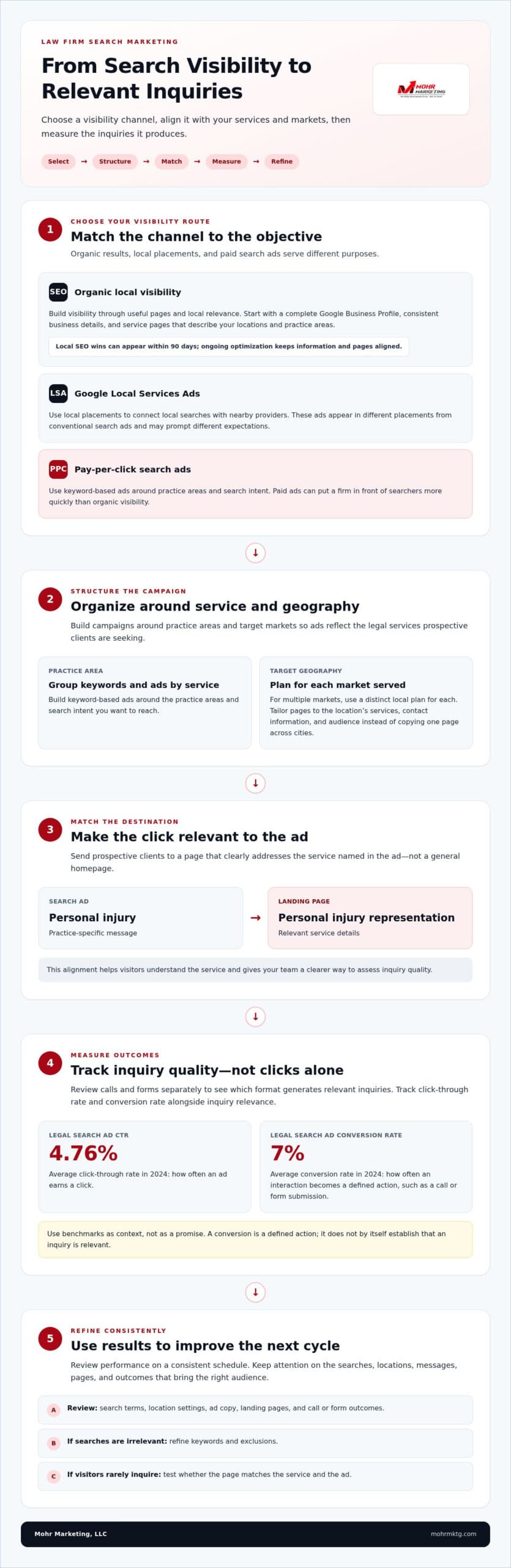
Law firms can build visibility through organic results, Google Local Services Ads, and pay-per-click search ads. These options serve different purposes. SEO develops visibility through useful pages and local relevance. Paid ads can put a firm in front of searchers more quickly, while Local Services Ads connect local searches with nearby providers. Choose based on your audience, target market, and campaign objective.
In a PPC search campaign, your firm selects keywords, writes ads, sets targeting, and directs clicks to relevant pages. For example, a personal injury ad should lead to a page about personal injury representation, not a general homepage. This alignment helps visitors understand the service and gives your team a clearer way to assess inquiry quality.
Local Services Ads and conventional search ads are not interchangeable. They appear in different placements and may prompt different expectations. Match each format to a specific task: use local placements to reach people seeking nearby help, and build keyword-based ads around practice areas and search intent. Review calls and forms separately to see which generates relevant inquiries.
Organic local SEO supports visibility in Google’s local results and Map Pack. Start with a complete Google Business Profile, consistent business details, and service pages that clearly describe the firm’s locations and practice areas. Then maintain accurate local listings and publish useful content tied to the community. Local SEO wins can appear within 90 days, though ongoing optimization keeps information and pages aligned.
If your firm serves multiple markets, build a distinct local plan for each. A national strategy can set shared messaging, tracking, and quality standards, while local execution reflects each office’s services and coverage. Avoid copying one location page across every city. Tailor each page with relevant service details, local contact information, and content suited to its audience.
Use performance benchmarks as context, not as a promise. Legal search ads averaged a 4.76% click-through rate and a 7% conversion rate in 2024. Click-through rate measures how often an ad earns a click; conversion rate measures how often an interaction becomes a defined action, such as a call or form submission. Track both alongside inquiry relevance.
Make optimization ongoing. Review search terms, location settings, ad copy, landing pages, and call or form outcomes on a consistent schedule. If a campaign attracts irrelevant searches, refine its keywords and exclusions. If visitors reach a page but rarely inquire, test whether it clearly explains the service and next step.
Firms weighing paid search against local visibility can map each channel to its target market and intake process. To discuss campaign priorities, share your search marketing goals.
Campaign structure by practice area and geography
Separate campaigns by legal service and target market so budgets, messaging, and results remain clear. For example, a personal injury campaign should not share an undifferentiated structure with family law.
Google Ads and PPC Management
Google Ads management covers campaign settings, keyword selection, ad copy, landing pages, and ongoing optimization. Pay-per-click campaigns charge for clicks, so your reporting should connect spend to calls, forms, and qualified consultations. Review search terms and location settings regularly. A useful manager explains what changed, why, and how the change affected performance.
Keywords for Search Ads
Target search terms that reflect a potential client’s legal need and location. Examples include “personal injury lawyer” paired with a city or “car accident attorney” paired with a nearby community. Add terms for relevant case types and exclude searches that do not match your services. Compare search-term reports with actual inquiries, then refine your keyword list around qualified demand.
Build the account around your firm’s actual structure. Create distinct campaigns for practice areas, then separate ad groups by closely related services or search intent. If your firm serves several locations, use geographic settings and landing pages that match each office’s coverage. This makes it easier to control budgets and identify which market or service generates relevant inquiries.
Set goals before launch. Choose a meaningful action, such as a completed inquiry form or a call connected to the right practice area. Track that action alongside clicks and traffic. Then assess lead quality through intake: record whether each inquiry fits your criteria and advances to a consultation. This connects advertising activity to business outcomes.
Use a consistent naming system for campaigns, ad groups, locations, and sources. For example, a label can identify both “personal injury” and the target city, making reports easier to interpret. Compare results by practice area and geography, not only at the account level. You can then focus on campaigns producing relevant opportunities and revise those attracting mismatched searches.
Plan for an optimization period. The first 30 days of a PPC campaign focus on gathering data and refining performance. A campaign may develop a consistent flow of qualified leads within 30-60 days after launch as optimization continues. Use this timeline to assess search terms, ad relevance, landing-page engagement, and inquiry quality rather than judging success by early clicks alone.
Organic search and paid campaigns can support different goals. Keep their reporting distinct while using shared insights about practice-area demand and geography. Search-term reports, consultation outcomes, and location trends can help you decide what to test next.
Google Ads and Microsoft Advertising
Google Ads and Microsoft Advertising let law firms compete for paid search visibility. Each platform needs a clear practice-area focus, relevant keywords, and a defined action to measure. For example, a personal injury campaign can target people seeking legal help after an accident and direct them to a matching page.
Legal search advertising must follow platform policies and applicable state bar rules. Requirements vary by state, so build compliance review into campaign approval. Check ad text and landing pages for accurate descriptions of your services, and avoid claims that could mislead prospective clients.
Start campaign planning with search intent. “Car accident attorney” signals a different need from “how to file an insurance claim.” Group keywords by practice area and intent, then write ad copy that accurately reflects the service page. Review actual search terms to identify irrelevant traffic and refine targeting.
Assess Google Ads and Microsoft Advertising separately rather than assuming they perform identically. Their audiences, search-term patterns, and results can differ. If you advertise on both platforms, use distinct tracking and reporting to see which source generates relevant calls or forms. Compare inquiry quality, not just click volume.
Set a budget around your firm’s capacity to respond to inquiries and handle potential matters. Allocate spending by practice area and geography, then monitor how each campaign uses its budget. If a location produces irrelevant traffic, refine its targeting. If a service attracts qualified inquiries, consider whether it warrants more investment.
Technical setup affects the quality of your performance data. Configure conversion tracking for meaningful actions, such as completed forms or calls, and test each event before launch. Confirm that ad clicks lead to functional pages on mobile and desktop. Without accurate tracking, reports may show visits but obscure which campaigns produce real inquiries.
Use a deliberate optimization cycle. Review keyword performance, search terms, ad relevance, landing-page behavior, and recorded inquiries. Where practical, change one meaningful element at a time, then compare results over a consistent review period. This helps distinguish genuine improvement from normal variation in campaign activity.
DIY management can work when someone has time to review campaigns, maintain tracking, and make informed adjustments. Hiring support may suit firms that lack those resources or need help coordinating platform setup, technical measurement, and advertising compliance. Either way, require reporting that connects each campaign to its practice area, location, and inquiry outcomes.
What search engine marketing means for law firms
For attorneys, Google Ads places paid listings in front of people searching for legal services. Your firm selects keywords, defines its target audience, writes ads, and directs clicks to a relevant page. The goal is to turn search intent into a meaningful action, such as a call or inquiry.
Search engine marketing has more than one common meaning. Some use it to mean paid search advertising; others include search engine optimization and social media marketing. For law firms, it is useful to treat SEM as the broader strategy, then measure paid and organic activity separately. That distinction clarifies which work builds long-term visibility and which buys ad placement.
Search engines matter during legal research. In the United States, 64% of consumers turned to search engines such as Google for help finding legal information in 2021. A practical plan maps the client journey: identify the question being searched, provide a relevant page, and make the next step clear. This connects visibility with conversion.
Search engine optimization strengthens unpaid visibility by improving site structure and creating useful pages. For example, an estate planning page can explain your services and answer common planning questions. Local SEO adds location relevance through accurate business details and pages for your service areas. These efforts help people find your firm without relying solely on advertising.
Paid search works differently. Google Ads can place an advertisement in search results for selected keywords, with campaign settings guiding where and when it appears. You can direct someone searching for a specific legal service to a matching page. Track calls and forms to see whether clicks produce relevant inquiries.
Do not measure SEM by traffic alone. Separate organic visits from paid clicks, then track which pages or campaigns lead to inquiries and consultations. If a practice-area page attracts visitors but few inquiries, review its relevance, clarity, and next step. If an ad generates mismatched requests, revisit its keywords and targeting.
The central takeaway is operational: treat SEM as a coordinated system, not a single advertising tactic. Set a goal for each channel, connect it to a specific audience and page, and review outcomes consistently. This helps your firm allocate effort among organic visibility, local SEO, and paid search based on the role each plays.
Mohr Marketing: Personal Injury Leads
Mohr Marketing, LLC supports law firms that need personal injury or motor vehicle accident (MVA) leads alongside their own search campaigns. These leads can complement attorney search engine marketing when your firm wants additional opportunities beyond paid search.
If your firm wants to move inquiries efficiently through intake, Mohr Marketing, LLC’s Legal Intake Services can support that process. Signed Retainers are also available for firms seeking signed cases rather than leads. The right fit depends on whether your priority is generating inquiries, managing intake, or receiving signed retainers.
Contact Mohr Marketing, LLC to discuss which option fits your firm’s needs.
Make the Next Marketing Decision Count
The right operating model is one your firm can manage consistently. Define a target practice and market, assign responsibility for campaign changes, and connect inquiry tracking to intake outcomes. For attorney search engine marketing, the DIY-versus-support decision comes down to capacity and execution. If your staff can review performance, refine campaigns, and follow inquiries through intake, in-house management may fit. If those tasks compete with casework, outside support may help fill the gap.
Mohr Marketing offers Mass Tort Leads, Personal Injury Leads, and Motor Vehicle Accident (MVA) Leads. These options can suit firms seeking additional case opportunities alongside their advertising efforts. Consider which practice areas your firm is prepared to serve, how inquiries will be handled, and what role additional leads could play in your growth plan.
Choose a next step that matches your firm’s priorities and operating capacity. A focused plan gives your team clear direction and a practical way forward.
Build deliberately, measure what matters, and keep your growth strategy moving.
Frequently Asked Questions
Can I Do Google Ads for My Law Firm Myself?
Yes, you can manage Google Ads yourself if you can maintain the account and assess its results. Before launch, confirm billing access, set up conversion tracking, and review every landing page on mobile and desktop. Set aside time for regular search-term reviews and ad adjustments. If campaign administration starts displacing intake or casework, compare the value of that time with the cost of outside management.
How Long Until I See Results from a PPC Campaign?
A PPC campaign can generate calls within days, while consistent qualified lead flow may take 30-60 days after launch as optimization continues. Early calls are not the same as qualified opportunities. Track when each inquiry arrives, whether it matches the firm’s case criteria, and whether it progresses to a consultation. That distinction helps separate initial activity from campaign performance that supports the firm’s goals.
How Much Should a Law Firm Budget for SEM?
Set an SEM budget based on your firm’s growth goals, target practice areas, geographic reach, and capacity to handle new inquiries. Start with a defined test budget, then use qualified-inquiry data to guide future spending.
What Is Search Engine Marketing for Attorneys?
Search engine marketing for attorneys means gaining visibility through search engines, particularly with paid search advertising and, in broader usage, organic SEO. A firm might run an ad for a specific service while developing useful pages that answer related legal questions. Treat each channel as a distinct source, then assess how it contributes to relevant inquiries and consultations.
How Much Does Attorney Search Engine Marketing Cost?
Costs depend on the services included, campaign scope, target practice areas, geography, and keyword competition. Paid media and professional management are separate budget considerations. Pricing depends on the scope of work and is provided after a quote request. Cost factors include platforms, campaign complexity, and the level of management. Avoid comparing proposals by total cost alone; review the work and reporting each includes.
What Is the Difference Between SEO and PPC for Law Firms?
SEO focuses on improving your firm’s unpaid search visibility through site structure, content, and relevance. PPC places paid ads for selected searches, with costs tied to ad interactions. For example, you can build an informational page for estate planning while running paid ads for a particular service. Compare each channel by its purpose, audience, and contribution to qualified consultations.
How Can Law Firms Measure Search Marketing ROI and Track Leads?
Connect campaign sources to inquiry and case outcomes. Use call and form tracking, record the practice area and source for each inquiry, and document whether it becomes a consultation or signed matter. Calculate ROI by comparing attributed case revenue with advertising and management costs. Review attribution carefully, since a prospective client may interact with several channels before contacting your firm.

Recent Posts
- Attorney Search Engine Marketing: Do It Yourself or Hire Help
- Improving Law Firm Marketing ROI: A Practical Measurement Framework
- 4 Ways to Assess Unqualified Legal Leads and Their Costs
Categories
- AI and Lead Generation
- Business Financing
- Call Verified MVA Leads
- Car Accident Help
- Car Accident Settlements
- Claimant Funding
- Compliance Program
- EMS-EMT Reports
- Geotargeting
- Google Maps Ranking
- Healthcare Practice Growth
- Law Firm Growth
- Law Office Operations
- Lead Generation
- Lead Generation For Attorneys
- Lead Generation For Chiropractors
- Lead Generation For Criminal Attorneys
- Lead Generation For D&A Treatment Centers
- Lead Generation For DUI Attorneys
- Lead Generation For Eye Doctors
- Lead Generation For Family Law Practices
- Lead Generation For PI Law Firms
- Lead Generation For Plastic Surgeons
- Leads For Healthcare Professionals
- Leads For Insurance Industry
- Legal Leads
- Legal Marketing
- Legal Updates
- Mass Tort Leads
- Medicare and Medicaid Leads
- Merchant Funding Leads
- Mold Leads
- Online Marketing Strategies
- Pre-Settlement Funding
- Signed MVA Cases
- Tort Updates
- Truck Accident Leads and Signed Cases
- Truck Accident Settlements
- Web Design