Real-Time Legal Leads: How to Evaluate Speed, Quality, and Fit in 2026
October 18, 2026 by Mohr Marketing
A lead captured in real time can still arrive too late to matter. The value of real time legal leads depends on the full path from a prospect’s search to delivery your intake team can act on. “Real time” may describe when an inquiry is captured, when it reaches your firm, or a live-call transfer. Those are different models, each with different demands on your team.
Speed matters, but it does not replace fit. Firms also need to understand how inquiries are screened, what consent records accompany them, and how fraud is filtered. Without those details, fast delivery can still create intake friction or leave important questions unanswered.
This guide explains how real-time web inquiries differ from live-call transfers and signed retainers. It also provides a practical framework for assessing delivery timing, qualification, consent documentation, fraud screening, and operational fit. Use it to determine whether a lead is not only timely, but actionable within your firm’s intake process.
Key Takeaways
- Real time legal leads can refer to different points between a prospect’s search and your firm’s follow-up, so define what “real time” means for each delivery model.
- Compare web inquiries, live-call transfers, and signed retainers by what your firm receives and the intake work each requires.
- Set campaign-specific qualification criteria before assessing verification, consent documentation, fraud screening, and performance.
- Match lead delivery to your firm’s intake capacity, with a clear owner for review and follow-up.
- Mohr Marketing’s AI WebTracker® captures high-intent prospects at the moment of search. Every delivery includes Scammer Scrub™ fraud filtering, and leads include signed retainers and police-report verification.
What Are Real-Time Legal Leads, and What Does “Real-Time” Actually Mean?
Real-time legal leads are prospect inquiries captured and routed while the prospect’s intent is active. To assess what “real time” means in practice, identify the event being measured. A person may search for legal information, respond to a campaign, submit an inquiry, and then have that information delivered to a firm. These are separate stages, and time can pass between them.
The broader idea of real-time data is information made available as events occur or shortly afterward. What is Real-Time Data? provides a general overview. In legal lead generation, the phrase describes a timing process. It does not establish that an inquiry is qualified, verified, or valuable to a particular case.
Real-time lead delivery means an inquiry is routed promptly; it does not guarantee a signed case. Qualification depends on the firm’s criteria and review. Case value depends on facts that a timing label alone cannot establish.
Real-time capture, delivery, and follow-up are different stages
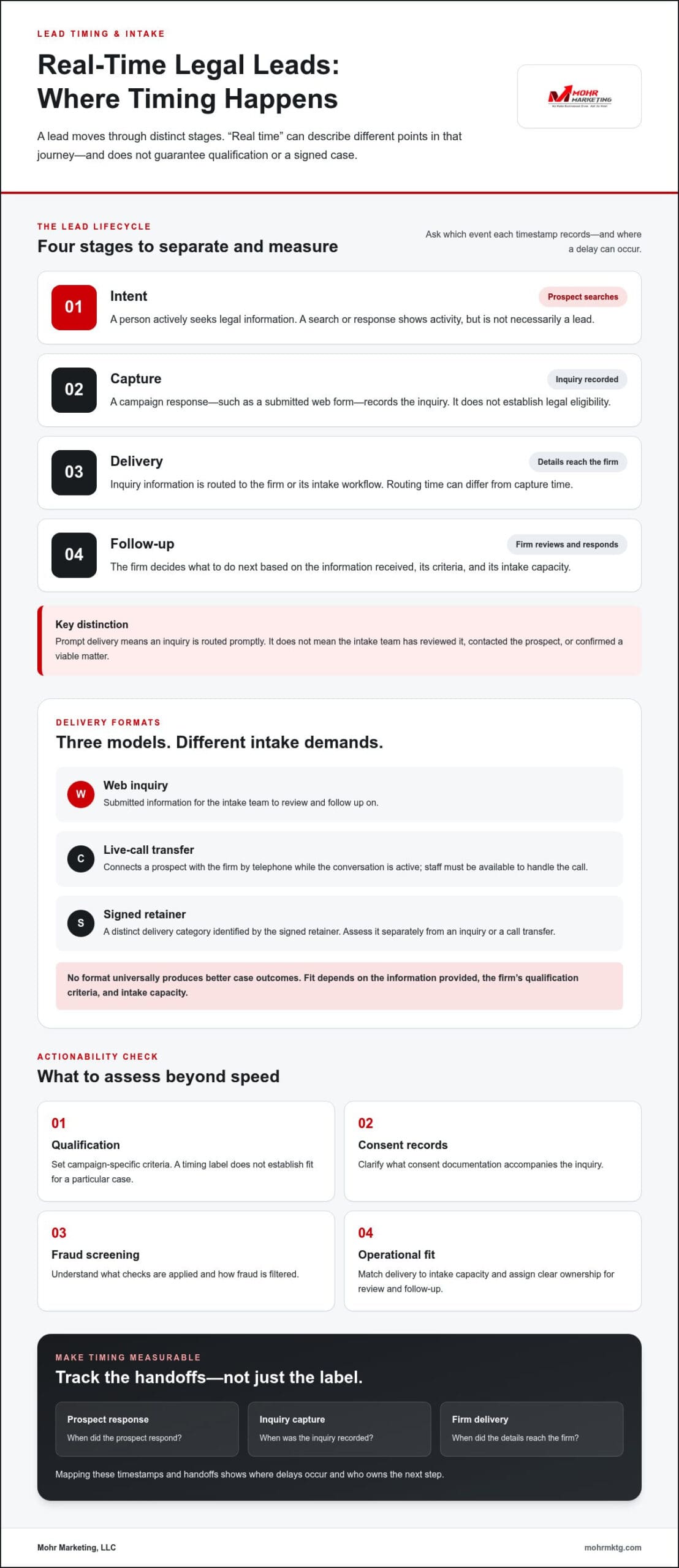
Separate the steps to understand where timing matters. Intent is when someone actively seeks legal information. A search or response shows activity, but is not necessarily a lead. Capture occurs when an inquiry is recorded through a campaign, such as a submitted web form. Delivery is when the inquiry details reach the firm or its intake workflow. Follow-up is the firm’s next action, such as reviewing the details and deciding how to respond.
For example, a prospect may submit an inquiry while searching for help, but a routing delay can mean the firm receives it later. Quick delivery also does not mean the intake team has reviewed or contacted the prospect. When evaluating a process, clarify which timestamp marks the prospect’s response, which marks capture, and which records delivery. This makes “real time” measurable and helps show where delays occur.
Real-time legal leads are not always live calls
A web inquiry typically arrives as submitted information for the intake team to review and follow up on. A live-call transfer connects a prospect with the firm by telephone while the conversation is active. The first format requires a process for reviewing and responding to inquiry details; the second requires staff available to receive and handle a call. Neither format universally produces better case outcomes. The right fit depends on the information provided, the firm’s qualification criteria, and its intake capacity.
Campaign design can specify both the case type and the contact path. For instance, a firm assessing truck accident signed cases and verified call transfer leads should distinguish the case information it needs from the call-handling workflow. That clarity helps the firm evaluate whether a delivery format fits its intake operation, rather than treating “real time” as a complete measure of quality.
How Real-Time Legal Leads Move from Search Intent to Firm Intake
Speed is one part of a lead’s path. To evaluate real time legal leads, map the steps from a prospect’s active search through campaign response, screening, routing, and firm follow-up. Each stage has a distinct purpose. Capture records the inquiry; screening checks defined information; routing moves details into the firm’s intake process. None of these steps, by itself, determines whether the prospect has a viable legal matter.
Real-time data is generally associated with information processed as it becomes available. The Real-Time Data Explained by IBM overview offers useful context. For lead generation, the practical question is where timing is measured and what happens between each stage.
From active search to a captured inquiry
The process begins with intent: a person is actively seeking information about a legal issue. Relevant advertising can give that person a response path, such as submitting an inquiry. That response signals interest, but does not establish legal eligibility. Mohr Marketing’s AI WebTracker® captures high-intent prospects at the moment of search, connecting search activity to a recorded inquiry.
Use this stage to assess whether the campaign messaging and qualification criteria align. A person who responds to information about a specific matter may still provide too little detail for the firm to evaluate fit. The campaign response starts the intake process; it does not resolve the firm’s review.
Screening, routing, and the firm’s next action
Screening and documentation can make an inquiry more actionable. Review what information is checked, how fraud screening is applied, and what consent documentation accompanies the inquiry. Mohr Marketing applies Scammer Scrub™ fraud filtering to every delivery. Screening supports campaign quality, but it is not a legal assessment of a claimant’s circumstances.
Routing sends the inquiry details to the firm or its intake workflow. The firm then determines the next step based on the information received, its campaign criteria, and its intake capacity. Intake staff can gather or review relevant details; counsel determines whether a matter fits the firm’s legal criteria.
The lead lifecycle moves an inquiry from active intent to firm review; it does not promise a conversion. To understand how the process works in practice, map who receives each delivery, what information is available at that point, and who owns follow-up. These handoffs help reveal whether delays occur during capture, screening, routing, or the firm’s own intake process.
For a campaign-specific discussion of capture, screening, and intake alignment, connect with Mohr Marketing.
Real-Time Legal Leads Compared: Web Inquiries, Live Transfers, and Signed Retainers
These formats represent different points in a firm’s intake process. A web inquiry is information submitted for follow-up. A live-call transfer connects a prospect directly with intake. A signed retainer represents a later acquisition stage, not simply another way to deliver an inquiry. Compare them by what the firm receives and what its team must do next.
| Format | Contact format | Information received | Intake action | Operational demands |
|---|---|---|---|---|
| Web inquiry | Submitted form or online response | Details the prospect provided | Review information and follow up | Capacity to manage queued inquiries and outreach |
| Live-call transfer | Prospect connected by telephone | Conversation begins in real time | Speak with the prospect and gather relevant details | Staff availability and call-handling readiness |
| Signed retainer | Acquisition-stage documentation | A signed retainer, rather than only an initial inquiry | Review the documentation within the firm’s process | Processes for reviewing and handling signed documentation |
Web inquiries versus live-call transfers
A web inquiry supports asynchronous follow-up: the firm receives submitted details and contacts the prospect through its intake workflow. A live transfer calls for an immediate conversation, so staff must be ready to answer, listen, and record information while the prospect is connected. Neither format is inherently superior. Match the contact path to your staffing, call-handling capacity, and ability to follow up consistently.
Contact format alone does not establish claim merit or case value. A call may allow a conversation to begin sooner, while a form may provide details for an initial review. In either case, the firm must assess the information against its own criteria. For motor vehicle accident campaigns, police-report-backed MVA cases illustrate how supporting documentation can be a distinct quality consideration, separate from whether the initial contact came by phone or web.
Lead inquiries versus signed retainer acquisition
An inquiry gives the firm a prospect’s submitted information or an opportunity to begin a conversation. A signed retainer is a different deliverable: Mohr Marketing offers signed retainers, including mass tort signed cases. This distinction affects what the firm needs to review and how its intake process handles the matter. A signed retainer does not guarantee a particular case outcome, and the firm remains responsible for its own assessment.
Use the table to identify the operational fit. Determine whether your team can manage web follow-up, receive live calls, or process signed documentation within its existing workflow. Real time legal leads describe timing, while the delivery format and acquisition stage determine what your intake team receives.
How to Evaluate Real-Time Legal Leads Before Scaling a Campaign
Assess a campaign against defined criteria before increasing its reach. Otherwise, quick delivery or a high inquiry count can look like success even when prospects do not match the firm’s needs. A disciplined review separates qualification, verification, consent records, delivery, and outcomes. It also clarifies which parts the campaign supports and which decisions remain with the firm.
Set qualification and verification requirements
Begin with the case criteria. Specify the matter details your intake team needs and any conditions that would make an inquiry unsuitable for the campaign. Requirements should reflect the practice area rather than a generic definition of a “good lead.” For motor vehicle accident matters, police-report verification may be relevant; it should not be treated as a universal requirement for unrelated case types.
Then assess how identity review, fraud screening, and qualification are handled before delivery. Identify what each check establishes, what information is documented, and what still requires review by the firm. Fraud screening can help flag suspect submissions, but it does not determine whether a person’s matter meets legal criteria. Mohr Marketing applies Scammer Scrub™ fraud filtering to every delivery, while firms retain responsibility for evaluating matters and their advertising compliance.
Review consent and delivery records
Make consent documentation part of the campaign review, not an afterthought. Record what evidence is provided with an inquiry and how it is associated with the campaign source. Documentation may use third-party tools such as TrustedForm or Jornaya. Review those records in light of your firm’s practices and obtain your own legal counsel on compliance questions. Campaign processes can support compliance; they do not replace the firm’s legal review or responsibilities.
For relevant motor vehicle accident campaigns, police-report-backed MVA cases illustrate why verification should match the case type. Focus on what the supporting record establishes and how it fits the firm’s intake review, rather than treating a document as a substitute for evaluating the matter.
Measure intake performance without confusing speed and quality
Track performance in separate categories. This helps distinguish delivery mechanics from prospect fit and downstream progress.
- Qualification criteria: Record whether inquiries meet the campaign’s defined requirements and why they do not when they fall outside them.
- Verification and consent: Review the screening outcome, available documentation, and campaign source associated with each inquiry.
- Delivery and follow-up: Track when an inquiry is routed, when the firm attempts contact, and whether follow-up was completed.
- Intake outcome: Record qualification decisions and signed-retainer status as distinct outcomes.
- Campaign review: Compare the full set of measures before scaling, then refine criteria or intake steps where patterns emerge.
Fast delivery and inquiry volume are operational measures, not proof of profitability. Evaluate them alongside qualification outcomes and signed-retainer status. This gives the firm a grounded basis for deciding whether a campaign fits its intake workflow and merits expansion.
For a practical discussion of campaign criteria and lead evaluation, contact Mohr Marketing.
How Mohr Marketing Connects Real-Time Intent with Direct-to-Firm Acquisition
For firms evaluating real time legal leads, the key is how active search intent becomes an inquiry the firm can review and act on. Mohr Marketing’s AI WebTracker® captures high-intent prospects at the moment of search. Its direct-to-firm approach routes acquisition to the law firm without reseller markup. Capture connects campaign activity to the firm’s intake process, but does not establish case fit or guarantee an outcome.
A direct-to-firm model built around screening
Direct-to-firm delivery focuses the acquisition path on the law firm receiving the inquiry. Mohr Marketing applies Scammer Scrub™ fraud filtering to every delivery. Its lead offerings include signed retainers and police-report-verified motor vehicle accident leads. These features support screening and documentation, but do not replace the firm’s review of a prospect’s circumstances.
Mohr Marketing has served law firms for more than 30 years, since 1994, and reports serving thousands of firms. Its built-in State Bar and UCPMP compliance supports campaign operations. It does not transfer responsibility for advertising decisions away from the law firm. Firms remain responsible for their own compliance and should obtain their own legal counsel.
That distinction matters. A provider’s screening and documentation can support a more structured intake process, but the firm must still assess the information it receives, determine whether the matter meets its criteria, and decide how to proceed. No lead-generation process can promise a signed case, revenue, or a particular campaign result.
A practical next step for evaluating fit
Before discussing campaign structure, prepare a clear outline of the firm’s practice area, qualification criteria, and intake capacity. Identify the matter details your team needs, the records relevant to screening, and who will review and follow up on inquiries. This gives the discussion a practical foundation and helps align the campaign with the firm’s workflow rather than a generic volume target.
Mohr Marketing delivers proposals in one business day. A discussion can address campaign structure, creative, and how acquisition fits the firm’s intake process. Use those details to assess whether the proposed approach aligns with your criteria and operational capacity. Real-time capture is one part of the process; screening, documentation, and firm review determine how an inquiry moves forward.
To discuss your firm’s lead acquisition needs, contact Mohr Marketing.
Turn Lead Evaluation Into an Intake Advantage
Treat acquisition as an operating process, not a standalone marketing metric. Build a feedback loop between campaign activity and intake: use what your team learns from inquiries to refine qualification criteria, clarify handoffs, and improve follow-up. That discipline helps your firm make decisions based on its own intake evidence rather than assuming that speed alone signals performance.
For firms considering real time legal leads, define the next step before expanding a campaign. Identify the practice area to prioritize, agree on what qualifies as a relevant inquiry, and assign ownership for reviewing outcomes. Set a regular review cadence so campaign decisions reflect what intake staff are seeing and recording. Clear expectations give your team a stronger basis for assessing fit and adjusting its approach.
A focused process helps your firm pursue growth with greater clarity. Start with the criteria that matter to your team, and build from there.
Frequently Asked Questions
Is “real-time” a standardized delivery-time guarantee for legal leads?
No. “Real-time” describes speed, but it does not establish a universal delivery threshold or guarantee a particular result. For real time legal leads, identify whether campaign reporting measures prospect capture, routing to the firm, or the firm’s intake response. Ask which timestamp starts the delivery measure and which marks the firm’s follow-up responsibility. Clear definitions make campaign reports easier to interpret and compare.
What information should a real-time legal lead include?
Useful information depends on the practice area and the firm’s qualification criteria. A campaign may capture contact details, the prospect’s stated issue, and consent documentation. Before launch, decide which fields intake staff need for an initial review, such as the matter type or relevant incident details. Keep required fields focused: more information does not automatically establish legal viability, and the firm must still assess the matter.
Can real-time lead generation support mass tort campaigns?
Yes. Campaigns can be structured for mass tort matters when the firm defines the relevant criteria and intake steps in advance. Specify what information intake staff need to identify a potential match to the campaign, then establish how the team will review and route inquiries. Mohr Marketing offers Mass Tort Acquisition and signed-case services. The firm retains responsibility for legal review and decisions about accepting a case.
What happens if a delivered inquiry appears fraudulent or does not meet criteria?
Record why the inquiry was flagged, preserve its available documentation, and compare it with the campaign’s agreed criteria. Consistent categorization helps distinguish suspected fraud from an inquiry that is simply outside the firm’s target. Mohr Marketing applies Scammer Scrub™ to every delivery, but screening cannot guarantee that every inquiry will become a case. Review flagged records as part of ongoing campaign quality checks.
Can real-time legal leads guarantee signed cases or revenue?
No. A lead should not be treated as a guarantee of signed cases, revenue, volume, or another business result unless a signed written agreement expressly says otherwise. Outcomes depend on factors including prospect decisions, matter eligibility, firm capacity, and legal evaluation. Use campaign reporting to understand what happened at each stage, then compare those operational results with your firm’s objectives. Past inquiry activity can inform decisions, but it does not promise future performance.
How should a firm document consent for legal marketing inquiries?
Preserve consent records with enough campaign context for your team to review the inquiry and its source. Third-party tools such as TrustedForm and Jornaya can document consent. Establish who can access the records and how they are reviewed alongside intake information. Applicable considerations depend on the campaign and communications involved, so firms should obtain their own legal counsel rather than treating documentation tools as a compliance determination.
How much do real-time legal leads cost?
There is no universal price for legal lead programs. Commercial terms can vary with campaign structure, practice area, volume, and qualification requirements. Compare proposals by the deliverable, verification and documentation provided, and how performance is measured, rather than relying on a general market estimate. Mohr Marketing tailors proposals to a firm’s campaign needs. Evaluate the expected workflow and fit alongside the commercial terms before deciding how to proceed.
Are real-time legal leads suitable for a firm without round-the-clock intake?
They may suit a firm with defined coverage and follow-up procedures, even if intake is not staffed around the clock. Map when inquiries can arrive, who reviews them, and what happens outside staffed hours. Then monitor whether handoffs are completed and how inquiries perform against qualification criteria. A clear process helps the firm assess its actual capacity before scaling. Fast delivery does not remove the need for timely, consistent intake.

Recent Posts
- Real-Time Legal Leads: How to Evaluate Speed, Quality, and Fit in 2026
- Commercial Vehicle Accident Client Acquisition: A Law Firm’s 2026 Guide
- Mass Tort Claimant Acquisition: A Practical Framework for Law Firms
Categories
- AI and Lead Generation
- Business Financing
- Call Verified MVA Leads
- Car Accident Help
- Car Accident Settlements
- Claimant Funding
- Compliance Program
- EMS-EMT Reports
- Geotargeting
- Google Maps Ranking
- Healthcare Practice Growth
- Law Firm Growth
- Law Office Operations
- Lead Generation
- Lead Generation For Attorneys
- Lead Generation For Chiropractors
- Lead Generation For Criminal Attorneys
- Lead Generation For D&A Treatment Centers
- Lead Generation For DUI Attorneys
- Lead Generation For Eye Doctors
- Lead Generation For Family Law Practices
- Lead Generation For PI Law Firms
- Lead Generation For Plastic Surgeons
- Leads For Healthcare Professionals
- Leads For Insurance Industry
- Legal Leads
- Legal Marketing
- Legal Updates
- Mass Tort Leads
- Medicare and Medicaid Leads
- Merchant Funding Leads
- Mold Leads
- Online Marketing Strategies
- Pre-Settlement Funding
- Signed MVA Cases
- Tort Updates
- Truck Accident Leads and Signed Cases
- Truck Accident Settlements
- Web Design