How to Reduce Client Acquisition Cost for Law Firms Without Sacrificing Case Quality
October 14, 2026 by Mohr Marketing
Reducing client acquisition cost for law firms starts with measuring the full path from marketing spend to signed clients, not simply cutting the budget. Lower ad spend may look like progress, but it can also reduce qualified opportunities while leaving costly intake bottlenecks untouched.
It is difficult to connect marketing spend to signed clients when reports focus only on leads. The picture is less complete still when staff time, software, and follow-up effort are excluded. A low cost per lead can become a high cost per signed case if inquiries do not fit the firm’s criteria or are not converted effectively.
This guide explains how to calculate acquisition cost using the expenses and outcomes that matter to your firm. You will learn how to identify avoidable waste, assess conversion processes, and compare growth options without treating lead volume as a measure of case quality. It also covers how managed digital marketing, lead delivery, and legal intake support can fit different acquisition strategies, with attention to transparent measurement and compliance. The goal is not to spend less at any cost. It is to make each investment accountable to the cases your firm wants to sign.
Key Takeaways
- Set a clear acquisition outcome before calculating CAC, so lead costs and signed-client costs are not treated as interchangeable.
- Use a consistent method to capture expenses, attribute results, and allocate shared costs across channels.
- Compare SEO, paid search, social campaigns, managed marketing, and lead acquisition by more than price alone.
- When reducing client acquisition cost for law firms, look for tracking gaps and conversion bottlenecks before cutting investment.
- Choose an acquisition model that fits your reporting needs, intake capacity, and desired outcomes.
Reducing Client Acquisition Cost for Law Firms Starts with Defining the Real Cost
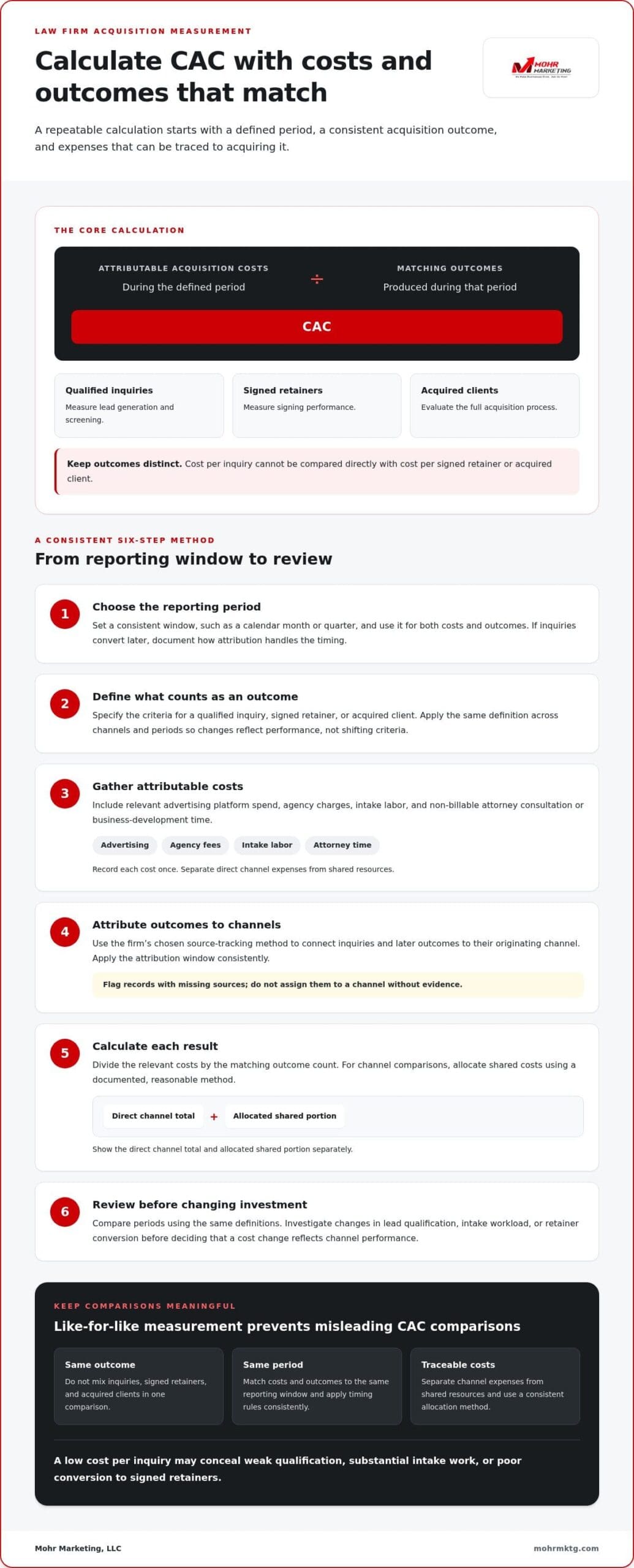
A CAC figure is useful only when the firm defines both what it spends and what counts as an acquisition. Client acquisition cost is the total attributable expense of acquiring clients, divided by the agreed acquisition outcome during a defined period. Change the expenses, the outcome, or the measurement period, and the result changes.
The basic concept is consistent with the broader explanation of Customer Acquisition Cost (CAC). For law firms, the denominator needs particular care: an inquiry is not automatically a qualified prospect, a signed retainer, or an acquired client. These milestones measure different points in the acquisition path. A report that divides costs by inquiries cannot be compared directly with one that divides them by signed retainers.
Choose the outcome before calculating law firm CAC
Decide what the calculation is meant to evaluate. Use inquiries to assess lead generation, qualified prospects to assess screening, signed retainers to assess signing performance, or acquired clients to evaluate the full acquisition process. Then apply the same definition across channels and reporting periods. If one campaign is measured by inquiries and another by retained clients, the figures do not show which channel acquires clients more efficiently.
Document the criteria for each stage. For example, define what makes an inquiry qualified and when a retainer counts as signed. This gives marketing, intake, and finance teams a shared basis for reviewing results. Firms assessing acquisition for high-value mold cases should also align the outcome with the case criteria they intend to pursue, as outlined in high-value mold case acquisition.
Count direct spend and the resources behind acquisition
Include costs that can reasonably be tied to acquiring the selected outcome. Depending on the firm’s process, these may include advertising, agency fees, intake labor, and attorney time spent on non-billable consultations or business development. Record channel-specific costs separately, then identify shared costs and apply a consistent allocation method. Do not assign general overhead to acquisition without a reasonable basis.
Include intake effort because inquiries require handling before they can become signed retainers or acquired clients. Track time spent on initial contact, qualification, follow-up, and scheduling when these activities are part of the acquisition process. This helps reveal whether an inexpensive inquiry creates substantial downstream work. It also connects marketing performance to legal intake ROI: intake value depends not only on inquiry volume, but also on how effectively the work advances suitable prospects toward the firm’s chosen outcome.
A low cost per inquiry can conceal weak qualification or poor conversion. If a channel generates many inquiries that rarely meet the firm’s criteria, its apparent efficiency may disappear when measured against signed retainers. Define the outcome first, count attributable resources consistently, and compare like with like. That discipline is the starting point for reducing client acquisition cost for law firms without cutting opportunities that produce quality cases.
How to Calculate Law Firm Client Acquisition Cost Step by Step
A useful CAC calculation is repeatable. It uses a defined period, a consistent outcome, and costs that can be traced to acquisition. This gives the firm a sound basis for comparing channels and identifying performance changes, rather than relying on a lead-cost figure alone.
CAC equals attributable acquisition costs divided by the acquired outcomes those costs produced during the same period. The outcome might be qualified inquiries, signed retainers, or acquired clients. Keep these measures separate. Tracking qualified inquiries alongside signed retainers shows where efficiency changes during qualification or conversion.
- Choose the reporting period. Set a consistent window, such as a calendar month or quarter, and use it for costs and outcomes. If there is a delay between the first inquiry and a signed retainer, document how your attribution process handles that timing.
- Define the outcome. Specify what counts as a qualified inquiry, signed retainer, or acquired client. Use the same definition across channels and periods so that changes in CAC reflect performance, not shifting criteria.
- Gather attributable costs. Collect advertising platform spend, agency charges, intake labor, and relevant non-billable attorney consultation or business-development time. Record each cost once and separate direct channel expenses from shared resources.
- Attribute outcomes to channels. Use the firm’s chosen source-tracking method to connect inquiries and later outcomes to the originating channel. Apply the same attribution window consistently. Flag records with missing sources rather than assigning them to a channel without evidence.
- Calculate each result. Divide the relevant costs by the matching outcome count. For channel comparisons, allocate shared costs using a documented, reasonable method, then show the direct channel total and allocated shared portion separately.
- Review the result. Compare the current figure with prior periods using the same definitions. Investigate changes in lead qualification, intake workload, or retainer conversion before deciding that a channel is performing better or worse.
Build a dataset you can trust
Reconcile invoices and platform reports with intake records and signed-retainer data. Where available, record the source, date, stage, and outcome for each inquiry. Note gaps, duplicates, and allocation assumptions. The Legal Marketing Association (LMA) offers a broader professional context for legal marketing, but your firm’s consistently tracked results should guide its CAC decisions.
Interpret CAC against your firm’s economics
A lower CAC is not automatically better. Compare it with the firm’s expected matter value and service-delivery economics, using the firm’s own assumptions. Review results by channel, practice area, and acquisition model when tracking supports a fair comparison. If a channel produces fewer inquiries but more qualified prospects or signed retainers, that difference should be visible in the outcome data.
Accurate measurement gives reducing client acquisition cost for law firms a practical starting point: identify which costs and process stages deserve attention before changing investment. To discuss a measurement approach aligned with your firm’s acquisition goals, discuss your firm’s acquisition goals.
Compare Law Firm Acquisition Channels by Cost, Quality, and Case Outcomes
Channel comparisons are useful only when they use the same outcome measure. Evaluate each source against qualified inquiries and signed retainers, then account for staff effort and the time required to produce results. A channel that generates inquiries quickly is not automatically more economical, and a slower channel is not automatically more valuable. The firm’s verified outcomes determine the economics.
| Channel | Cost structure | Time horizon | Measurement and intake considerations | Outcome quality to assess |
|---|---|---|---|---|
| SEO | Internal or external work, content, and related marketing expenses | Builds over time; results may not align with short reporting windows | Track inquiry source and later stages; ensure intake can handle organic inquiries | Qualification and signed-retainer rates by relevant topic and practice area |
| Paid search | Advertising spend plus campaign management where applicable | Can generate activity while campaigns run; evaluate outcomes over a consistent attribution period | Connect platform activity to qualified inquiries and signed retainers; plan for inquiry handling | Fit with the firm’s case criteria, not click or inquiry volume alone |
| Social campaigns | Campaign spend and creative or management resources | Depends on campaign goals and audience response | Track source through intake and qualification; account for follow-up workload | Whether inquiries meet the firm’s requirements and progress to its chosen outcome |
| Agency-managed marketing | Agency charges and campaign costs, with internal intake resources counted separately | Depends on the channel mix and campaign objectives | Review reporting access, attribution, and handoffs to intake | Evaluate verified outcomes alongside campaign activity |
| Lead acquisition | Payment may be tied to delivered leads or another defined outcome | Depends on delivery and the firm’s follow-up process | Clarify what is delivered and measured; ensure capacity for prompt, consistent intake | Assess qualification, case-criteria fit, and progression to signed retainers |
Separate lead cost from signed-case cost
A low cost per lead can look efficient even when few inquiries qualify or sign. Pay-per-lead typically ties payment to a delivered lead, while pay-per-signed-case ties it to the defined signed outcome. Managed marketing generally covers campaign work under an agreed service arrangement, so compare its total attributable costs with the results it supports. For practice-area context, review the mass tort signed-case model alongside the firm’s own tracked performance.
Personal injury acquisition also requires practice-area-specific evaluation. Assess how each source aligns with the firm’s case criteria, intake process, and signed-retainer outcomes rather than relying on broad channel assumptions.
Match channels to firm capacity
Before increasing volume, assess intake availability, practice-area focus, case criteria, and the team’s ability to respond and follow up. Internal teams may have direct control over execution, but they also need capacity for campaign management and lead handling. External support or lead acquisition can shift parts of that workload, while clear attribution and intake ownership remain essential. Compare each model using the same cost and outcome definitions. This makes reducing client acquisition cost for law firms a quality-focused decision, not simply a search for the lowest headline lead cost.
Reduce Client Acquisition Cost by Fixing Measurement and Conversion Leaks
Before reducing a channel’s budget, confirm that the data shows where acquisition is breaking down. Missing source attribution, duplicate inquiries, and inconsistent definitions can make a productive channel look weak or an inefficient one appear successful. Trace each inquiry from its first recorded source through qualification, intake, signed retainer, and acquired client. The stage where results drop points to a more specific problem than a high-level CAC figure alone.
CAC can improve through better conversion, not only lower spending. If suitable inquiries are being lost during follow-up or qualification, improving the process may increase signed outcomes without reducing qualified demand. Diagnose the leak before changing investment.
- Check source data. Identify inquiries without a recorded channel and investigate whether tracking gaps are concentrated in a particular source or intake path.
- Remove duplicates carefully. Establish how repeat inquiries are identified and counted. Otherwise, one prospect may inflate lead volume while outcomes remain unchanged.
- Standardize stages. Confirm that marketing and intake use consistent criteria for qualified inquiry, signed retainer, and acquired client.
- Review the full path. Compare the number of inquiries entering each stage with the number advancing. A sharp drop can direct attention to targeting, eligibility screening, follow-up coverage, or intake handling.
Find avoidable waste without cutting qualified demand
Review targeting and case criteria together. A campaign may attract inexpensive inquiries that consistently fall outside the firm’s focus, while a higher-cost source may produce stronger qualification or retainer results. Examine inquiry and signed-retainer trends before reallocating budget. Look for recurring low-value sources, gaps in follow-up coverage, or criteria that teams apply differently.
Protect sources that produce suitable opportunities while testing changes in a controlled, reversible way. Adjust one element at a time, such as targeting or qualification messaging, and keep the comparison period and success measure consistent. Avoid making a permanent budget decision based on a short-term fluctuation or incomplete outcome data.
Align marketing performance with intake operations
Marketing and intake should share definitions and a clear handoff. Review whether inquiries are handled consistently, qualification outcomes are recorded, and delays or missed follow-ups are affecting progression. Intake performance is part of acquisition economics, not a separate reporting issue. Firms examining operational conversion improvements can assess legal intake services ROI alongside channel results.
For each proposed change, document the problem, adjustment, review period, and outcome that will determine whether to continue. Compare qualified inquiries and signed retainers, then record the decision and its rationale. This creates a disciplined test rather than an untracked budget shift. Reducing client acquisition cost for law firms depends on preserving effective demand while correcting measurable waste.
Choose a Law Firm Acquisition Model That Supports Lower CAC
The right acquisition model depends on what the firm needs to control, which outcome it wants to measure, and how much work its team can absorb. Compare models by deliverable, payment trigger, reporting transparency, compliance process, and operational workload. Then assess results against the firm’s case criteria and economics. No model guarantees lower CAC or signed cases; performance must be measured against defined outcomes.
Select based on goals, capacity, and payment structure
Internal marketing may suit a firm with the staff and expertise to manage campaign strategy, execution, tracking, and follow-up. Managed digital marketing can fit a firm seeking external strategic execution and channel oversight while retaining visibility into performance. Pay-per-lead ties payment to defined lead delivery, while pay-per-signed-case ties it to the agreed signed-retainer outcome. Each structure changes what the firm pays for, not the need to assess quality.
Mohr Marketing provides managed digital marketing for campaign execution, lead delivery for verified inquiries, signed retainers tied to a signed-case outcome, and legal intake services to support inquiry handling. The appropriate fit depends on practice-area focus, case qualification requirements, internal intake capacity, and the firm’s preferred measurement point. A firm with limited follow-up capacity should address intake workload before increasing lead volume.
Before selecting a model, clarify what is delivered and when payment is triggered. Define how source, qualification, and outcome data will be reported. Review the compliance process and determine who owns each operational handoff. These points make models easier to compare without relying on a headline cost or assuming that a particular payment structure produces better cases.
Turn the measurement plan into a growth decision
Set the baseline before launch. Record current CAC, chosen outcome definitions, reporting cadence, and who is responsible for reviewing results. Keep definitions consistent across marketing and intake so the team can distinguish a change in lead volume from a change in qualification or signed-retainer performance.
As results accumulate, use transparent performance data to refine targeting, channel mix, and intake workflows. Review outcomes by practice area when tracking supports a fair comparison. If a model produces qualified inquiries but the firm lacks capacity to process them, resolve the workload constraint before expanding. If inquiry volume is strong but few prospects meet case criteria, revisit targeting and qualification alignment. This keeps reducing client acquisition cost for law firms tied to measurable improvement rather than indiscriminate spending cuts.
A clear model, shared outcome definitions, and consistent reporting give the firm a practical basis for deciding what to maintain, adjust, or scale. To discuss a client acquisition strategy with Mohr Marketing, discuss your firm’s acquisition goals.
Build the Next Stage of Firm Growth on Measurable Decisions
Turn acquisition data into a disciplined growth plan. Set a baseline, identify the outcome the firm values, and choose an approach that fits its practice focus and operational capacity. Then review performance consistently and adjust based on evidence. That is how reducing client acquisition cost for law firms can support growth without making case quality an afterthought.
Mohr Marketing brings more than 30 years of industry experience to legal marketing and lead generation. Its turnkey marketing and intake ecosystem supports firms seeking verified inquiries, signed retainers, or coordinated acquisition support, with national coverage. Results remain firm-specific, so evaluate each approach against the firm’s own criteria and measured outcomes.
For a measurable client acquisition strategy aligned with your firm’s goals, contact Mohr Marketing.
Frequently Asked Questions
What is client acquisition cost for a law firm?
Client acquisition cost, or CAC, measures the expense associated with securing a defined outcome, such as a signed retainer or new client. Its usefulness depends on what the firm counts as an acquisition. For example, comparing practice areas is more meaningful when each calculation uses the same outcome and reporting period. Use CAC as a firm-specific management measure, not as a standalone judgment about whether a campaign or case type is worthwhile.
How do you calculate client acquisition cost for a law firm?
Choose the outcome and period, collect costs tied to acquisition, and divide those costs by the matching outcomes recorded in that period. Keep separate calculations for inquiries, qualified prospects, signed retainers, and acquired clients. For example, if an inquiry arrives near the end of a reporting window but signs later, apply the firm’s documented attribution approach consistently rather than changing the reporting rule to fit the result.
What costs should law firms include when measuring CAC?
Include expenses that can reasonably be connected to acquiring the outcome being measured, such as campaign spending, agency charges, intake work, and relevant attorney time spent with prospective clients. Keep a record of how staff time is estimated, especially when employees support several functions. Avoid counting the same expense in both a channel total and a shared-cost allocation, and label excluded costs so comparisons remain clear.
Can a law firm reduce CAC without reducing its marketing budget?
Yes. A firm can reduce client acquisition cost by improving how existing investment turns into suitable signed matters. For instance, a campaign may reach the intended audience while inconsistent qualification or follow-up prevents appropriate prospects from advancing. Identify a specific bottleneck, test one operational or targeting adjustment, and monitor case fit as well as signed outcomes before shifting budget.
Is cost per lead the same as client acquisition cost?
No. Cost per lead measures spending against inquiries, while CAC uses a defined acquisition outcome, such as a signed retainer or acquired client. A channel can generate numerous inquiries but contribute few prospects that meet the firm’s criteria. Conversely, a smaller inquiry pool may include more suitable matters. Reviewing both measures helps distinguish whether a performance change comes from lead volume, qualification, or later conversion.
How often should a law firm review its client acquisition cost?
Review CAC on a schedule that fits campaign activity and the time prospects need to progress to the chosen outcome. A firm might review operational indicators more often than final acquisition results, but it should keep definitions and attribution consistent. If a reporting period contains incomplete outcomes, mark the figures as provisional and revisit them when the outcome data is more complete.
What happens if a firm’s CAC rises while lead volume stays steady?
Steady lead volume with rising CAC means the firm should investigate both costs and the path from inquiry to outcome. Check whether campaign expenses changed, then compare qualification and retainer progression by channel and practice area. A shift in case mix, intake handling, or attribution records may explain the change. Do not assume the channel itself has weakened until these factors have been reviewed.

Recent Posts
- How to Reduce Client Acquisition Cost for Law Firms Without Sacrificing Case Quality
- Generating Birth Injury Inquiries: A Guide for Law Firms
- Digital Retainer Signing Guide for Law Firms
Categories
- AI and Lead Generation
- Business Financing
- Call Verified MVA Leads
- Car Accident Help
- Car Accident Settlements
- Claimant Funding
- Compliance Program
- EMS-EMT Reports
- Geotargeting
- Google Maps Ranking
- Healthcare Practice Growth
- Law Firm Growth
- Law Office Operations
- Lead Generation
- Lead Generation For Attorneys
- Lead Generation For Chiropractors
- Lead Generation For Criminal Attorneys
- Lead Generation For D&A Treatment Centers
- Lead Generation For DUI Attorneys
- Lead Generation For Eye Doctors
- Lead Generation For Family Law Practices
- Lead Generation For PI Law Firms
- Lead Generation For Plastic Surgeons
- Leads For Healthcare Professionals
- Leads For Insurance Industry
- Legal Leads
- Legal Marketing
- Legal Updates
- Mass Tort Leads
- Medicare and Medicaid Leads
- Merchant Funding Leads
- Mold Leads
- Online Marketing Strategies
- Pre-Settlement Funding
- Signed MVA Cases
- Tort Updates
- Truck Accident Leads and Signed Cases
- Truck Accident Settlements
- Web Design