Medical Malpractice Leads: A Strategic Guide for Law Firms
October 8, 2026 by Mohr Marketing
A high volume of inquiries does not guarantee a strong malpractice caseload. Medical malpractice leads are useful when they align with your firm’s case criteria and your intake team can evaluate them effectively. In a complex practice area, an inquiry is only the start of a review, not a measure of legal merit.
Before comparing acquisition models, establish what a lead represents, how it is verified, and what qualification means. If those terms are unclear, lead counts can obscure whether prospects fit your strategy or what work your team must handle after delivery.
This guide explains how to assess medical malpractice inquiries against your firm’s criteria and compare acquisition models by their deliverables, verification, and operational role. It also shows how to connect marketing, intake, and case evaluation. Mohr Marketing brings more than 30 years of industry experience to legal lead generation and intake, helping firms distinguish a delivered inquiry from a fully executed retainer. The goal is a clearer acquisition strategy, with a firm distinction between a lead and legal representation.
Key Takeaways
- Map the path from audience intent to firm review so you can identify where inquiry quality and follow-up need attention.
- Assess medical malpractice leads against your firm’s practice focus and intake capacity, not volume alone.
- Compare inquiry delivery with signed-retainer delivery by the output received and the work your team must handle next.
- Set campaign criteria separately from the legal standards your firm uses to evaluate potential cases.
- Review acquisition outcomes across marketing and intake to guide future decisions about case acquisition.
What Medical Malpractice Leads Represent, and Why Case Fit Matters
A prospective claimant’s inquiry is not a case accepted by a law firm. It indicates that someone wants to discuss possible harm connected to healthcare. The inquiry may be relevant to your practice, but it does not establish negligence, prove a claim, or mean your firm has agreed to represent the person.
A medical malpractice lead is an inquiry from someone reporting possible harm involving healthcare, not a finding that malpractice occurred or that the matter has legal merit. This distinction keeps marketing metrics in context. Campaigns can attract and deliver prospective claimants; your firm evaluates the facts and decides whether a matter fits its criteria.
In a complex practice area, context is more useful than a high inquiry count. A short account of the care event, when it happened, and the reported impact can help intake staff understand what the person wants to discuss. Without that information, a large number of inquiries may say little about whether a campaign is reaching your intended audience.
What information gives a malpractice inquiry useful context?
Start with a neutral account of the alleged treatment or care event. The person might report a complication after a procedure, a delayed diagnosis, or a change in treatment they believe caused harm. An approximate timeline can help staff understand the sequence, including when care occurred and when the person noticed the reported impact. Available records and the person’s description of that impact provide context for review; neither, on its own, proves negligence. A general overview of What is Medical Malpractice? can help readers understand the broad category, but an individual inquiry still requires case-specific assessment.
Why does medical malpractice differ from general injury lead generation?
An accident may be described through an identifiable event, such as a collision at a particular time. A healthcare-related allegation can involve a sequence of decisions, treatment, symptoms, and later consequences. The person’s initial account may not capture the full context, so treat the inquiry as a starting point rather than a complete case summary.
The contrast is visible in event-based categories, including truck accident signed cases and verified call transfer leads, where an inquiry can center on a specific incident. Malpractice criteria also vary by firm, based on its practice focus and capacity to assess the matter. No allegation automatically qualifies. A campaign can attract relevant inquiries, but your firm’s legal review determines whether a particular matter meets its standards.
For acquisition decisions, define relevance before judging performance. Identify the information your intake team needs to understand an inquiry, then assess whether delivered prospects align with your firm’s focus. This separates marketing reach from legal evaluation and gives lead volume a more meaningful operational context.
How Medical Malpractice Leads Move from Search Intent to Firm Review
Each inquiry begins with an information need. A person may be researching a healthcare experience, looking for general information, or trying to speak with a law firm. These intentions are not interchangeable. Campaign design influences who sees a message, what expectations it sets, and whether someone chooses to submit an inquiry. The firm’s review follows delivery.
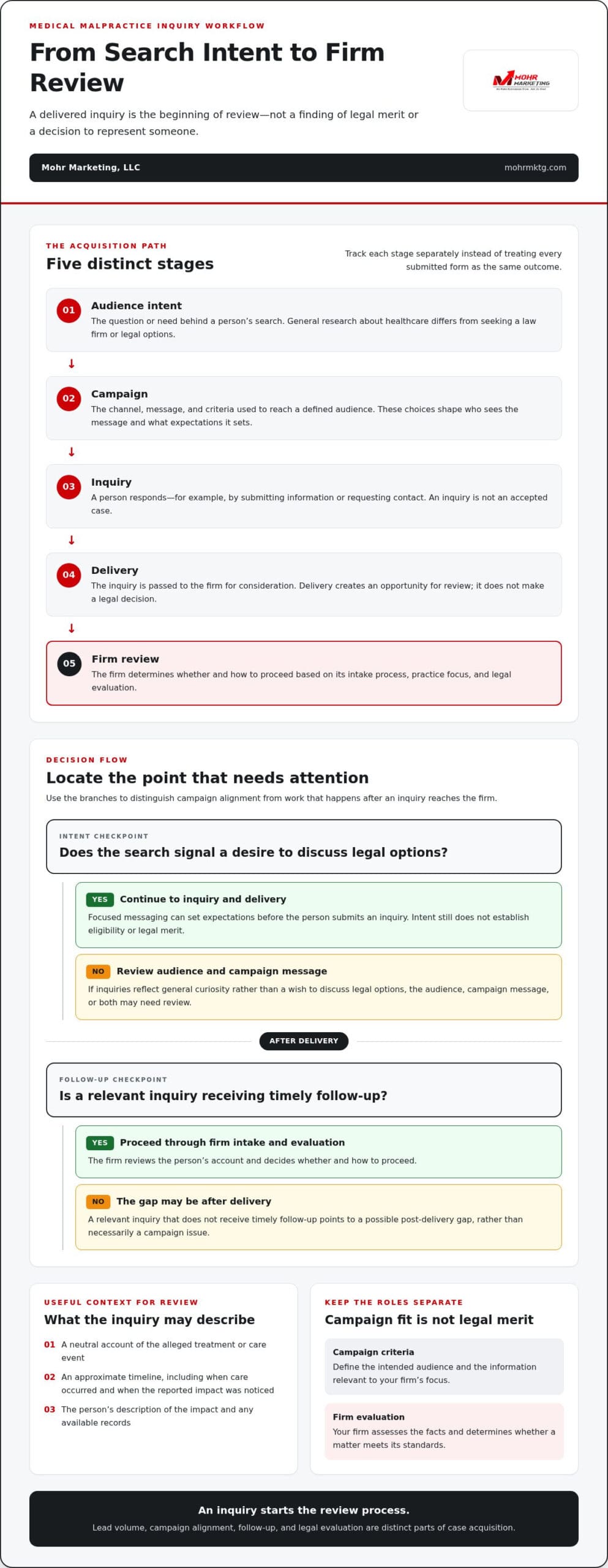
A practical sequence is audience intent → campaign → inquiry → delivery → firm review. Each stage has a distinct function:
- Audience intent: The question or need behind a person’s search.
- Campaign: The channel, message, and criteria used to reach a defined audience.
- Inquiry: The person’s response, such as submitting information or requesting contact.
- Delivery: The inquiry is passed to the firm for consideration.
- Firm review: The firm determines whether and how to proceed.
This sequence helps firms identify where results may be misaligned. If inquiries reflect general curiosity rather than a desire to discuss legal options, the audience, campaign message, or both may need review. If an inquiry is relevant but does not receive timely follow-up, the gap may be after delivery. Tracking the stages separately makes campaign performance easier to interpret than treating every submitted form as the same outcome.
What does search intent signal in a malpractice campaign?
A broad search about a medical condition, treatment, or healthcare process can reflect educational research. A query seeking a law firm or asking how to discuss possible legal options signals a different intent, though it still does not establish eligibility or legal merit. Focused messaging should state what the campaign concerns and what action a person can take. This helps set expectations before an inquiry reaches the firm.
Channel matters, too. A search ad, informational page, or other campaign placement may reach people at different points in their decision process. The message and campaign criteria shape who responds and what context they provide. Use those choices to define the intended audience, not to predict whether any individual has a viable matter.
Where do lead delivery and legal review differ?
Delivery creates an opportunity for review; it does not make a legal decision. A delivered inquiry gives the firm information to consider through its own intake and evaluation process. The firm determines whether the person’s account warrants further discussion, whether representation is appropriate, and whether to accept a case. These decisions are separate from marketing activity.
That distinction also clarifies what to measure. Marketing can assess whether a campaign attracts inquiries aligned with its stated audience and criteria. The firm can assess what happens after delivery, including whether inquiries receive appropriate follow-up and how they progress through review. Medical malpractice leads are an acquisition input, not accepted cases.
Mapping these handoffs can help your team identify where campaign expectations and internal review need closer alignment. To discuss how marketing and intake can work together, discuss your acquisition approach with Mohr Marketing.
Medical Malpractice Leads Compared with Signed Retainers
An inquiry and a signed retainer are different acquisition outputs. With medical malpractice leads, the firm receives a prospective claimant’s inquiry to review. A signed-retainer model delivers a fully executed retainer agreement. That output occurs later in the acquisition process, but it does not guarantee a particular case outcome, recovery, or value.
Lead volume and signed retainers measure different acquisition stages, so compare each model against the work and outcomes it is designed to track.
| Comparison point | Inquiry delivery | Signed-retainer delivery |
|---|---|---|
| What the firm receives | A prospective claimant’s inquiry for firm review. | A fully executed retainer agreement. |
| What follows | The firm handles follow-up, intake, and its own legal evaluation. | The firm manages the matter under its engagement process and determines appropriate next steps. |
| What it helps measure | Inquiry flow and alignment with campaign criteria. | Acquisition at a later stage, after a retainer has been executed. |
What does a lead-based acquisition model deliver?
A delivered inquiry gives the firm an opportunity to assess a prospective matter. It is not a decision about legal merit or acceptance of representation. After delivery, the firm’s internal process matters: staff follow up, gather relevant context, and route the inquiry for legal review. Before a campaign begins, define the intended lead criteria and delivery expectations so everyone has a clear understanding of the output.
That clarity also supports useful performance analysis. A firm can examine whether inquiries align with its stated focus and whether its intake process can handle the resulting work. A high count alone does not show how many inquiries are relevant, reviewed, or advanced. Track those measures separately.
What changes when the deliverable is a signed retainer?
A signed-retainer deliverable is a fully executed retainer agreement, not simply a person who has expressed interest or requested contact. Because delivery occurs later in the acquisition process, the measurement point shifts from inquiry generation to completed engagement. Firms should still distinguish this milestone from the eventual case result: an executed agreement does not establish the matter’s outcome or value.
Mohr Marketing offers signed-retainer services in other legal categories. Its mass tort signed-case services provide an example of an acquisition model measured at a later stage. This is distinct from medical malpractice lead delivery. The relevant comparison is the deliverable and measurement point, not an assumption that the categories share case criteria.
Choose a model by matching its output to your firm’s acquisition strategy and operational capacity. If your process is built to review inquiries, assess lead delivery on that basis. If you are evaluating a signed-retainer model, assess the later-stage deliverable separately. Neither metric replaces the firm’s case evaluation or outcome tracking.
A Practical Framework for Assessing Medical Malpractice Lead Fit
Assessing fit requires more than deciding whether an inquiry sounds relevant. Connect campaign focus to your firm’s review capacity, then use consistent operating measures to identify where alignment is strong or weak. Keep campaign requirements separate from legal evaluation standards: marketing can describe the intended audience, but the firm determines whether a matter merits further review or representation.
Use this four-step planning sequence:
- Define practice focus. Identify the malpractice matters and claimant circumstances the firm is equipped to evaluate. A defined focus gives campaign planning a practical boundary.
- Set criteria. Document the inquiry characteristics that should guide campaign targeting, including relevant alleged events and circumstances. Separate these marketing criteria from the legal standards attorneys apply to an individual matter.
- Map capacity. Determine who receives inquiries, how intake work is assigned, and how prospects move into firm review. Match campaign demand to the team’s ability to respond and evaluate inquiries.
- Review outcomes. Compare campaign alignment, contact results, and later-stage progress using consistent categories. Use the findings to refine planning rather than treating a single result as proof of quality.
How should a firm define its target inquiry?
Write down the types of alleged care events and claimant circumstances the firm evaluates. Specify which inquiry details help determine whether a prospect fits the campaign’s audience, and identify exclusions that prevent the campaign from attracting clearly unrelated inquiries. Review the criteria with the legal and intake decision-makers who will use them. This creates a shared planning standard without turning campaign language into a legal conclusion.
Criteria should be clear enough to guide consistent campaign decisions, but they should not attempt to decide whether negligence occurred. That remains a firm-side legal evaluation. Keeping the functions distinct reduces confusion between marketing relevance and case merit.
Which operating measures help interpret lead performance?
Track each stage separately: delivered inquiries, prospects your team successfully contacts, and signed retainers. Add a consistent way to record inquiry relevance and downstream review status. Review the same categories over a consistent reporting period before changing campaign criteria. Otherwise, short-term variation may prompt adjustments that do not address the underlying issue.
Interpret the measures together. Low contact outcomes may point to a follow-up or capacity challenge, while weak alignment with the intended audience may call for a campaign review. Neither pattern, by itself, establishes legal merit or predicts future results. For medical malpractice leads, disciplined tracking helps your firm make better acquisition decisions without confusing marketing performance with legal judgment.
How Mohr Marketing Connects Medical Malpractice Leads with Case Acquisition
Once your firm has defined its practice focus, inquiry criteria, and intake capacity, connect those decisions across the acquisition process. Mohr Marketing provides medical malpractice leads and legal intake services, alongside signed-retainer services for other legal categories. This brings related stages of marketing and case acquisition into a broader ecosystem. Your firm remains responsible for legal evaluation, representation decisions, and case acceptance.
This connection matters because disconnected stages can obscure what performance data means. If campaign messaging targets one type of inquiry but intake records outcomes using different definitions, it becomes harder to identify whether a gap stems from audience fit, follow-up, or the firm’s own criteria. Shared language gives marketing and intake teams a clearer basis for reviewing results and adjusting processes.
What does a connected acquisition approach address?
A connected approach treats campaign intent, inquiry delivery, and intake as related operating stages. Campaign planning defines the intended audience and message. Delivery gives the firm an opportunity to review an inquiry. Intake then applies the firm’s process to understand the person’s needs and route the inquiry appropriately. These stages inform one another, but they remain distinct measures and decisions.
Consistent definitions support practical review. For example, teams can distinguish an inquiry that matches the campaign audience from one that progresses through intake, without treating either status as a legal conclusion. Marketing can support acquisition; it cannot replace the firm’s judgment about legal merit or representation.
Mohr Marketing serves law firms nationally and brings more than 30 years of industry experience. Its approach connects legal marketing and intake rather than treating acquisition as a lead count alone. Firms can consider medical malpractice leads, legal intake services, or signed-retainer models for other legal categories in light of their acquisition objectives and internal workflow. The appropriate comparison depends on the output the firm needs and the stages it intends to manage internally.
What should a firm clarify before starting a conversation?
Prepare a concise picture of how acquisition should work inside your practice. Identify:
- Practice focus: The types of healthcare-related inquiries the firm is equipped to review.
- Target criteria: The campaign characteristics that define relevance, kept distinct from legal standards used to assess individual matters.
- Intake capacity: Who handles incoming inquiries, how they are routed, and what follow-up the team can support.
- Acquisition objective: Whether the firm is assessing lead delivery, signed retainers, or broader marketing and intake support.
These points make an initial discussion more specific. They also clarify which acquisition stage the firm wants to strengthen, what its team can manage, and which measures will be useful for review. No acquisition model can guarantee a case outcome; a clear operating plan helps set expectations and supports a more disciplined evaluation.
Discuss your firm’s medical malpractice acquisition needs with Mohr Marketing to explore an approach aligned with your practice focus and intake structure.
Build Your Next Acquisition Decision Around Firm Fit
Use your lead strategy as an operating decision, not just a marketing metric. Identify what your firm wants its acquisition process to accomplish, where intake capacity can support that goal, and which outcomes will help you assess progress. With medical malpractice leads, a clear plan connects campaign expectations to the way your firm reviews prospective matters.
A focused conversation can help translate those priorities into an acquisition approach that fits your practice. Bring your target inquiry criteria and current intake considerations so the discussion starts with your firm’s needs.
Take the next step by discussing your medical malpractice lead strategy with Mohr Marketing.
Frequently Asked Questions
What are medical malpractice leads?
Medical malpractice leads are inquiries from people seeking information or legal help about alleged harm involving healthcare. For example, someone may describe a concern about care and ask to speak with a law firm. The inquiry is an initial point of contact, not evidence that negligence occurred. Record what the person is requesting and the campaign source so your team can route the inquiry for appropriate follow-up.
Is every medical malpractice lead a viable case?
No. An inquiry alone does not establish that a legal claim exists, that supporting evidence is available, or that the matter fits the firm’s practice. A person may provide limited information at first, so the firm’s review process should determine what additional context is needed. Keep marketing descriptions accurate and avoid treating an inquiry as a guaranteed case or a commitment to representation.
How are medical malpractice leads different from general personal injury leads?
Medical malpractice inquiries concern alleged harm connected to healthcare and may require the firm to review treatment details, records, and a sequence of events. Other personal injury inquiries can center on a different kind of incident, such as a vehicle collision, with different initial information needs. These categories call for distinct campaign planning, but neither category alone determines whether a particular matter has legal merit.
Can a law firm receive signed retainers instead of leads?
Yes. Some acquisition arrangements deliver inquiries for the firm to assess, while signed-retainer models deliver fully executed retainer agreements. Before comparing them, clarify exactly what constitutes delivery, what work your team handles afterward, and which stage your reporting will measure. A signed agreement marks an engagement milestone; it does not guarantee a particular case outcome, recovery, or value.
How much do medical malpractice leads cost?
There is no single price that applies to every campaign or acquisition arrangement. The scope, deliverable, and agreed terms can affect how an offer is structured. Compare options by defining what counts as a delivered inquiry, what services are included, and what responsibilities remain with your team. A headline figure alone will not show whether the model fits your intake workflow or acquisition goals.
Can a law firm use medical malpractice leads across multiple states?
A firm can plan for a national audience, but its own practice scope and review processes should guide campaign planning across jurisdictions. Do not assume that one message or intake path fits every state. Have the appropriate legal decision-makers review the intended audience, campaign language, and handling process for the jurisdictions involved. This keeps acquisition planning aligned with the firm’s scope and internal compliance review.
What should a law firm track after receiving medical malpractice leads?
Track delivered inquiries, contact outcomes, fit with the firm’s stated criteria, and signed retainers as separate stages. For example, distinguish an inquiry your team reached from one that remains uncontacted, then record its progress under consistent categories. Review these measures together over time with marketing, intake, and case-evaluation staff. They help identify process patterns, but they do not determine legal merit or predict case results.

Recent Posts
- Medical Malpractice Leads: A Strategic Guide for Law Firms
- Pay-Per-Lead Legal Marketing: A Guide for Law Firms
- Exclusive Personal Injury Leads: How Law Firms Should Evaluate Quality in 2026
Categories
- AI and Lead Generation
- Business Financing
- Call Verified MVA Leads
- Car Accident Help
- Car Accident Settlements
- Claimant Funding
- Compliance Program
- EMS-EMT Reports
- Geotargeting
- Google Maps Ranking
- Healthcare Practice Growth
- Law Firm Growth
- Law Office Operations
- Lead Generation
- Lead Generation For Attorneys
- Lead Generation For Chiropractors
- Lead Generation For Criminal Attorneys
- Lead Generation For D&A Treatment Centers
- Lead Generation For DUI Attorneys
- Lead Generation For Eye Doctors
- Lead Generation For Family Law Practices
- Lead Generation For PI Law Firms
- Lead Generation For Plastic Surgeons
- Leads For Healthcare Professionals
- Leads For Insurance Industry
- Legal Leads
- Legal Marketing
- Legal Updates
- Mass Tort Leads
- Medicare and Medicaid Leads
- Merchant Funding Leads
- Mold Leads
- Online Marketing Strategies
- Pre-Settlement Funding
- Signed MVA Cases
- Tort Updates
- Truck Accident Leads and Signed Cases
- Truck Accident Settlements
- Web Design