Roundup Cancer Lawsuit Leads: Buying Guide for Law Firms
September 27, 2026 by Mohr Marketing
A high lead count can still produce a weak pipeline. The value of roundup weedkiller cancer lawsuit leads depends on whether your team can review case-fit information, verify details, reach the claimant, and move the inquiry through intake. Volume alone does not answer those questions.
That is a practical concern when evaluating providers. Duplicate, incomplete, or unreachable inquiries can consume staff time, while delivery that exceeds your intake capacity can slow follow-up. A consistent evaluation process helps you compare providers using evidence and operational fit, rather than unsupported performance promises.
This guide explains how to assess documented case-fit information, verification steps, duplicate controls, claimant contactability, delivery terms, and your team’s response capacity. It also covers what to confirm directly with a provider, including whether Roundup-specific leads or signed cases are currently available. Use these criteria to make a more informed acquisition decision and match lead volume to the intake workflow your firm can support.
Key Takeaways
- Keep marketing-generated inquiries, verified leads, signed retainers, and referred matters distinct when comparing provider offers.
- For roundup weedkiller cancer lawsuit leads, define the information your firm needs with counsel rather than relying on assumed universal eligibility rules.
- Compare delivery models by reviewing verification records, consent documentation, exclusivity terms, replacement policies, and reporting.
- Before launch, assign responsibility for response, attorney review, documentation, escalation, and final disposition.
- Use a consistent provider-selection process: confirm availability, set criteria, inspect evidence, align intake capacity, and review delivery terms.
Roundup weedkiller cancer lawsuit leads: what law firms are evaluating
Before comparing providers, define what your firm is buying. Roundup-related claimant leads are marketing-generated inquiries from people who responded to a campaign. They are not confirmed cases, legal outcomes, or a substitute for attorney review.
A lead is a marketing-generated inquiry that may warrant further review. A signed case is a matter in which the claimant has signed a retainer with a law firm. A verified lead means that specified information has been checked according to the provider’s process. Verification does not establish legal merit, confirm that your firm will accept the matter, or guarantee representation. A referred matter is another category. Ask the provider to explain what “referral” means in its delivery model rather than assuming it is equivalent to a signed retainer.
These distinctions matter in day-to-day operations. An inquiry may need follow-up and additional information. A verified lead may include checks against defined fields, but your team still needs to know which fields were checked and how. Attorney assessment and any decision to offer representation remain separate steps. The same distinction between an inquiry and a signed matter applies across practice areas. For example, firms can review Mohr Marketing, LLC’s truck-accident signed cases and verified call-transfer leads as a separate offering.
What does a Roundup lawsuit lead represent?
A Roundup lawsuit lead represents a potential claimant response that requires review by the receiving firm. Marketing qualification reflects the campaign’s screening process, not a legal determination. Establish your required information and acceptance criteria with counsel, then confirm which information the provider collects, verifies, and passes along. Do not treat a provider’s description of a lead as proof that it meets your firm’s legal or case requirements.
Why does Roundup-specific campaign fit matter?
Audience, campaign messaging, and screening questions influence who responds and what information is available at intake. A general mass tort inquiry may not provide the details your team needs for a Roundup-related review. Ask prospective providers for the current campaign scope, documented qualification criteria, verification steps, and delivery terms. Confirm directly whether Roundup-specific leads or signed retainers are currently available.
Keep legal context current. The history of Roundup and glyphosate controversy offers background, but it should not replace authoritative legal sources or counsel’s assessment. Litigation details and case criteria can change. Have qualified counsel review the relevant legal context and define the standards your firm will use before evaluating campaign inquiries.
How to assess Roundup lawsuit lead quality before buying
Assess the process behind each inquiry, not just the provider’s label. A documented review helps your firm distinguish a complete, reachable contact from an inquiry that has undergone legal screening. Before evaluating roundup weedkiller cancer lawsuit leads, agree with responsible counsel on the information your team needs. Do not treat any provider’s checklist as a universal eligibility standard.
Verification should be defined by documented checks, not by a provider label. Use this review before purchase:
- Source: Ask how the inquiry was generated, which audience the campaign targeted, and how the campaign’s messaging was presented.
- Consent documentation: Confirm which records accompany delivery and how your team can review them. Ask the provider to explain what documentation is available for each inquiry.
- Required fields: Agree with counsel on the information your intake team needs. Request the provider’s field list and identify gaps before launch.
- Validation: Ask which details are checked, how checks are performed, and whether verification happens before delivery. Request examples of the evidence or records provided, with appropriate safeguards for claimant information.
- Duplicate controls: Clarify how the provider identifies and handles repeat inquiries, including whether it checks against prior deliveries to your firm.
- Delivery records: Confirm which delivery timestamps, status details, and supporting documents your firm receives, and how your team can review them.
Which verification questions should firms ask providers?
Ask for specific, written answers. How was the inquiry generated? What consent documentation is supplied? Which fields are validated? What happens when an inquiry is incomplete or duplicated? Confirm when checks occur and what evidence is available. A phone or contactability check only indicates whether a person can be reached. It does not establish legal eligibility or case merit.
How should firms define a qualified inquiry?
Set firm-specific criteria with responsible attorneys before measuring campaign performance. Keep three dimensions separate: information completeness, contactability, and substantive legal screening. Then apply consistent acceptance and rejection reason codes, such as incomplete information, unable to reach, or attorney review required. These categories can reveal patterns without turning a marketing definition into a legal standard.
For context, consult the EPA’s information on glyphosate alongside current legal sources. Regulatory information and attorney assessment serve different purposes; neither substitutes for the other. To discuss mass tort lead and intake needs, firms can contact Mohr Marketing and confirm whether a Roundup-specific campaign is available, along with its criteria and delivery terms.
Compare Roundup lead delivery models against your firm’s needs
Compare what the provider delivers with the work your firm is equipped to perform. An inquiry may require contact, information gathering, and attorney review. A signed retainer arrives at a later stage, but confirm what was completed and how it is documented. Intake support can cover different tasks, so define the scope in writing rather than assuming what “support” includes.
Lead status describes the delivery stage, not the claimant’s legal merit or the outcome of a case. No model is universally superior. The right fit depends on your intake capacity, review process, and case strategy.
| Delivery model | What the firm may receive | What to confirm |
|---|---|---|
| Inquiry lead | A claimant response and the information collected through the campaign. | Verification records, delivery format, consent documentation, duplicate handling, and which follow-up tasks remain with your team. |
| Signed retainer | A matter with a retainer represented as completed. | What “completed” means, which parties signed, what documentation is supplied, and what attorney review is still required. |
| Supported intake | Intake assistance defined by the provider’s specific scope. | Tasks performed, handoff points, records provided, and which responsibilities remain with your firm. |
Inquiry leads versus signed retainers
With inquiry leads, your team generally needs to manage contact, gather missing details, and determine whether the matter warrants attorney review. With signed retainers, verify the execution record and exactly what the provider means by “signed.” Mohr Marketing lists mass tort signed cases. Confirm directly whether Roundup-specific availability, criteria, and delivery terms apply.
Provider terms that affect campaign fit
Document how the provider handles duplicates, invalid contact details, and disputed deliveries. Clarify reporting cadence, delivery timing, territory scope, and any exclusivity terms. Ask what reports are available and how delivery records can be reconciled with your firm’s intake outcomes. Review commercial terms directly with the provider rather than relying on assumptions or generalized comparisons.
Campaign context may also inform attorney review. For background, the IARC classification of glyphosate describes the agency’s hazard classification, which is distinct from a firm’s assessment of an individual matter. For broader acquisition planning, use a structured mass tort lead generation roadmap alongside your own criteria. Firms evaluating potential lead or intake needs can contact Mohr Marketing to confirm current scope and terms.
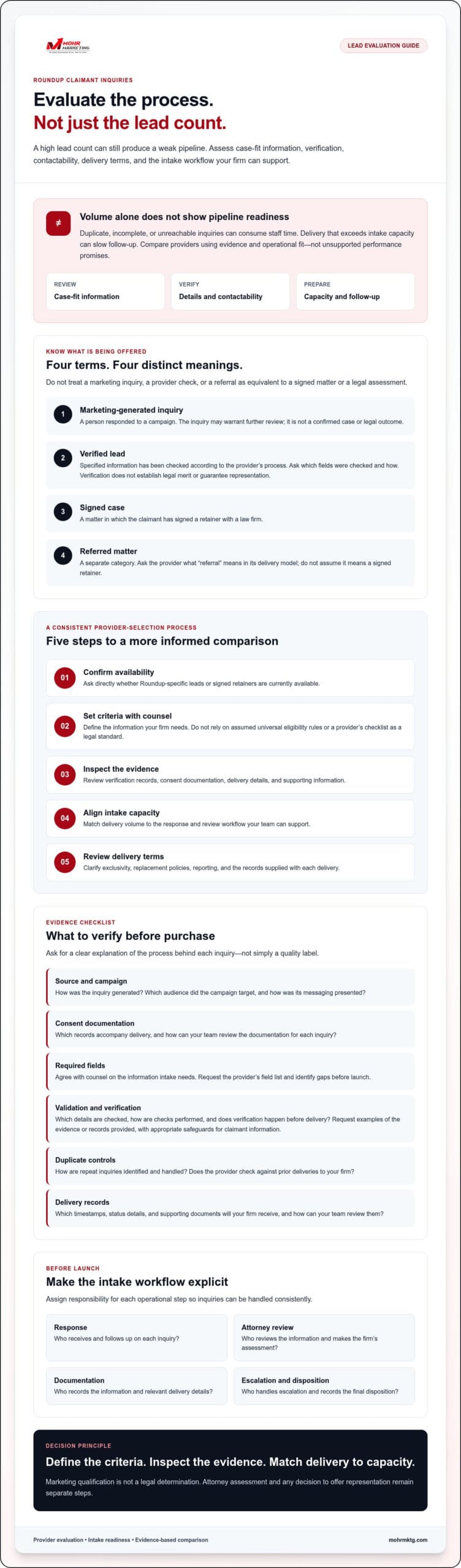
Prepare intake operations to convert Roundup claimant inquiries responsibly
Lead delivery is only one part of the process. Before a campaign begins, map each handoff so an inquiry reaches the right person, receives follow-up that matches your staffing, and is reviewed using the firm’s established criteria. A defined workflow helps prevent inquiries from stalling between marketing, intake, and attorney review.
What should a Roundup lead intake workflow include?
Assign an owner to receive each inquiry, track outreach, and route it for attorney review. Establish what intake staff may ask and when questions must be escalated to an attorney. Staff should not make legal judgments outside their authority.
Use a consistent record for each inquiry. Capture the source, delivery details, consent records provided, claimant-reported information, contact attempts, review status, and final disposition. If information is incomplete or the claimant cannot be reached, record that outcome rather than leaving the inquiry’s status unclear. Document the firm’s follow-up process and set response coverage to match available staff.
Which performance indicators help evaluate fit?
Track measures that show both inquiry quality and operational workload. Consider delivery completeness, contactability, duplicate rate, and firm-defined qualification outcomes. Record why inquiries do not advance, such as missing information, unsuccessful contact, or attorney review. Consistent reason codes make patterns visible and support a more useful evaluation than lead count alone.
Compare campaign results across consistent time periods and account for intake capacity. If staff cannot keep up with delivered inquiries, higher volume may create a backlog rather than a stronger pipeline. Consider the ROI of legal intake services in operational terms: assess whether the workflow and resources devoted to follow-up align with the outcomes your firm tracks. Do not treat volume by itself as evidence of case quality or return.
For firms evaluating roundup weedkiller cancer lawsuit leads, review the process with the people who will handle inquiries before agreeing to delivery. Confirm who receives the records, who owns follow-up, how attorney review is triggered, and how unresolved inquiries are documented. Mohr Marketing lists legal intake services among its offerings. Confirm directly whether the available scope fits your Roundup campaign and internal workflow.
Choose a Roundup lead partner with clear criteria and verifiable terms
Select a provider through a documented review, not a volume claim. For roundup weedkiller cancer lawsuit leads, follow a clear sequence: confirm current availability, define your firm’s criteria with counsel, inspect the provider’s verification evidence, check that delivery matches your intake capacity, and review delivery and commercial terms before committing.
A due diligence checklist for lead providers
Ask each prospective provider for written definitions and supporting details. Clear answers make it easier to compare offers and identify gaps before delivery begins.
- Lead status: What does the provider mean by an inquiry, a verified lead, a signed retainer, or another delivery type?
- Source and consent: How was the inquiry generated, and what consent records accompany it? Ask how the provider handles and shares claimant information and what documentation your firm can review.
- Verification: Which fields are checked, when are checks performed, and what records demonstrate that work?
- Delivery and invalidation: How are inquiries delivered? What process applies to duplicates, incomplete records, invalid contact details, or disputed deliveries?
- Reporting: What campaign activity and delivery information will be reported, how often, and how can discrepancies be raised and resolved?
Review the provider’s data-handling and compliance processes with your firm’s appropriate advisers. Do not assume that broad assurances establish the steps followed for a specific campaign. Request details relevant to the proposed scope, then check that the written terms match the answers you received.
When to discuss a campaign with Mohr Marketing
Mohr Marketing lists mass tort leads, signed cases, and legal intake services among its offerings. These are potential acquisition options, not a promise of Roundup-specific inventory or a particular result. Contact the company directly to confirm whether a Roundup campaign is currently available and clarify its scope, qualification criteria, verification steps, delivery model, and terms.
Prepare for that discussion by identifying your practice focus, intake capacity, counsel-defined criteria, and preferred delivery model. Then compare the proposed campaign with those requirements. A suitable partner should be able to explain its process clearly enough for your team to evaluate the evidence, workflow, and reporting before making a decision.
Build a More Deliberate Lead Acquisition Plan
Strong acquisition decisions start with clear distinctions: an inquiry is not a signed retainer, verification is not legal qualification, and a larger lead count does not automatically mean a better pipeline. Evaluate roundup weedkiller cancer lawsuit leads using documented case-fit information, verification steps, delivery terms, and your firm’s intake capacity.
Before choosing a provider, define criteria with counsel, request evidence of the provider’s process, and confirm how delivery issues and reporting are handled. Then match follow-up responsibilities to your team’s actual capacity. These steps give your firm a repeatable way to assess providers without relying on unsupported promises.
Mohr Marketing reports more than 30 years of industry experience and lists mass tort leads, signed cases, and legal intake among its services. Confirm directly whether Roundup-specific services are currently available and review the applicable scope and terms before deciding whether there is a fit.
With defined criteria and a workable intake plan, your team can pursue growth with greater clarity and control.
Frequently Asked Questions
What are Roundup weedkiller cancer lawsuit leads?
Roundup weedkiller cancer lawsuit leads are marketing-generated inquiries from people who responded to a campaign related to potential Roundup claims. An inquiry is not a confirmed case, a legal determination, or a promise of representation. Firms should clarify whether a provider delivers inquiries, verified leads, signed retainers, or another service, and assess each according to its documented scope and the firm’s review process.
How can a law firm verify Roundup lawsuit leads?
Ask the provider how each inquiry was generated and what information is checked before delivery. Request details about the fields collected, validation methods, consent records, duplicate controls, and supporting delivery documentation. Then distinguish contactability checks from attorney review: confirming that contact details work does not establish legal merit or eligibility. Define your firm’s review criteria with counsel and record consistent outcomes during intake.
Are Roundup lawsuit leads the same as signed cases?
No. A lead is an inquiry that may require contact, information gathering, and review. A signed case generally refers to a matter for which the claimant has signed a retainer, but ask the provider exactly what “signed” means and what documentation accompanies delivery. Neither the label nor a completed retainer establishes the case’s merits or guarantees a particular legal outcome.
What should firms ask before buying Roundup-related leads?
Ask whether Roundup-specific leads or signed retainers are currently available, and request the campaign scope and qualification criteria in writing. Clarify the inquiry source, consent documentation, verification steps, delivery format, duplicate and invalidation policies, exclusivity terms, reporting, and how discrepancies are handled. Define your firm’s information requirements with counsel, then confirm that your intake team has capacity to respond to and review inquiries using those criteria.
How much do Roundup weedkiller lawsuit leads cost?
Pricing depends on the provider’s delivery model and the terms of the proposed campaign, so there is no single amount to assume. Request a current quote directly and clarify what the fee covers, how billing is structured, and how duplicates, incomplete inquiries, or disputed deliveries are treated. Compare the written terms alongside verification, delivery scope, and reporting rather than using price alone to judge fit.
Can a lead provider guarantee that an inquiry will become a case?
A provider cannot reliably promise that an inquiry will become a case, since the claimant’s information, attorney review, and the firm’s acceptance decision all affect whether it proceeds. Treat guarantees of case conversion or legal outcomes cautiously. A provider can explain its delivery process and any specific contractual commitments, but your firm should review those terms and keep marketing verification separate from legal assessment.
What happens if a Roundup lead is incomplete or duplicated?
The outcome depends on the provider’s written delivery and dispute terms. Before purchase, ask how incomplete records and duplicates are identified, how your firm reports a problem, what documentation is needed, and whether a replacement or other resolution applies. Track each issue consistently in intake records. This helps your team assess provider performance and distinguish a delivery problem from an inquiry that simply does not advance after review.

Recent Posts
- Roundup Cancer Lawsuit Leads: Buying Guide for Law Firms
- Tracking Law Firm Marketing: A Practical Guide
- High-Value Mold Case Acquisition: A Strategic Guide
Categories
- AI and Lead Generation
- Business Financing
- Call Verified MVA Leads
- Car Accident Help
- Car Accident Settlements
- Claimant Funding
- Compliance Program
- EMS-EMT Reports
- Geotargeting
- Google Maps Ranking
- Healthcare Practice Growth
- Law Firm Growth
- Law Office Operations
- Lead Generation
- Lead Generation For Attorneys
- Lead Generation For Chiropractors
- Lead Generation For Criminal Attorneys
- Lead Generation For D&A Treatment Centers
- Lead Generation For DUI Attorneys
- Lead Generation For Eye Doctors
- Lead Generation For Family Law Practices
- Lead Generation For PI Law Firms
- Lead Generation For Plastic Surgeons
- Leads For Healthcare Professionals
- Leads For Insurance Industry
- Legal Leads
- Legal Marketing
- Legal Updates
- Mass Tort Leads
- Medicare and Medicaid Leads
- Merchant Funding Leads
- Mold Leads
- Online Marketing Strategies
- Pre-Settlement Funding
- Signed MVA Cases
- Tort Updates
- Truck Accident Leads and Signed Cases
- Truck Accident Settlements
- Web Design