Beyond “Buying Leads”: Navigating CA SB 37 and Compliant Case Acquisition
September 8, 2026 by Mohr Marketing
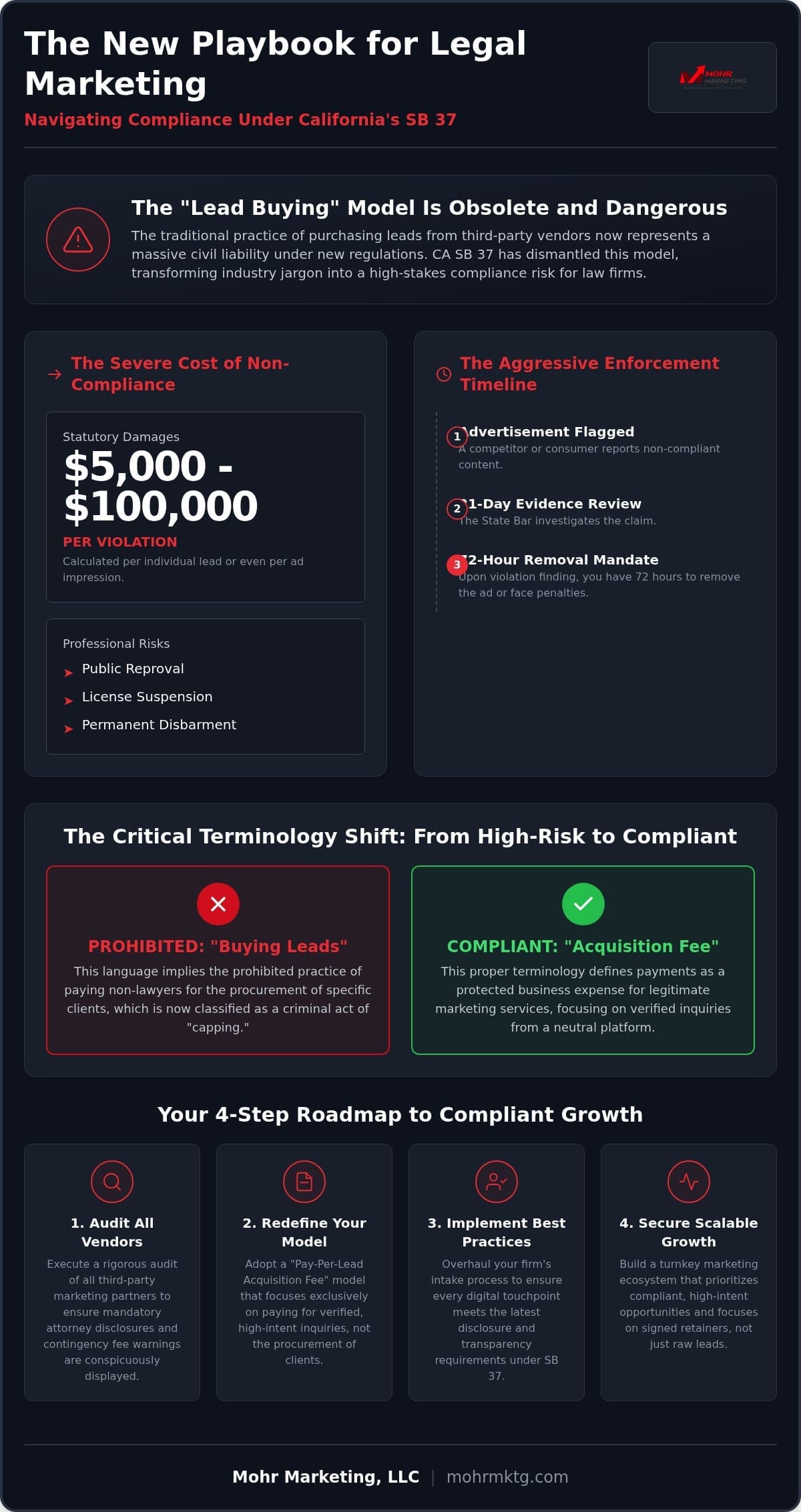
A single non-compliant digital advertisement can now trigger substantial fines for your firm. The evolving regulatory landscape has effectively dismantled the traditional “lead buying” model in favor of strict transparency. You’ve likely spent years relying on third-party vendors, but new compliance requirements mean those old habits now represent a massive civil liability. It’s a high-stakes environment where confusion leads to litigation.
We recognize the urgency of protecting your practice from competitor-led civil actions while maintaining a steady flow of new cases. This guide, brought to you by Mohr Marketing, LLC, provides a definitive roadmap to transition your firm from high-risk lead buying to a compliant, performance-based acquisition model. You’ll gain a clear understanding of mandatory terminology updates and learn how to eliminate inefficient intermediaries that put your ability to practice at risk.
We will examine the expanded definition of “advertisement” and its impact on every social post or email your firm sends. By implementing law firm intake process best practices, you can secure high-intent inquiries while ensuring every touchpoint meets the latest disclosure requirements. This is your strategy for scaling safely in today’s evolving legal marketing landscape.
Key Takeaways
- Identify the expanded scope of CA SB 37 and how the new definition of “advertisement” subjects nearly all digital communications to strict Bar oversight.
- Evaluate the severe financial risks of non-compliance, including statutory damages that reach up to $100,000 per violation under the 2026 mandates.
- Implement law firm intake process best practices by adopting a “Pay-Per-Lead Acquisition Fee” model that focuses exclusively on verified inquiries.
- Execute a rigorous audit of all third-party marketing vendors to ensure mandatory attorney disclosures and contingency fee warnings are conspicuously displayed.
- Secure scalable firm growth through a turnkey marketing ecosystem that prioritizes high-intent opportunities and compliant signed retainers.
The End of “Buying Leads”: Why CA SB 37 Changes Everything
January 1, 2026, fundamentally altered the landscape of legal marketing. CA SB 37 represents the most significant update to attorney advertising and solicitation rules in a generation. This legislation targets digital “runners” and deceptive third-party brokers who have historically operated in a regulatory gray area. These entities often use aggressive tactics that the State Bar now classifies as prohibited solicitation. For any firm handling California cases, compliance is no longer optional; it is a matter of professional survival.
The phrase “buying leads” has transitioned from industry jargon to a major liability. Under current Bar mandates, this terminology implies the prohibited practice of paying non-lawyers for the procurement of legal business. To align with law firm intake process best practices, firms must shift their focus toward a compliant, performance-based acquisition model focused on verified mass tort inquiries or similar high-intent opportunities. This law applies to any attorney generating business within the state, regardless of where their physical headquarters are located.
The Legal Reclassification of Runners and Cappers
SB 37 significantly expands the legal definition of a “runner” to encompass many modern digital lead brokers. Attorneys must now draw a sharp line between paying for the “procurement of business” and paying for legitimate “marketing services.” The former is a criminal act; the latter is a protected business expense. Accepting referrals from non-compliant nongovernmental entities creates immediate exposure. You must verify that your partners operate within the rules governing legal advertising to avoid being swept up in “capping” investigations.
The State Bar evaluates these relationships based on three primary factors:
- Whether the fee is tied to the successful procurement of a specific client.
- If the vendor is providing a recommendation rather than a neutral platform.
- The degree of transparency in the vendor’s own advertising methods.
The 72-Hour Enforcement Window
The enforcement mechanism under SB 37 is aggressive. When an advertisement is flagged, the State Bar of California has 21 days to complete an evidence determination process. If they find a violation, the advertiser receives a notification and must remove the non-compliant content within 72 hours. This isn’t just about Bar discipline. The law now empowers competitors and aggrieved consumers to initiate private civil actions. A single oversight in your law firm intake process best practices can lead to statutory damages ranging from $5,000 to $100,000 per violation. This shift from Bar-only oversight to private litigation means your competitors are now your most active regulators. They are incentivized to monitor your ads and file suit for any missing disclosures or misleading claims.
Understanding the Penalties: The Cost of Non-Compliance
SB 37 isn’t a mere suggestion; it’s a financial landmine. Statutory damages range from $5,000 to $100,000 per violation. In a digital environment, the calculation of “per violation” is a point of significant contention. It doesn’t refer to a single campaign, but rather to each individual lead generated or even every impression served to a consumer. If your firm uses a non-compliant template across thousands of impressions, the financial exposure becomes catastrophic. Courts also possess the power of injunctive relief. They can freeze your entire marketing operation instantly while a case proceeds, effectively cutting off your firm’s oxygen.
Beyond the monetary hit, the professional risk is absolute. The State Bar treats “unlawful solicitation” as a tier-one ethical breach. Violations can lead to public reproval, suspension, or the permanent loss of your license to practice law. Establishing a practical compliance framework is no longer a back-burner project. It’s the only way to shield your firm’s assets and reputation from aggressive enforcement. Don’t assume your current vendors are protecting you; the liability rests solely on the attorney whose name appears on the ad.
Civil Liability and Competitor Lawsuits
The law now allows “any person” to bring a civil action against your firm. This means your competitors are now your most aggressive compliance monitors. They have every incentive to find an error in your disclosures and file a lawsuit to disrupt your growth. Because SB 37 allows for the recovery of attorney’s fees, boutique litigation firms are already hunting for non-compliant lawyer ads. Your marketing is no longer just a business tool; it’s a public target for private litigation. This environment demands that your law firm intake process best practices include a legal review of every ad before it goes live.
The Multiplier Effect of Digital Campaigns
Digital campaigns pose the greatest risk for rapid-fire violations. A single non-compliant ad template on Google or Facebook can trigger thousands of statutory violations in a matter of hours. If you rely on “shared” lead landing pages managed by third-party brokers, you’re essentially betting your firm on their compliance. “Blind” lead buying is now a catastrophic business risk for national firms because you lack control over the mandatory disclosures required by law. You must have total visibility into the environment where your firm’s name appears. Adopting modern law firm intake process best practices requires auditing the source of every inquiry. If you’re unsure if your current vendor meets these strict standards, you should request a compliance audit immediately.
Acquisition Fees vs. Lead Buying: The Professional Terminology Shift
Law firms must immediately pivot from the colloquialism of “buying leads” to the professional standard of “Pay-Per-Lead Acquisition Fees.” Under CA SB 37, words carry regulatory weight. Using terminology that suggests a simple transaction for a human being’s contact information can be construed as prohibited solicitation. Instead, your internal documentation and vendor contracts should reflect “marketing service fees” or “acquisition costs.” This is a core component of law firm intake process best practices in a post-2026 regulatory environment.
The distinction lies in what you are actually paying for. You aren’t purchasing a person; you are paying for a professional marketing and intake ecosystem that identifies, verifies, and delivers high-intent opportunities. Transitioning to “Signed Retainers” as a performance metric provides a more compliant framework than raw, unvetted leads. When you pay for a signed retainer, you are paying for the comprehensive labor of lead generation, initial screening, and the administrative work required to secure a signature. This structure emphasizes the service provided rather than the “procurement” of a client, aligning your firm with ethical standards that demand transparency.
Defining Verified Inquiries
A “verified inquiry” under the 2026 mandates is an opportunity that has been rigorously screened for both legal merit and consumer intent. To maintain compliance, firms should prioritize high-intent search data over the “interruption” marketing common on social media. Clickbait ads often generate low-quality volume that increases Bar risk without providing value. Professional acquisition strategies focus on mesothelioma leads built on real search intent and other high-stakes categories where the consumer is actively seeking help. This verification process ensures that every inquiry your intake team handles is legitimate, documented, and compliant with the new advertising standards.
The Performance-Based Marketing Model
Structuring your growth through “Pay-Per-Signed-Case” fees is entirely ethical when framed as a marketing cost. The key is the contractual clarity that you are paying for the “marketing work” that produced the case, not the case itself. This includes the cost of media buying, the technology stack for intake, and the personnel required for verification. By utilizing mass tort signed cases as your primary acquisition vehicle, you eliminate the friction of chasing dead-end leads. This model protects your firm by ensuring that marketing expenditures are tied to tangible, verified outcomes that have already passed through a compliant intake filter. It’s the most direct path to scaling your firm while adhering to law firm intake process best practices.
How to Audit Your Legal Marketing for SB 37 Compliance
Compliance is not a one-time event; it is an ongoing operational requirement. Firms must move beyond surface-level reviews and implement a granular audit of their entire acquisition funnel. If you haven’t reviewed your vendor list since the January 2026 effective date, you’re likely out of compliance. A systematic audit ensures that every inquiry meets the new Bar mandates and protects your firm from predatory civil actions. Follow this five-step checklist to secure your marketing operations.
- Inventory Vendors: Document every third-party entity providing case acquisition or intake services. You are responsible for their conduct as if it were your own.
- Audit Ad Copy: Review every active advertisement for misleading claims. SB 37 requires conspicuous disclosures, including the name of the attorney responsible for the content.
- Review Intake Scripts: Ensure your intake team isn’t making legal promises or “encouraging” the hiring of a lawyer in a way that constitutes prohibited solicitation.
- Update Contracts: Replace all “lead purchase” language with professional terminology like “acquisition service fees.” Your contracts must reflect a service-based relationship.
- Verify Original Sources: Demand transparency regarding where your inquiries originate. Avoid “blind” aggregators who hide the landing pages they use to capture consumer data.
Auditing Your Intake Ecosystem
Your intake department is the front line of regulatory risk. Under SB 37, the line between qualifying a lead and soliciting a client has narrowed. Training your team on law firm intake process best practices is essential for maintaining this distinction. Scripts should focus on factual qualification rather than persuasive solicitation. Speed-to-lead remains a critical metric for conversion, but it must be executed with a non-aggressive, professional tone that respects the consumer’s autonomy. Understanding the ROI of legal intake services requires a balance between conversion efficiency and strict adherence to Bar-mandated communication standards.
Landing Page and Disclosure Requirements
Landing pages are often the primary source of SB 37 violations. The law requires clear, conspicuous disclosures identifying the entity paying for the advertisement. Many “Legal Help Centers” or “Advocacy Groups” must now explicitly state they are marketing entities and not law firms. This transparency prevents the “misleading” label that triggers Bar determination processes. For example, a compliant high-value mold case acquisition strategy uses clearly branded landing pages that disclose the sponsoring firm’s information. Adopting these law firm intake process best practices ensures that the consumer knows exactly who they are contacting from the first click, eliminating the risk of “deceptive” marketing claims.
Scalable Growth Through Verified Performance-Based Marketing
Mohr Marketing, LLC delivers the industry standard for SB 37 compliance through our turnkey marketing and intake ecosystem. We’ve replaced the “volume-at-all-costs” mentality with a focus on verified quality acquisition. This shift toward high-intent opportunities directly reduces Bar risk while increasing your firm’s ROI. Our data-driven strategies prioritize transparency at every stage of the funnel. You don’t need more volume; you need better verification.
Implementing law firm intake process best practices requires more than just better scripts. It requires a strategic partner who understands the mechanics of growth under the 2026 mandates. We provide a streamlined path to success by removing the friction of non-compliant intermediaries. This ensures your marketing budget is an investment in growth, not a liability waiting to be discovered by a competitor or the Bar.
The Mohr Marketing, LLC Method: Transparency and Verification
We eliminate inefficient intermediaries and “blind” leads that obscure the consumer’s journey. In the current regulatory environment, a lead without a clear origin is a liability. Our method focuses on delivering fully executed retainer agreements as part of a compliant national growth strategy. This approach ensures that every inquiry has been vetted through a rigorous screening process before it reaches your firm. By following our roadmap to scalable growth in 2026, you can expand your caseload without compromising your ethical standing. We handle the complex verification work so you can focus on litigation.
Securing Your Firm’s Future in 2026
Waiting for a Bar complaint is a death sentence for a mass tort practice. The 2026 mandates have turned marketing into a high-stakes legal battlefield where competitors are incentivized to sue. Adopting professional “Acquisition” terminology and transparent intake protocols early provides a massive competitive advantage. It builds a wall of compliance around your practice that protects your resources and your license. Firms that master law firm intake process best practices today will be the ones still standing when the Bar begins its first wave of enforcement actions. Don’t leave your firm’s future to chance with unverified lead vendors.
Secure Your Firm’s Competitive Advantage
The 2026 legal landscape demands a total departure from traditional lead acquisition. CA SB 37 has turned marketing into a high-stakes compliance environment where errors cost up to $100,000 per violation. Surviving this shift requires a meticulous audit of your vendors and a fundamental update to your internal terminology. Transitioning to a model built on verified inquiries and signed retainers isn’t just about growth; it’s about professional preservation.
Adopting law firm intake process best practices ensures that your firm remains protected from competitor-led litigation and Bar scrutiny. Mohr Marketing brings over 30 years of industry leadership to your practice. We offer a turnkey marketing and intake ecosystem designed for strict adherence to CA SB 37 and national Bar mandates. Our focus on high-intent, verified performance provides the antidote to the risks introduced by new solicitation rules. You can scale your caseload with confidence while eliminating inefficient intermediaries that threaten your license.
The window for proactive compliance is closing. Secure your firm’s future today and lead the market with a transparent, results-oriented strategy.
Frequently Asked Questions
Can I still buy leads in California after SB 37?
You cannot “buy leads” in the traditional sense without incurring significant risk. SB 37 classifies certain third-party brokerage as prohibited solicitation. To follow law firm intake process best practices, you must shift to a “Pay-Per-Lead Acquisition Fee” model. This ensures you’re paying for professional marketing services that deliver high-intent opportunities rather than purchasing raw consumer data from unvetted brokers. Transparency in your vendor contracts is now a mandatory requirement for California practice.
What is the difference between a “lead” and a “verified inquiry”?
A lead is often just unverified contact information, whereas a verified inquiry has undergone a rigorous screening process. Mohr Marketing utilizes a turnkey ecosystem to filter for legal merit and consumer intent before an opportunity reaches your desk. This process eliminates the “volume-at-all-costs” approach and provides a compliant path for acquiring new cases. Verified inquiries ensure that you only spend resources on claimants who meet specific, pre-defined case criteria.
Does SB 37 apply to law firms located outside of California?
Yes, SB 37 applies to any firm generating cases within California, regardless of the firm’s physical headquarters. If your digital advertisements target California residents or encourage them to hire a lawyer for a California-based claim, you must comply with all disclosure and terminology mandates. National firms are especially vulnerable to private civil actions if their ad templates don’t include the specific attorney names and bona fide office addresses required by the State Bar.
What specific terms are banned under SB 37 and Bar mandates?
While specific words aren’t banned in a dictionary sense, terms like “buying leads” or “buying cases” create immediate liability during Bar determination processes. These phrases imply the criminal act of paying a runner or capper for the procurement of business. You should update all internal documentation and vendor agreements to reflect “marketing service fees” or “acquisition fees.” This terminology shift proves that your firm is paying for legitimate advertising labor rather than prohibited solicitation.
How much are the fines for violating attorney advertising rules in 2026?
Statutory damages for violations of CA SB 37 range from $5,000 to $100,000 per violation. In the digital space, “per violation” can apply to every lead generated or even every impression served on a non-compliant ad. Because the law allows for the recovery of attorney’s fees, boutique litigation firms are incentivized to file civil actions against law firms. These fines are separate from any professional discipline or license suspension the State Bar may impose.
Is “Pay-Per-Signed-Case” still a legal model under the new mandates?
The “Pay-Per-Signed-Case” model remains legal when it’s structured as a fee for professional marketing and intake services. You’re paying for the labor required to identify, screen, and secure a fully executed retainer agreement. This performance-based model aligns with ethical rules because it compensates the vendor for the “marketing work” performed. It’s a transparent alternative to traditional lead buying that ensures your firm only pays for verified, litigation-ready opportunities.
What should I do if the State Bar flags one of my advertisements?
You must remove the flagged advertisement within 72 hours of receiving notification from the State Bar. The Bar has a 21-day determination process to evaluate evidence of a violation before issuing this notice. Failure to act within the 72-hour window exposes your firm to immediate civil liability and potential statutory damages. It’s vital to have a protocol in place to audit and pull ads across all platforms, including Google, Facebook, and third-party landing pages.
How do I know if my current lead vendor is SB 37 compliant?
A compliant vendor will provide total transparency regarding the original source of every inquiry. They must demonstrate that their landing pages include the mandatory attorney disclosures and contingency fee warnings required by SB 37. If your vendor uses “blind” aggregators or refuses to show you the exact ad copy used to generate inquiries, they’re likely non-compliant. You should demand a full audit of their intake scripts to ensure they’re following law firm intake process best practices.
Recent Posts
- Attorney Search Engine Marketing: Do It Yourself or Hire Help
- Improving Law Firm Marketing ROI: A Practical Measurement Framework
- 4 Ways to Assess Unqualified Legal Leads and Their Costs
Categories
- AI and Lead Generation
- Business Financing
- Call Verified MVA Leads
- Car Accident Help
- Car Accident Settlements
- Claimant Funding
- Compliance Program
- EMS-EMT Reports
- Geotargeting
- Google Maps Ranking
- Healthcare Practice Growth
- Law Firm Growth
- Law Office Operations
- Lead Generation
- Lead Generation For Attorneys
- Lead Generation For Chiropractors
- Lead Generation For Criminal Attorneys
- Lead Generation For D&A Treatment Centers
- Lead Generation For DUI Attorneys
- Lead Generation For Eye Doctors
- Lead Generation For Family Law Practices
- Lead Generation For PI Law Firms
- Lead Generation For Plastic Surgeons
- Leads For Healthcare Professionals
- Leads For Insurance Industry
- Legal Leads
- Legal Marketing
- Legal Updates
- Mass Tort Leads
- Medicare and Medicaid Leads
- Merchant Funding Leads
- Mold Leads
- Online Marketing Strategies
- Pre-Settlement Funding
- Signed MVA Cases
- Tort Updates
- Truck Accident Leads and Signed Cases
- Truck Accident Settlements
- Web Design