Performance Marketing for Law Firms: 2026 Scaling Guide
September 5, 2026 by Mohr Marketing
Paying for clicks in 2026 is a financial gamble that high-stakes firms can no longer afford to lose. With competitive personal injury keywords now reaching $500 per click in major markets, the traditional agency model has become an unsustainable drain on your capital. You’re likely frustrated by high cost-per-lead metrics that yield low conversion rates and unqualified inquiries. It’s time to demand more from your budget. Transitioning to performance-based marketing for law firms allows you to stop subsidizing agency overhead and start paying for tangible results.
You deserve a predictable cost-per-acquisition and a scalable volume of mass tort or personal injury cases. This guide provides a clear roadmap to eliminate marketing waste and secure signed retainers through a verified, high-intent ecosystem. We’ll show you how to navigate the 2026 regulatory environment, including California Senate Bill 37, while shifting your focus from raw lead volume to the cost-per-signed-case (CPSC) metric. You’ll learn to implement a turnkey intake process that protects your resources and fuels aggressive expansion without burdening your internal team.
Key Takeaways
- Eliminate financial risk by shifting from traditional advertising retainers to a model where you pay only for verified results.
- Master the hierarchy of performance-based marketing for law firms to determine whether PPL or signed retainers best suit your current growth phase.
- Implement a turnkey intake ecosystem that converts high-intent inquiries into signed cases without taxing your internal staff.
- Secure your practice by understanding the critical ethical distinctions between fee-sharing and compliant acquisition fees in the 2026 legal landscape.
- Scale high-value practice areas like mass torts using predictable cost-per-acquisition strategies that bypass inefficient intermediaries.
The Inefficiency of Traditional Legal Advertising vs. Performance Models
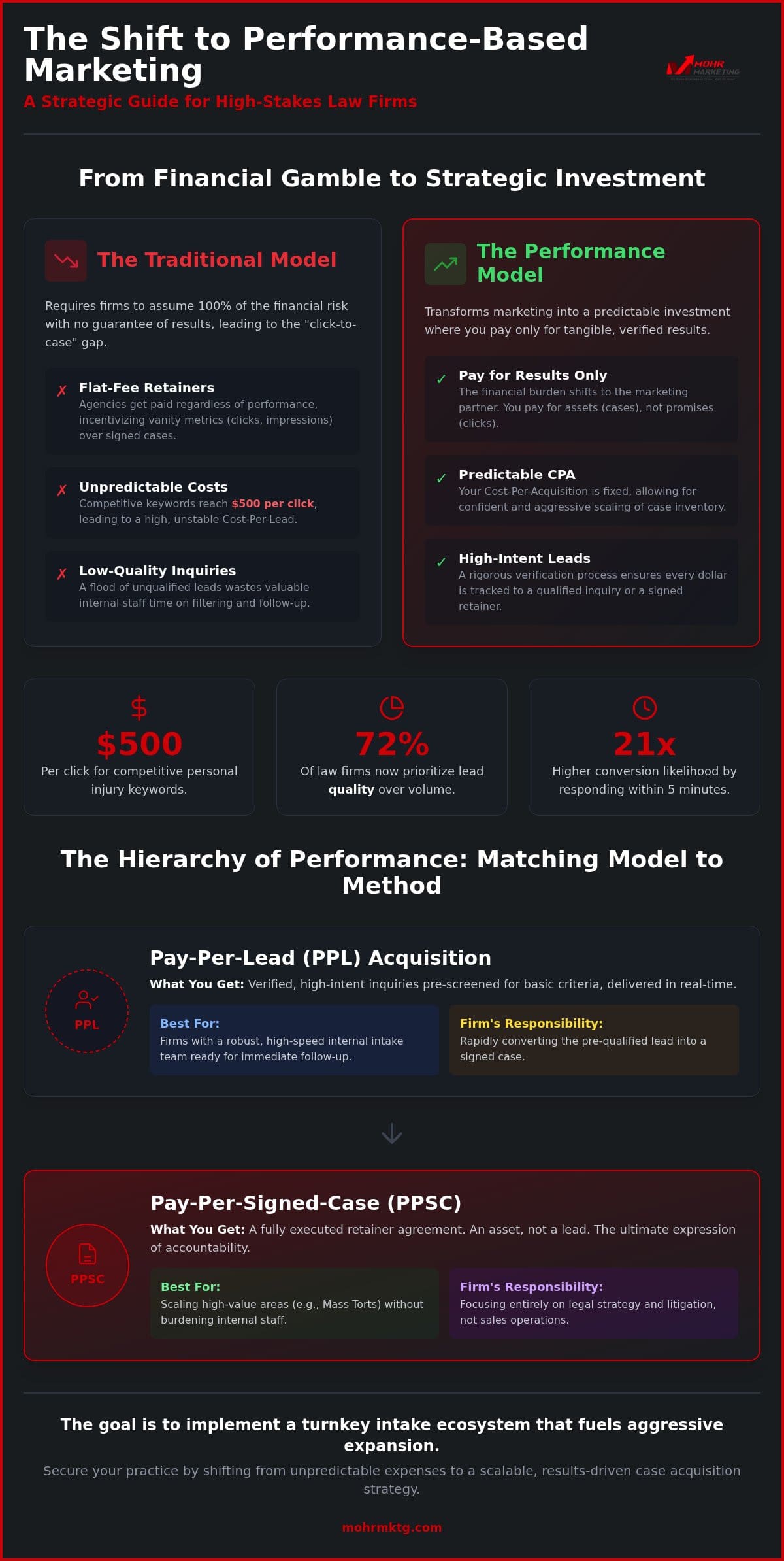
Traditional legal marketing models are fundamentally broken. They require law firms to assume 100% of the financial risk while agencies collect guaranteed fees. This disconnect creates a “click-to-case” gap where high traffic numbers often fail to produce actual revenue. In 2026, high-stakes firms are moving away from these legacy structures. They’re demanding outcome-based financial accountability. Standard web marketing often fails because it prioritizes vanity metrics over the mechanical precision required for case acquisition. The gamble stops here.
The Problem with Flat-Fee Retainers
Flat-fee retainers incentivize volume over quality. Agencies receive their monthly payment whether they deliver ten signed cases or zero. This lack of skin in the game results in a flood of unqualified inquiries. It’s a systemic failure. Research indicates that 72% of law firms now prioritize lead quality over volume, yet traditional agencies continue to push for more clicks. Your internal staff then wastes valuable time filtering through junk leads. This creates a massive hidden cost that never appears on an agency report. When an agency isn’t tied to your ROI, their optimization efforts stop at the click. They don’t care about the retainer; you do.
The Performance-Based Solution
The shift toward Performance-based advertising fundamentally changes the relationship between a law firm and its marketing partner. In this model, agencies only profit when the firm achieves a specific outcome. This might involve paying for verified inquiries or actual signed cases. It transforms marketing from an unpredictable expense into a strategic investment in case inventory. You’re no longer buying promises; you’re buying assets.
Implementing performance-based marketing for law firms ensures complete transparency. Every dollar spent is tracked to a verified inquiry or a specific case type, such as Mass Tort Leads. This model eliminates inefficient intermediaries and forces a rigorous verification process. It allows partners to scale with confidence. You know your cost-per-acquisition is fixed and predictable. This strategic shift moves your firm from a defensive posture of “spending” to an aggressive stance of “investing.” It removes the friction from your growth process and places the burden of performance where it belongs: on the provider.
The Hierarchy of Performance: PPL vs. Pay-Per-Signed-Case
Success in performance-based marketing for law firms requires understanding the distinct tiers of case acquisition. You shouldn’t view all performance models as equal. They range from simple lead generation to the delivery of fully executed retainers. Choosing the wrong tier for your firm’s current infrastructure leads to operational friction. It’s about matching the delivery model to your internal intake capabilities. High-growth firms must select the tier that aligns with their financial goals and labor capacity.
Pay-Per-Lead (PPL) Acquisition
Pay-Per-Lead is the entry point for firms with robust, high-speed intake teams. These aren’t raw web form submissions. Verified inquiries are pre-screened for basic criteria and high intent. Real-time delivery is the critical variable here. Research indicates that law firms responding to inquiries within five minutes are 21 times more likely to convert the lead. If your staff can’t meet this pace, PPL becomes a liability. Quality benchmarks must include verification of contact data and case-specific qualifying questions to ensure you’re not paying for junk traffic. Adhering to regulations on legal advertising ensures these acquisition methods remain ethically sound while maintaining high conversion standards.
Pay-Per-Signed-Case: Fully Executed Retainers
The Pay-Per-Signed-Case model is the ultimate expression of financial accountability. It eliminates the intake burden entirely. Instead of receiving a lead to chase, you receive a client ready for litigation. This model is the gold standard for Mass Tort Leads and police-report-backed MVA cases. The marketing partner handles the lead generation, the initial screening, and the signing of the retainer agreement. You pay only for the asset, not the effort. This allows your firm to focus on legal strategy rather than sales operations. It’s the most predictable path to scaling case volume without increasing fixed overhead. It removes the “click-to-case” disconnect by delivering a finished product.
Deciding between these models depends on your firm’s growth trajectory. PPL offers lower entry costs but requires higher internal labor. Signed cases require a higher initial investment per unit but offer a guaranteed ROI on case inventory. You can consult with our strategic team to determine which model fits your current case acquisition infrastructure.
The Intake Ecosystem: The Engine Behind Performance Success
Marketing generates the inquiry, but intake closes the case. Most law firms fail at this critical junction. They invest heavily in lead generation only to lose a significant portion of those opportunities through slow response times or inconsistent screening. A turnkey intake ecosystem is the only way to ensure performance-based marketing for law firms delivers a predictable ROI. Without a mechanical process to capture intent, you’re merely subsidizing the competition’s growth. The engine of your firm must be as aggressive as your advertising.
The Mohr Marketing Method treats intake as a high-precision manufacturing process. It’s designed to eliminate the friction between the initial search and the signed retainer. This is particularly vital for complex litigation, such as mesothelioma leads, where the window of opportunity is narrow and the case criteria are exceptionally strict. Speed and precision are not optional; they are the primary drivers of your acquisition cost.
The 4 Pillars of High-Conversion Intake
Successful conversion relies on four non-negotiable standards. First, you must implement an instant response protocol. Research confirms that law firms contacting inquiries within five minutes are 21 times more likely to convert that lead. Second, rigorous qualification is essential. Intake agents must filter every inquiry against your specific legal mandates to ensure you only pursue viable cases. Third, maintain absolute professionalism to establish authority from the first second of the call. Finally, data verification ensures that every piece of information is accurate before the file reaches your desk. This structured approach turns raw interest into a bankable asset.
Outsourcing vs. Internal Intake
Managing high-volume inquiries in-house carries massive hidden costs. You’re forced to manage staffing levels, training protocols, and 24/7 coverage. These administrative burdens often lead to “lead fatigue” among internal staff, resulting in missed calls and sloppy screening. A specialized legal intake service eliminates this overhead. It provides a scalable solution that grows with your case volume without requiring additional office space or benefits packages. By utilizing Legal Intake Services, you shift the operational risk to a partner who is incentivized to maximize your conversion rates. This allows your attorneys to focus on litigation while we handle the mechanics of claimant acquisition.
Navigating Compliance and Ethics in Performance-Based Marketing
Performance-based marketing for law firms is a powerful growth engine, but it requires absolute adherence to ethical standards. You can’t afford to compromise your license for the sake of lead volume. The primary hurdle remains the distinction between prohibited fee-sharing and legitimate case acquisition fees. State bar associations generally prohibit attorneys from sharing legal fees with non-lawyers. However, paying a flat fee for marketing services or a specific, pre-determined price per verified inquiry or signed case is a standard business expense. You must ensure your marketing partner operates strictly within these boundaries.
Transparency is your best defense. You need to know exactly where your leads originate and how they’re handled before they reach your firm. In 2026, regulatory scrutiny is increasing. For example, California Senate Bill 37, which became effective on January 1, 2026, introduced strict penalties for misleading attorney advertisements. Violations can result in statutory damages ranging from $5,000 to $100,000 per unique advertisement. This isn’t just about ethics; it’s about financial survival and protecting your professional standing. The gamble ends with rigorous verification.
Compliance Checklist for 2026
To protect your firm, implement a rigorous auditing process. You must verify the source of every lead and inquiry. Ensure all advertising materials meet the specific requirements of the jurisdictions where you practice. This includes mandatory disclosures of office locations and the avoidance of unsubstantiated claims regarding awards or skills. Maintaining clear, accessible documentation for every campaign is vital for reporting and potential audits. If you can’t trace the origin and processing of a lead, don’t buy it. High-stakes firms require a partner who eliminates inefficient intermediaries to maintain a clean chain of custody for every claimant.
Ethics in Mass Tort and PI Advertising
Claimant acquisition for Mass Tort Leads requires a high degree of sensitivity and accuracy. You must avoid misleading claims that promise specific outcomes or exaggerate the potential value of a case. Proper disclosure is mandatory. Your performance-based partners should prioritize ethical verification over raw numbers. This means every inquiry is screened through a process that respects the potential client’s situation while adhering to legal mandates. Working with agencies that possess over 30 years of industry experience ensures your firm benefits from a partner who understands the long-term value of a clean reputation. Proactive steps safeguard your firm’s license while driving aggressive expansion.
Scaling Your Firm with a Results-Driven Case Acquisition Strategy
Scaling your practice requires a shift from passive advertising to aggressive, strategic case acquisition. You must identify practice areas where the return on investment justifies the capital outlay. Performance-based marketing for law firms provides the mechanical precision needed to dominate these competitive spaces. It’s about moving from a “wait and see” approach to a model of predictable growth. When you control the cost-per-acquisition, you control your firm’s future. The objective is to build a bankable inventory of cases with fixed costs.
Mass torts represent the most significant opportunity for rapid expansion. Acquiring Mass Tort Leads with predictable costs allows you to build a massive case inventory without the financial volatility of traditional search advertising. Similarly, you can dominate the motor vehicle accident market by securing Police Report-Backed Cases. These cases come with verified documentation, reducing the time your staff spends on preliminary investigation. For firms seeking niche, high-margin opportunities, strategic case acquisition for High-Value Mold Litigation offers a path to market leadership in a specialized field.
Focused Acquisition: Mass Tort and Personal Injury
Mass tort litigation requires a specialized marketing ecosystem that can handle high volume and strict qualifying criteria. You cannot scale these practices using generic web marketing tactics. Scaling your personal injury practice effectively involves focusing on verified, high-intent inquiries that have already passed through a rigorous screening process. Leveraging Truck Accident Signed Cases is a primary strategy for achieving maximum ROI. These cases typically involve higher policy limits and more significant damages. A fixed-cost acquisition model makes these high-stakes cases highly profitable by removing the risk of wasted ad spend.
The Mohr Marketing Advantage
Choosing a partner is the most critical decision in your scaling journey. You need a strategic growth engine, not a vendor. Mohr Marketing brings over 30 years of experience in the legal and healthcare sectors. This deep insider knowledge allows us to eliminate the friction that typically slows down firm expansion. We use a data-driven approach to remove inefficient intermediaries and verify every claimant. Transitioning your firm to a performance-based model is a methodical process. It begins with auditing your current acquisition costs and identifying the practice areas most ripe for results-driven expansion. We provide the turnkey infrastructure you need to stop gambling on clicks and start investing in cases.
Secure Your Firm’s Growth in 2026
The transition from traditional advertising to a results-driven model isn’t just a trend; it’s a strategic necessity for high-stakes practices. You’ve learned that eliminating marketing waste requires more than just better ads. It demands a rigorous intake ecosystem and a deep understanding of the hierarchy of performance. Implementing performance-based marketing for law firms is the most direct path to sustainable expansion. By focusing on the cost-per-signed-case, you remove the financial risk that often paralyzes firm growth.
Don’t settle for agencies that hide behind vanity metrics. Success requires a partner who understands the mechanical precision of case acquisition. You need an expert who prioritizes strict adherence to state bar compliance while delivering high-intent inquiries. With over 30 years of specialized legal marketing experience, Mohr Marketing provides the turnkey intake ecosystem your firm needs to scale without adding administrative friction. You can now build a predictable case inventory with absolute transparency and reliability.
Take control of your acquisition costs today and position your practice for aggressive, long-term growth.
Frequently Asked Questions
What is performance-based marketing for law firms?
Performance-based marketing for law firms is a results-oriented model where the firm pays for specific outcomes, such as verified inquiries or signed retainers, rather than just ad impressions or clicks. It shifts the financial risk from the law firm to the marketing partner. This strategy ensures that every dollar spent is tied to a tangible asset. Firms use this to achieve a predictable cost-per-acquisition and eliminate the waste associated with traditional flat-fee agency retainers.
Is pay-per-signed-case legal and ethical according to the Bar?
Yes, provided the structure avoids prohibited fee-sharing. Ethical compliance hinges on paying a set acquisition fee for marketing and intake services rather than a percentage of the legal fee. You must ensure all advertising materials comply with state-specific mandates, such as the requirements under California Senate Bill 37. Working with a partner that has 30 years of experience helps maintain strict adherence to these evolving bar mandates and transparency standards.
How do you verify the quality and intent of legal leads?
Verification involves a multi-step screening process that filters inquiries against your specific case criteria. We use a turnkey intake ecosystem to confirm contact details, incident dates, and injury severity before a file reaches your desk. This process ensures that only high-intent claimants who meet your litigation standards are delivered. Rigorous data verification prevents your internal staff from wasting time on unqualified inquiries or duplicate submissions that drain firm resources.
What practice areas are best suited for performance-based models?
High-stakes litigation areas with clear qualifying criteria are the most effective for this model. These include mass torts, personal injury, and motor vehicle accidents. Medical malpractice also benefits from performance-based marketing for law firms due to the high cost of case investigation. By using a results-driven strategy, firms can aggressively expand these departments without the volatility of traditional PPC campaigns. This approach provides a stable foundation for scaling high-value case inventory nationally.
How quickly can my firm start receiving signed cases?
Onboarding typically allows for case delivery to begin shortly after your specific criteria and intake protocols are established. Because the infrastructure is already built, you don’t have to wait months for SEO results or campaign optimization. The turnkey nature of our ecosystem allows for rapid deployment. Once the campaign is active, verified inquiries or signed retainers are delivered in real-time as they are processed through our specialized legal intake call center.
What is the difference between a lead and a signed retainer?
A lead is a verified inquiry from a potential claimant who has expressed interest and met basic screening criteria. A signed retainer is a fully executed agreement where the claimant has already committed to your firm’s representation. While leads require your team to perform the final conversion, signed retainers are ready for immediate litigation. Choosing between these depends on whether your firm prefers to manage its own conversion or receive completed case files.
Does performance-based marketing work for Mass Tort cases?
It is the most efficient way to scale mass tort litigation. Mass torts require a massive volume of claimants who meet very specific medical or exposure requirements. A performance model allows you to acquire these cases at a fixed cost, protecting your capital from the high click costs of competitive keywords. This strategy is essential for building a significant inventory in litigations like mesothelioma or environmental contamination cases without unpredictable financial exposure.
How does the intake process affect the cost-per-acquisition?
The intake process is the primary factor in determining your final cost-per-acquisition. Slow response times or poor screening protocols cause high-value opportunities to slip through the cracks, which drives up your overall costs. Implementing the 5-minute response rule and using professional intake agents significantly increases conversion rates. A specialized ecosystem ensures that you aren’t overpaying for raw traffic that fails to turn into signed cases, effectively lowering your acquisition expenses.

Recent Posts
- Attorney Search Engine Marketing: Do It Yourself or Hire Help
- Improving Law Firm Marketing ROI: A Practical Measurement Framework
- 4 Ways to Assess Unqualified Legal Leads and Their Costs
Categories
- AI and Lead Generation
- Business Financing
- Call Verified MVA Leads
- Car Accident Help
- Car Accident Settlements
- Claimant Funding
- Compliance Program
- EMS-EMT Reports
- Geotargeting
- Google Maps Ranking
- Healthcare Practice Growth
- Law Firm Growth
- Law Office Operations
- Lead Generation
- Lead Generation For Attorneys
- Lead Generation For Chiropractors
- Lead Generation For Criminal Attorneys
- Lead Generation For D&A Treatment Centers
- Lead Generation For DUI Attorneys
- Lead Generation For Eye Doctors
- Lead Generation For Family Law Practices
- Lead Generation For PI Law Firms
- Lead Generation For Plastic Surgeons
- Leads For Healthcare Professionals
- Leads For Insurance Industry
- Legal Leads
- Legal Marketing
- Legal Updates
- Mass Tort Leads
- Medicare and Medicaid Leads
- Merchant Funding Leads
- Mold Leads
- Online Marketing Strategies
- Pre-Settlement Funding
- Signed MVA Cases
- Tort Updates
- Truck Accident Leads and Signed Cases
- Truck Accident Settlements
- Web Design