Forecasting Law Firm Revenue: A Strategic Guide for 2026
September 1, 2026 by Mohr Marketing
What if your revenue forecast isn’t an accounting problem, but a failure of acquisition science? While the industry saw a 12.4% revenue growth in the first half of 2026, many firms still treat their financial future like a game of chance. High volatility in settlement timing and unpredictable lead quality make forecasting law firm revenue growth feel like guesswork. You can’t scale a firm on hope. You need precision.
It’s common to feel a disconnect between marketing spend and actual signed cases. This misalignment creates friction that stalls growth and wastes resources. This guide delivers the data-driven frameworks required to project legal revenue with precision. We’ll align case acquisition with financial modeling to turn your intake process into a predictable engine. You’ll gain the perspective needed to protect resources while pursuing aggressive expansion.
We will detail the mechanics of a 12-week rolling forecast model and establish reliable cost-per-signed-case metrics. You’ll learn how to bridge the gap between intake efficiency and financial growth. This approach ensures every marketing dollar results in a verified retainer. It’s time to replace guesswork with mechanical accuracy and strategic value.
Key Takeaways
- Shift focus from bank balances to pipeline precision to account for the 6-18 month settlement lag in legal revenue cycles.
- Establish “Cost Per Signed Case” as the North Star metric for forecasting law firm revenue growth and ensuring predictable scaling.
- Reduce financial volatility by utilizing performance-based acquisition models that prioritize fully executed retainers over raw inquiries.
- Construct a 12-week rolling forecast by mapping case inventory to specific litigation stages to estimate the timing of cash inflows.
- Integrate a professional intake ecosystem to plug leaks and ensure alignment between marketing investment and realized financial growth.
Beyond the Bank Balance: Why Law Firm Revenue Forecasting Requires Pipeline Precision
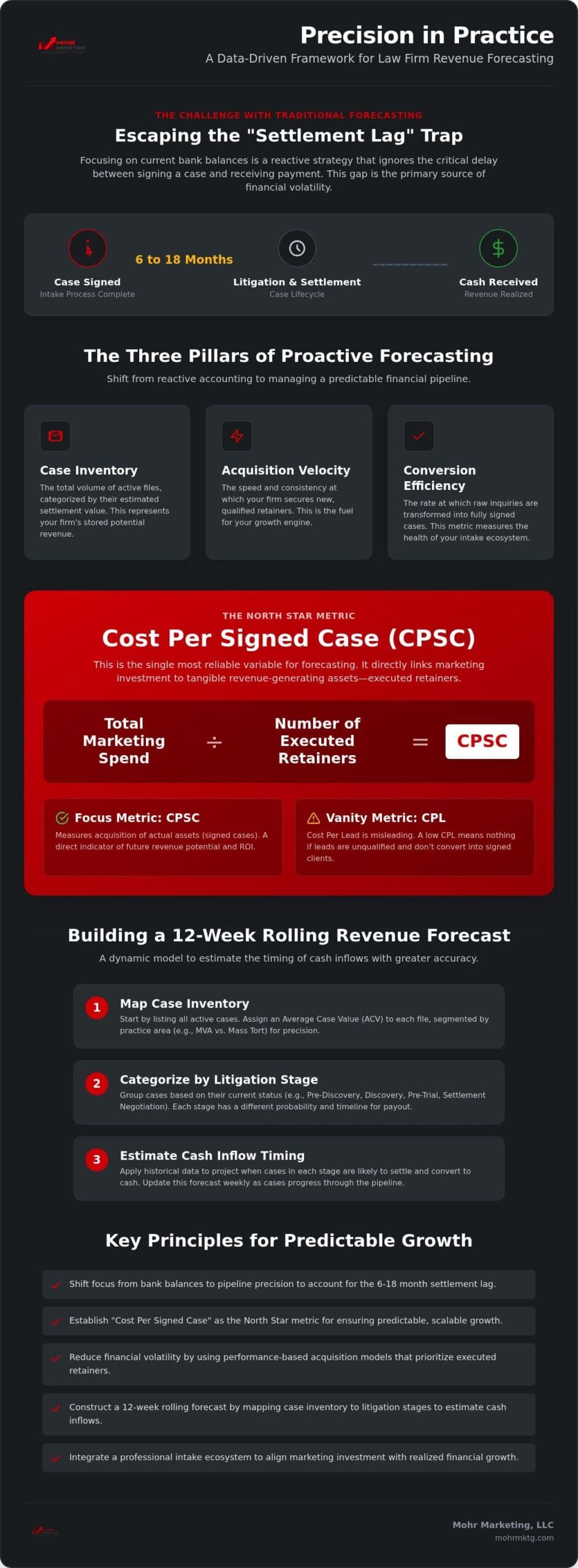
Revenue forecasting is the projection of future cash inflows based on current case inventory and acquisition rates. It’s more than a simple accounting task. It’s a strategic financial forecast that dictates your firm’s ability to scale. Many partners fall into the “Settlement Lag” trap by focusing on current bank balances. This ignores the 6 to 18 month revenue gap between signing a case and receiving a settlement check. If your intake slowed down six months ago, your revenue will drop today, regardless of your team’s current workload.
To master forecasting law firm revenue growth, you must track three specific pillars:
- Case Inventory: The total volume of active files categorized by their estimated settlement value.
- Acquisition Velocity: The speed at which your firm secures new, qualified retainers.
- Conversion Efficiency: The rate at which raw inquiries transform into signed cases through your intake ecosystem.
Moving from reactive accounting to proactive growth modeling requires a shift in perspective. You aren’t just managing a practice. You’re managing a financial pipeline that requires constant, predictable pressure to remain viable.
The Problem with Backward-Looking Metrics
Realization and collection rates are lagging indicators. They report on past performance but offer no insight into next year’s stability. Relying on historical settlement averages is a dangerous strategy if you don’t account for current fluctuations in lead volume. High-stakes professionals understand that a 91% realization rate is meaningless if the total volume of billable work is shrinking. You can’t bank on the past to fund future expansion. Forecasting Variance is the gap between projected settlement values and actual cash received.
Integrating Acquisition into the Financial Model
Your marketing budget is a capital investment in future revenue. It’s the primary fuel for your growth engine. Case Velocity determines exactly when that projected revenue will hit your operating account. Firms that rely on inconsistent lead sources often suffer from a Predictability Gap. Without a steady stream of mass tort signed cases or police report backed MVA cases, your forecast is little more than a guess. You must stabilize the acquisition variable to ensure your financial model remains accurate and actionable.
The 2026 Growth Equation: Identifying Core Revenue Forecasting Metrics
Standard KPIs like utilization or realization rates are insufficient for predicting future performance. They report on how efficiently you’re working today, but they don’t account for the cost of acquiring the business in the first place. For 2026, the North Star metric for any growth-oriented firm is Cost Per Signed Case (CPSC). This metric provides the direct link between marketing spend and tangible financial outcomes. When forecasting revenue from your law firms’ case inventory, you must first define the Average Case Value (ACV) for each specific practice area.
ACV for a motor vehicle accident (MVA) case differs significantly from a mass tort file. To calculate ACV, divide total historical settlement revenue by the number of cases closed within that specific practice area over a 12-month period. This allows you to apply a specific financial weight to your current pipeline. If your acquisition engine is currently focused on mass torts, your long-term revenue forecast will look drastically different than a model focused on high-volume, lower-value MVA cases. Precision in forecasting law firm revenue growth depends on these segmented calculations.
Calculating Cost Per Signed Case (CPSC)
The formula for CPSC is direct: Total Marketing Spend divided by the Number of Fully Executed Retainers. CPSC is a far more reliable forecasting variable than Cost Per Lead (CPL) because it accounts for the quality of the intake process. A low CPL is a vanity metric if those leads don’t sign. By focusing on mass tort signed cases, you fix the acquisition variable. This eliminates the volatility associated with lead quality and provides a hard number that can be plugged directly into your financial model.
The Intake Conversion Rate (ICR)
The Intake Conversion Rate (ICR) measures the delta between a raw inquiry and a signed case. Poor intake processes leak revenue. This creates a gap in your forecast that never materializes in the operating account. Analyzing the ROI of legal intake services reveals that small improvements here have massive downstream effects. Consider the Intake Multiplier. A 5% increase in intake efficiency doesn’t just result in 5% more cases; it compounds across your entire marketing spend. Over a 12-month period, this efficiency gain can shift your firm’s trajectory without increasing your advertising budget. If you’re looking to stabilize your pipeline, you can evaluate your current acquisition strategy to identify these hidden leaks.
Performance-Based Acquisition: Reducing Volatility in Financial Projections
The traditional Pay-Per-Lead (PPL) model is the enemy of accurate financial modeling. When you buy raw leads, you’re buying a variable, not a result. This forces your accounting team to guess conversion rates that fluctuate based on lead source quality. To achieve precision in forecasting law firm revenue growth, you must shift toward a Pay-Per-Signed-Case (PPSC) model. This approach eliminates the “Lead Quality” variable entirely. It transforms your marketing spend from a speculative expense into a predictable acquisition of secured assets.
Signed retainers are the most stable units of measurement in a litigation forecast. They represent a “Guaranteed Pipeline” because the initial hurdles of intake and qualification are already cleared. Relying on shared leads is a recipe for failure. Shared leads create “phantom” revenue. They appear in your CRM but fail to convert because you’re competing with three other firms for the same signature. Exclusivity is a requirement for any forecast that aims for mechanical accuracy. You can’t model growth on cases you only have a 25% chance of winning.
Eliminating the “Lead-to-Case” Guesswork
Verified inquiries and signed retainers provide a stable data set for 12-week rolling projections. When you secure truck accident signed cases, you gain immediate pipeline stability. You aren’t waiting to see if a lead will answer the phone. The case is already in your inventory. This level of certainty allows for more aggressive scaling. You can commit to larger operational investments because you know exactly how many new files will enter your system each month. Performance-based models remove the friction that usually stalls firm expansion. They allow you to plan for talent acquisition and infrastructure upgrades with confidence.
Verified Inquiries vs. Raw Leads
There’s a critical instructional difference between a raw lead and a verified inquiry. A lead is a potential opportunity that requires significant resources to qualify. A verified inquiry or signed case is a qualified financial asset. In a multi-practice forecast, you must weight these assets differently based on their specific ACV. For example, a motor vehicle accident case has a different burn rate than a complex mass tort file. Integrating high-value mold case acquisition into your model requires specific weighting to account for niche-specific settlement timelines. By categorizing your acquisition by case type and status, you build a forecast that reflects the actual cash-flow reality of your firm. This granular approach ensures that your growth projections are based on hard data rather than optimistic assumptions.
Strategic Implementation: Building a 12-Week Rolling Revenue Forecast
A 12-week rolling forecast is the tactical bridge between your current bank balance and your long-term expansion goals. It’s the only way to achieve consistent accuracy in forecasting law firm revenue growth. This model requires a five-step process that integrates your existing case inventory with your future acquisition pipeline. You must move away from static annual budgets that fail to account for the fluid nature of litigation timelines.
- Step 1: Inventory every active case by its specific “Stage of Litigation” (Pre-suit, Discovery, or Settlement).
- Step 2: Apply historical “Burn Rates” to each stage to estimate the actual time to cash-in-hand.
- Step 3: Overlay your “Acquisition Pipeline” using your committed marketing spend and established CPSC.
- Step 4: Adjust for “Intake Friction” by calculating the percentage of leads that fail to sign despite meeting criteria.
- Step 5: Reconcile your data weekly to identify variances in case velocity and adjust your projections accordingly.
Phase 1: The Case Inventory Audit
Timing accuracy depends on your ability to track “Days in Stage” within your CRM. Don’t value every case at its maximum potential. Assign a “Probability of Success” percentage to every file based on its stage. A case in settlement might be weighted at 90% while a pre-suit file is 50%. Discounting total value is essential for a conservative forecast. This prevents optimistic projections from leading to operational instability and is a core requirement for forecasting law firm revenue growth with precision.
Phase 2: The Acquisition Overlay
Your acquisition overlay predicts future revenue by multiplying projected signed cases by your ACV. High-intent data sources are critical. Utilizing police report-backed MVA cases shortens the “Verification Lag” in your forecast. Because these cases are pre-verified, they move through intake faster than raw inquiries. Set specific “Triggers” for scaling. If revenue exceeds projections, you can aggressively increase marketing spend to capture market share and drive growth.
Scaling with Certainty: Leveraging Signed Retainers for Predictable Growth
The signed retainer is the most powerful unit of measurement in any litigation forecast. It is a secured interest in future cash flow. It has already passed the filters of qualification and intake. Shifting your firm from a spend-based budget to a results-based growth plan is the final stage of professionalizing your operation. This transition allows you to stop managing marketing expenses and start managing financial outcomes. Mastering the art of forecasting law firm revenue growth requires this fundamental shift in perspective.
A results-based growth model offers tangible long-term value. It leads to more predictable partner distributions. It significantly lowers your firm’s reliance on external lines of credit. When you eliminate the uncertainty of lead conversion, your 12-week rolling forecast becomes a reliable map for scaling. You can hire staff, upgrade technology, and move into new practice areas with the confidence that your case inventory will support the investment. This is the difference between reactive accounting and aggressive strategic expansion.
The Mohr Marketing Advantage in 2026
Mohr Marketing provides a turnkey ecosystem backed by over 30 years of industry experience. This ecosystem acts as a critical risk-mitigation tool for partners who cannot afford to waste capital on unverified leads. We prioritize strict compliance with state laws and bar mandates to protect your firm’s future revenue from regulatory friction. Our focus on fully executed retainers ensures that you are injecting high-intent assets directly into your litigation pipeline. A forecast is merely a tool. Signed cases are the fuel that drives your firm’s expansion.
Next Steps for Managing Partners
Transitioning to a high-precision forecasting model requires immediate tactical changes. Managing partners must look beyond the bank balance to identify the structural weaknesses in their acquisition engine. Success in 2026 depends on your ability to turn data into certainty when forecasting law firm revenue growth.
- Audit your intake conversion rate: Determine exactly how many high-intent inquiries fail to become signed cases within the first 48 hours.
- Identify the leaks: Look for friction in your verification process that causes potential clients to drop out of the funnel.
- Fix the acquisition variable: Replace inconsistent, shared lead sources with exclusive, performance-based retainers to stabilize your forecast.
Stop treating your growth like guesswork. By aligning your intake efficiency with strategic financial modeling, you create a firm that is resilient to market shifts and primed for aggressive growth. You can consult with our strategic team to evaluate your current acquisition model and identify opportunities for immediate optimization.
Master Your Firm’s Financial Future in 2026
Professional revenue modeling is the difference between reactive management and aggressive expansion. You’ve learned that precision in forecasting law firm revenue growth requires a shift from backward-looking accounting to forward-looking acquisition science. By implementing a 12-week rolling forecast and prioritizing Cost Per Signed Case metrics, you eliminate the volatility that stalls firm development. Stabilizing your pipeline is the only way to protect your resources while pursuing growth.
Mohr Marketing offers 30+ years of industry expertise to help you secure fully verified, high-intent inquiries within a compliance-first marketing ecosystem. We provide the signed retainers. They act as the fuel for your financial model. These are not just leads; they’re qualified financial assets ready for your inventory. Transitioning to a results-based growth plan ensures that your partner distributions remain stable and your reliance on credit decreases.
You now have the data-driven framework to turn your intake process into a predictable engine for success. It’s time to stop treating your firm’s future like a game of chance and start scaling with mechanical accuracy. Your path to a more stable and profitable practice begins with the strategic alignment of case acquisition and financial modeling.
Frequently Asked Questions
How far in advance should a law firm forecast its revenue?
Firms should maintain a 12-month annual forecast and a rolling 12-week tactical forecast. The annual model provides a strategic roadmap for hiring and infrastructure. The 12-week model allows you to manage cash flow and respond to immediate fluctuations in case velocity. This dual approach ensures you balance long-term expansion goals with short-term operational needs. High-stakes firms use this rhythm to maintain stability during unpredictable litigation cycles.
What is the most common mistake in law firm revenue forecasting?
Relying on backward-looking metrics like historical billing is the most frequent error. These numbers reflect past work rather than future cash flow. Partners often ignore the “Settlement Lag” and fail to account for the current volume of new retainers entering the pipeline. Without integrating acquisition data, your forecast is just a record of history. Precision requires tracking the conversion of inquiries into signed cases in real-time.
How does case acquisition cost impact my firms profit margins?
Case acquisition cost is the primary variable that dictates net profitability. If your Cost Per Signed Case (CPSC) rises without a corresponding increase in settlement value, your margins shrink. Efficient firms stabilize this cost by using performance-based models to ensure every marketing dollar produces a verified asset. This predictability allows you to scale your firm without eroding the profit necessary for partner distributions and technological reinvestment.
Should I use a “Pay-Per-Lead” or “Pay-Per-Signed-Case” model for better forecasting?
The Pay-Per-Signed-Case model is superior for forecasting law firm revenue growth because it removes the lead-quality variable. Pay-Per-Lead models introduce “phantom” revenue where leads fail to convert. When you buy signed retainers, you’re acquiring qualified financial assets with a known probability of success. This certainty allows your accounting team to build models based on actual inventory rather than speculative inquiries that might never sign.
How do I account for settlement delays in my 12-week forecast?
Apply a historical “burn rate” to every case based on its current stage of litigation. If discovery typically takes six months, discount any revenue from those files in your immediate 12-week window. You must also track “Days in Stage” within your CRM to identify cases that are stalling. Adjusting for these delays prevents cash flow surprises and ensures your firm remains liquid during extended litigation periods.
What KPIs are most important for predicting law firm growth in 2026?
Focus on Cost Per Signed Case (CPSC), Case Velocity, and the Intake Conversion Rate. While traditional firms track billable hours, growth-oriented firms track the speed at which inquiries become retainers. These metrics provide a forward-looking view of your pipeline’s health. Monitoring these specific data points is the only way to achieve mechanical accuracy when forecasting law firm revenue growth in a competitive national market.
Can intake efficiency actually change my revenue projections?
Intake efficiency is the primary throttle for your firm’s revenue. A 5% increase in your conversion rate compounds across your entire marketing budget. This doesn’t just add a few cases; it significantly lowers your overall acquisition cost and increases the volume of your pipeline. Professional intake services plug the leaks where high-intent inquiries fail to sign, turning wasted marketing spend into realized financial assets for your forecast.
How do I forecast revenue for a new mass tort practice area?
Use historical industry data for Average Case Value (ACV) and combine it with a performance-based acquisition model. Since you lack internal history, buying signed retainers provides a “Guaranteed Pipeline” with fixed costs. This allows you to project revenue based on the number of cases you commit to acquiring. It’s a risk-mitigation strategy that prevents your new practice area from becoming a drain on your firm’s existing resources.

Recent Posts
- Mass Tort Claimant Acquisition: A Practical Framework for Law Firms
- Signed Cases for Attorneys: A 2026 Evaluation Guide
- How to Get More Personal Injury Cases: A 2026 Growth Guide
Categories
- AI and Lead Generation
- Business Financing
- Call Verified MVA Leads
- Car Accident Help
- Car Accident Settlements
- Claimant Funding
- Compliance Program
- EMS-EMT Reports
- Geotargeting
- Google Maps Ranking
- Healthcare Practice Growth
- Law Firm Growth
- Law Office Operations
- Lead Generation
- Lead Generation For Attorneys
- Lead Generation For Chiropractors
- Lead Generation For Criminal Attorneys
- Lead Generation For D&A Treatment Centers
- Lead Generation For DUI Attorneys
- Lead Generation For Eye Doctors
- Lead Generation For Family Law Practices
- Lead Generation For PI Law Firms
- Lead Generation For Plastic Surgeons
- Leads For Healthcare Professionals
- Leads For Insurance Industry
- Legal Leads
- Legal Marketing
- Legal Updates
- Mass Tort Leads
- Medicare and Medicaid Leads
- Merchant Funding Leads
- Mold Leads
- Online Marketing Strategies
- Pre-Settlement Funding
- Signed MVA Cases
- Tort Updates
- Truck Accident Leads and Signed Cases
- Truck Accident Settlements
- Web Design