Tampon Lawsuit Ads: High-Intent Case Acquisition Guide
August 22, 2026 by Mohr Marketing
The era of broad PFAS marketing is over. Firms still chasing those dismissed claims are burning capital on non-viable leads. Effective advertising for tampon lawsuits now requires a pivot toward lead-contamination torts supported by the latest 2026 court rulings. You’ve likely seen the cost-per-lead skyrocket while the quality of claimants drops due to strict medical criteria and the July 2025 PFAS dismissal. It’s frustrating to watch your budget disappear into a funnel that doesn’t produce signed retainers.
We understand that efficiency and tangible outcomes are the only metrics that matter in a competitive mass tort environment. This guide provides the blueprint to master the mechanics of acquiring high-value tampon litigation claimants through precision marketing and verified intake ecosystems. We’ll examine the current scientific landscape, including the 2024 Berkeley study and recent 2026 filings like the Franco Lopez case in California, to build a compliant and scalable funnel for your firm. You’ll learn to eliminate inefficient intermediaries and focus on cases with documented reproductive harm.
Key Takeaways
- Identify the critical legal divergence between lead and PFAS claims to focus your acquisition efforts on viable, high-value torts.
- Optimize your advertising for tampon lawsuits by prioritizing high-intent search queries that target specific toxic metal exposure over broad social media awareness.
- Implement a rigorous compliance framework that adheres to 2026 state bar mandates to protect your firm from deceptive marketing allegations.
- Eliminate the bottleneck of non-viable leads by transitioning to a verified intake ecosystem that delivers fully executed retainers.
- Master the medical causation requirements necessary to filter inquiries and focus resources on claimants with documented reproductive harm.
The Landscape of Tampon Litigation in 2026
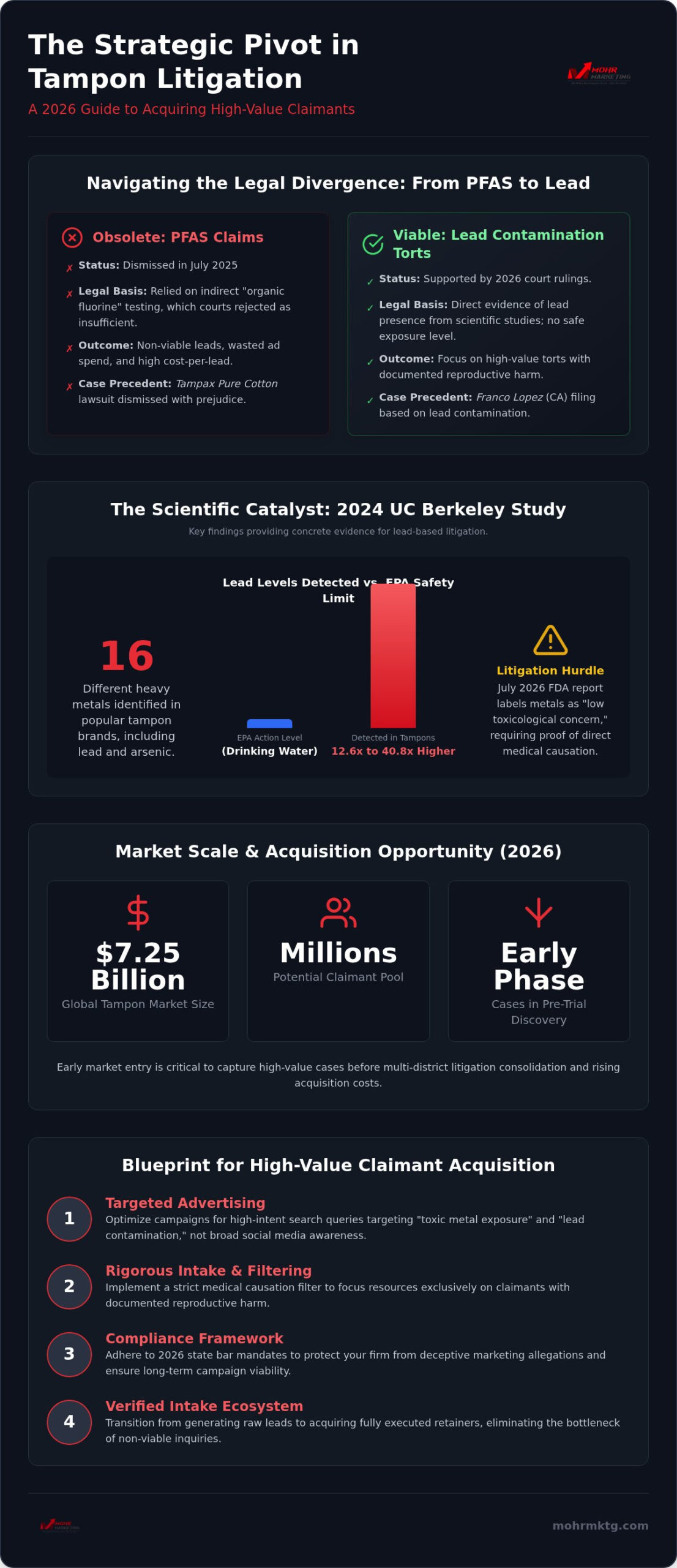
The tampon litigation environment has undergone a fundamental transformation since the 2025 dismissal of major PFAS-related claims. While early lawsuits focused on “forever chemicals,” the current legal battleground centers on heavy metal contamination. This shift is not merely a change in chemicals; it’s a strategic move from economic loss class actions to personal injury mass torts. Firms are now targeting specific reproductive injuries rather than simple consumer refunds. Failure to adapt to this shift means wasting capital on obsolete PFAS theories. Success in advertising for tampon lawsuits in 2026 depends on understanding this scientific pivot and the resulting change in claimant criteria.
The Scientific Catalyst: UC Berkeley Findings
The 2024 University of California, Berkeley study serves as the foundational evidence for current filings. Researchers identified sixteen different heavy metals, including lead and arsenic, across multiple popular brands. Lead is particularly significant because it lacks a safe exposure level. Unlike the PFAS cases that struggled with “organic fluorine” testing methods, lead levels in certain products have been measured at 12.6 to 40.8 times the EPA’s action level for drinking water. This data provides a more concrete path to establishing liability. While the industry has a long history of Toxic Shock Syndrome litigation, the current focus on systemic metal absorption introduces new challenges regarding bioaccessibility. A July 2026 FDA report labeling these metals as “low toxicological concern” creates a significant hurdle. Litigation success now hinges on proving direct medical causation rather than just product presence.
Market Viability and Claimant Volume
The global tampon market is estimated at $7.25 billion in 2026. This massive consumer base creates a high-volume opportunity for firms entering the tort early. Unlike niche pharmaceutical torts, the potential claimant pool spans millions of users. Early entry is critical to capturing market share before lead costs escalate. Firms looking to scale quickly should focus on mass tort signed cases to bypass the friction of raw lead generation and the high percentage of non-qualifying inquiries. The 2026 litigation cycle is currently in the pre-trial discovery phase for cases like Otkina v. Procter & Gamble. This provides a strategic window for aggressive acquisition before multi-district litigation consolidation occurs. High-intent advertising for tampon lawsuits must target users searching for specific contaminants to ensure case viability and minimize budget waste on broad, low-intent traffic.
Lead vs. PFAS: Navigating Legal Divergence
The July 2025 dismissal of the PFAS-focused lawsuit against Tampax Pure Cotton marked a definitive shift in the legal landscape. This case was dismissed with prejudice because the plaintiffs failed to provide specific evidence of PFAS presence, relying instead on “organic fluorine” as a surrogate. Courts have rejected this indirect testing as insufficient for establishing liability. If your current advertising for tampon lawsuits still targets “forever chemicals,” you’re likely generating inquiries that will be dismissed at the discovery phase. These legal and regulatory issues demonstrate that broad claims without precise chemical verification are no longer viable.
Firms must pivot advertising copy toward the lead contamination findings established in 2024. Unlike PFAS, the presence of lead in these products directly contradicts “pure” and “organic” marketing labels. This creates a dual-threat litigation strategy combining product liability with consumer fraud. To ensure your firm targets only viable lead-contamination torts, you should consult with our intake specialists about filtering non-qualifying PFAS inquiries.
Lessons from Dismissed PFAS Class Actions
The failure of Lowe v. Edgewell highlights the necessity of rigorous evidentiary standards. Cursory testing allegations are no longer enough to survive a motion to dismiss. When firms market to potential claimants, the intake process must verify the specific brand and product line to avoid the pitfalls of previous dismissals. You don’t want a database full of Tampax Pure Cotton inquiries based on PFAS theories that have already been rejected by federal courts. Precision in your initial targeting prevents budget waste on non-starter cases.
The Lead Contamination Advantage
Lead exposure offers a clearer path to establishing liability because there’s no safe level of lead in the human body. The 2024 Berkeley study provides the scientific baseline needed to argue that manufacturers failed their duty to warn. Effective advertising for tampon lawsuits should focus on long-term usage and brand loyalty to Tampax Pearl or Radiant lines. These consumers represent the highest case value because their exposure is cumulative. By building case criteria around documented reproductive harm and heavy metal presence, firms can secure more resilient retainers that withstand the scrutiny of defense counsel and the FDA’s recent “low concern” positioning.
Strategic Advertising for Tampon Lawsuits
High-performance advertising for tampon lawsuits requires moving beyond broad awareness campaigns. Social media platforms like Meta are effective for mass education, but they often capture low-intent inquiries from users who are merely curious. To secure high-value claimants, you must dominate search engines where users are actively seeking solutions. A user searching for specific litigation terms is already aware of the potential harm and is looking for a firm to represent them. This distinction between awareness and intent is what separates a bloated database from a profitable docket.
Search Intent vs. Social Interruption
Search queries like “tampon lead lawsuit” or “Tampax lead exposure attorney” indicate a user is deep in the conversion funnel. These long-tail keywords consistently outperform general terms like “toxic tampons” because they filter out casual researchers. While social media creates a necessary echo chamber for tort awareness, Google Search captures the actual conversion. Your strategy should leverage social media to drive search volume, then use aggressive search bidding to capture that intent. Understanding the FDA regulation of tampons as Class II medical devices helps you refine your ad copy. Highlighting how manufacturers allegedly failed to meet these safety standards adds the professional authority necessary to convert skeptical users into claimants.
Developing High-Conversion Funnels
Your landing page is your most critical asset in the acquisition process. It must be mobile-first because the vast majority of claimants in this demographic access information via smartphone during short windows of personal time. A slow, desktop-centric page will destroy your conversion rate. The page must establish immediate trust through professional design and clear, declarative statements about the litigation. Avoid dense blocks of text. Use staccato fragments to deliver key facts about lead contamination and reproductive harm. The objective is to move the user from the initial click to a completed intake form in under sixty seconds. For firms that lack the resources to manage high-volume raw inquiries, transitioning to mass tort signed cases is the most efficient way to scale. This model removes the friction of internal intake and ensures your budget is spent only on verified, high-intent claimants who meet strict medical criteria.
Compliance and Ethics in Mass Tort Marketing
Ensure all advertising for tampon lawsuits meets strict state bar mandates and Trial Partner Services Association (TPSA) guidelines. Compliance isn’t a secondary concern. It’s the foundation of your firm’s reputation and docket viability. Recent updates to attorney advertising rules in Alabama and California (January 2026) and New York (June 2026) have increased scrutiny on mass tort solicitations. You must avoid misleading claims regarding potential settlement amounts. As of August 2026, no official settlement funds exist for lead contamination cases. Any advertisement suggesting immediate payouts is fraudulent and risks severe regulatory sanctions.
State Bar Mandates and Disclosures
Navigating “Attorney Advertising” disclaimer requirements is mandatory for every digital asset you deploy. Transparency regarding the scientific status of the litigation is actually a strategic marketing asset. Don’t hide the July 2026 FDA report that labeled trace metals as a “low toxicological concern.” Instead, address it directly by highlighting the divergence between regulatory standards and the alleged heavy metal concentrations found in consumer products. This builds trust with high-intent claimants who value accuracy over hyperbole. You must avoid the “guaranteed outcome” trap. Every piece of digital copy should emphasize that results depend on individual case facts and medical documentation. This professional decorum protects your firm while you pursue high-volume case acquisition.
Data Privacy and HIPAA Considerations
Protecting sensitive health data during the intake process is a non-negotiable requirement. When you scale your funnel, your lead provider must use secure, HIPAA-compliant infrastructure to handle reproductive health information. Non-compliant intake processes create a massive liability risk in high-stakes litigation. If a data breach occurs, the resulting fallout could dwarf the value of your entire docket. You need a partner that understands the mechanics of secure data transmission. We provide mass tort signed cases that are processed through a verified, compliant ecosystem. This eliminates the risk of mishandling claimant data and ensures that every retainer in your possession is backed by a secure audit trail. Reliability in data management is what separates seasoned industry veterans from opportunistic intermediaries.
Scaling Acquisition with Verified Signed Cases
Traditional advertising for tampon lawsuits creates a volume problem that stalls firm growth. Most marketing efforts generate a high volume of raw inquiries, but volume does not equal value. The primary bottleneck in mass torts is the “lead-to-retainer” gap. Firms often find themselves chasing non-responsive leads or individuals who only qualify under dismissed PFAS theories. This waste of internal resources prevents you from scaling your dockets at the pace required for a national litigation effort. You need a solution that moves beyond raw data to deliver tangible assets.
The Mechanics of the Mohr Intake Ecosystem
Our solution replaces raw data with fully executed documents. We utilize a turnkey intake ecosystem that filters every inquiry through a rigorous verification process built on 30 years of industry experience. We screen for specific product lines, such as Tampax Pearl and Radiant, and verify the duration of exposure. Most importantly, we confirm the claimant meets the medical criteria for reproductive harm before the retainer is ever sent. This transition from digital inquiry to signed agreement happens within minutes, capturing the claimant’s intent while it’s at its peak. By delivering mass tort signed cases, we ensure your staff spends time on litigation, not telemarketing. Our process maintains strict compliance with state bar mandates, ensuring every case is ready for your docket.
De-Risking Your Practice Growth
The ROI of a signed case is transparent and immediate. Stop gambling on raw lead quality. Comparing raw leads to signed cases reveals a stark difference in financial performance. Raw leads carry hidden costs: intake labor, CRM overhead, and the high price of non-conversions. Performance-based advertising for tampon lawsuits is the only logical strategy for this tort. A pay-per-signed-case model eliminates these variables. It protects your firm’s capital by ensuring every dollar spent results in a signed retainer. This strategy allows your firm to enter the 2026 tampon litigation cycle with a predictable cost-per-case, removing the volatility of traditional marketing. For firms ready for national expansion, this model provides the most streamlined path to success.
Efficiency is your greatest weapon. Don’t let your expansion be throttled by inefficient intermediaries or low-quality data. Secure your position in this tort by focusing on verified, high-intent claimants who have already committed to the legal process. Partnering with a veteran team allows you to bypass the friction of traditional lead generation and move directly to docket growth.
Dominate the 2026 Tampon Litigation Market
The shift from PFAS theories to heavy metal contamination is the defining factor for success in 2026. Firms that continue to rely on broad social awareness will see their budgets eroded by non-viable inquiries. You must pivot to high-intent search strategies and focus on lead-contamination torts supported by the latest scientific findings. Efficiency in advertising for tampon lawsuits is no longer optional. It’s a requirement for national expansion.
You need a partner that eliminates the friction of raw lead generation and delivers fully executed documents. Mohr Marketing brings 30 years of industry experience to your practice. We provide verified inquiries and fully executed retainers through a transparent, performance-based model. We’ve optimized the intake ecosystem so you can focus on litigation while we handle the mechanics of high-intent claimant acquisition.
Take the proactive step to secure your firm’s position in this evolving tort and build a resilient docket today.
Frequently Asked Questions
Is the tampon lawsuit still active after the Tampax PFAS dismissal?
Yes, litigation remains active with a primary shift toward lead and heavy metal contamination. While the July 2025 PFAS-focused dismissal affected specific claims, newer filings like the July 2026 Franco Lopez case target broader toxic substances. Current litigation is in the pre-trial discovery phase for several Tampax-related cases. This divergence means firms must focus their acquisition on lead-based injuries rather than dismissed chemical theories to maintain case viability.
What brands are currently named in the tampon lead contamination studies?
The 2024 University of California, Berkeley study identified heavy metals in multiple major brands. The Procter & Gamble Company is the primary defendant in current lead-related litigation, specifically regarding its Tampax Pearl and Tampax Radiant product lines. Other hygiene companies like Kimberly-Clark have also been named in recent 2026 class action filings. Your marketing should target users of these specific brands to ensure you capture claimants who meet the exposure criteria established in active lawsuits.
How does a pay-per-signed-case model work for mass torts?
A pay-per-signed-case model operates on a performance basis where firms pay only for fully executed retainer agreements. This eliminates the financial risk associated with raw lead generation. We handle the entire funnel, including high-intent digital marketing, rigorous medical screening, and document execution. This turnkey ecosystem removes the burden of internal intake from your staff. It ensures that every dollar of your budget results in a verified claimant ready for your docket.
What medical criteria are required for a viable tampon lead case?
Viable cases generally require documented reproductive harm or systemic health issues linked to heavy metal exposure. Successful litigation depends on proving medical causation, specifically connecting long-term tampon usage to injuries like infertility, endometriosis, or other reproductive disorders. Our intake process screens for these specific conditions and verifies the duration of product usage. This filtering is essential because trace metal presence alone, as noted by the July 2026 FDA report, may not meet current litigation standards.
Can I advertise for tampon lawsuits nationally?
Yes, you can and should advertise for tampon lawsuits on a nationwide basis to achieve the necessary volume for mass tort litigation. We provide nationwide acquisition services that comply with various state bar mandates. Because a formal MDL has not yet been established, capturing a broad geographic claimant pool allows your firm to build a stronger position before potential consolidation. Our ecosystem manages national campaigns to deliver high-quality signed retainers regardless of the claimant’s location.
What is the difference between lead and arsenic contamination in tampons?
Both lead and arsenic were identified in the 2024 Berkeley study, but lead currently serves as the primary legal battleground. Lead is particularly significant because scientific consensus maintains there is no safe level of human exposure. Arsenic contamination presents a parallel liability argument, but lead levels in some products were found to be significantly higher than EPA drinking water standards. Effective advertising for tampon lawsuits should highlight these specific contaminants to attract claimants who understand the toxicity risks.
How long does the intake process take for a mass tort claimant?
The intake process through a verified ecosystem typically takes only a few minutes from the initial inquiry to the signed retainer. Speed is critical in mass torts to prevent claimant attrition. Once a user submits their information via a high-intent landing page, they are immediately screened against medical and usage criteria. If they qualify, the retainer agreement is presented for digital signature instantly. This rapid transition captures intent and secures the case before the claimant loses interest.
Why should I choose search-based advertising over social media for this tort?
Search-based advertising captures users with active intent, whereas social media primarily generates broad awareness. A user searching for specific litigation terms is actively seeking legal representation, making them a higher-value lead than a casual social media scroller. While social media can drive initial interest, search engines are where conversions happen. By prioritizing search intent, you reduce budget waste on non-viable inquiries and focus your resources on claimants who are ready to sign a retainer immediately.

Recent Posts
- Medical Malpractice Leads: A Strategic Guide for Law Firms
- Pay-Per-Lead Legal Marketing: A Guide for Law Firms
- Exclusive Personal Injury Leads: How Law Firms Should Evaluate Quality in 2026
Categories
- AI and Lead Generation
- Business Financing
- Call Verified MVA Leads
- Car Accident Help
- Car Accident Settlements
- Claimant Funding
- Compliance Program
- EMS-EMT Reports
- Geotargeting
- Google Maps Ranking
- Healthcare Practice Growth
- Law Firm Growth
- Law Office Operations
- Lead Generation
- Lead Generation For Attorneys
- Lead Generation For Chiropractors
- Lead Generation For Criminal Attorneys
- Lead Generation For D&A Treatment Centers
- Lead Generation For DUI Attorneys
- Lead Generation For Eye Doctors
- Lead Generation For Family Law Practices
- Lead Generation For PI Law Firms
- Lead Generation For Plastic Surgeons
- Leads For Healthcare Professionals
- Leads For Insurance Industry
- Legal Leads
- Legal Marketing
- Legal Updates
- Mass Tort Leads
- Medicare and Medicaid Leads
- Merchant Funding Leads
- Mold Leads
- Online Marketing Strategies
- Pre-Settlement Funding
- Signed MVA Cases
- Tort Updates
- Truck Accident Leads and Signed Cases
- Truck Accident Settlements
- Web Design