Value of EMS Reports in Car Accident Lawsuits
August 13, 2026 by Mohr Marketing
The first ten minutes following a collision often dictate the ultimate trajectory of a legal claim, yet many firms overlook the most objective evidence available. While hospital records are vital, they often reflect a patient after compensatory mechanisms or ER interventions have masked the true severity of the trauma. Understanding the EMS-EMT accident reports value to car accident law suit outcomes is essential for any firm aiming to maximize settlement recovery. These contemporaneous records capture the clinical reality of the scene before legal coaching or recall bias can influence the narrative.
You’ve likely faced insurance adjusters who use a brief delay in ER visits to argue that your client wasn’t actually injured. It’s a common tactic designed to devalue legitimate claims. This article provides a clear framework for using NEMSIS v3.5.1 standardized data to establish immediate medical necessity and counter “gap in care” arguments. You’ll learn how to leverage electronic Patient Care Reports (ePCRs) to validate injury severity, analyze Glasgow Coma Scale scores for traumatic brain injury cases, and secure the high-impact evidence needed to drive significant settlement increases.
Key Takeaways
- Leverage the hearsay exception for medical diagnosis to ensure EMS reports serve as admissible, foundational evidence of injury from the moment of impact.
- Utilize Glasgow Coma Scale (GCS) and Mechanism of Injury (MOI) data to quantify clinical severity before ER interventions or compensatory mechanisms mask patient symptoms.
- Maximize the EMS-EMT accident reports value to car accident law suit outcomes by using objective scene documentation to effectively counter insurance company “gap in care” arguments.
- Identify high-value surgical cases early in the intake process by correlating ambulance transport and documented scene pathology with higher policy limit payouts.
- Scale your firm’s growth by prioritizing signed retainers that arrive with verified medical transport data and objective evidence already established.
The Evidentiary Weight of EMS and EMT Accident Reports
EMS reports aren’t just administrative logs; they are the first clinical snapshots of a trauma event. These records provide a baseline of injury severity before a claimant’s body begins to compensate for shock or an ER physician administers pain management. For attorneys, the EMS-EMT accident reports value to car accident law suit success lies in their status as contemporaneous evidence. Because these reports are generated for the express purpose of medical diagnosis and treatment, they often qualify for a specific hearsay exception. This makes them highly admissible and difficult for defense counsel to exclude during discovery or trial.
Contemporaneous Documentation vs. Delayed Treatment
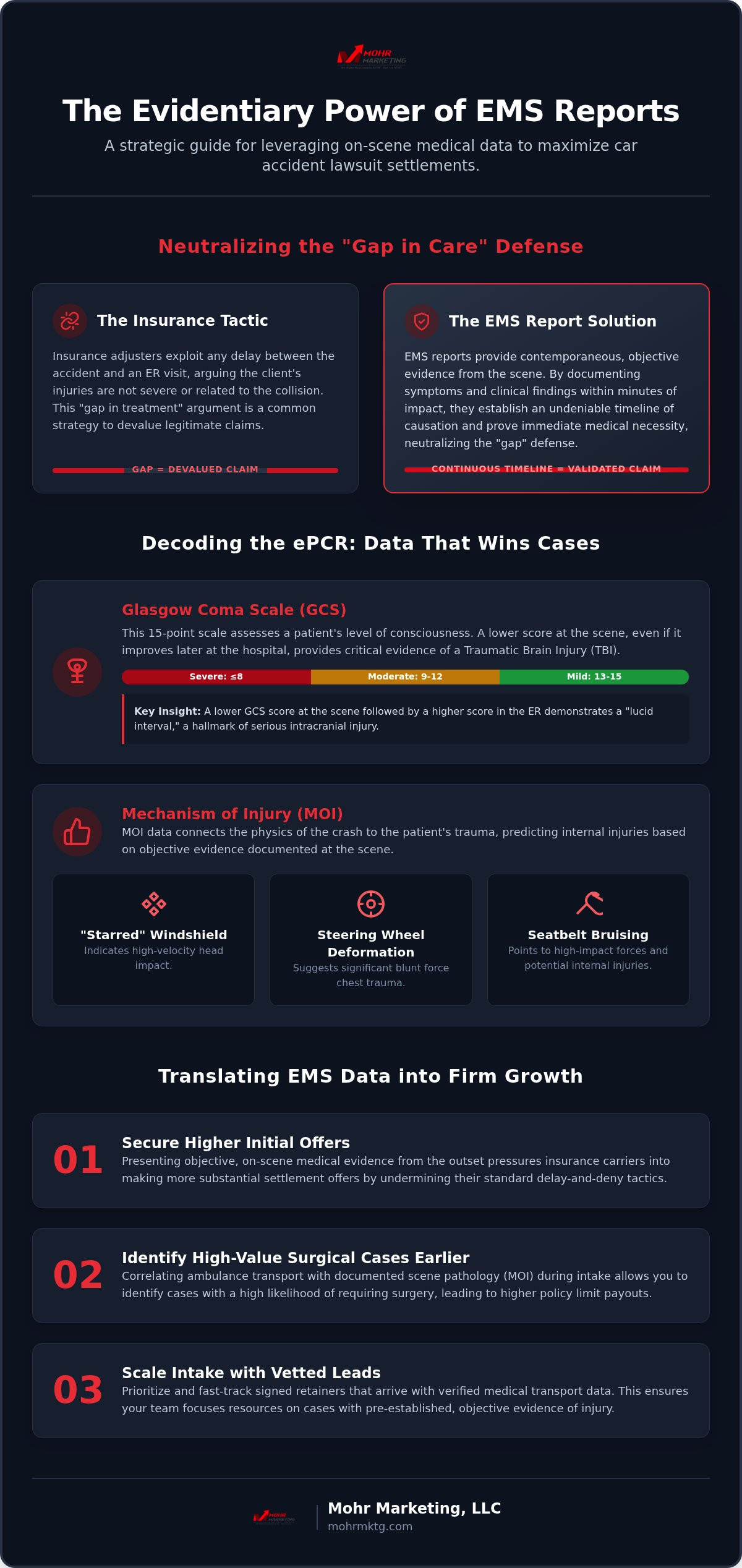
Insurance adjusters frequently exploit any delay between the accident and the first medical visit to argue a “gap in treatment.” They claim the injury didn’t happen at the scene or wasn’t severe enough to warrant immediate care. EMS reports effectively neutralize this defense. By documenting symptoms within minutes of the impact, these records establish an undeniable timeline of causation. This is why firms focusing on police-report-backed-mva-cases often see higher initial settlement offers. Documentation created at the scene is difficult to impeach because it captures the patient’s raw, uncoached physical state before legal considerations enter the picture.
The Legal Admissibility of Pre-Hospital Records
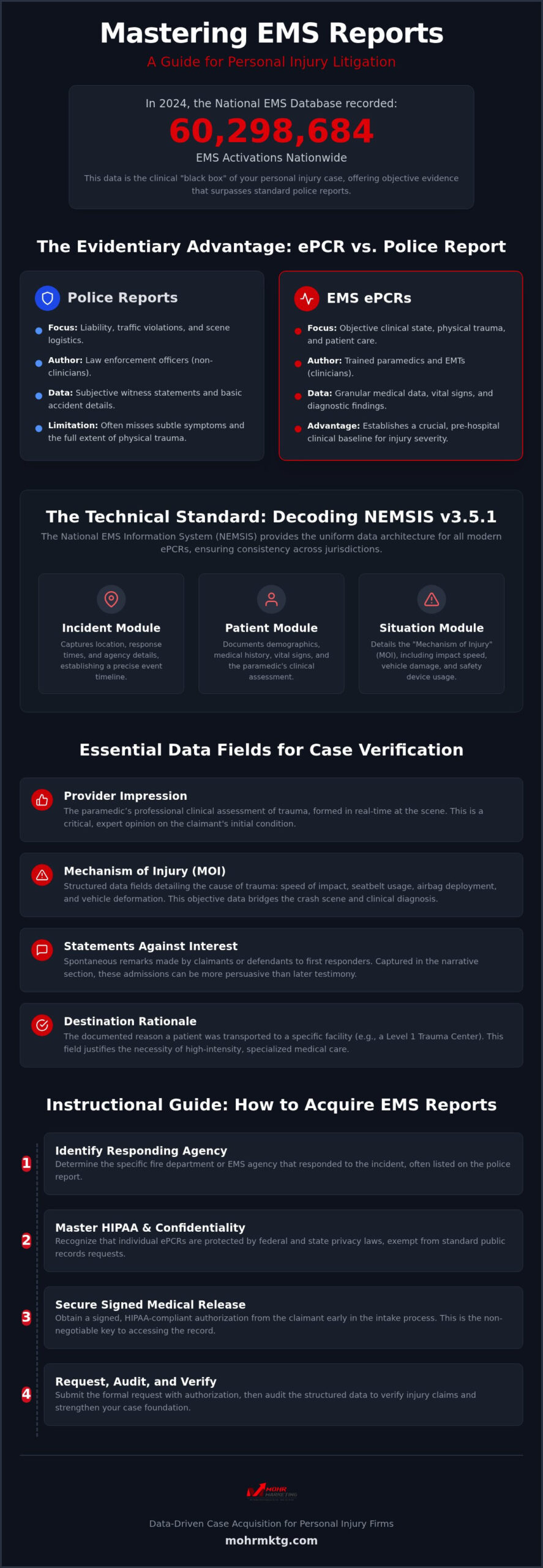
Pre-hospital records are created within the Emergency Medical Services (EMS) framework and serve as a vital tool for corroborating or impeaching witness testimony. EMTs are trained to observe more than just vital signs. They document the vehicle’s interior state, including airbag deployment, steering wheel deformation, and the presence of blood or shattered glass. These observations provide objective proof of the impact’s force. Mechanism of Injury is a clinical assessment that uses the physical forces involved in a collision to predict the likelihood and severity of internal trauma. When an EMT notes a “starred windshield” or “intrusion into the passenger cabin,” they are building your case’s medical foundation before the client even reaches the hospital. These details prove that the physical pathology matches the accident dynamics, leaving little room for defense counsel to dispute injury mechanics.
Key Data Points: How EMT Documentation Quantifies Injury Severity
The raw data within a patient care report provides the clinical leverage needed to counter low-ball insurance offers. Unlike hospital records that summarize days of care, these reports focus on acute distress. The EMS-EMT accident reports value to car accident law suit recovery is found in the SOAP (Subjective, Objective, Assessment, Plan) narrative. This structure records the patient’s immediate complaints and the medic’s physical findings before any legal coaching occurs. These details are critical because of the legal implications of EMS documentation, which serves as a baseline for all subsequent medical treatment.
Interpreting the Glasgow Coma Scale (GCS)
The Glasgow Coma Scale is a 15-point score used to assess a patient’s level of consciousness. It evaluates eye opening, verbal response, and motor response. A score of 13 to 15 indicates a mild brain injury; 9 to 12 suggests moderate trauma; and 8 or below is a severe traumatic brain injury (TBI). You shouldn’t assume a “perfect” 15 in the ER negates a scene-level TBI. If an EMT records a 13 at the crash site but the patient improves to a 15 at the hospital, you’ve documented a “lucid interval.” This fluctuation is a hallmark of intracranial pressure and provides the objective proof needed to secure a higher settlement.
Mechanism of Injury (MOI) and Physical Findings
EMTs use the Mechanism of Injury to predict internal damage based on the crash’s physical forces. This data point connects vehicle damage to physical pathology. If a report mentions “starring” on the windshield, it’s a direct indicator of high-velocity head impact. Steering wheel deformation suggests significant blunt force chest trauma. These physical markers are often overlooked by ER doctors who focus on the patient’s current state rather than the scene’s physics.
- Seatbelt Bruising: Often correlates with internal abdominal bleeding or mesenteric tears.
- Triage Tags: In multi-vehicle accidents, these prioritize the most severe injuries, establishing immediate medical necessity.
- Vitals: Tachycardia or hypotension at the scene proves acute physical distress that a later hospital reading can’t erase.
If your firm is looking to scale with cases that already feature this level of documented medical transport, contact our intake specialists to discuss verified MVA leads and signed retainers.
EMS Reports vs. Hospital Records: The Evidentiary Advantage
Hospital records focus on diagnostic testing and long-term stabilization, but EMS reports capture the raw clinical reality of the accident scene. This distinction is critical because the EMS-EMT accident reports value to car accident law suit strategy often hinges on establishing symptoms before they’re masked by hospital interventions. ER physicians treat a patient in a controlled, sterile environment; EMTs treat a patient in the chaos of the collision. These records provide a bridge between the physics of the crash and the medical diagnosis, offering details that hospital staff simply aren’t present to witness.
The Adrenaline Mask and Delayed Symptom Onset
Defense counsel frequently exploits ER records that note “no acute distress” or “patient denies pain.” They use these entries to claim the injury didn’t occur or was a result of a subsequent event. However, the massive adrenaline surge following a high-impact crash temporarily suppresses pain receptors. Patients often report specific localized pain to EMTs at the scene, only to feel “fine” by the time they reach the triage desk thirty minutes later. By the time the adrenaline wears off, the patient is already in the ER, where the focus shifts to life-threatening issues rather than soft-tissue complaints. Using the EMS narrative allows you to explain this physiological delay and prevent insurers from devaluing the claim.
Scene Narrative: The EMT as a Neutral Professional Witness
EMTs are trained observers who document more than just the claimant. They witness the defendant’s behavior, the positioning of the vehicles, and spontaneous utterances made by all parties. This is vital for the admissibility of patient statements and scene observations that never make it into a sterile hospital chart. A medic’s note that the defendant was “stumbling” or “smelled of alcohol” provides foundational evidence that can corroborate a police report or impeach a defendant’s testimony later in the litigation process.
Tracking the immediate need for narcotics also serves as an objective pain marker. If a medic administers Fentanyl or Morphine in the back of an ambulance, it establishes a definitive record of high-intensity trauma. This immediate medical necessity is often buried in hospital Transfer of Care (TOC) notes but remains explicit in the EMS documentation. Firms targeting truck-accident-signed-cases-and-verified-call-transfer-leads prioritize these reports to ensure the initial trauma intensity is documented before the defense can argue the client was “ambulatory” or uninjured at the scene.
Strategic Case Vetting: Identifying High-Value MVA Claims
Case vetting is a game of probability and clinical precision. Firms that rely solely on a claimant’s subjective narrative often find themselves bogged down by low-value soft-tissue files. Understanding the EMS-EMT accident reports value to car accident law suit outcomes is the difference between a high-volume firm and a high-margin firm. By analyzing the “Run Sheet” or ePCR during the initial intake phase, you can identify objective markers that correlate directly with higher Bodily Injury Liability (BIL) payouts. This data-driven approach eliminates the inefficiency of traditional intake methods and ensures your marketing dollars target viable recovery targets.
Filtering for High-Impact Settlements
Identify immediately whether the transport was classified as Advanced Life Support (ALS) or Basic Life Support (BLS). ALS interventions represent a significant escalation in care. If a medic performs cardiac monitoring, administers intravenous narcotics, or manages an advanced airway, they’re documenting a high-intensity trauma event. The EMS-EMT accident reports value to car accident law suit vetting process allows you to pivot toward high-intent, high-value opportunities with surgical potential early in the litigation cycle. Conversely, BLS transport usually involves non-invasive monitoring and basic wound care. Another critical value signal is the mention of extrication. If a report notes the use of the “Jaws of Life” or heavy rescue equipment, the physical forces involved almost certainly guarantee significant pathology. Firms that prioritize police-report-backed MVA cases use these objective scene findings to stop-loss marketing spend on unviable leads early in the funnel.
Optimizing Intake with Medical Verification
Securing the EMS report within the first 48 hours is a strategic necessity for accurate case qualification. This document serves as a clinical “triage tag” for your entire intake pipeline. It identifies “Red Flag” issues, such as a claimant’s mention of pre-existing injuries or a lack of objective distress at the scene, before you commit to the expense of full medical records retrieval. Verified medical data at the intake stage transforms a “lead” into a “high-intent opportunity.” This rigor improves the overall conversion efficiency of your firm’s intake operations. By focusing on cases with documented ambulance transport and scene-level trauma, you ensure that every signed retainer in your inventory has a foundational path to a successful settlement.
Scaling Your Firm with Verified, High-Intent MVA Leads
Consistent growth in personal injury law requires a shift from chasing volume to securing verified value. The EMS-EMT accident reports value to car accident law suit success extends beyond the courtroom and into your firm’s bottom line. By prioritizing cases with documented medical transport, you eliminate the financial drain of unviable soft-tissue claims. Mohr Marketing, LLC specializes in this transition, moving your firm away from raw web inquiries and toward signed retainers backed by objective clinical data. This ensures your marketing budget is an investment in recoverable damages rather than administrative overhead.
The Advantage of Performance-Based Case Acquisition
Traditional lead generation forces your intake team to act as medical investigators. This process wastes dozens of hours on uncooperative or uninjured claimants who never had a viable case. A performance-based model removes this administrative friction by delivering cases that have already met strict clinical criteria. When you acquire signed retainers, the foundational work of verifying the accident’s severity is already complete. To reduce friction in your workflow, follow these steps:
- Verify Transport: Only accept cases where ambulance transport is confirmed by dispatch or scene records.
- Review GCS Scores: Prioritize intakes where scene-level Glasgow Coma Scale scores indicate potential TBI.
- Audit Mechanism of Injury: Ensure the vehicle damage documented by EMTs matches the physical pathology reported by the client.
This data-driven approach ensures your cost per signed case remains predictable. Your staff can focus on litigation and settlement negotiation rather than lead qualification. By targeting police-report-backed MVA cases, you secure the objective evidence needed to defeat insurance company “gap in care” defenses before they’re even raised.
Next Steps: Partnering for National Growth
The 2026 legal landscape demands transparency and rigorous verification. With 30 years of industry experience, Mohr Marketing, LLC provides a turnkey ecosystem designed for firms seeking aggressive national expansion. Our process prioritizes high-intent MVA claimants who have already received professional medical intervention at the scene. This ensures the EMS-EMT accident reports value to car accident law suit strategy is baked into every file you receive. You pay for tangible results and verified opportunities, not just empty inquiries. Secure your firm’s leadership position by focusing on high-value MVA opportunities that arrive with the evidence required for maximum recovery.
Maximize Case Value Through Clinical Verification
EMS reports provide the clinical baseline necessary to defeat “gap in care” defenses and establish immediate medical necessity. By leveraging objective scene data like Glasgow Coma Scale scores and Mechanism of Injury assessments, you can quantify trauma severity before it’s masked by hospital stabilization. Understanding the EMS-EMT accident reports value to car accident law suit outcomes allows your firm to prioritize high-margin litigation and secure maximum settlement recovery for your clients.
Mohr Marketing, LLC offers a turnkey intake and verification ecosystem backed by over 30 years of industry expertise. We ensure strict compliance with state bar mandates while delivering high-intent MVA cases that feature documented medical transport. Our performance-based model eliminates the waste associated with raw web inquiries, providing a direct and efficient path to national firm expansion. Partnering with a specialist ensures that every case in your inventory is backed by the foundational evidence required to drive significant insurance payouts.
Take the next step in optimizing your case acquisition strategy and building a high-value personal injury practice through rigorous medical verification.
Frequently Asked Questions
Does not taking an ambulance to the hospital lower my settlement value?
Declining an ambulance generally reduces settlement value because it allows insurance adjusters to argue a “gap in treatment.” Immediate transport establishes a clinical record of trauma from the moment of impact. This contemporaneous documentation makes it difficult for defense counsel to claim the injuries were minor or non-existent. Without this baseline, you lose the most objective evidence of your acute physical distress.
What is a GCS score and why does it matter in a car accident lawsuit?
The Glasgow Coma Scale (GCS) is a 15-point clinical tool used to assess neurological function and consciousness. In a lawsuit, a GCS score below 15 at the scene provides objective evidence of a traumatic brain injury (TBI). Even if the score improves later in the ER, the initial scene-level deficit proves the physiological impact of the collision and validates the severity of the head trauma.
Can an insurance company deny my claim if the EMS report says I was ‘stable’?
Adjusters often misinterpret the term “stable” to mean “uninjured” to justify low settlement offers. Clinically, “stable” simply means a patient’s vital signs are not currently deteriorating; it doesn’t negate the presence of fractures, internal bleeding, or soft-tissue damage. Lawyers use the specific physical findings and mechanism of injury in the report to counter this superficial defense and prove the underlying pathology.
How do I obtain the EMS or EMT report after a car accident?
You must submit a formal request to the specific emergency service provider or fire department that responded to the scene. This process requires a signed HIPAA-compliant medical release form. Most agencies now utilize electronic Patient Care Reports (ePCRs) through the NEMSIS v3.5.1 standard, which allows for faster retrieval than traditional paper records. Your attorney can typically expedite this request during the discovery phase.
What is the difference between an EMS report and a police report for a lawsuit?
A police report focuses on liability and traffic violations, while an EMS report documents physical pathology and medical causation. The EMS-EMT accident reports value to car accident law suit strategy relies on the clinical data that police officers aren’t trained to capture. While the police report proves who is at fault, the EMS report proves the extent of the damage to the human body.
Will an ambulance bill be covered by the final settlement amount?
Ambulance bills are categorized as recoverable medical expenses in a personal injury settlement. These costs are typically paid out of the final settlement or through Personal Injury Protection (PIP) coverage depending on your state’s laws. Including these costs ensures the total recovery reflects the full financial burden of the emergency response and the immediate medical intervention required after the crash.
How do lawyers use EMT SOAP notes to prove pain and suffering?
SOAP notes (Subjective, Objective, Assessment, Plan) provide a narrative of the patient’s acute distress. Lawyers use the “Subjective” section to highlight the client’s raw, uncoached reports of pain at the scene. The “Objective” section corroborates this through documented vitals, such as an elevated heart rate or high blood pressure, which clinically proves the body’s response to significant physical trauma.
Can an EMS report help if there were no witnesses to the accident?
Yes, EMS personnel serve as neutral, third-party professional witnesses. Their observations of vehicle intrusion, airbag deployment, and the claimant’s physical orientation provide objective evidence when no other witnesses are present. Their documentation of the scene’s physics creates a reliable narrative that establishes how the collision caused the specific injuries, making the EMS-EMT accident reports value to car accident law suit success even more critical.

Recent Posts
- NEC Baby Formula Case Acquisition: A Law Firm’s 2026 Guide
- Justifying Marketing Investment to Law Firm Partners: A Data-Driven Framework
- Roundup Cancer Lawsuit Leads: Buying Guide for Law Firms
Categories
- AI and Lead Generation
- Business Financing
- Call Verified MVA Leads
- Car Accident Help
- Car Accident Settlements
- Claimant Funding
- Compliance Program
- EMS-EMT Reports
- Geotargeting
- Google Maps Ranking
- Healthcare Practice Growth
- Law Firm Growth
- Law Office Operations
- Lead Generation
- Lead Generation For Attorneys
- Lead Generation For Chiropractors
- Lead Generation For Criminal Attorneys
- Lead Generation For D&A Treatment Centers
- Lead Generation For DUI Attorneys
- Lead Generation For Eye Doctors
- Lead Generation For Family Law Practices
- Lead Generation For PI Law Firms
- Lead Generation For Plastic Surgeons
- Leads For Healthcare Professionals
- Leads For Insurance Industry
- Legal Leads
- Legal Marketing
- Legal Updates
- Mass Tort Leads
- Medicare and Medicaid Leads
- Merchant Funding Leads
- Mold Leads
- Online Marketing Strategies
- Pre-Settlement Funding
- Signed MVA Cases
- Tort Updates
- Truck Accident Leads and Signed Cases
- Truck Accident Settlements
- Web Design