EMS Data for Case Qualification: A Law Firm Guide
August 8, 2026 by Mohr Marketing
Your intake funnel is leaking revenue because you’re relying on the subjective memories of traumatized claimants. Most firms wait weeks for hospital records, only to discover the “catastrophic” injury was actually a minor soft-tissue claim. Using EMS data for case qualification changes this dynamic by providing objective clinical data from the scene. It’s the difference between a high-stakes gamble and a data-driven investment. You need certainty, not stories, to protect your marketing ROI.
You’ve likely felt the sting of wasted overhead on leads that never materialize into signed retainers. This guide shows you how to leverage the NEMSIS v3.5.1 standard and electronic Patient Care Reports to verify injury severity at the point of intake. We’ll break down the technical requirements for accessing pre-hospital data and how to use it to eliminate low-value “junk” cases immediately. You’ll gain a clear strategy for reducing qualification timelines and increasing your conversion rate for high-payout cases. Stop guessing. Start verifying.
Key Takeaways
- Master the use of electronic Patient Care Reports (ePCR) and NEMSIS standards to establish an objective clinical foundation for every case.
- Analyze specific data points like Mechanism of Injury (MOI) and Glasgow Coma Scale (GCS) to verify liability and quantify injury severity.
- Optimize your intake funnel by using EMS data for case qualification to eliminate the financial risks of claimant recall bias and intentional exaggeration.
- Implement a structured framework for HIPAA-compliant record retrieval and intake script updates to capture critical pre-hospital data early.
- Leverage a turnkey, performance-based intake ecosystem to secure high-intent signed retainers without the overhead of manual data verification.
The Strategic Role of EMS Data in Legal Case Qualification
Anecdotal intake is a structural weakness in many personal injury firms. When you rely solely on what a claimant remembers during a high-stress phone call, you’re building a case on shifting sand. Using EMS data for case qualification transforms this process into a clinical verification exercise. The foundational document for this objective screening is the Electronic Patient Care Report (ePCR). Unlike a standard Electronic health record (EHR), which often focuses on long-term treatment, the ePCR captures the immediate aftermath of an incident. It provides the first objective snapshot of injury severity before legal coaching or recall bias can influence the narrative.
The National EMS Information System (NEMSIS) framework standardizes this pre-hospital data. As of August 2026, the industry has transitioned to NEMSIS v3.5.1, a version that ensures every EMS agency collects data in a uniform format. For a law firm, this standardization is a competitive advantage. It allows your intake team to move beyond “anecdotal intake” and embrace “clinical intake.” You stop asking what the client thinks happened and start analyzing what the EMS record proves. This is the most critical early-stage evidence for Motor Vehicle Accident (MVA) and mass tort cases because it establishes a baseline of injury that cannot be easily disputed by defense counsel later in the litigation cycle.
Understanding ePCR and NEMSIS 3.5 Standards
Modern emergency services now utilize real-time data entry at the scene. Standardized fields within the NEMSIS v3.5.1 framework allow for the automated screening of injury mechanisms. You should instruct your intake team to focus specifically on “Incident Patient Assessment” fields to verify immediate injury severity. These fields record vital signs, mental status, and physical trauma at the moment of impact. Because the data is structured, it allows for a faster, more mechanical determination of case viability. You can verify if a claimant was truly incapacitated or if the injuries were superficial before you ever open a file.
Why Real-Time Data Beats Delayed Medical Records
Hospital records often suffer from a significant lag, sometimes taking three to six months to become available for review. Waiting for these documents to qualify a lead is an expensive mistake. EMS reports are typically available within days of the incident. This speed allows you to “stop-loss” your marketing spend on unviable cases early in the funnel. Integrating this data into your workflow is essential for maximizing the ROI of Legal Intake Services. By qualifying cases with clinical data rather than claimant stories, you ensure your firm’s resources are reserved for high-value, verifiable injuries that have the highest probability of conversion to a signed retainer.
Decoding ePCR: Key Data Points for Mass Tort and MVA Qualification
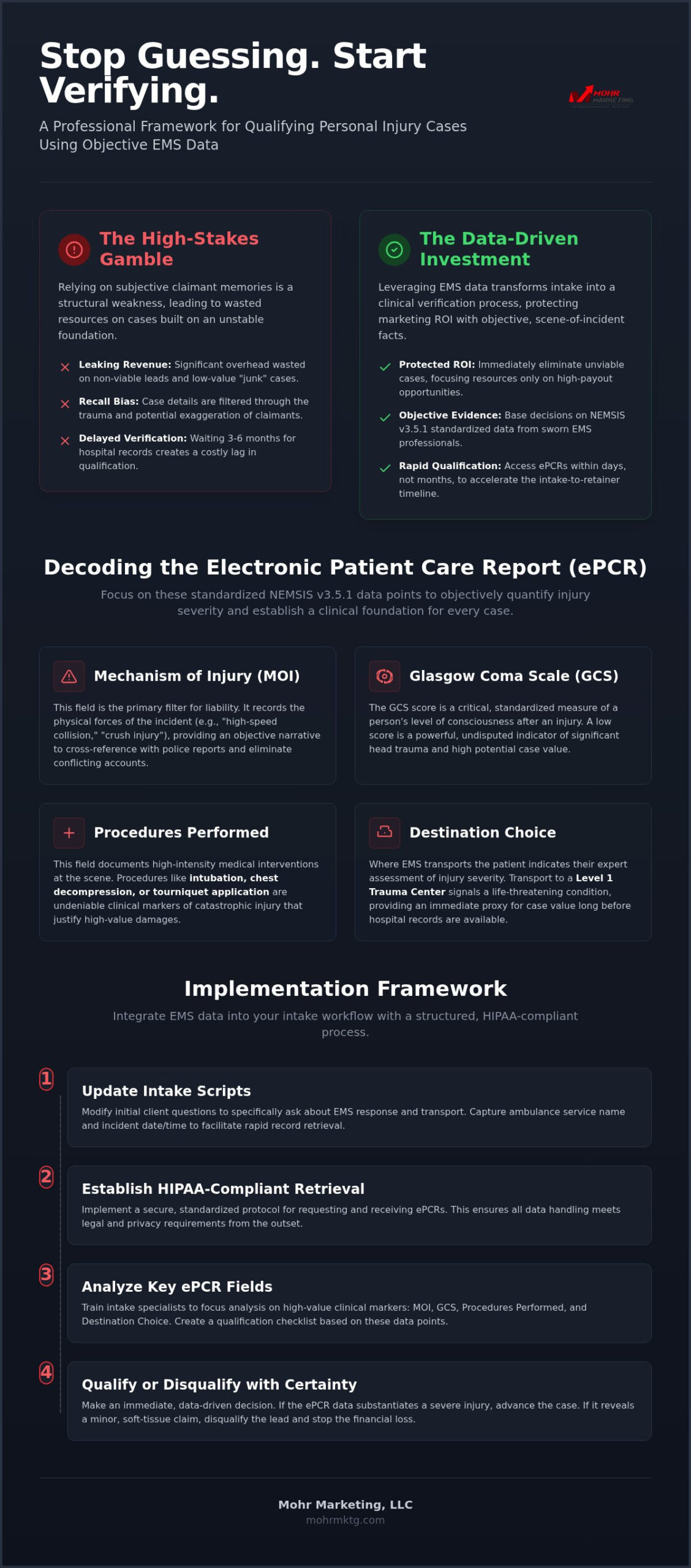
Raw ePCR data is only valuable if your intake team knows which fields drive settlement value. Using EMS data for case qualification requires a tactical focus on clinical markers that defense teams can’t easily hand-wave away. By targeting specific fields within the NEMSIS framework, you move from subjective claimant stories to objective, third-party verification of trauma. This transition is essential for firms that want to stop wasting time on “soft” cases that lack clinical evidence.
Mechanism of Injury (MOI) as a Liability Filter
The ‘Mechanism of Injury’ (MOI) field is your primary tool for confirming liability and accident dynamics. It records the physical forces involved in an incident, such as “high-speed rear-end collision” or “crush injury.” You should cross-reference MOI data with official narratives to ensure consistency. For those managing police report-backed MVA cases, this dual-verification eliminates the risk of conflicting accounts regarding the severity of the impact. In mass tort scenarios, specific MOI descriptors can trigger automatic qualification by matching documented exposure or injury criteria from the scene.
Clinical Indicators of High-Value Damages
Case valuation starts with clinical proxies found in the ePCR. You must monitor ‘Procedures Performed’ for high-intensity interventions like intubation, chest decompression, or tourniquet application. These are undeniable indicators of catastrophic injury that set the stage for high-value settlements. Similarly, ‘Destination Choice’ provides an expert triage signal. Transport to a Level 1 Trauma Center suggests a severity level that justifies a higher case value than a standard ER visit.
To quantify non-economic damages, analyze ‘Pain Scale’ entries alongside ‘Medication Administered.’ The use of high-potency narcotics like Fentanyl or Morphine at the scene establishes a contemporaneous record of significant physical suffering. For Traumatic Brain Injury (TBI) claims, the Glasgow Coma Scale (GCS) score is the most critical metric. A low GCS score recorded by a paramedic provides the immediate neurological evidence needed to qualify a TBI case. Using EMS data for case qualification ensures your firm has a consistent baseline for every inquiry, regardless of the jurisdiction. This consistency is maintained by the National EMS Information System (NEMSIS) standards.
You can also use ‘Provider Impression’ and ‘Protocol Age’ to counter defense arguments regarding pre-existing conditions. These fields document the acute nature of the injury as assessed by the first medical professional on the scene. If you’re ready to stop gambling on unverified leads, you can speak with our intake specialists about our data-driven qualification process.
EMS Data vs. Claimant Self-Reporting: Eliminating Intake Bias
Relying on a claimant’s version of events is a structural liability. While most potential clients don’t intend to deceive, they are often traumatized, medicated, or suffering from significant recall bias during the initial intake call. Using EMS data for case qualification eliminates this subjectivity by introducing an objective witness into your funnel. Paramedics and EMTs have no financial stake in the litigation. Their contemporaneous notes in the ePCR provide a clinical reality check that cannot be coached or forgotten. By prioritizing these records, you move away from a “trust but verify” model to a “verify to trust” standard.
Data-driven qualification is the only way to significantly reduce case drop rates. When a firm signs a retainer based solely on self-reporting, they risk discovering a lack of medical necessity or a conflicting liability narrative months into the discovery process. Using EMS data for case qualification ensures that the clinical foundation of the case is solid before you commit attorney hours or marketing capital. This proactive screening identifies intentional exaggeration early, allowing your team to focus exclusively on high-integrity claimants who have the medical documentation to back their claims.
The Cost of Inaccurate Intake
Processing a signed case that fails medical record verification later creates a “ghost cost” that erodes firm profitability. This cost includes wasted staff time, medical record retrieval fees, and the opportunity cost of not pursuing viable leads. EMS data provides a pre-signature audit trail that protects your overhead. By verifying the severity and mechanism of injury at the point of inquiry, you ensure that every file you open meets a strict threshold for success. This level of precision is why leading firms prioritize mass tort signed cases that have already undergone rigorous clinical verification.
Verifying Intent and Consistency
Insurance adjusters and defense counsel prioritize the ePCR because it’s the first medical document created after an incident. They look for discrepancies between the “on-scene statement” and the later “intake statement” to impeach claimant credibility. If your intake narrative doesn’t match the paramedic’s observations, the case value drops immediately. You must compare these accounts side-by-side during the qualification phase. A consistent data set across the ePCR, police report, and intake script allows you to build a bulletproof case file from day one. This consistency signals to insurers that the claim is legitimate and high-value, leading to faster settlements and higher conversion rates from inquiry to payout.
Implementation Framework: Integrating EMS Data into Your Intake Workflow
Moving from theory to practice requires a structural overhaul of your intake funnel. You can’t successfully implement a strategy of using EMS data for case qualification without a repeatable, documented process. It starts with your intake scripts and ends with your CRM’s automation logic. If your team is still asking generic questions, you’re leaving high-value data on the table. A clinical verification framework ensures that every lead is measured against the same objective standard from the first contact.
Follow these five steps to integrate clinical data into your workflow:
- Update intake scripts. Ensure staff ask for the specific EMS agency name and the destination hospital.
- Implement HIPAA-compliant authorizations. Use forms that explicitly include pre-hospital providers to avoid retrieval delays.
- Define NEMSIS keywords. Train staff to flag terms like “Extrication,” “Trauma Alert,” or “ALS Transport” immediately.
- Partner for verification. Use a strategic partner to cross-reference claimant claims against clinical data sets before signing.
- Prioritize by severity. Shift your follow-up queue to put high-severity ALS cases at the top of the dashboard.
Training Your Intake Team for Data Literacy
Intake professionals don’t need to be clinicians, but they must understand case tiering. Provide a cheat sheet that distinguishes between Basic Life Support (BLS) and Advanced Life Support (ALS). A BLS transport might indicate a minor soft-tissue claim. Conversely, an ALS transport means paramedics provided advanced intervention. These are your high-value targets. Speed is non-negotiable here. Research indicates that responding to an inquiry within five minutes can increase conversion by up to 300%. Data-backed leads should never wait in a queue.
Automation and CRM Integration
Efficiency is the enemy of manual entry. Use APIs to pull NEMSIS-compatible data directly into your case management system. This allows you to set “Red Flag” alerts for inquiries that don’t meet verified injury thresholds. For example, if a claimant reports a catastrophic injury but the EMS data shows “Patient Refusal,” your CRM should trigger an immediate review. This level of precision is critical for high-volume firms, particularly those managing truck accident signed cases where liability and damages are complex. Using EMS data for case qualification ensures your automation is built on facts, not assumptions.
Securing High-Intent Cases with Mohr Marketing’s Verified Intake Ecosystem
Implementing an internal system for using EMS data for case qualification is a significant capital and operational undertaking. Most firms lack the clinical staff, technical integrations, and 24/7 intake infrastructure required to execute this at scale. Mohr Marketing, LLC serves as the strategic partner that handles this data heavy lifting. We bridge the gap between raw marketing interest and clinically verified litigation opportunities. By leveraging our turnkey intake ecosystem, your firm can bypass the technical hurdles of NEMSIS integration and focus exclusively on case management.
Our performance-based model represents the ultimate application of high-data qualification. We operate on a pay-per-signed-case basis, meaning we bear the financial risk of lead generation and clinical screening. You only pay for results. With 30+ years of industry experience, we’ve refined a process that moves beyond “buying leads” to the strategic acquisition of verified retainers. We provide the mechanical accuracy and procedural precision your high-stakes practice requires to maintain a competitive advantage.
The Mohr Marketing, LLC Advantage: Beyond Standard Lead Gen
Our verification process mimics the clinical scrutiny found in ePCR documentation. We don’t rely on claimant stories; we build our intake around rigorous verification to eliminate inefficient intermediaries. This ensures that every signed retainer we deliver is backed by documented injury mechanisms and objective data. Our turnkey ecosystem handles the entire lifecycle from initial inquiry to the signed retainer, ensuring no friction in your growth process. To understand how this fits into a broader strategy, review our Mass Tort Lead Generation Roadmap for scalable growth in 2026.
Next Steps: Scaling Your Practice with Data-Verified Retainers
Your first step is to audit your current intake conversion rate against industry benchmarks. If you’re seeing a high volume of case drops after the initial signature, your qualification process is likely failing to account for clinical reality. Transitioning to a performance-based acquisition model allows you to stabilize your cost-per-acquisition. You stop gambling on unverified self-reporting and start investing in data-verified facts. Using EMS data for case qualification is no longer a luxury for top-tier firms; it’s a requirement for survival in a high-cost marketing environment.
Transform Your Intake Strategy with Clinical Precision
The shift from anecdotal self-reporting to clinical verification is a necessity for firms targeting high-value litigation. By leveraging standardized ePCR data and NEMSIS protocols, you eliminate the financial risks of claimant bias and recall errors. You’ve learned how to identify high-value damages through clinical proxies like GCS scores and ALS transport status. Integrating these clinical markers into your workflow ensures that using EMS data for case qualification becomes a permanent competitive advantage for your practice.
Mohr Marketing provides a turnkey intake and verification ecosystem backed by 30+ years of legal marketing authority. We handle the technical data retrieval and screening so you can focus on litigation. Our national reach allows us to scale your MVA and mass tort acquisition with precision and speed. Stop gambling on unverified leads and start building your case files on a foundation of objective medical evidence.
Your firm’s growth depends on the quality of your data. Take control of your intake funnel today and secure the litigation opportunities your practice deserves.
Frequently Asked Questions
Is using EMS data for case qualification HIPAA compliant?
Using EMS data for case qualification is fully HIPAA compliant when supported by a valid claimant authorization. EMS agencies are covered entities, meaning they must release Electronic Patient Care Reports (ePCR) to authorized legal representatives. Your firm should ensure all data is handled using encryption and multi-factor authentication. HIPAA regulations require you to store these authorization forms for at least six years to maintain a proper audit trail.
How do I obtain an EMS report (ePCR) for a potential claimant?
You must submit a formal records request to the specific EMS agency that provided treatment, accompanied by a signed HIPAA release. Most agencies require you to identify the specific unit or incident number, which can be found in the police report or through claimant intake. While some agencies offer online portals, others require a mailed request and a small administrative fee for document retrieval.
What is the difference between NEMSIS data and a standard medical record?
NEMSIS data is structured and standardized for emergency care, while hospital records are often narrative-heavy and focus on long-term treatment. The NEMSIS v3.5.1 standard ensures that fields like “Mechanism of Injury” are uniform across different jurisdictions. This structure allows your intake team to perform automated screening. It’s faster to analyze than a standard medical record, which can take months to arrive from a hospital’s records department.
Can EMS data be used to qualify mass tort cases like Camp Lejeune or Mesothelioma?
EMS data is most effective for acute injury cases like MVAs, but it can verify emergency admissions related to chronic mass tort conditions. It confirms the clinical severity of a specific respiratory or cardiac event at the scene. While it doesn’t prove long-term exposure, it establishes an objective clinical baseline for the claimant’s current health status. This data helps you prioritize high-severity claimants who required immediate ALS intervention.
What are the most important NEMSIS fields for personal injury lawyers?
The most critical fields are “Mechanism of Injury,” “Glasgow Coma Scale (GCS),” and “Medication Administered.” These fields provide objective proof of the forces involved in an accident and the immediate neurological state of the victim. A low GCS score is the gold standard for qualifying Traumatic Brain Injury claims. You should also monitor “Destination Choice” to see if the patient was diverted to a Level 1 Trauma Center.
How much does it cost to integrate EMS data into a law firm’s intake process?
Integration costs vary based on whether you utilize internal API connections or a strategic intake partner. Cloud-based ePCR software packages typically range from $200 to $700 per month for basic access. Many firms find that the manual labor required for record retrieval is more expensive than the software itself. Most high-volume practices prefer a performance-based acquisition model to avoid the technical overhead of managing raw clinical data sets.
Can EMS data help prove pain and suffering in a motor vehicle accident case?
Yes, by documenting the administration of high-potency narcotics like Fentanyl or Morphine at the scene of the accident. These entries provide a contemporaneous record of acute physical distress that is difficult for defense counsel to dispute. Using EMS data for case qualification establishes a clinical timeline of suffering that begins at the moment of impact. It provides the objective evidence needed to support non-economic damage claims during settlement negotiations.
How does Mohr Marketing verify cases using clinical data points?
Mohr Marketing utilizes a turnkey intake ecosystem that cross-references claimant inquiries against objective clinical markers found in NEMSIS v3.5.1 data. We analyze specific injury mechanisms and treatment protocols to ensure every signed retainer meets your firm’s strict criteria. This process eliminates the “junk” cases often found in standard lead generation. We handle the technical verification so you receive only high-intent, clinically-vetted litigation opportunities ready for your legal team.

Recent Posts
- High-Quality Mold Leads: Scale Your Toxic Tort Practice
- Scaling Your Firm with High-Quality Mold Case Leads
- The Hidden Risks of Cheap Personal Injury Leads: A Law Firm’s Guide to Quality Acquisition
Categories
- AI and Lead Generation
- Business Financing
- Call Verified MVA Leads
- Car Accident Help
- Car Accident Settlements
- Claimant Funding
- Compliance Program
- EMS-EMT Reports
- Geotargeting
- Google Maps Ranking
- Healthcare Practice Growth
- Law Firm Growth
- Law Office Operations
- Lead Generation
- Lead Generation For Attorneys
- Lead Generation For Chiropractors
- Lead Generation For Criminal Attorneys
- Lead Generation For D&A Treatment Centers
- Lead Generation For DUI Attorneys
- Lead Generation For Eye Doctors
- Lead Generation For Family Law Practices
- Lead Generation For PI Law Firms
- Lead Generation For Plastic Surgeons
- Leads For Healthcare Professionals
- Leads For Insurance Industry
- Legal Leads
- Legal Marketing
- Legal Updates
- Mass Tort Leads
- Medicare and Medicaid Leads
- Merchant Funding Leads
- Online Marketing Strategies
- Pre-Settlement Funding
- Signed MVA Cases
- Tort Updates
- Truck Accident Leads and Signed Cases
- Truck Accident Settlements
- Web Design