High-Quality Mold Leads: Scale Your Toxic Tort Practice
September 24, 2026 by Mohr Marketing
Most law firms investing in mold leads aren’t building a toxic tort docket; they’re accidentally funding home repair contractors. High inquiry volume looks impressive on paper, but it drains valuable marketing capital when the submissions consist of minor drywall patches instead of actionable habitability or personal injury claims.
You already know the frustration of sorting through shared aggregator pools, chasing uncontactable callers, and losing viable toxic exposure claimants to sluggish internal intake screening. Successfully expanding a toxic tort practice demands strict evidentiary proof, documented clinical causation, and immediate contact, not generic contractor requests.
In this guide, you will learn how to evaluate, acquire, and convert verified toxic mold exposure leads into high-value signed cases without wasting capital on shared contractor inquiries. We detail the operational framework required to separate low-margin remediation calls from serious toxic torts, alongside the intake workflows needed to shorten time-to-retainer.
Key Takeaways
- Distinguish high-value toxic tort claims from routine remediation inquiries to prevent misallocating marketing budgets on property repairs.
- Implement a structured five-stage qualification protocol that verifies physical exposure duration, landlord notice, and objective clinical causation.
- Compare the cost efficiency and conversion metrics of raw web forms, live call transfers, and fully executed signed retainers.
- Eliminate intake friction and claimant drop-off by deploying rapid-response protocols that secure viable toxic exposure prospects within minutes.
- Leverage end-to-end legal intake ecosystems to acquire exclusive, verified mold leads while maintaining nationwide bar advertising compliance.
Understanding Mold Leads: Remediation Inquiries vs. Toxic Tort Claims
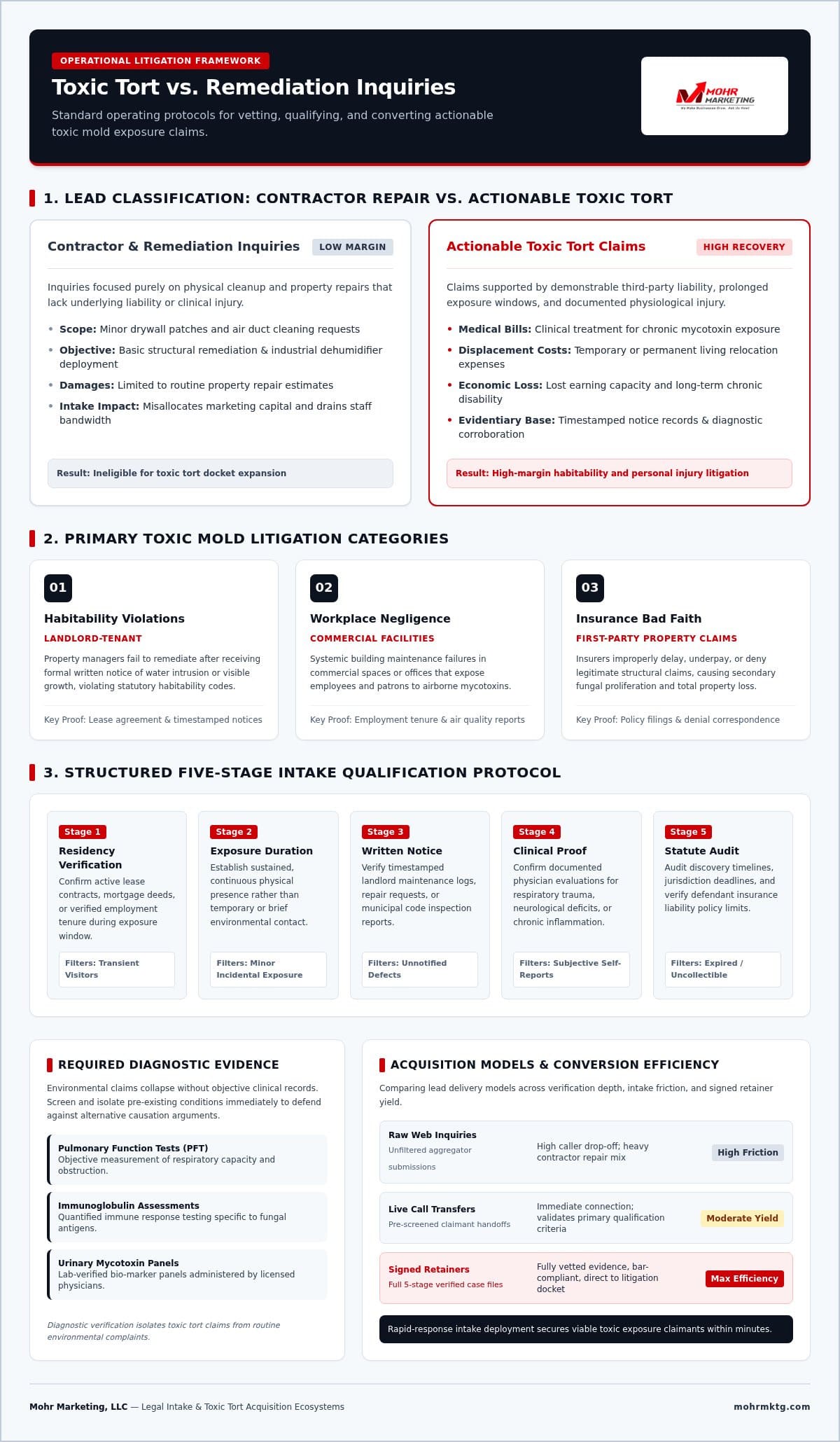
Most digital campaigns targeting mold inquiries attract property owners seeking drywall repair or air duct cleaning. For a law firm, these inquiries drain intake bandwidth and waste capital. High-value mold litigation requires identifying individuals who have suffered documented physical harm or catastrophic property loss due to another party’s negligence. Differentiating between basic service calls and actionable litigation is the foundation of acquiring qualified legal mold leads.
The Core Differences Between Contractor and Legal Mold Inquiries
Contractor inquiries focus entirely on structural remediation, such as removing contaminated baseboards or running industrial dehumidifiers. In contrast, an actionable toxic tort claim centers on demonstrable liability and measurable human damages. While contractors bill for immediate physical cleanup, litigators evaluate substantial economic recovery models: extensive medical bills, temporary or permanent displacement expenses, lost earning capacity, and chronic disability caused by prolonged exposure to hazardous mycotoxins.
Primary Litigation Categories in Toxic Mold Exposure
Viable legal claims generally fall into three distinct operational categories, each requiring rigorous verification protocols:
- Landlord-Tenant Habitability Violations: Claims where property managers received formal notice of active water intrusion or visible growth but failed to remediate the issue, breaching statutory habitability standards.
- Commercial and Workplace Negligence: Inquiries involving commercial facilities or office buildings where systemic maintenance failures exposed employees or patrons to airborne toxins, creating clear third-party liability.
- First-Party Insurance Bad Faith: Disputes where an insurer improperly delayed, underpaid, or denied legitimate structural remediation claims, directly causing secondary fungal contamination and severe personal property loss.
Generic lead aggregators fail because their screening forms treat every caller as an estimate request. They don’t assess exposure duration, notice timelines, or clinical diagnoses. Just as specialized practices rely on truck accident signed cases and verified call transfer leads to bypass minor fender benders, toxic exposure litigation demands immediate triage to isolate high-damages claimants from routine property repairs.
Essential Qualification Criteria for Vetting High-Intent Mold Claimants
Scaling a toxic tort docket requires moving past basic contact capture. Sourcing viable mold leads demands a structured, multi-stage vetting rubric that filters out non-actionable complaints before they reach your legal team. Without strict intake criteria, your staff wastes critical billable hours assessing unprovable exposure.
Executing this strategy effectively requires five standardized checkpoints:
- Residency Verification: Confirming active lease agreements, mortgage statements, or employment tenure during the exposure window.
- Duration of Exposure: Establishing sustained physical presence in the contaminated environment rather than transient contact.
- Written Notice Records: Verifying timestamped landlord communications, repair requests, or municipal code inspection reports.
- Clinical Corroboration: Confirming medical evaluations for respiratory trauma, neurological deficits, or chronic inflammatory conditions.
- Statute Compliance: Auditing local discovery timelines and defendant liability limits before proceeding.
Establishing Medical Causation and Clinical Documentation
Proving causation requires objective clinical records. Environmental claims often collapse when plaintiffs allege health issues without medical corroboration. While the EPA notes that allergic reactions to mold and asthma attacks are common physiological responses, toxic tort actions require documented medical intervention.
Intake screeners must verify pulmonary function tests, immunoglobulin assessments, or urinary mycotoxin panels administered by licensed physicians. Screen past medical histories immediately; pre-existing respiratory conditions must be isolated to prevent defense teams from arguing alternative causation. Claimants lacking formal medical evaluations prior to intake should be filtered out immediately.
Documenting Structural Liability and Property Negligence
Physical evidence of systemic failure must accompany the injury claim. High-converting intake demands third-party verification, including certified indoor air quality (IAQ) laboratory findings, mold spore trap analyses, and visible moisture mapping. Crucially, your intake team must confirm timestamped written repair requests that prove the landlord or property manager had actual notice of the water intrusion and delayed remediation.
Evaluating Timeliness and Jurisdictional Standing
Statutory timelines dictate case survival. Your team must cross-reference state-specific personal injury discovery rules against the date the claimant first connected their symptoms to the structural hazard. Confirm active municipal health citations and review property ownership structures to ensure adequate commercial liability policies exist.
Deploying this level of front-end rigor safeguards legal capital. Rather than sifting through unvetted inquiries, firms adopting formal high-value mold case acquisition protocols secure pre-screened claimants backed by verified physical and clinical proof. If you want to refine your docket criteria, your firm can request an intake assessment to audit your screening standards.
Acquisition Models Compared: Raw Inquiries, Call Transfers, and Signed Retainers
Legal practices evaluating mold leads generally choose between three distinct delivery frameworks: raw web inquiries, live call transfers, and executed retainers. Each mechanism carries direct operational trade-offs between upfront marketing expenditure and internal intake overhead. Understanding these operational differences prevents firms from misallocating intake labor on low-converting inquiries.
To determine the true acquisition cost, legal administrators must evaluate the complete intake cycle, not just the front-end invoice. Sifting through unqualified claims drains internal resources. A disciplined calculation requires factoring in paralegal screening hours, follow-up touchpoints, and document chasing costs alongside initial lead acquisition expenses.
Raw Web Forms vs. Verified Inbound Transfers
Raw digital forms generate immediate volume, but they push the burden of lead triage onto your internal staff. Contact rates drop sharply when teams delay outreach; claimants evaluating properties with toxic exposure often submit requests to multiple sources simultaneously. When paralegals spend hours attempting to reach unverified digital submissions, billable efficiency suffers.
Live inbound transfers mitigate this operational friction. With verified transfers, screened claimants who have already confirmed physical residency, landlord notice, and observable health effects of mold exposure are routed directly to your intake department. This handoff eliminates cold outbound dialing and ensures your screeners speak exclusively with engaged prospects.
The Performance Advantage of Executed Retainer Agreements
The executed retainer model shifts administrative risk entirely away from the law firm. In this structure, legal teams avoid paying for unqualified web traffic or dead-end phone numbers. Instead, marketing investments map directly to fully qualified, signed legal agreements that meet your firm’s case specifications.
Executing an agreement requires comprehensive document handling, including retainer distribution, electronic signature collection, and preliminary records gathering. Outsourcing this workflow frees paralegals to focus on active case management and litigation prep rather than administrative chasing. By eliminating operational intake bottlenecks, firms secure predictable docket growth backed by verified claimants ready for immediate legal action.
Optimizing Intake Workflows to Maximize Toxic Exposure Case Conversion
Generating qualified inquiries is only half the battle. A law firm’s ultimate return on investment hinges on conversion velocity. In competitive tort acquisition, claimant drop-off accelerates with every hour an inquiry sits untouched. Turning high-intent mold leads into signed litigation files requires an intake infrastructure designed for immediate qualification, empathetic communication, and frictionless execution.
Firms scaling their dockets must deploy standardized intake question sets during the initial intake screening. Screeners should follow strict logic trees that immediately distinguish catastrophic habitability breaches from minor maintenance issues. By addressing causation markers, insurance coverage, and defendant liability on the very first touchpoint, intake teams protect attorneys from reviewing non-viable claims.
Rapid-Response Protocols and Contact Velocity
Contact speed directly determines retention rates. When a claimant reaches out regarding property contamination or sudden respiratory illness, they are often in acute distress and actively seeking counsel. Law firms must deploy multi-channel engagement systems combining rapid phone outreach, confirmation SMS messages, and secure email dispatches within minutes of submission.
Intake personnel require specialized training to interview distressed claimants who may be dealing with displacement, extensive property loss, or medical trauma. Screeners must extract critical timeline details while keeping the conversation focused. Implementing systematic call audits ensures team members adhere strictly to qualification criteria and capture all necessary liability facts.
Digital Retainer Packaging and Rapid Execution
Manual document delivery introduces unacceptable delays. In modern legal operations, firms lose viable claimants if they require physical mailings or cumbersome desktop portals. Retainer agreements must be mobile-optimized and delivered immediately via secure SMS or encrypted email while the intake specialist remains on the line with the claimant.
High-converting legal teams collect vital documentation at the point of initial engagement. This includes securing digital signatures on HIPAA disclosures, collecting electronic copies of lease agreements, and gathering photos of visible water intrusion. This rigorous document collection process mirrors the operational structures used to acquire mass tort signed cases, ensuring files arrive fully developed.
Similar to protocols applied in truck accident signed cases and verified call transfer leads, rapid intake routing eliminates procedural drop-off and secures claimant representation before competing counsel intervenes.
Scaling Your Toxic Mold Docket: Mohr Marketing’s Turnkey Acquisition Ecosystem
Building a high-margin environmental tort practice requires an acquisition engine that eliminates administrative waste. Sourcing viable mold leads at scale is impossible when relying on generic lead brokers who do not understand legal evidentiary standards. Mohr Marketing delivers an integrated case acquisition infrastructure built on over 30 years of specialized legal and professional marketing leadership, connecting law firms nationwide with verified claimants.
Rather than passing along raw, unvetted contact forms, Mohr Marketing operates an end-to-end acquisition ecosystem. Every campaign aligns with strict nationwide compliance frameworks, adhering precisely to individual state bar advertising mandates and regulatory requirements. This enterprise approach ensures firms expand their active litigation inventory while mitigating compliance risk.
Proprietary Search Discovery and Intent-Driven Marketing
Acquiring actionable claims begins with capturing pure legal intent. Mohr Marketing deploys targeted search strategies designed to identify individuals experiencing severe, documented damages. Instead of capturing generic property cleaning queries, campaigns target high-intent search terms that reflect true habitability violations, severe respiratory illnesses, and landlord negligence.
Algorithmic screening protocols actively filter out non-actionable consumer maintenance questions before they enter the intake pipeline. Prospective claimants move directly into conversion funnels tailored to complex environmental claims. This intent-driven methodology operates on the same precise case qualification criteria that Mohr Marketing uses to source high-stakes toxic exposure files, such as mesothelioma leads for law firms built on real search intent and strict case criteria.
Comprehensive Intake, Screening, and Retainer Delivery
Front-end traffic only creates value when backed by specialized intake execution. Mohr Marketing deploys dedicated intake specialists trained to screen for complex environmental illness, structural water damage, and property management failure. Inquiries undergo multi-point vetting to confirm injury severity, notice timelines, and defendant insurance coverage.
Once an inquiry satisfies your practice’s custom criteria, the intake ecosystem completes the acquisition cycle:
- Executed Retainers: Delivering fully executed, firm-approved legal retainer agreements and HIPAA releases via mobile e-signature.
- Evidence Packaging: Compiling initial photographic records of property contamination, lease agreements, and medical treatment summaries.
- Direct Software Handoff: Delivering litigation-ready claimant packages directly into your firm’s case management software for immediate attorney assignment.
This streamlined process mirrors enterprise frameworks deployed across mass tort signed cases. By bridging the gap between high-intent digital search and executed retainers, Mohr Marketing provides a reliable, scalable pathway for firms looking to dominate their environmental tort dockets nationwide.
Scale Your Toxic Tort Practice With Verified Retainers
Expanding a profitable toxic tort practice requires eliminating low-margin property repair noise and focusing strictly on catastrophic personal injury and habitability claims. Sustainable docket growth hinges on objective clinical causation screening, verified landlord notice documentation, and rapid multi-channel intake protocols that convert qualified mold leads into retained clients before claimant interest fades.
Mohr Marketing supports your firm with over 30 years of specialized legal case acquisition expertise. Our turnkey intake ecosystem manages the entire lifecycle, from targeted intent discovery to fully executed retainers, eliminating administrative screening bottlenecks for your paralegal staff. We maintain strict nationwide compliance with state bar advertising regulations and TCPA standards, delivering litigation-ready claimant packages directly to your team.
Deploying an enterprise acquisition partner protects your billable hours, streamlines case onboarding, and positions your firm to dominate complex toxic exposure litigation with confidence.
Frequently Asked Questions
What criteria distinguish a viable toxic mold legal claim from a standard remediation inquiry?
A viable toxic mold legal claim requires clear physical injury, clinical medical records, and established defendant liability, whereas standard remediation inquiries involve only physical property cleaning. Viable claims feature sustained environmental exposure, formal written notice delivered to landlords or property managers, and documented economic damages such as medical expenses or displacement costs. Without documented human bodily injury or severe habitability breaches, an inquiry remains a low-margin contractor job rather than a legal tort.
How do exclusive mold leads differ from shared aggregator inquiries in legal practice marketing?
Exclusive mold leads are routed solely to your firm, ensuring immediate contact without competing against multiple attorneys or home repair contractors. In contrast, shared aggregator inquiries are distributed across several buyers simultaneously. This dilutes lead value, causes caller fatigue, and drastically lowers conversion rates. Investing in exclusive inquiries protects your intake staff from chasing uncontactable prospects while securing higher-intent claimants who need focused legal representation.
Why is clinical documentation critical during the initial toxic mold intake screening process?
Clinical documentation establishes medical causation, which is the most vulnerable element of toxic exposure litigation. Defense counsel routinely argues that respiratory distress or neurological issues stem from alternative environmental or pre-existing factors. Verifying diagnostic tests, such as pulmonary function exams, allergy panels, or mycotoxin screenings, during intake ensures your firm takes on claimants with substantiated injuries. Filtering out claimants without objective physician evaluations protects billable hours and case viability.
How does the pay-per-signed-case model protect law firms investing in toxic mold acquisition?
The pay-per-signed-case model eliminates front-end marketing risk by requiring firms to pay only for fully executed retainer agreements, not raw web clicks or unverified calls. This structure shifts intake screening, document delivery, and e-signature collection away from your internal staff. Your marketing capital directly funds verified case inventory, ensuring total budget efficiency and removing the administrative overhead of screening non-viable inquiries.
What specific records are required to prove property owner negligence in mold exposure lawsuits?
Proving property owner negligence requires documented evidence that the landlord or management company had notice of moisture intrusion but failed to remediate it properly. Essential records include timestamped maintenance tickets, certified indoor air quality lab reports, municipal code violation notices, and photos of visible water damage. Pairing these records with a signed lease agreement confirms legal standing and establishes a clear timeline of ongoing property negligence.
How quickly should an intake team engage a toxic mold exposure inquiry to maintain viability?
Intake teams should engage high-intent mold leads within five minutes of submission. Claimants facing severe water contamination or sudden health emergencies often reach out to multiple resources at once. Delayed responses cause contact rates to plummet and increase claimant attrition. Utilizing rapid-response protocols with automated multi-channel follow-up ensures your firm initiates qualification and delivers retainer documents while the prospect remains engaged and ready to proceed.
Recent Posts
- High-Quality Mold Leads: Scale Your Toxic Tort Practice
- Scaling Your Firm with High-Quality Mold Case Leads
- The Hidden Risks of Cheap Personal Injury Leads: A Law Firm’s Guide to Quality Acquisition
Categories
- AI and Lead Generation
- Business Financing
- Call Verified MVA Leads
- Car Accident Help
- Car Accident Settlements
- Claimant Funding
- Compliance Program
- EMS-EMT Reports
- Geotargeting
- Google Maps Ranking
- Healthcare Practice Growth
- Law Firm Growth
- Law Office Operations
- Lead Generation
- Lead Generation For Attorneys
- Lead Generation For Chiropractors
- Lead Generation For Criminal Attorneys
- Lead Generation For D&A Treatment Centers
- Lead Generation For DUI Attorneys
- Lead Generation For Eye Doctors
- Lead Generation For Family Law Practices
- Lead Generation For PI Law Firms
- Lead Generation For Plastic Surgeons
- Leads For Healthcare Professionals
- Leads For Insurance Industry
- Legal Leads
- Legal Marketing
- Legal Updates
- Mass Tort Leads
- Medicare and Medicaid Leads
- Merchant Funding Leads
- Online Marketing Strategies
- Pre-Settlement Funding
- Signed MVA Cases
- Tort Updates
- Truck Accident Leads and Signed Cases
- Truck Accident Settlements
- Web Design