2026 Guide: Data-Driven Case Acquisition for Law Firms
August 7, 2026 by Mohr Marketing
Your firm is likely overpaying for junk inquiries while your competitors pick off high-value trucking cases before you even see the police report. We agree that the current cost-per-lead model is broken and unsustainable for firms looking to scale. Over 164,000 attorneys are fighting for the same personal injury cases. Relying on traditional digital marketing isn’t just expensive; it’s a strategic failure. You’ve felt the drain on your intake resources from low-intent calls. Stop chasing clicks. Start utilizing accident data intelligence for law firms to secure a definitive competitive edge.
This guide teaches you how to leverage advanced accident data intelligence to identify high-value motor vehicle and trucking cases before your competitors. We’re breaking down the shift toward actionable case intelligence. We’ll show you how to secure a higher ratio of signed retainers by focusing on verified, high-intent data. This is the framework for bypassing inefficient intermediaries and using real-time intelligence to build a predictable, scalable caseload for your firm.
Key Takeaways
- Stop competing in over-saturated digital channels and shift your focus to high-intent data that identifies high-value cases before they hit the open market.
- Understand the critical role of accident data intelligence for law firms in filtering out junk inquiries using real-time crash notifications and police-report-backed data.
- Learn how to layer specific data points like insurance limits and injury severity to transform raw contact information into actionable case intelligence.
- Audit your intake ecosystem to stop wasting resources on low-conversion leads and start scaling your caseload with predictable precision.
- Discover how the Pay-Per-Signed-Case model eliminates financial risk by bridging the gap between raw data and a fully executed retainer.
The Evolution of Legal Marketing: Why Raw Leads are Obsolete
The 2026 legal market is unforgiving. With over 164,000 personal injury attorneys competing for visibility, traditional digital channels like PPC and social media have reached a saturation point. High-intent search data, once the gold standard, is no longer sufficient to maintain a competitive edge. Every firm is bidding on the same keywords, driving costs to unsustainable levels. You aren’t just buying leads; you’re buying access to a crowded auction where the prize is often a low-quality inquiry that has already been shopped to multiple competitors.
The Rising Cost of Customer Acquisition (CAC)
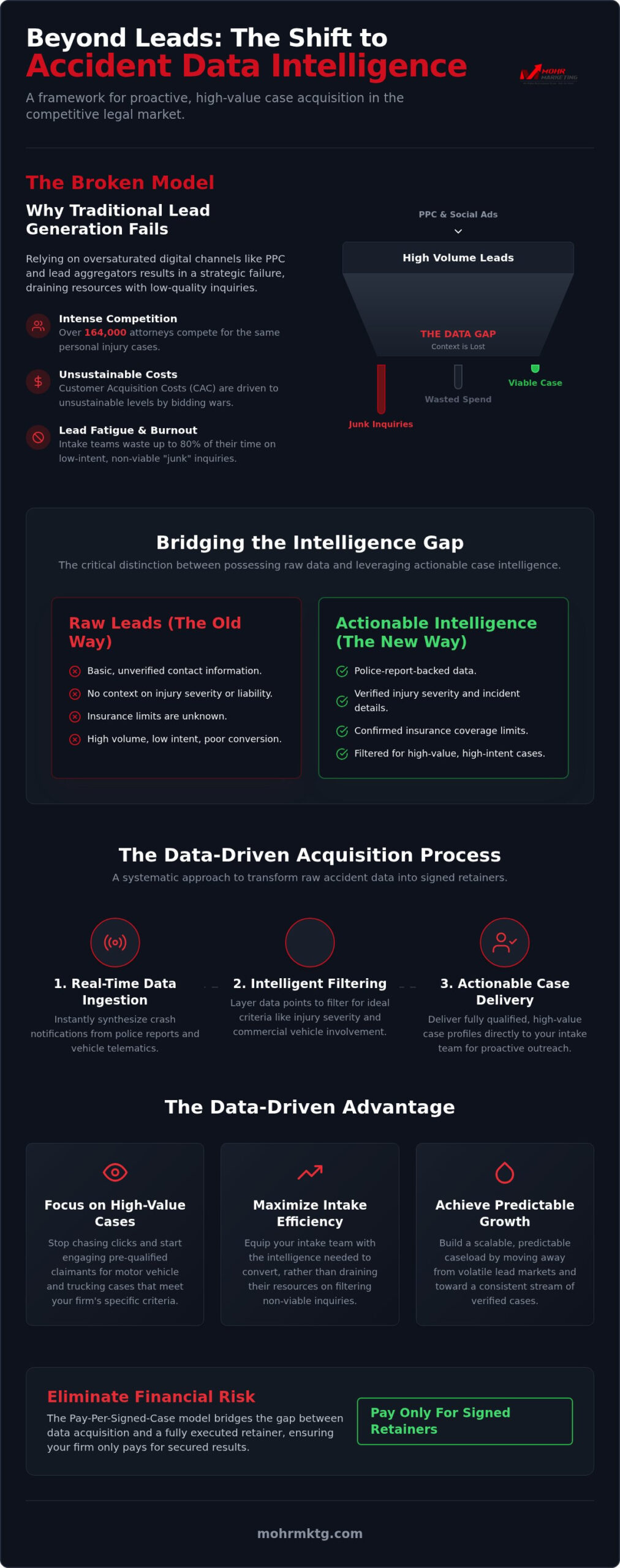
Acquisition costs in the legal sector have outpaced general inflation for years. Lead aggregators have commoditized the process, prioritizing volume over validity. This creates a “Data Gap” where firms possess contact information but lack the critical context needed to determine case value. Lead fatigue is the measurable decline in intake efficiency caused by a high volume of low-quality, repetitive inquiries that drain firm resources without producing signed retainers. When your team spends 80% of their time chasing “junk” calls, your true acquisition cost for a viable case skyrockets.
The Intelligence Advantage
Survival in this environment requires a shift from reactive lead buying to proactive case acquisition. This is where Legal Technology evolves into a strategic offense. By implementing accident data intelligence for law firms, you stop waiting for a victim to find you. You instead use real-time crash notifications and police reports to identify qualified claimants immediately. This intelligence reduces wasted spend on non-viable inquiries by filtering for insurance limits and injury severity before the first call is ever made. Utilizing accident data intelligence for law firms allows your team to focus exclusively on high-value motor vehicle and trucking cases that meet your specific criteria.
Moving toward police-report-backed MVA cases represents a fundamental pivot in how firms grow. It’s the difference between casting a wide, expensive net and using a laser-guided system. The goal isn’t more leads. It’s more signed retainers. Data is just noise without the filter of intelligence to turn raw accident reports into revenue. Firms that fail to bridge the data gap will continue to see their margins shrink while data-driven competitors capture the market.
What is Accident Data Intelligence for Law Firms?
Accident data intelligence for law firms is the strategic synthesis of multi-source information to identify, qualify, and secure high-value legal cases. It’s not a simple directory of names. It’s a filtered stream of actionable insights derived from police reports, vehicle telematics, and real-time crash notifications. This intelligence allows your firm to Leverage Legal Analytics to identify the specific variables that turn a routine accident into a high-stakes litigation opportunity. By moving beyond raw leads, you eliminate the guesswork that plagues traditional intake workflows.
Data accuracy is the cornerstone of this process. Verification ensures that the information your intake team receives is grounded in fact, not just a digital footprint. Predictive analytics layers this verified data to distinguish between minor fender-benders and catastrophic trucking collisions. This allows your firm to prioritize resources on cases with clear liability and significant insurance coverage. If you want to see how this looks in practice, you can learn more about our data-driven intake ecosystem.
Real-Time Crash Data and Telematics
The integration of IoT and vehicle telematics has revolutionized accident reporting. Modern vehicles act as mobile sensors, transmitting impact data almost instantly. These real-time notifications allow law firms to reach claimants during the “golden hour” when they’re most in need of professional guidance. Relying on police-report-backed MVA cases provides a layer of institutional verification that digital search queries can’t match. It ensures that the accident actually occurred and that the details provided are documented by law enforcement.
Commercial Vehicle and Trucking Intelligence
Trucking cases require a specialized intelligence framework because the stakes are higher and the defendants are more complex. Effective accident data intelligence for law firms must incorporate FMCSA data, weight class specifications, and carrier safety histories. Identifying “deep pocket” defendants early in the acquisition process is essential for firms focused on large settlements. This data-driven approach filters out non-commercial inquiries, focusing exclusively on truck accident signed cases that offer significant recovery potential. By targeting specific carrier histories and violation records, you can build a caseload of high-stakes litigation with predictable precision.
Raw Data vs. Actionable Case Intelligence: Spotting the Difference
A name and a phone number do not constitute a lead. In the high-stakes world of personal injury, raw contact information is often a liability rather than an asset. It forces your intake team to act as detectives, wasting hours on unverified inquiries that may lack liability or sufficient insurance coverage. True accident data intelligence for law firms moves beyond basic identity. It layers critical variables like injury severity, property damage metrics, and preliminary liability assessments to ensure your firm only pursues viable litigation.
Relying on unverified data from mass aggregators is a massive financial risk. These providers often sell shared leads to multiple firms simultaneously, triggering a race to the bottom that destroys your conversion rates. Exclusive case intelligence is different. It provides a protected stream of data that hasn’t been recycled or shopped. When you eliminate the “junk” inquiries, your cost-per-signed-case drops because your resources are focused on high-intent victims who meet your specific firm criteria.
The Anatomy of a High-Value Case
Transforming an inquiry into a high-value case requires specific data markers that raw leads simply cannot provide. Intelligence filters allow you to prioritize cases based on objective indicators of value. Look for these key data points:
- Injury Severity: Documented markers for traumatic brain injuries (TBI), spinal cord trauma, or surgical requirements.
- Insurance Policy Limits: Identification of commercial carriers or high-limit personal policies early in the process.
- Property Damage: Telematics and police reports indicating high-impact collisions that correlate with serious injury.
- Liability Clarity: Police report narratives that clearly establish third-party fault and minimize comparative negligence issues.
For a broader look at how different providers stack up, consult our guide on personal injury lead generation companies to understand the current market landscape.
Verification and Compliance Standards
Data is worthless if it isn’t compliant. You must audit your providers for strict adherence to TCPA and state bar mandates. Automated systems often miss the nuances of complex medical or accident data, making “Human-in-the-loop” verification essential for maintaining quality. In 2026, legal data acquisition requires documented consumer consent and transparent attorney identification to meet evolving state bar and federal marketing standards. This rigorous verification process ensures that every piece of accident data intelligence for law firms is both actionable and legally sound.
Implementing a Data-Driven Acquisition Strategy
Transitioning to a data-driven model requires more than just a software subscription. It demands a total overhaul of your current acquisition workflow. Stop guessing which marketing channels work and start executing a strategy built on verified intelligence. The path to a predictable caseload follows a specific, five-step implementation process designed to eliminate waste and maximize retainer volume.
- Step 1: Audit Your Intake. Analyze your current conversion rates. Identify exactly where inquiries fail to become retainers. Most firms find that unverified data and slow response times are the primary leaks in their funnel.
- Step 2: Align Data Sources. Select intelligence streams that match your practice areas. If you’re chasing commercial trucking cases, you need weight-class and carrier data, not just basic MVA reports.
- Step 3: CMS Integration. Automated delivery is essential. Push accident data intelligence for law firms directly into your Case Management System to eliminate manual entry bottlenecks and ensure immediate visibility.
- Step 4: Precision Training. Your intake team must handle verified inquiries differently than cold leads. They should lead with the facts already established by the data to build instant credibility with the claimant.
- Step 5: Performance Transition. Move away from traditional lead buying. Adopt a model where you pay for results, not just contact information. This aligns your financial risk with your firm’s growth.
Optimizing the Intake Ecosystem
Speed-to-lead remains the single most critical metric in 2026. Data intelligence provides the target, but your intake team must strike while the information is fresh. High-value claimants often sign with the first firm that demonstrates professional competence and immediate availability. Utilizing professional Legal Intake Services ensures that your firm captures these opportunities around the clock. This turnkey approach converts accident data intelligence for law firms into executed retainers without taxing your internal staff.
Measuring Success: Beyond Cost-Per-Lead
Cost-per-lead is a vanity metric that hides inefficiency. To scale predictably, you must define Cost-Per-Signed-Case as your primary KPI. This figure tells you the true price of firm growth. Additionally, calculate the Lifetime Value (LTV) of cases acquired through high-intent data. Establish a feedback loop between your litigation results and your marketing data. By identifying which specific data points correlate with your largest settlements, you can refine your acquisition criteria to focus exclusively on high-stakes litigation.
The Mohr Marketing Advantage: Data Intelligence Meets Signed Cases
Raw data is a commodity. Signed retainers are the outcome that drives revenue. Mohr Marketing isn’t just a data provider; we’re a strategic partner that bridges the gap between accident data intelligence for law firms and fully executed retainers. Our turnkey ecosystem handles the entire lifecycle of acquisition. We manage everything from initial data identification to verified call transfers and signed cases. This allows your firm to focus on litigation while we handle the mechanics of growth.
Risk is the enemy of scaling. Traditional marketing models force you to pay for potential, but we force you to pay for performance. The Pay-Per-Signed-Case model is the logical evolution of accident data intelligence for law firms. It eliminates marketing risk by shifting the burden of conversion to our intake ecosystem. You don’t pay for clicks or unverified inquiries. You pay for cases that meet your specific firm criteria and are ready for your legal team to file. This model ensures your marketing spend is always an investment, never a gamble.
Why Experience Matters in Data Filtering
Michael Mohr brings over 30 years of industry experience to every acquisition campaign. This legacy allows us to filter for high-value mass tort and MVA opportunities with surgical precision. We don’t just rely on automated algorithms. We employ a proprietary verification process, similar to our rigorous approach for mesothelioma leads, to ensure every case has documented intent and merit. Transparency is our baseline. You receive direct communication and a data-backed path to success that eliminates the friction of traditional lead buying.
Secure Your Firm’s Growth for 2026
The legal market is shifting toward high-intent, data-backed cases. Firms that adopt these advanced acquisition strategies today will own the market tomorrow. Being a first-mover gives you access to the highest-value trucking and MVA cases before they’re diluted by mass-market aggregators. Don’t let your competitors dictate your growth trajectory. Scale your caseload with predictable, verified results that drive immediate ROI and long-term stability.
Ready to move beyond raw leads? Visit our Contact Us page to begin a consultation and secure your firm’s competitive advantage for 2026.
Command the 2026 Legal Market with Data Intelligence
The era of high-cost, low-intent digital marketing is over. You’ve seen the drain that unverified inquiries place on your intake staff. To maintain a competitive edge, your firm must pivot from buying raw leads to acquiring actionable case intelligence. This shift allows your team to stop chasing junk calls and focus on high-value motor vehicle and trucking litigation. It’s the only way to ensure your marketing spend translates directly into firm growth.
Mohr Marketing leverages over 30 years of industry expertise to deliver verified, high-intent cases. Our performance-based Pay-Per-Signed-Case model ensures that your expansion is tied to tangible results, not just clicks. By integrating accident data intelligence for law firms into your workflow, you bypass inefficient intermediaries and secure a first-mover advantage. Stop gambling on unverified data and start scaling with precision.
Take control of your firm’s expansion today. We’re ready to help you build a predictable, high-value caseload and dominate your market.
Frequently Asked Questions
What is accident data intelligence for law firms?
Accident data intelligence for law firms is the strategic use of real-time crash notifications, telematics, and police reports to identify qualified claimants. It’s a filtered stream of information that distinguishes high-value opportunities from minor incidents. By layering data points like injury severity and insurance policy limits, firms can focus resources on the most viable litigation. This proactive strategy replaces the uncertainty of traditional lead buying with actionable case intelligence.
How does real-time accident data improve case acquisition?
Real-time data allows your firm to identify and contact claimants during the “golden hour” immediately following an accident. This speed provides a definitive competitive advantage over firms relying on reactive search engine marketing. By acting on crash notifications as they happen, you capture high-intent victims before they are bombarded by mass-market advertising. It turns case acquisition into a proactive, data-driven offensive rather than a passive waiting game.
Is using accident data intelligence compliant with legal ethics rules?
Compliance is maintained by strictly adhering to state bar mandates and federal laws like the TCPA. In 2026, regulations like California’s SB 37 require transparent attorney identification in all marketing. You must ensure your data provider documents consumer consent and follows rigorous verification protocols. Utilizing a partner with deep industry experience protects your firm’s reputation while allowing you to leverage advanced data intelligence for growth.
What is the difference between pay-per-lead and pay-per-signed-case?
Pay-per-lead requires payment for raw contact information, often resulting in high costs for low-quality inquiries. In contrast, pay-per-signed-case is a results-oriented model where you only pay for a fully executed retainer. This shift eliminates marketing waste and removes the financial risk of “junk” leads. It forces the provider to deliver cases that actually meet your firm’s specific litigation criteria and settlement goals.
Can accident data help identify commercial trucking cases specifically?
Data filters allow you to isolate commercial vehicle incidents by analyzing weight classes, carrier histories, and FMCSA safety records. This specialized intelligence identifies high-value trucking cases involving “deep pocket” defendants from the start. By targeting specific carrier violations and impact metrics, your firm can build a caseload focused on catastrophic injuries. This precision ensures your marketing spend is directed toward cases with the highest recovery potential.
How fast must a firm respond to data-driven inquiries?
Response times should be measured in minutes, not hours. The first firm to demonstrate professional competence and immediate availability usually secures the retainer. High-value claimants are often in a state of crisis and value rapid, decisive communication. Utilizing a professional intake service or a turnkey ecosystem ensures your firm strikes while the data is fresh, maximizing your conversion rate and ROI.
Do I need special software to use accident data intelligence?
You don’t need proprietary software, but your Case Management System should integrate with the data stream via API. Automated delivery is essential to eliminate manual entry bottlenecks and ensure your intake team acts instantly. Most firms find that direct integration into their existing CMS provides the best balance of speed and efficiency. This setup allows you to manage data-verified inquiries within your established workflow.
Why should I choose Mohr Marketing for data-driven case acquisition?
Mohr Marketing provides over 30 years of industry expertise and a performance-based model that aligns with your firm’s success. We utilize accident data intelligence for law firms to deliver verified, high-intent retainers rather than raw leads. Our turnkey ecosystem manages the entire process from identification to signed case. This approach eliminates your financial risk and provides a predictable, scalable path to increasing your firm’s caseload.
Recent Posts
- NEC Baby Formula Case Acquisition: A Law Firm’s 2026 Guide
- Justifying Marketing Investment to Law Firm Partners: A Data-Driven Framework
- Roundup Cancer Lawsuit Leads: Buying Guide for Law Firms
Categories
- AI and Lead Generation
- Business Financing
- Call Verified MVA Leads
- Car Accident Help
- Car Accident Settlements
- Claimant Funding
- Compliance Program
- EMS-EMT Reports
- Geotargeting
- Google Maps Ranking
- Healthcare Practice Growth
- Law Firm Growth
- Law Office Operations
- Lead Generation
- Lead Generation For Attorneys
- Lead Generation For Chiropractors
- Lead Generation For Criminal Attorneys
- Lead Generation For D&A Treatment Centers
- Lead Generation For DUI Attorneys
- Lead Generation For Eye Doctors
- Lead Generation For Family Law Practices
- Lead Generation For PI Law Firms
- Lead Generation For Plastic Surgeons
- Leads For Healthcare Professionals
- Leads For Insurance Industry
- Legal Leads
- Legal Marketing
- Legal Updates
- Mass Tort Leads
- Medicare and Medicaid Leads
- Merchant Funding Leads
- Mold Leads
- Online Marketing Strategies
- Pre-Settlement Funding
- Signed MVA Cases
- Tort Updates
- Truck Accident Leads and Signed Cases
- Truck Accident Settlements
- Web Design