Personal Injury Claimant Screening: Intake Optimization
August 3, 2026 by Mohr Marketing
Your firm is likely losing thousands of dollars every month on inquiries that will never reach a settlement. You know the frustration of a flooded inbox filled with low-intent leads that eat up your staff’s most productive hours. While the average personal injury payout is $52,900, chasing the wrong cases makes that number irrelevant to your firm’s actual profit. Mastering how to screen personal injury claimants is the only way to transform your intake from a cost center into a high-performance engine.
We’ll show you how to implement a rigorous, data-driven screening protocol that filters for high-value litigation opportunities while slashing your cost-per-acquisition. This article provides a standardized checklist covering essential legal triggers, such as the two-year statute of limitations for negligence in Florida for incidents occurring after March 2023. You’ll discover how to optimize your intake ecosystem to secure signed retainers faster than your competition. It’s time to move beyond manual screening and focus on the strategic filters that drive tangible growth.
Key Takeaways
- Implement a multi-pillar screening strategy to verify liability and quantify damages before committing firm resources to a case.
- Master how to screen personal injury claimants using standardized questionnaires that capture critical data points and maintain consistency across your intake team.
- Prioritize high-value cases by identifying “Green Flags” such as immediate medical intervention while filtering out inquiries with vague incident details.
- Boost lead-to-retainer conversion rates by deploying “Speed to Lead” protocols and automated follow-up sequences within your CRM ecosystem.
- Scale firm growth efficiently by shifting from high-overhead manual screening to performance-based acquisition models for verified signed retainers.
The Three Pillars of Professional Claimant Screening
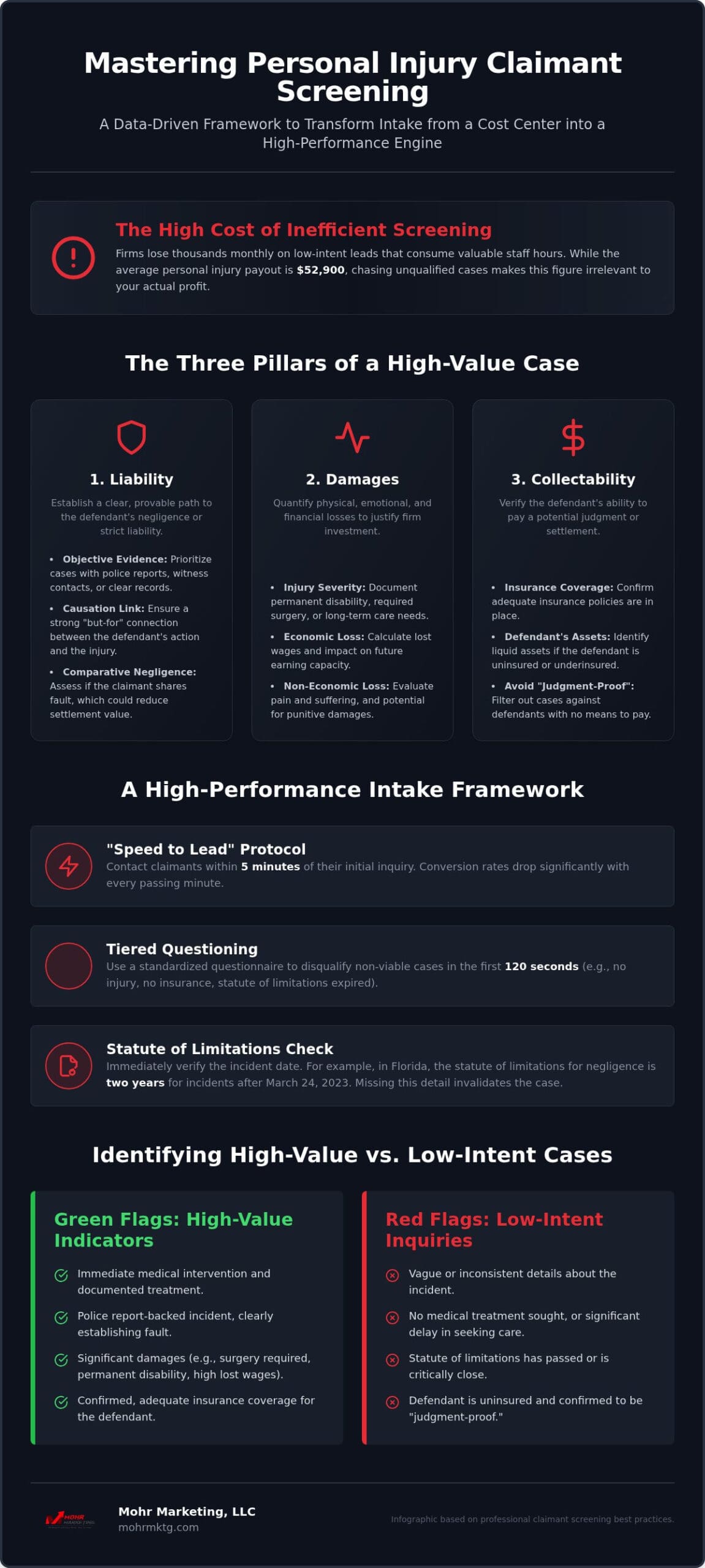
Claimant screening is the systematic verification of legal standing and financial viability. It’s the primary filter that protects your firm’s profitability from the drain of low-intent inquiries. Every case you sign must stand on three non-negotiable pillars: liability, damages, and collectability. If even one pillar is weak, the inquiry is a liability rather than an asset. Mastering how to screen personal injury claimants requires moving beyond passive data collection toward a model of aggressive verification.
Liability is your foundation. You must establish a clear path to proving the defendant’s negligence or strict liability. During the initial personal injury screening, your team should prioritize inquiries with immediate, objective evidence. High-quality police-report backed MVA cases provide a significant advantage here. The liability is often documented by a neutral third party at the scene, which reduces the risk of a “he-said, she-said” dispute later in the litigation process.
Damages justify the investment of your firm’s time and capital. You are quantifying physical, emotional, and financial losses to ensure the potential settlement value justifies the resources required to win. A claimant with perfect liability but no medical treatment is a low-value inquiry. You need cases where the impact on the victim’s life is clear and documented.
Collectability is the final, often overlooked filter. You must verify that the defendant has adequate insurance coverage or liquid assets to satisfy a potential judgment. A million-dollar case against an uninsured, judgment-proof individual is worth zero to your firm. Professional screening ensures you aren’t chasing ghosts.
Establishing Clear Liability
Screen for direct evidence immediately. If the claimant cannot provide a police report, witness contact information, or medical records, the risk increases. You must also identify potential comparative negligence issues. In states with strict fault rules, even a minor share of blame can drastically diminish the case’s settlement value. Your intake team should assess the “but-for” causation carefully. If the link between the defendant’s action and the injury is weak, the case will likely fail under pressure. This rigorous approach is essential when determining how to screen personal injury claimants for maximum ROI.
Quantifying Economic and Non-Economic Damages
Verify injury severity through objective data points. Permanent disability, required surgery, or the need for long-term care are significant indicators of high-value litigation. You must document lost wages and the specific impact on future earning capacity. Non-economic damages, such as pain and suffering, require a different level of scrutiny. Evaluate the potential for punitive damages in egregious cases, such as drunk driving or gross corporate negligence. These factors transform a standard inquiry into a high-value asset for your firm.
A Step-by-Step Framework for Legal Intake Teams
Scaling a high-volume personal injury practice requires an operational framework that eliminates guesswork. You cannot rely on manual, attorney-led screening if you intend to capture significant market share. Instead, deploy a standardized intake questionnaire to ensure data consistency across every inquiry your firm receives. This system allows your team to master how to screen personal injury claimants with mechanical precision, ensuring no high-value case slips through the cracks due to human error.
Implement strict “Speed to Lead” protocols immediately. Conversion rates drop significantly if a claimant isn’t contacted within five minutes of their initial inquiry. Once on the phone, utilize tiered questioning to disqualify non-viable cases in the first 120 seconds. If there’s no insurance, no injury, or the statute of limitations has passed, the call should end. Use digital verification tools to cross-reference claimant data against public records to prevent fraud and ensure you’re dealing with a legitimate victim.
The Initial Contact Protocol
Your intake staff must use assertive, professional language to build authority from the first sentence. They should ask open-ended questions that allow the claimant to describe the incident in their own words. This often reveals critical details about liability that a “yes or no” question might miss. During this phase, verify basic contact information and the exact date of the incident. In Florida, for example, the statute of limitations for negligence is now two years for incidents occurring on or after March 24, 2023. Missing this detail renders the rest of the screening process moot.
Applying Case-Specific Criteria
Different case types require specialized filters. For motor vehicle accidents, verify the insurance carrier and policy limits early. A case with clear liability but a minimum policy limit may not meet your firm’s revenue thresholds. For mass torts, confirm the specific medical diagnosis and duration of exposure to the harmful substance. Always ask if the claimant is already represented by another firm. Identifying these ethical conflicts early protects your reputation and resources. If your current system is failing to filter these details effectively, you may need to re-evaluate your intake strategy with a professional partner.
Identifying High-Value Cases vs. Low-Intent Inquiries
Efficiency in personal injury law is defined by your ability to separate high-value litigation from low-intent noise. When you understand how to screen personal injury claimants, you focus your firm’s resources on cases with the highest potential ROI. High-value cases often present “Green Flags” early in the intake process. These include immediate medical intervention, clear police reports, and high-impact injuries. Conversely, “Red Flags” like significant gaps in medical treatment or a history of multiple prior claims suggest a case that may be difficult to settle or win at trial.
You must differentiate between soft tissue claims and catastrophic injury cases during the initial contact. While soft tissue cases can provide steady volume, catastrophic injuries require a higher capital investment but offer significantly larger payouts. Assessing claimant credibility is also vital. A claimant who is vague about incident details or lacks “jury appeal” can undermine even the strongest liability case. Look for consistent narratives and documented evidence to ensure you are signing a case that will withstand the discovery process.
Screening for High-Value MVA and Trucking Cases
Your team should prioritize police report-backed MVA cases to ensure factual accuracy from the start. These reports provide an objective foundation for liability that is difficult for insurance companies to dispute. When evaluating truck accident cases, look for commercial insurance policies. These policies typically have much higher limits than standard personal auto insurance, often reaching into the millions. Verify the “Commercial Driver” status and ask about the availability of electronic logbooks. These data points are essential for proving negligence in complex trucking litigation.
Mass Tort and Specialized Litigation Screening
Mass tort cases require a different level of precision. You must confirm specific product use or environmental exposure before committing your firm’s resources. For instance, mesothelioma intent-based leads must be vetted for direct asbestos exposure and a confirmed medical diagnosis. Ensure the claimant’s diagnosis matches the specific criteria outlined in the litigation’s master complaint. You should also screen for pre-existing conditions that could complicate the causation argument. Conflicting medical histories can derail a mass tort claim, so rigorous verification of the medical timeline is mandatory.
Optimizing the Intake Ecosystem for Maximum Conversion
A high-performance screening process is only as effective as the ecosystem supporting it. If your team understands how to screen personal injury claimants but lacks the technical infrastructure to act, your conversion rate will stagnate. You must integrate intake data directly into a CRM to eliminate manual entry errors and data silos. This ensures that every qualified inquiry is tracked from the first touchpoint to the final settlement. Automated follow-up sequences using text and email are essential for claimants who don’t sign immediately. These touchpoints keep your firm top-of-mind while your staff focuses on new, high-priority inquiries.
Scaling requires moving beyond the limitations of your internal staff’s schedule. Leveraging 24/7 professional intake services allows you to capture high-value leads outside of standard business hours. While some competitors argue for direct attorney access, this model isn’t scalable for firms pursuing aggressive growth. A professional intake service provides the necessary volume without burning out your legal team. You must monitor conversion metrics relentlessly. Track the progression from raw inquiries to qualified leads and, finally, to signed retainers to identify bottlenecks in your funnel.
The Role of Technology in Screening
Securing a retainer requires speed. Implement e-signature tools to capture a commitment the moment a claimant is qualified. If you wait even an hour to send paperwork, the likelihood of a “no-show” increases significantly. Use lead scoring algorithms to prioritize high-value inquiries for immediate follow-up. This ensures your best staff members are talking to your best potential cases first. Compliance is non-negotiable. Ensure all digital marketing funnels and communication protocols are fully CCPA and TCPA compliant to protect your firm from regulatory risk.
Measuring Intake Efficiency
Data drives refinement. Track “Time to Retainer” as a primary key performance indicator for your intake team. If this number is climbing, your screening or follow-up process is failing. Analyze disqualification reasons to refine your front-end marketing and lead acquisition. If 80% of inquiries are disqualified for the same reason, your targeting needs immediate adjustment. Benchmarking your performance against the ROI of legal intake services provides a clear picture of where your firm stands. Efficient conversion isn’t just about signing cases; it’s about doing so at a lower cost-per-acquisition.
The Performance Model: Moving Beyond Manual Screening
Traditional manual screening is a bottleneck that restricts firm growth. Relying on in-house staff to filter hundreds of inquiries leads to high overhead costs, inevitable staff burnout, and inconsistent case quality. When your team is bogged down in the minutiae of initial calls, they aren’t focused on high-value litigation. Modern firms are abandoning this inefficient approach in favor of performance-based acquisition. Shifting to pay-per-signed-case leads allows you to bypass the friction of the intake process entirely.
The Mohr Marketing, LLC advantage lies in delivering fully verified inquiries and executed retainers directly to your firm. With over 30 years of industry experience, we provide a turnkey marketing and intake ecosystem that eliminates the inefficient middleman. This model reduces friction in the case acquisition lifecycle, ensuring that every dollar spent is tied directly to a signed client. You no longer need to worry about the logistics of how to screen personal injury claimants because the rigorous verification has already been completed by an authoritative expert. This strategic shift ensures your resources are dedicated to settlement and trial, not administrative filtering.
Why Signed Retainers Outperform Standard Leads
Signed retainers solve the primary pain points of legal intake: the “no-show” and the “unreachable” lead. Standard leads often go cold before your team can make contact, wasting both time and marketing spend. With a performance model, your firm only pays for converted opportunities that meet your specific criteria. This allows you to accelerate firm growth by focusing 100% of your resources on litigation rather than administrative screening. It is a transition from chasing inquiries to managing a portfolio of high-value assets.
Scaling Your Practice with High-Intent Opportunities
Integration is the key to scalability. By incorporating a turnkey marketing ecosystem into your existing firm infrastructure, you can rapidly expand into high-value niches. Whether you’re targeting mold case acquisition or complex mass torts, the performance model provides the necessary volume without the hiring headache. Partnering with a strategic agency that understands personal injury lead generation companies ensures your firm remains ahead of market shifts. This proactive approach secures a leadership position in an increasingly competitive legal landscape, allowing you to scale without increasing internal overhead.
Strategic Growth Through Intake Precision
Implementing a rigorous intake framework is not merely a procedural update; it is a strategic necessity for firms targeting market leadership. By mastering the nuances of how to screen personal injury claimants, your firm effectively de-risks its acquisition pipeline and ensures that capital is only deployed toward cases with high settlement potential. The combination of data-driven questionnaires, rapid response protocols, and automated CRM integration creates a scalable infrastructure that operates independently of individual staff limitations.
Mohr Marketing, LLC provides the final component of this optimization by delivering fully executed retainers and verified inquiries. With over 30 years of industry experience, we offer a performance-based model that prioritizes your firm’s profitability and compliance. This approach allows your legal team to bypass the friction of the intake funnel and focus exclusively on high-stakes litigation and trial preparation. It’s the most direct path to reducing your cost-per-acquisition while increasing your total case value.
Building a high-performance practice requires a commitment to operational excellence and strategic partnerships. When you align your firm’s goals with a verified acquisition ecosystem, you secure a sustainable competitive advantage in a crowded legal market. Start focusing on the cases that matter and let a seasoned expert handle the mechanics of your growth.
Frequently Asked Questions
What are the most important questions to ask during a personal injury intake?
Focus on the date of the incident, a detailed description of liability, and the specific nature of medical treatment. You must verify if the claimant has already hired an attorney to avoid ethical conflicts. Ask about insurance coverage and policy limits immediately. These data points determine if the inquiry meets your firm’s minimum revenue thresholds before you commit further resources.
How do you determine if a personal injury claim is worth pursuing?
A claim is worth pursuing only when clear liability, significant damages, and defendant collectability intersect. You must also verify the statute of limitations. For example, Florida negligence cases occurring on or after March 24, 2023, now have a strict two-year filing deadline. If the defendant is uninsured or judgment-proof, even a case with severe injuries may not be financially viable for your firm.
What is the difference between a lead and a qualified claimant?
A lead is merely contact information from an individual who may have been injured. A qualified claimant is a vetted inquiry that has passed through a rigorous screening protocol. Qualification confirms that the incident fits your specific practice area, falls within the legal filing window, and possesses enough potential value to justify the cost of litigation. Leads require work; qualified claimants represent signed opportunities.
How can I automate my law firm’s screening process?
Integrate standardized digital questionnaires directly into your CRM ecosystem to capture and score data automatically. Use lead scoring algorithms to prioritize high-value inquiries for immediate staff contact. Automation is a critical component of how to screen personal injury claimants at scale. It ensures that every inquiry is filtered through the same objective criteria without the delays or errors associated with manual entry.
What are common “red flags” when screening personal injury leads?
Significant gaps in medical treatment and a history of multiple prior claims are primary indicators of a low-value case. Vague incident details often suggest liability issues that will become problematic during discovery. You should also be cautious of claimants who contact you days before the statute of limitations expires. These factors increase your firm’s risk and typically result in lower settlement offers from insurance carriers.
Is it better to hire an in-house intake team or outsource screening?
Outsourcing to a professional service often provides superior ROI by offering 24/7 coverage and specialized expertise. Internal teams frequently suffer from burnout and inconsistent quality during high-volume periods. When you outsource how to screen personal injury claimants to an expert partner, you eliminate the overhead of training and management. This allows your legal team to focus exclusively on litigation and case resolution.
How does a pay-per-signed-case model work for personal injury lawyers?
In this performance-based model, your firm pays only for fully executed retainers that meet your pre-defined criteria. This shifts the financial risk of marketing and screening to the provider. You don’t pay for raw leads or unqualified inquiries. This approach ensures a predictable cost-per-acquisition and allows you to scale your case volume without increasing your internal administrative burden or marketing department headcount.
What legal compliance rules apply to screening and acquiring claimants?
All claimant acquisition must strictly adhere to TCPA and CCPA regulations regarding digital communication and data privacy. You must also follow state bar rules concerning attorney advertising and the prohibition of improper solicitation. Contingency fee agreements must be in writing and signed by the client as per ABA Model Rule 1.5. Professional screening services ensure these compliance mandates are met before the case reaches your desk.

Recent Posts
- Mass Tort Digital Marketing Agency
- Personal Injury Signed Retainers: The Strategic Guide to Scalable Case Acquisition in 2026
- Motor Vehicle Accident Leads: A 2026 Guide to High-Intent Case Acquisition
Categories
- AI and Lead Generation
- Business Financing
- Call Verified MVA Leads
- Car Accident Help
- Car Accident Settlements
- Claimant Funding
- Compliance Program
- EMS-EMT Reports
- Geotargeting
- Google Maps Ranking
- Healthcare Practice Growth
- Law Firm Growth
- Law Office Operations
- Lead Generation
- Lead Generation For Attorneys
- Lead Generation For Chiropractors
- Lead Generation For Criminal Attorneys
- Lead Generation For D&A Treatment Centers
- Lead Generation For DUI Attorneys
- Lead Generation For Eye Doctors
- Lead Generation For Family Law Practices
- Lead Generation For PI Law Firms
- Lead Generation For Plastic Surgeons
- Leads For Healthcare Professionals
- Leads For Insurance Industry
- Legal Leads
- Legal Marketing
- Legal Updates
- Mass Tort Leads
- Medicare and Medicaid Leads
- Merchant Funding Leads
- Online Marketing Strategies
- Pre-Settlement Funding
- Signed MVA Cases
- Tort Updates
- Truck Accident Leads and Signed Cases
- Truck Accident Settlements
- Web Design