Tampon Lawsuit Litigation: Key Updates and Case Trends
July 22, 2026 by Mohr Marketing
The belief that the July 2026 FDA study would end the tampon toxic metal crisis was a strategic miscalculation for manufacturers. While federal regulators claim trace metal levels are low, the momentum behind tampon lawsuit litgation continues to build through aggressive consumer protection claims and economic loss theories. Leading firms recognize that waiting for definitive medical causation is a losing strategy in a market that’s already moving toward consolidation. Cases like Barton v. The Procter & Gamble Company prove that the legal focus has shifted toward disclosure and consumer trust.
You’re likely struggling with high lead costs and the difficulty of verifying product usage over long periods. It’s a common challenge in competitive mass torts where medical causation remains medically complex. This guide provides a roadmap for securing high-intent signed retainers while avoiding the marketing waste typical of emerging dockets. We’ll analyze the latest case trends, identify high-value criteria, and explain how to build a verified docket using a performance-based acquisition model that eliminates inefficient intermediaries and focuses on tangible results.
Key Takeaways
- Analyze how the 2024 discovery of heavy metals shifted the litigation landscape from acute injury to systemic reproductive harm.
- Identify the specific medical diagnoses and usage thresholds required to qualify high-value claimants in tampon lawsuit litgation.
- Shift your acquisition strategy from broad TV campaigns to targeted digital funnels that capture search intent at the moment of discovery.
- Eliminate marketing waste by transitioning from raw lead generation to a performance-based model for acquiring verified, signed retainers.
- Leverage a turnkey intake ecosystem to secure fully executed retainers ready for immediate litigation without the burden of internal processing.
The Evolution of Tampon Litigation: From TSS to Toxic Metal Exposure
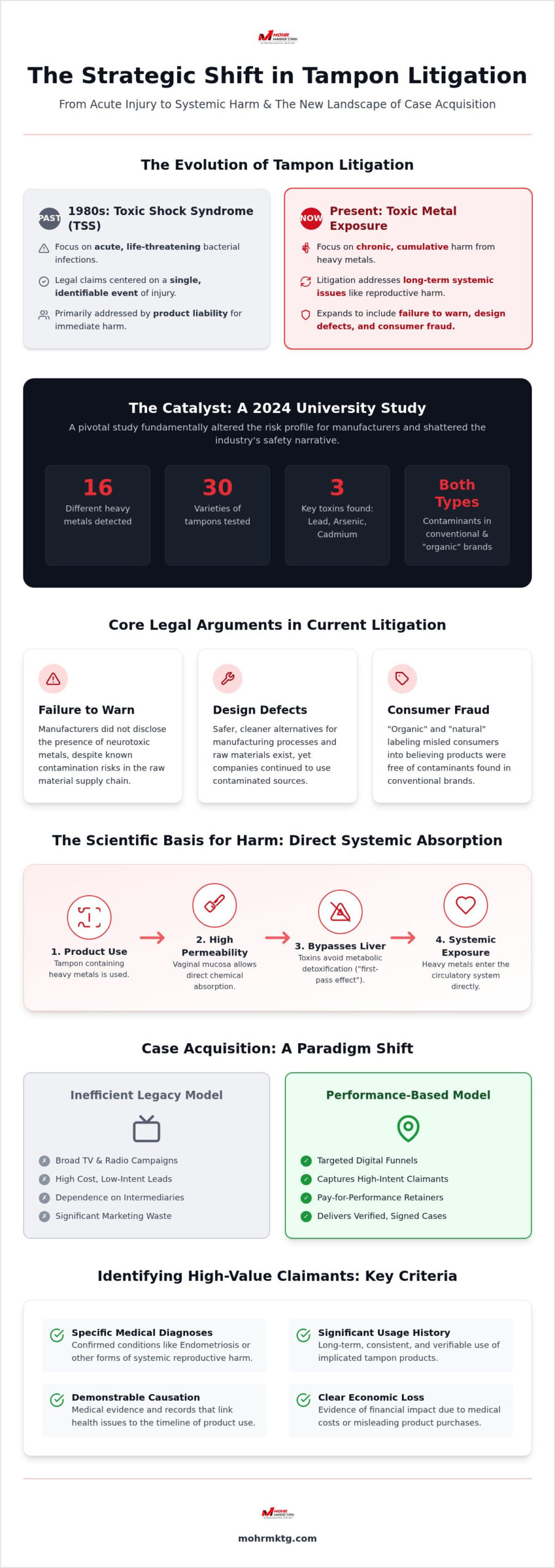
Menstrual product liability has a long history, but the legal landscape is shifting rapidly. The 1980s Rely tampon crisis established the baseline for product liability in this sector, focusing primarily on acute, life-threatening bacterial infections. However, the Evolution of Tampon Litigation: From TSS was just the beginning. Modern tampon lawsuit litgation targets a silent, systemic threat: chronic heavy metal exposure. While TSS cases were often binary, modern litigation addresses the cumulative physiological impact of lead, arsenic, and cadmium absorbed through highly permeable vaginal tissue.
The 2024 Heavy Metal Study: A Catalyst for Mass Torts
The 2024 University of California, Berkeley study fundamentally altered the risk profile for manufacturers. Researchers detected 16 different metals across 30 tampon varieties, including lead, arsenic, and cadmium. The presence of these toxins in both conventional and organic products shattered the industry’s safety narrative. The FDA’s classification of tampons as Class II medical devices requires performance testing, but it didn’t historically mandate testing for heavy metal leaching into the bloodstream. This regulatory gap left millions of consumers exposed to neurotoxins and endocrine disruptors for decades. Manufacturers failed to test for systemic absorption, creating a massive opening for liability claims based on long-term reproductive harm.
Shifting Liability: Failure to Warn and Design Defects
Current litigation strategies move beyond simple injury claims to address broader corporate negligence. Attorneys are successfully leveraging several key legal theories to build robust dockets:
- Failure to Warn: Manufacturers didn’t disclose the presence of neurotoxic metals despite known risks of contamination in the supply chain.
- Design Defects: Safe alternatives and cleaner manufacturing processes exist, yet companies continued using contaminated raw materials.
- Consumer Fraud and Greenwashing: “Organic” and “natural” labeling misled consumers into paying a premium for products that contained the same heavy metal contaminants as conventional brands.
As of mid-2026, cases like Barton v. The Procter & Gamble Company and Otkina et al. v. P&G continue to progress through the federal court system. These lawsuits initially prioritized economic loss and false advertising, but personal injury claims are gaining ground as medical causation data regarding reproductive health matures. Firms looking to scale their dockets must act now. Waiting for a global settlement often means paying significantly higher acquisition costs later. You can secure your position in this emerging market by acquiring mass tort signed cases while the market remains in its early growth phase.
Scientific Basis for Claims: Heavy Metals and Systemic Reproductive Harm
The physiological reality of the vaginal canal creates a unique, high-risk pathway for systemic toxicity. Unlike the skin or the digestive tract, the vaginal mucosa is highly permeable and richly vascularized. This structure allows chemicals to bypass the liver’s metabolic detoxification entirely. The Scientific Basis for Claims in modern tampon lawsuit litgation rests on the documented presence of neurotoxic and endocrine-disrupting metals. Researchers have confirmed the presence of Lead, Arsenic, Cadmium, and Mercury in widely used products. These metals don’t remain localized; they enter the circulatory system directly through the vaginal epithelium.
The vaginal first-pass effect refers to the direct systemic absorption of substances through the vaginal wall into the circulatory system, bypassing the hepatic metabolism that typically filters and neutralizes ingested toxins. This scientific mechanism is the legal cornerstone for establishing harm. It proves that even trace amounts of heavy metals are biologically significant when delivered through this route. It establishes a direct link between product use and systemic presence.
The Impact of Lead and Arsenic on Women’s Health
Lead and arsenic are potent neurotoxins that cause severe hormonal disruptions even at low concentrations. Chronic exposure through monthly tampon use is increasingly linked to Endometriosis and unexplained Infertility. These metals interfere with estrogen signaling and uterine health. Cadmium exposure presents another layer of risk, specifically linked to kidney dysfunction and bone density loss in long-term users. Proving causation in tampon lawsuit litgation requires sophisticated expert testimony from toxicologists and reproductive endocrinologists. Attorneys must demonstrate that the cumulative exposure via vaginal absorption exceeds safe biological thresholds over years of product use. Success depends on connecting these specific contaminants to documented reproductive pathologies that have no other clear environmental cause.
Vaginal Tissue Permeability vs. Traditional Exposure Routes
Standard FDA safety thresholds for ingestion are fundamentally flawed and inapplicable to menstrual products. The gastrointestinal tract possesses protective barriers like stomach acid and specialized enzymes designed to neutralize toxins. The vaginal canal lacks these metabolic defenses. This absence of a protective barrier means that ingestion-based “safe” levels are irrelevant for vaginal insertion. This scientific nuance provides the foundation for design defect claims. Manufacturers understood the high permeability of vaginal tissue. They failed to design products that accounted for this physiological vulnerability. They prioritized cost over safety. They ignored the fact that vaginal absorption is significantly more efficient and dangerous than ingestion. If you’re building a docket based on these scientific links, you need a partner who understands the nuance of medical verification. Reach out to discuss your case acquisition strategy today and secure your position in this litigation.
Defining High-Value Case Criteria for Tampon Litigation
Success in tampon lawsuit litgation depends on rigorous claimant screening. High-intent leads are only valuable if they meet specific medical and usage thresholds. Firms can’t afford to waste resources on dockets filled with unverified claims. Establishing a direct link between chronic exposure and systemic harm requires a methodical approach to data collection. Defining High-Value Case Criteria involves more than just a history of product use; it requires documented medical evidence that aligns with known toxicological patterns.
Viable cases typically require a minimum of five to ten years of consistent tampon use. Frequency matters. Daily use during menstrual cycles creates the cumulative heavy metal load necessary for systemic disruption. Primary medical diagnoses currently prioritized include:
- Ovarian or Cervical Cancer
- Primary Ovarian Insufficiency (POI)
- Severe Endometriosis requiring surgical intervention
- Unexplained Infertility
Exclusionary factors are equally critical. Claimants with a heavy smoking history or professional exposure to industrial metals often face insurmountable causation hurdles. Pre-existing genetic predispositions to reproductive cancers can also weaken a claim’s standing in tampon lawsuit litgation. Defense counsel will exploit these variables to dismiss individual cases during the discovery phase. You must filter these out early to maintain docket integrity.
Medical Benchmarks for Qualifying Claimants
Establishing the heavy metal load is a complex process. While blood tests provide a snapshot of current exposure, hair follicle testing offers a longer-term window into chronic absorption. Timeline requirements are strict. The injury must have manifested during or shortly after the period of heaviest product usage. This temporal proximity is vital for overcoming the “trace amounts” defense typically used by manufacturers. Expert medical review must confirm that the diagnosis isn’t attributable to alternative environmental factors or lifestyle choices.
Product Identification Challenges and Solutions
Brand identification remains a significant hurdle. Claimants often struggle to recall specific product lines used a decade ago. Verification requires a paper trail. Loyalty program data from major retailers provides an objective record of purchases. Digital receipts and Amazon order histories are gold mines for evidence. Even for “organic” brands, proving the purchase of specific lots found to be contaminated is essential for establishing liability. If your firm is struggling to verify these details at scale, acquiring mass tort signed cases through a professional intake service ensures every retainer is backed by rigorous documentation and purchase history.
Strategic Case Acquisition: Navigating the Tampon Mass Tort Market
Traditional mass tort marketing relies on broad-reach television campaigns. This approach is increasingly inefficient for tampon lawsuit litgation. TV spots often attract low-quality inquiries that clog your intake department and drive up the cost per signed retainer. High-stakes litigation requires a more surgical approach. You need to reach potential claimants at the exact moment they discover the link between their reproductive health issues and heavy metal exposure. This search intent is the most valuable asset in the current market. It represents a motivated individual seeking immediate legal guidance.
Digital funnels capture this intent with precision. When a user searches for specific case updates, they are actively seeking legal recourse. A hyper-targeted digital strategy ensures your firm appears as the primary solution. This method doesn’t just generate volume; it generates high-intent inquiries from individuals who are ready to sign. Compliance remains a top priority. Navigating state bar rules for mass tort advertising requires a partner who understands the nuances of legal ethics and disclosure requirements. Reliability is built on transparency and rigorous verification of every lead generated.
Digital Intake Ecosystems for High-Intent Claimants
A turnkey marketing funnel is the backbone of a successful docket. It moves beyond simple landing pages to create a comprehensive educational journey. By providing value-driven content, you establish authority before the first phone call. This process is essential for Mass Tort Lead Generation: A Roadmap to Scalable Growth. The ecosystem must operate 24/7. Lead decay happens in minutes, not hours. If you aren’t responding instantly to a new inquiry, your competitors will. A seamless transition from click to intake is the only way to maintain a competitive advantage in a crowded market.
Qualifying Claimants at the Point of Entry
Volume is a liability if it isn’t qualified. Your intake process must utilize automated screening questions to filter out non-qualifying inquiries immediately. This protects your firm’s resources and focuses your team on high-value cases. Legal intake professionals play a dual role. They must conduct rigorous verification while maintaining an empathetic approach during claimant interviews. This balance is critical for conversion. Understanding The ROI of Legal Intake Services helps you see that efficiency in the first five minutes determines the ultimate success of your docket. Every signed retainer is the result of a precise, mechanical intake process that leaves no room for error.
Scaling Your Docket with Verified Tampon Litigation Signed Cases
Scaling a mass tort docket requires a shift from speculative marketing to performance-based acquisition. Traditional “Pay-Per-Lead” models often burden firms with high volumes of unverified inquiries. This creates a bottleneck in your intake department and inflates the cost of each viable case. For tampon lawsuit litgation, the complexity of medical verification makes the “Pay-Per-Signed-Case” model the only logical choice for firms prioritizing growth. This model eliminates the financial risk associated with non-qualifying leads. You only pay for fully executed retainers that meet your firm’s specific criteria.
Outsourcing the entire intake and verification process reduces firm overhead significantly. You don’t need to hire and train a specialized team to handle the sensitive and technical nature of menstrual health inquiries. Mohr Marketing delivers fully executed retainers ready for immediate litigation. This turnkey approach allows your legal team to focus on litigation strategy rather than administrative processing. For complex cases requiring immediate human interaction, “Verified Call Transfer Leads” provide a distinct competitive advantage. They connect your attorneys with pre-screened claimants who have already passed initial medical and usage filters.
The Performance Model: Pay-Per-Signed-Case Advantage
Predictability is the foundation of a successful mass tort practice. By utilizing Mass Tort Signed Cases, firms can accurately forecast docket growth and ROI. You aren’t guessing how many leads will convert; you are purchasing confirmed interest and verified injury. This transparency allows for aggressive scaling without the fear of marketing waste. It transforms case acquisition from a variable expense into a manageable, data-driven investment. This is the most efficient path to leading the tampon lawsuit litgation market.
Why Partner with Mohr Marketing for Tampon Litigation?
Success in high-stakes legal lead acquisition depends on experience and infrastructure. Mohr Marketing brings 30 years of industry expertise to the table. Our turnkey marketing and intake ecosystem is designed specifically for the nuances of emerging torts. We maintain strict compliance with state bars while leveraging advanced digital funnels to capture high-intent search traffic. We prioritize transparency in every data point. This ensures you know exactly how your cases are sourced and verified. Don’t leave your firm’s expansion to chance. Partner with Mohr Marketing for Tampon Litigation Signed Cases to secure a steady stream of high-value retainers today.
Dominate the Tampon Litigation Market with Strategic Precision
The transition from acute TSS claims to chronic toxic metal exposure represents a fundamental shift in menstrual product liability. Firms that successfully navigate tampon lawsuit litgation will be those that prioritize scientific causation and rigorous claimant screening. You’ve seen how the 2024 heavy metal study and subsequent litigation trends have created a high-intent market for legal services. Success in this docket depends on your ability to verify long-term product usage and link it to systemic reproductive harm.
Scaling your practice requires more than just high lead volume. It requires a turnkey intake ecosystem and 30+ years of legal marketing expertise to ensure every case is viable. By focusing on fully verified and signed retainers, you eliminate the inefficiencies of traditional lead generation and focus your resources on high-value litigation. This performance-based approach ensures your firm maintains a competitive advantage while minimizing marketing waste.
Taking a proactive stance now positions your firm as a leader in this emerging mass tort. We’re ready to help you build a high-value docket with the mechanical accuracy your growth requires.
Frequently Asked Questions
What is the basis for the tampon toxic metal lawsuit?
The basis for current litigation is the undisclosed presence of neurotoxic heavy metals in menstrual products. Plaintiffs allege that manufacturers failed to warn consumers about lead, arsenic, and cadmium contamination. Many claims focus on “greenwashing,” where companies marketed products as organic or natural while containing systemic toxins. These lawsuits argue that the vaginal first-pass effect makes even trace amounts biologically significant for reproductive health.
Which tampon brands are named in current litigation?
Procter & Gamble’s Tampax brand is the central focus of several active lawsuits, including Barton v. The Procter & Gamble Company. Other manufacturers identified in the 2024 heavy metal study are also facing potential liability. While Tampax is the most prominent name in federal filings, the litigation landscape is expanding to include various organic brands that failed to disclose contamination during the manufacturing process.
What are the qualifying injuries for a tampon lawsuit claim?
Qualifying injuries currently targeted include severe reproductive disorders and cancers. Ovarian cancer, cervical cancer, and endometriosis requiring surgical intervention are primary benchmarks for high-value claims. Additionally, cases involving primary ovarian insufficiency and unexplained infertility are gaining traction. These injuries must be linked to a consistent history of product use to establish the cumulative exposure necessary for systemic harm.
Is there an MDL (Multi-District Litigation) for tampon heavy metals?
There isn’t a centralized MDL for tampon toxic metals as of July 2026. Litigation is currently proceeding through individual and class-action filings in federal courts. The outcome of ongoing motions in cases like Barton v. P&G will likely determine if the Judicial Panel on Multidistrict Litigation consolidates these matters. Monitoring these jurisdictional developments is essential for firms building new dockets today.
How can my law firm acquire signed retainers for tampon cases?
Firms can acquire tampon lawsuit litgation signed retainers by leveraging performance-based acquisition models. Mohr Marketing provides a turnkey intake ecosystem that delivers fully verified retainers ready for litigation. This approach bypasses the high costs and low conversion rates of traditional lead generation. It allows your firm to secure high-intent claimants who’ve already passed rigorous medical and usage screening protocols.
What heavy metals were found in tampons during the 2024 study?
The 2024 University of California, Berkeley study detected 16 different metals in various tampon samples. Lead, arsenic, cadmium, and mercury were the most concerning contaminants found. These neurotoxins were present in both conventional and organic products across 30 different varieties. The study’s findings serve as the scientific foundation for current claims regarding the failure of manufacturers to ensure product safety and purity.
How does the “Pay-Per-Signed-Case” model work for mass torts?
The Pay-Per-Signed-Case model ensures you only pay for fully executed retainers that meet your specific criteria. It eliminates the financial risk of purchasing unverified inquiries or low-quality leads. This model is particularly effective for tampon lawsuit litgation because it shifts the burden of intake and verification to a specialized partner. It provides a transparent, predictable path for scaling your firm’s mass tort docket.
What is the statute of limitations for tampon litigation claims?
The statute of limitations varies significantly by state and the specific nature of the claim. Most personal injury and product liability statutes range from two to four years from the date of injury or discovery. Because many heavy metal injuries manifest over time, the “discovery rule” is often a central legal point. You should consult local statutes to ensure timely filing for individual claimants.

Recent Posts
- Attorney Search Engine Marketing: Do It Yourself or Hire Help
- Improving Law Firm Marketing ROI: A Practical Measurement Framework
- 4 Ways to Assess Unqualified Legal Leads and Their Costs
Categories
- AI and Lead Generation
- Business Financing
- Call Verified MVA Leads
- Car Accident Help
- Car Accident Settlements
- Claimant Funding
- Compliance Program
- EMS-EMT Reports
- Geotargeting
- Google Maps Ranking
- Healthcare Practice Growth
- Law Firm Growth
- Law Office Operations
- Lead Generation
- Lead Generation For Attorneys
- Lead Generation For Chiropractors
- Lead Generation For Criminal Attorneys
- Lead Generation For D&A Treatment Centers
- Lead Generation For DUI Attorneys
- Lead Generation For Eye Doctors
- Lead Generation For Family Law Practices
- Lead Generation For PI Law Firms
- Lead Generation For Plastic Surgeons
- Leads For Healthcare Professionals
- Leads For Insurance Industry
- Legal Leads
- Legal Marketing
- Legal Updates
- Mass Tort Leads
- Medicare and Medicaid Leads
- Merchant Funding Leads
- Mold Leads
- Online Marketing Strategies
- Pre-Settlement Funding
- Signed MVA Cases
- Tort Updates
- Truck Accident Leads and Signed Cases
- Truck Accident Settlements
- Web Design