Mass Tort Advertising: A Strategic Guide to High-Intent Case Acquisition in 2026
July 14, 2026 by Mohr Marketing
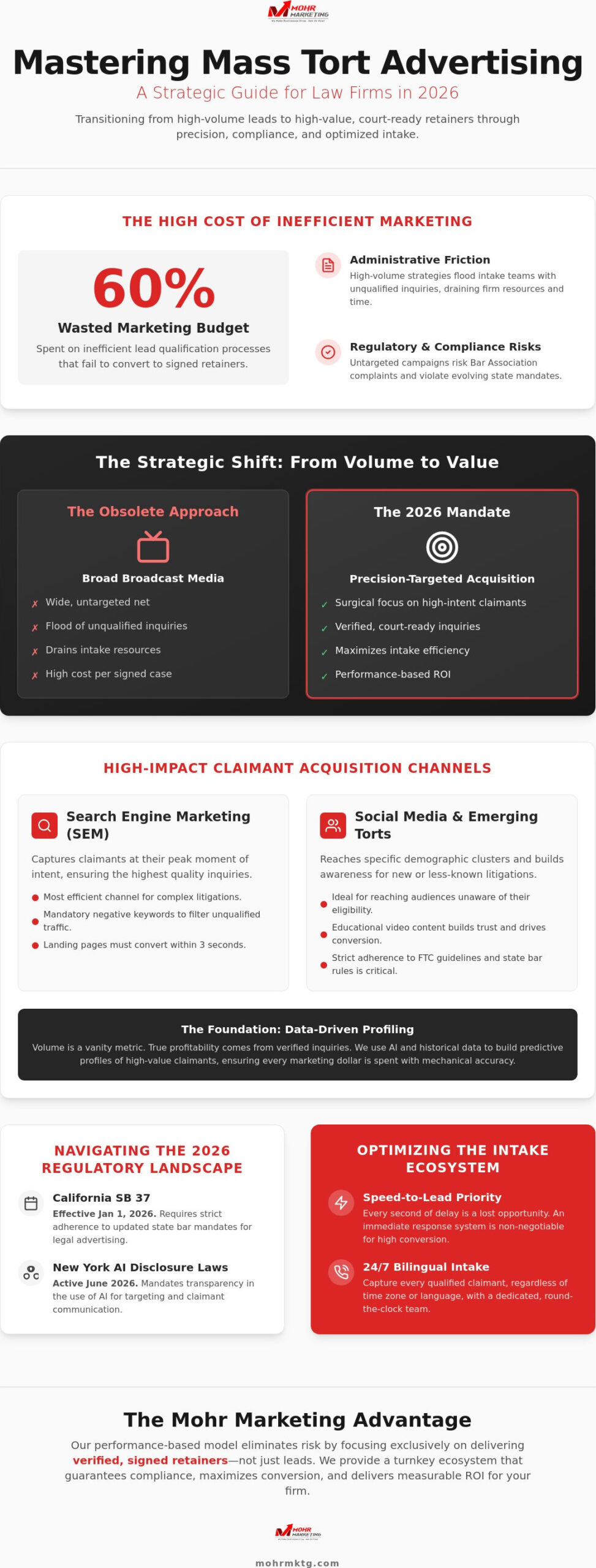
Your firm might be wasting up to 60% of its marketing budget on inefficient lead qualification processes that never reach a signed retainer. In the current market, high-volume strategies often yield nothing but administrative friction and the risk of bar association complaints. You’ve likely experienced the frustration of high costs per lead paired with low conversion rates. It’s a common struggle to stay ahead of evolving mandates like California’s SB 37 or New York’s AI disclosure laws while trying to maintain a competitive edge.
This guide will show you how to master mass tort advertising in 2026 by focusing on high-intent case acquisition and immediate intake execution. We’ll move beyond generic lead generation to focus on verified, court-ready claimants who meet rigorous vetting standards. You’ll learn how to implement a turnkey ecosystem that ensures strict compliance with state bar mandates while increasing your conversion from initial inquiry to signed case. We’re covering the strategic shift toward quality, the impact of new regulatory hurdles, and the mechanics of scaling your firm’s ROI through direct verification and the elimination of inefficient intermediaries.
Key Takeaways
- Identify high-intent claimants by transitioning from broad broadcast media to precision-targeted search and social channels.
- Navigate the 2026 regulatory landscape with strict adherence to updated state bar mandates and mandatory attorney advertising disclosures.
- Optimize your conversion rates by prioritizing speed-to-lead and implementing a 24/7 bilingual intake ecosystem.
- Maximize firm ROI by shifting your mass tort advertising strategy toward performance-based models that deliver verified, signed retainers.
The Evolution of Mass Tort Advertising: Trends for 2026
The era of broad, untargeted television campaigns is over. High-stakes mass tort litigation now demands surgical precision. In 2026, firms can’t afford to cast a wide net and hope for the best. Social inflation is driving jury awards to record highs, which forces advertising budgets upward. Efficiency is now the only path to survival. If your advertising budget isn’t optimized for high-intent capture, you’re subsidizing your competitors’ growth. Modern mass tort advertising requires a multi-platform strategy that prioritizes data transparency over raw lead volume. Compliance is equally critical. With California’s SB 37 effective as of January 1, 2026, and New York’s AI disclosure laws active as of June 2026, your strategy must be as legally sound as it is aggressive.
From TV to Search: The Intent Shift
Broad awareness campaigns, similar to the Camp Lejeune blitz, often result in a flood of unqualified inquiries. These leads kill intake efficiency and drain firm resources. Success in 2026 relies on capturing users at the exact moment of search. You need to identify niche criteria that signal a claimant is ready to sign. This means focusing on mesothelioma leads built on real search intent rather than general brand awareness. Search intent provides a direct path to high-value cases. It eliminates the expensive “shout” phase of marketing. Instead, it moves straight to the solution for a specific problem. Precision search targeting ensures you aren’t paying for researchers or casual browsers. You’re paying for potential plaintiffs.
The Rise of Data-Driven Claimant Profiling
Volume is a vanity metric. Profitability comes from verified inquiries. 2026 marks the end of the “black box” lead generation model. We use historical data to build predictive profiles of high-value claimants. This allows for aggressive scaling without sacrificing quality. AI-driven targeting now refines audience segments in real-time. It identifies patterns in claimant behavior that human auditors might miss. This level of precision ensures that every dollar spent on mass tort advertising targets an individual who meets strict court-mandated criteria. Data transparency allows you to audit campaign performance with mechanical accuracy. You see exactly where the waste is and cut it out immediately. Eliminating inefficient intermediaries is the only way to protect your firm’s margins in a tightening market.
High-Impact Channels for Mass Tort Claimant Acquisition
Precision targeting defines successful mass tort advertising in 2026. Broad reach is a liability. You need to meet claimants where they’re already looking for answers. This requires a balanced mix of search, social, and programmatic channels. Each channel serves a specific purpose in the acquisition funnel. Search captures existing demand. Social creates it. Programmatic maintains it. You shouldn’t guess which channel works. Use data to dictate your spend. High-stakes litigation requires a mechanical approach to media buying where every dollar is tracked against the final signed retainer.
Search Engine Marketing (SEM) Strategies
Paid search captures intent at its peak. It’s the most efficient way to secure claimants for complex litigations. For example, high-value mold case acquisition requires targeting specific environmental and health-related queries. You aren’t just buying clicks; you’re buying the opportunity to sign a qualified retainer. Negative keyword strategies are mandatory. They act as a shield against budget depletion. You must filter out low-value inquiries from people seeking general information or pro bono advice. Your landing pages must load fast and deliver immediate value. If the user doesn’t see a clear path to a retainer within three seconds, they’ll bounce. Every second of delay is a lost opportunity for your firm.
Social Media and Emerging Torts
Platforms like Facebook and Instagram excel at reaching specific demographic clusters. This is vital for emerging torts where public awareness is low. Use educational video content to build trust before asking for a sign-up. This “value-first” approach converts better than aggressive sales pitches. All creative assets must follow Compliance and Ethical Mandates to avoid regulatory scrutiny. Stick to the facts of the litigation. This approach builds a stronger case file and protects your firm’s reputation. It also ensures your ads don’t get flagged by platform algorithms or state bar auditors. Compliance isn’t a hurdle; it’s a competitive advantage that ensures campaign longevity.
Programmatic display keeps your firm top-of-mind for long-tail litigations. It uses retargeting to stay in front of users who’ve already shown interest. Direct response video drives high-intent inquiries by explaining complex legal criteria in digestible formats. It bridges the gap between a raw lead and a signed retainer. If you want to refine your channel strategy and eliminate waste, speak with our team to see how we verify every inquiry before it reaches your desk. Relying on a single channel is a risk you don’t need to take. Diversify your acquisition to stabilize your case flow.
Compliance and Ethical Mandates in Legal Advertising
Compliance isn’t a suggestion; it’s a structural requirement for any firm looking to scale. In 2026, the regulatory environment for mass tort advertising is more aggressive than ever. State bars aren’t just watching for blatant lies anymore. They’re auditing the entire acquisition funnel, from the first social media impression to the final signed retainer. If your marketing partner doesn’t prioritize transparency, your firm carries the liability. You need a partner that understands the mechanical precision required to stay within ethical bounds while maintaining a competitive edge.
Navigating State-Specific Bar Rules
Alabama, California, and New York all updated their advertising mandates in the first half of 2026. These changes focus on “no-go” zones, such as incentivized lead generation or misleading claims about potential settlement amounts. You can’t run a national campaign using a “one-size-fits-all” creative strategy. Each asset must be vetted against the strictest state mandates to ensure compliance. This includes clear “Attorney Advertising” disclaimers and the inclusion of physical office addresses or phone numbers as required by California’s SB 37. Standardizing these rules across national campaigns isn’t just a hurdle; it’s a way to ensure your case acquisition is scalable and defensible.
Protecting Claimant Privacy
Handling sensitive medical data requires more than just a standard CRM. You must implement HIPAA-compliant protocols for every inquiry. This means secure data transmission and encrypted storage for all medical information captured during the intake process. Following a mass tort lead generation roadmap helps you maintain these standards while scaling your case acquisition. Verification processes must respect claimant confidentiality while ensuring the lead meets court-mandated criteria. Data security isn’t just about IT; it’s about building trust with potential plaintiffs from the first touchpoint.
Transparency in your lead sources is your best defense against a bar audit. The FTC guidance on deceptive advertising highlights the risks of misleading consumers about prescription drug safety or litigation outcomes. Your ads should inform, not terrify. By focusing on verified, non-incentivized leads, you build a case file that stands up to judicial scrutiny. Don’t let a compliance oversight derail a multi-million dollar litigation effort. Direct verification and the elimination of inefficient intermediaries are the only ways to ensure your mass tort advertising remains profitable and compliant in a tightening market.
Optimizing the Intake Ecosystem for Maximum Conversion
Generating a high-intent inquiry is only half the battle. Speed-to-lead remains the single most critical factor in your ROI. Research indicates that firms can waste up to 60% of their marketing spend due to inefficient lead qualification and slow response times. In the high-stakes world of mass tort advertising, a five-minute delay can mean the difference between a signed retainer and a lost opportunity. Your intake ecosystem must operate with mechanical precision, 24 hours a day, 7 days a week. It must be bilingual to capture national claimants and equipped with automated scripts to filter out non-viable inquiries before they reach your legal team.
The Mechanics of Rapid Intake
Reducing friction is the goal. Every additional step in the intake process increases the likelihood of claimant drop-off. You need a turnkey system that moves a prospect from a digital inquiry to a fully executed retainer in a single, seamless session. This is especially true for high-stakes litigation where competition is fierce. Integrating truck accident signed cases into your existing workflows allows your staff to focus on litigation rather than administrative chasing. Understanding the ROI of legal intake services is essential for firms looking to scale. Efficient conversion reduces your cost-per-case and maximizes the impact of your advertising spend.
Verification and Quality Control
Quality control starts at the first touchpoint. You must validate claims early using objective data like medical records or police reports. This prevents your pipeline from being clogged with fraudulent or duplicate submissions. For example, police-report backed MVA cases provide a higher level of certainty and quality that raw leads cannot match. Tech-enabled filtering ensures that only claimants who meet strict court-mandated criteria move forward. This rigorous vetting process protects your resources and ensures that your firm only invests in viable, high-value litigation. If you are ready to eliminate intake friction and secure higher conversion rates, contact our team today to discuss a performance-based acquisition strategy.
The transition from a verified inquiry to a signed retainer should be instantaneous. In 2026, claimants expect immediate digital solutions. Use e-signature platforms and real-time call transfers to close the gap. By professionalizing your intake, you turn mass tort advertising into a predictable engine for growth. You aren’t just buying leads; you’re building a portfolio of signed cases with a clear path to settlement.
The Mohr Marketing Advantage: Performance-Based Case Acquisition
The traditional lead generation model is broken. You shouldn’t pay for raw data that fails to convert into a viable case. Mohr Marketing eliminates the uncertainty inherent in mass tort advertising by focusing on results rather than just reach. With over 30 years of industry experience, we’ve refined a turnkey ecosystem that filters out the noise and delivers high-intent claimants. We move beyond the role of a standard vendor. We act as a strategic partner that protects your resources while aggressively pursuing your firm’s expansion. Our approach is mechanical, precise, and designed to remove the friction that typically kills legal ROI.
Predictable Growth with Signed Retainers
Stop chasing dead leads. Inefficient intermediaries often sell the same raw data to multiple firms, which drives up costs and lowers your conversion rates. Our model is built on accountability. We provide mass tort signed cases that are fully vetted and ready for litigation. This performance-based approach removes the financial risk from your firm. You pay for executed retainers, not potential inquiries. It’s a transparent, data-driven strategy that ensures your marketing budget is an investment in growth rather than an administrative expense. You gain a predictable case flow that allows for better financial planning and resource allocation.
National Scaling for Professional Practices
Scaling a practice shouldn’t require a massive increase in internal headcount. You don’t need a sprawling in-house marketing department to compete on a national level. Mohr Marketing’s intake ecosystem provides instant scalability. We handle the digital targeting, the 24/7 bilingual intake, and the rigorous verification process. This allows your team to focus on what they do best: litigating cases. You get the benefits of a national mass tort advertising campaign with the mechanical accuracy of a precision-engineered acquisition engine. We eliminate the need for you to manage multiple vendors or complex tech stacks.
The future of the legal industry belongs to firms that prioritize conversion efficiency. You need a partner that stays ahead of technological trends and regulatory shifts like New York’s AI disclosures or California’s SB 37. Don’t settle for expensive leads when you can secure signed retainers. Request a custom growth strategy today to see how our turnkey ecosystem can transform your case acquisition and maximize your firm’s ROI. Your firm’s expansion depends on a reliable, scalable path to success that bypasses the inefficiencies of the traditional market.
Scale Your Practice with Precision Case Acquisition
Winning in 2026 requires a total departure from outdated broadcast strategies. You must prioritize high-intent search capture and a rapid intake ecosystem that converts inquiries into signed retainers before the competition intervenes. Success depends on maintaining strict compliance with evolving state bar mandates while eliminating the waste associated with unfiltered lead volume. By focusing on quality markers and verified data, you protect your firm’s resources and ensure a predictable path to growth. Efficient conversion is no longer an option; it’s a structural requirement for profitability.
Mohr Marketing offers a fully compliant turnkey ecosystem backed by 30+ years of industry experience. We provide performance-based models that shift the financial risk from your firm to our acquisition engine, delivering verified cases ready for litigation. It’s time to professionalize your mass tort advertising and remove the friction from your national scaling efforts. Our data-driven strategies ensure you aren’t just buying data, but building a portfolio of high-value cases.
Secure your next high-value case with Mohr Marketing. We are ready to help you dominate your litigation category and secure the high-intent claimants your firm deserves.
Frequently Asked Questions
What is the average cost of mass tort advertising in 2026?
Average costs vary significantly by tort. As of mid-2026, the industry-wide average cost per signed case is approximately $1,265, while a qualified lead averages around $112. Meaningful mass tort campaigns typically require monthly investments between $500,000 and $2 million. You should focus on the cost-per-signed-retainer rather than raw lead costs to measure true performance. High-intent search traffic often commands a premium but yields a higher conversion rate to signed cases.
How do I ensure my mass tort ads are compliant with the Bar Association?
Compliance requires strict adherence to state-specific mandates like California’s SB 37 and New York’s AI disclosure laws. You must include a genuine office address and a functioning telephone number in all creative assets. Avoid using deceptive tactics or making specific promises regarding settlement amounts. Alabama and California updated their rules in January 2026; New York followed in June. Working with a partner that understands these legal nuances protects your firm from bar complaints.
Is Pay-Per-Lead or Pay-Per-Signed-Case better for my law firm?
Performance-based models like Pay-Per-Signed-Case are generally better for firms seeking predictable growth. This model shifts the financial risk away from your firm; you only pay for verified claimants who have executed a retainer. Pay-Per-Lead models often result in high volumes of unqualified inquiries that drain your intake resources. By focusing on signed retainers, you eliminate the administrative friction of chasing unresponsive leads and ensure every marketing dollar contributes directly to your case portfolio.
How long does it take to see results from a mass tort advertising campaign?
You will see raw inquiries almost immediately after launching a campaign, but the path to settlement is a long-term investment. The timeline from initial mass tort advertising spend to final settlement distribution typically spans 3 to 7 years. Your intake team must be ready to sign cases within minutes of the first click to maximize conversion. While the case acquisition phase is relatively fast, the litigation and MDL processes dictate the ultimate return on investment.
What are the most profitable mass torts to advertise for right now?
Profitable litigations in 2026 include emerging claims related to GLP-1 receptor agonists like Ozempic and Mounjaro, PFAS “forever chemicals,” and Depo-Provera. These categories show high claimant intent and significant surge potential. The Depo-Provera MDL has seen a massive increase in filings throughout early 2026, surging over 2,600% since the previous year. You should also monitor product liability issues involving high-tech healthcare devices. Diversifying your portfolio across these high-growth torts helps stabilize your long-term revenue.
Can I target specific demographics with mass tort advertising?
Yes, modern digital channels allow for surgical demographic and geographic targeting. Connected TV (CTV) and social media platforms enable you to reach specific age groups, occupations, or regions affected by environmental hazards. This precision prevents you from wasting budget on broad broadcast marketing. By tailoring your creative assets to the specific demographic most likely to be harmed, you increase the relevance of your mass tort advertising and drive higher conversion rates.
How does the intake process affect my advertising ROI?
Your intake process is the single most important factor in determining your final ROI. Firms often waste 60% of their marketing budget because they lack the speed and qualification scripts needed to sign leads. An efficient intake system must be bilingual and operate 24/7 to capture claimants the moment they respond. Without a robust bridge between the ad click and the signed retainer, your acquisition costs will skyrocket while your conversion rates plummet.
What should I look for in a mass tort marketing agency?
Look for a partner that offers transparency, data-driven strategies, and a proven track record. An agency should eliminate inefficient intermediaries by verifying every inquiry directly. You need a strategic partner that understands both the marketing mechanics and the legal compliance requirements of 2026. Prioritize agencies that offer performance-based models and have the infrastructure to handle national scaling without increasing your internal administrative burden. Transparency in lead sources is your best defense against audits.

Recent Posts
- Real-Time Legal Leads: How to Evaluate Speed, Quality, and Fit in 2026
- Commercial Vehicle Accident Client Acquisition: A Law Firm’s 2026 Guide
- Mass Tort Claimant Acquisition: A Practical Framework for Law Firms
Categories
- AI and Lead Generation
- Business Financing
- Call Verified MVA Leads
- Car Accident Help
- Car Accident Settlements
- Claimant Funding
- Compliance Program
- EMS-EMT Reports
- Geotargeting
- Google Maps Ranking
- Healthcare Practice Growth
- Law Firm Growth
- Law Office Operations
- Lead Generation
- Lead Generation For Attorneys
- Lead Generation For Chiropractors
- Lead Generation For Criminal Attorneys
- Lead Generation For D&A Treatment Centers
- Lead Generation For DUI Attorneys
- Lead Generation For Eye Doctors
- Lead Generation For Family Law Practices
- Lead Generation For PI Law Firms
- Lead Generation For Plastic Surgeons
- Leads For Healthcare Professionals
- Leads For Insurance Industry
- Legal Leads
- Legal Marketing
- Legal Updates
- Mass Tort Leads
- Medicare and Medicaid Leads
- Merchant Funding Leads
- Mold Leads
- Online Marketing Strategies
- Pre-Settlement Funding
- Signed MVA Cases
- Tort Updates
- Truck Accident Leads and Signed Cases
- Truck Accident Settlements
- Web Design