Pay-Per-Signed-Case for Law Firms: The 2026 Guide to Performance-Based Acquisition
July 4, 2026 by Mohr Marketing
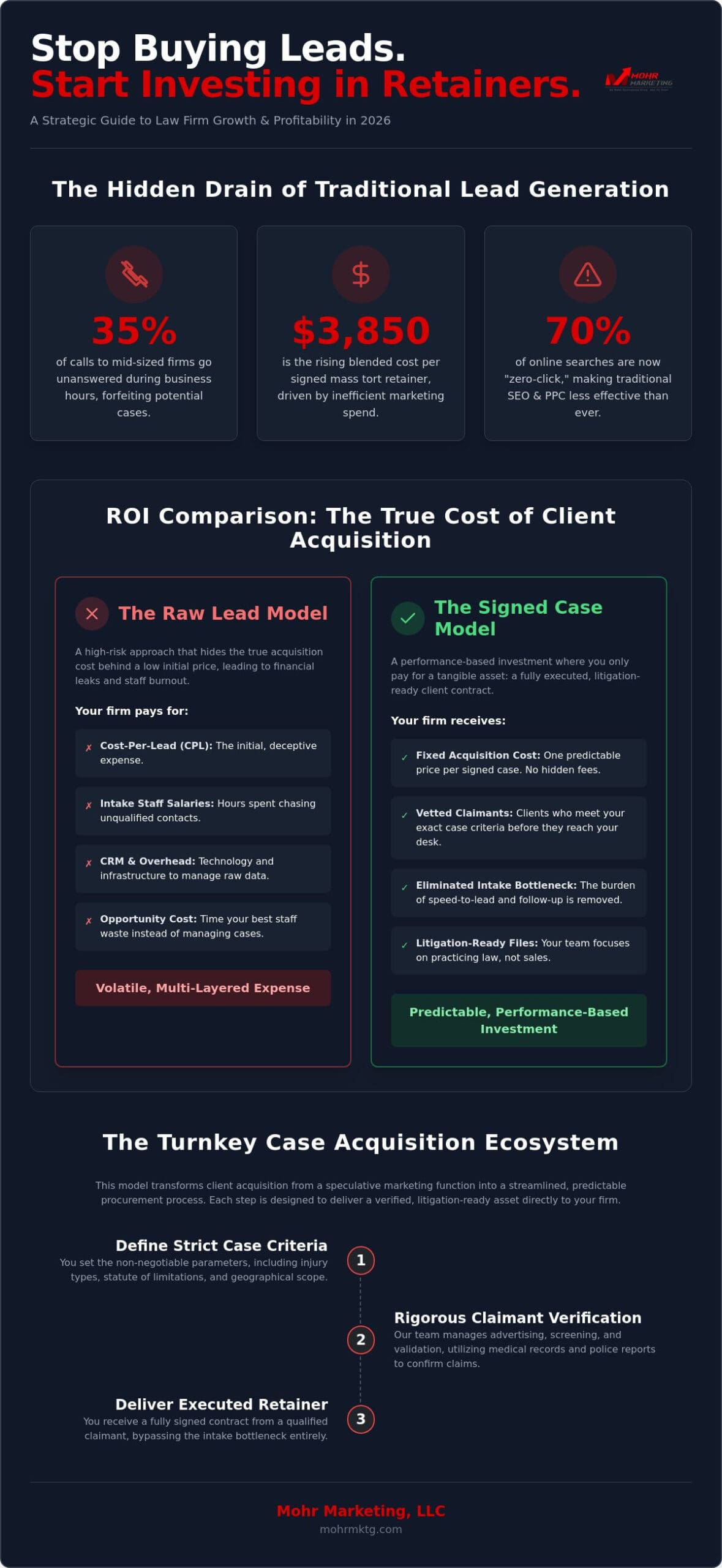
Your current marketing spend is likely leaking capital through unqualified leads and an inefficient intake department. With 35% of calls to mid-sized firms going unanswered during business hours, traditional lead generation has become a liability rather than an asset. Transitioning to a pay per signed case law firm model is the only way to ensure your budget is tied directly to firm growth. It’s time to stop gambling on clicks and start investing in fully executed retainers.
You’ve likely felt the pressure of rising costs, as the blended U.S. cost per signed retainer for mass torts climbed to $3,850 in early 2026. It’s frustrating to watch your intake team waste hours chasing claimants who don’t meet your criteria. We’ll show you how to eliminate marketing waste and scale your firm using a performance-based acquisition model that guarantees results. This guide provides a strategic roadmap for 2026. We’ll analyze the shift toward “answer engine optimization,” the strict new liability standards under regulations like California’s SB 37, and the tactical removal of the intake bottleneck to deliver a predictable cost-per-acquisition for your personal injury or mass tort practice.
Key Takeaways
- Shift your acquisition strategy from purchasing low-intent raw leads to securing fully executed retainer contracts.
- Transitioning to a pay per signed case law firm model eliminates the hidden financial drain of intake labor and marketing waste.
- Implement rigorous verification processes that utilize medical records and police reports to validate claimant assertions before they reach your desk.
- Identify and scale high-growth practice areas such as mass torts and medical malpractice by defining strict case criteria.
- Deploy a turnkey case acquisition ecosystem to bypass intake bottlenecks and receive litigation-ready files immediately.
Understanding the Pay-Per-Signed-Case Model for Law Firms
The pay-per-signed-case (PPSC) model is a fundamental shift in how successful firms acquire new business. In this framework, you aren’t paying for a “lead” or a “click.” You’re paying for a contract. This model is a direct response to the inefficiencies of traditional marketing where firms often buy raw data and then shoulder the entire burden of conversion. By partnering with a pay per signed case law firm provider, you outsource the financial risk of the top-of-funnel process. You only pay when a claimant meets your specific criteria and signs a retainer.
In 2026, the cost of raw leads is rising while conversion rates are plummeting. Nearly 70% of searches now result in “zero-click” outcomes, and the blended cost per signed retainer for mass torts has reached $3,850. Buying “interest” is no longer sustainable for high-stakes litigation. Firms need “contracts.” This approach aligns your marketing spend with your actual revenue goals. It mirrors the logic of the Contingency Fee Model; the marketing partner is only compensated when a tangible asset is delivered to the firm. It transforms marketing from a speculative expense into a predictable procurement strategy.
The Mechanics of a Performance-Based Agreement
Success in this model depends on rigid case criteria. You define the parameters, such as medical proof of injury or specific dates within the statute of limitations. The marketing partner manages the advertising, the initial screening, and the document execution. This process is far more involved than generating “verified inquiries.” While an inquiry is just a person who says they were hurt, a fully executed retainer is a legal asset ready for your file. For complex litigation, utilizing mass tort signed cases ensures your team spends their time litigating rather than chasing phone numbers. It removes the friction between marketing and the courtroom.
Compliance and Ethical Considerations
Operating within this model requires strict adherence to state bar mandates. You must ensure that payments are structured as marketing fees for procurement rather than prohibited fee-sharing with non-lawyers. Transparency is paramount. Under 2026 regulations like California’s SB 37, attorneys are held strictly liable for the content published by their third-party partners. Every advertisement must be truthful and include mandatory disclosures. A professional partner maintains the integrity of the attorney-client relationship from the moment of signing. This ensures the claimant’s first interaction with your brand is professional, compliant, and sets a standard for the litigation to follow.
Signed Retainers vs. Raw Leads: An ROI Comparison
Buying raw leads is a deceptive accounting practice that often hides the true cost of claimant acquisition. Most firms look only at the cost-per-lead (CPL), ignoring the secondary expenses that erode profitability. To find your actual cost, you must combine your marketing spend with intake salaries, CRM overhead, and the opportunity cost of lost time. When you partner with a pay per signed case law firm, these variables disappear. You replace a volatile, multi-layered expense with a single, fixed price for a fully executed contract. In the context of 2026 mass tort acquisition, ROI is defined as the net settlement value minus the fixed acquisition cost of a signed retainer, effectively bypassing the 24% inflation currently seen in raw lead benchmarks.
Low-intent leads do more than drain your bank account; they demoralize your staff. Chasing unqualified claimants who don’t answer the phone or don’t meet basic criteria creates “lead fatigue.” This leads to a toxic cycle where your best intake professionals lose motivation, causing even high-quality leads to slip through the cracks. Transitioning to signed retainers ensures every file your team touches is a viable legal asset. This shift in focus from “sales-style” follow-ups to actual case management is essential for maintaining a competitive edge in high-stakes litigation like police-report-backed MVA cases.
Eliminating the Intake Bottleneck
Response time is the primary killer of conversion. Data from May 2026 shows that 35% of calls to mid-sized law firms go unanswered during business hours. If you aren’t responding within five minutes, your conversion rate drops off a cliff. A performance-based model utilizes turnkey intake services to solve this. We handle the speed-to-lead pressure, ensuring that every claimant is screened and signed before your competitors even see the lead. This allows your firm to redirect internal resources toward litigation and trial preparation rather than managing a call center.
Financial Predictability and Scalability
Scaling a firm requires financial certainty. Traditional PPC campaigns are subject to market volatility and bidding wars that can double your CPL overnight. By contrast, a pay-per-case model treats acquisition as a fixed variable. This predictability allows you to plan national expansions with confidence, knowing exactly how many cases your budget will yield. While managing these third-party relationships, it’s vital to review the Formal Opinion on Third-Party Payer Ethics to ensure your firm maintains its professional independence. If you’re ready to stabilize your growth, you can request a consultation to discuss our current inventory of signed retainers.
Evaluating Quality: How Signed Cases Are Verified
A signature on a retainer is meaningless if the claimant doesn’t meet your firm’s strict litigation criteria. Verification is the barrier between a profitable file and a wasted resource. In a performance-based model, the burden of proof shifts to the marketing partner. We don’t just deliver a name; we deliver a verified legal asset. This requires a multi-step protocol that moves beyond basic contact information to include objective evidence of a claim’s validity. When you engage with a pay per signed case law firm provider, you should expect every retainer to be backed by a clear paper trail.
Objective data points are the gold standard of verification. For motor vehicle and commercial transit litigation, we prioritize verified truck accident cases that include preliminary police reports or accident exchange data. This ensures the claimant was actually at the scene and that a report exists to support liability. In mass tort or medical malpractice scenarios, we verify medical records or proof of prescription. This rigorous filtering prevents “property damage only” or “no injury” claims from entering your system. We utilize high-intent search data to find individuals actively seeking legal remedies, rather than relying on interruptive social media ads that often produce low-quality inquiries.
The Legal Intake Ecosystem
The path from a digital touchpoint to a final signature must be seamless and data-driven. Our ecosystem uses criteria-driven screening to weed out non-qualifying inquiries in real-time. If a claimant’s injury occurred outside the statute of limitations or they lack medical proof of harm, the process stops immediately. This speed-to-signature is critical; firms that respond to leads within five minutes see significantly higher conversion rates. We leverage AI-driven intake technology, which saw a 79% adoption rate among legal professionals by late 2024, to maintain 24/7 responsiveness and precision in document execution.
Ensuring Exclusivity and Intent
Shared leads are a toxic element in legal marketing that leads to a “race to the bottom” and claimant frustration. Every retainer we provide is 100% exclusive to your firm. We eliminate the risk of double-selling, ensuring your team isn’t competing with three other firms for the same individual. Transparency is the foundation of this trust. We provide the full claimant history and high-value indicators, especially in niche areas like high-value mold case acquisition. By focusing on verified intent and exclusive contracts, we remove the friction of traditional lead generation and deliver cases that are ready for immediate litigation.
Strategic Implementation: Scaling Your Firm Nationally
Scaling a firm to a national level requires a shift from local visibility to systematic procurement. The first step is identifying high-growth practice areas where the volume of claimants justifies the acquisition spend. Mass tort, motor vehicle accidents (MVA), and medical malpractice remain the primary drivers of firm revenue in 2026. Once you’ve selected a focus, you must define strict case criteria. This prevents litigation friction by ensuring every file has necessary medical proof and falls within the statute of limitations before your team ever sees it. This is why many organizations choose to operate as a pay per signed case law firm; it standardizes the inventory coming into the office and ensures your attorneys only handle viable files.
Integration is the third critical step in a performance-based strategy. Your marketing partner’s intake data should flow directly into your firm’s CRM or case management software in real-time. Manual data entry is a point of failure that causes delays and lost claimants. A seamless API connection ensures that as soon as a contract is signed, your legal team can begin the discovery process. Finally, you must monitor the ROI of your signed retainers against actual settlement values. This data allows you to adjust your acquisition strategy based on which case types yield the highest net profit rather than just the lowest acquisition cost. When you treat case acquisition as a pay per signed case law firm operation, you gain the financial clarity needed to outbid competitors in saturated markets.
Dominating the Mass Tort Market
Mass tort litigation demands a volume of verified inquiries that local PI campaigns simply cannot provide. To maintain a competitive position in 2026, firms need hundreds of contracts, not just a few leads. Utilizing mass tort signed cases allows you to scale to a national level without the massive expense of increasing internal headcount. You bypass the need for a large, in-house intake department and focus your capital on the trial lawyers who actually win the settlements. This model allows you to enter national litigations with zero infrastructure lag, moving from decision to acquisition in a matter of days.
Diversifying Your Case Portfolio
A healthy firm balances quick-turn MVA cases with the long-tail revenue of mass torts. Performance marketing allows you to test new practice areas with zero upfront risk. If you want to expand into high-stakes litigation, you can acquire mesothelioma leads or target high-value mold case acquisition without building a new marketing department from scratch. This diversification protects your firm from market shifts or legislative changes that might impact a single practice area. It provides a steady stream of cash flow while you wait for larger settlements to mature. If you are ready to expand your footprint and secure high-value contracts, you can contact our team today to review our current inventory of signed retainers.
The Mohr Marketing Advantage: Turnkey Case Acquisition
Mohr Marketing, LLC provides a turnkey solution that bypasses the trial-and-error often associated with generalist marketing firms. We bring 30 years of industry experience to every campaign. Unlike general SEO agencies that promise “visibility” or “traffic,” we deliver fully executed retainers ready for litigation. This pay per signed case law firm model ensures that your capital is never tied up in unproven strategies. We operate as a strategic partner, protecting your resources while aggressively pursuing your firm’s expansion. Generalist agencies often lack the medical and legal intake precision required to convert high-intent traffic into signed contracts. We fill that gap with mechanical accuracy.
Our “Straight-Talker” approach is built on radical transparency. Every verified inquiry undergoes a rigorous screening process before it becomes a signed retainer. We eliminate inefficient intermediaries, providing a direct path from claimant discovery to your case management system. This level of procedural precision is essential for firms managing high-stakes personal injury or truck accident leads. You receive more than just data; you receive a validated legal asset. We handle the friction of the top-of-funnel so your attorneys can focus on the mechanics of litigation and trial preparation.
Data-Driven Growth Strategies
We utilize high-intent search data to capture claimants at the exact moment they seek legal help. Our team customizes intake funnels to match your firm’s specific litigation style and criteria. This ensures that the volume of mass tort signed cases you receive aligns perfectly with your internal capacity. Firms that partner with Mohr Marketing, LLC often transition from local players to national leaders by leveraging our established infrastructure and market insights. We don’t just generate interest; we secure the contracts that drive firm revenue and market share.
Getting Started with Pay-Per-Signed-Case
Onboarding begins with a comprehensive alignment on your firm’s specific case criteria and monthly volume goals. We establish the technical bridges needed to deliver data directly into your CRM. Within the first 30 days of a performance campaign, you should expect a steady flow of verified retainers that meet your exact specifications. This period is focused on calibrating the intake funnel to ensure the highest possible conversion rate for your specific practice areas. This isn’t a long-term branding exercise; it’s a high-impact momentum builder designed for immediate growth. If you’re ready to eliminate marketing waste, you can Partner with Mohr Marketing, LLC for performance-based growth and secure your firm’s future in the 2026 legal market.
Standardize Your Firm’s Growth for 2026
Transitioning to a performance-based acquisition model is a strategic requirement in a market where raw leads are increasingly volatile. Shifting the risk to a marketing partner eliminates intake waste and provides the financial clarity needed for national scaling. It’s about replacing speculation with verified contracts that are ready for immediate litigation. You’ve already analyzed the ROI; now it’s time to implement the solution.
Engaging a pay per signed case law firm partner ensures your growth is supported by a turnkey intake ecosystem and the extensive expertise of Mohr Marketing, LLC. We prioritize strict compliance with state laws and bar mandates, protecting your firm while delivering high-quality legal assets. You can focus on the courtroom while we manage the complex mechanics of claimant discovery and screening.
Secure Your Next High-Value Case with Mohr Marketing, LLC. Your firm’s expansion starts with predictable results and a streamlined path to success.
Frequently Asked Questions
What is the difference between a lead and a signed case?
A lead is simply a point of contact representing potential interest, while a signed case is a contractually bound client ready for litigation. In the lead model, your firm assumes the risk of conversion and intake failure. With a signed retainer, the marketing partner has already verified the claimant against your specific criteria and secured their signature on your firm’s documents. This eliminates the uncertainty of the top-of-funnel process.
How does pay-per-signed-case marketing remain bar compliant?
Compliance is maintained by structuring payments as flat marketing fees for procurement rather than sharing a percentage of legal fees. It’s critical to follow state-specific mandates, such as California’s SB 37, which requires transparent advertising and bona fide contact information. A professional pay per signed case law firm provider ensures all marketing materials are truthful and that the attorney-client relationship remains independent and direct from the moment of signing.
What information is included with a signed retainer?
Each delivery includes the fully executed retainer agreement along with a comprehensive claimant profile. This profile contains verified contact information, a detailed description of the incident or injury, and supporting documentation such as police reports or proof of medical treatment. By receiving a complete file, your legal team can bypass the initial discovery phase and move directly into case management and filing.
Can I specify the criteria for the cases my firm receives?
Yes, you can define rigorous filters to ensure every claimant fits your litigation strategy. Common criteria include specific injury types, dates within the statute of limitations, geographic locations, and the presence of documented medical evidence. This customization prevents your firm from acquiring low-value files and ensures that your acquisition spend is directed toward cases with the highest potential for a successful settlement or verdict.
Is there an upfront cost for performance-based legal marketing?
Performance-based models typically eliminate the high upfront costs and retainer fees associated with traditional SEO or PPC agencies. Instead of paying for speculative visibility, your firm pays for tangible outcomes in the form of executed contracts. This shift in financial risk allows firms to manage their budgets with mechanical accuracy, as every dollar spent is tied directly to a verified legal asset rather than a variable cost-per-click.
How are the claimants verified before signing the retainer?
Verification involves a multi-step screening process that utilizes both human intake specialists and data-driven technology. We review objective evidence, such as medical records for mass torts or police reports for motor vehicle accidents, to validate the claimant’s assertions. This rigorous protocol ensures that the person signing the retainer actually has a viable claim, which is a hallmark of a reliable pay per signed case law firm ecosystem.
What happens if a signed case does not meet my firm’s standards?
Most performance agreements include a clear replacement policy for cases that fail to meet the pre-defined criteria upon closer inspection. If a delivered case is found to have a conflict of interest or a previously undisclosed disqualifier, it can typically be returned for a credit or a replacement. This safeguard ensures that you only pay for cases that meet the strict standards established during the onboarding process.
How quickly can a firm start receiving signed retainers?
Firms can often begin receiving signed retainers within days of completing the onboarding and criteria alignment phase. If the provider has an existing inventory of verified claimants in your practice area, delivery is nearly instantaneous. For new or highly specialized campaigns, the process moves from strategy to execution quickly, allowing your firm to gain high-impact momentum without the long lead times required by traditional organic marketing.

Recent Posts
- Bar-Compliant Legal Marketing: 2026 Guide for Law Firms
- Auto Accident Lead Generation: Build a Verified Case Pipeline in 2026
- Car Accident Case Acquisition: Strategic Law Firm Guide
Categories
- AI and Lead Generation
- Business Financing
- Call Verified MVA Leads
- Car Accident Help
- Car Accident Settlements
- Claimant Funding
- Compliance Program
- EMS-EMT Reports
- Geotargeting
- Google Maps Ranking
- Healthcare Practice Growth
- Law Firm Growth
- Law Office Operations
- Lead Generation
- Lead Generation For Attorneys
- Lead Generation For Chiropractors
- Lead Generation For Criminal Attorneys
- Lead Generation For D&A Treatment Centers
- Lead Generation For DUI Attorneys
- Lead Generation For Eye Doctors
- Lead Generation For Family Law Practices
- Lead Generation For PI Law Firms
- Lead Generation For Plastic Surgeons
- Leads For Healthcare Professionals
- Leads For Insurance Industry
- Legal Leads
- Legal Marketing
- Legal Updates
- Mass Tort Leads
- Medicare and Medicaid Leads
- Merchant Funding Leads
- Mold Leads
- Online Marketing Strategies
- Pre-Settlement Funding
- Signed MVA Cases
- Tort Updates
- Truck Accident Leads and Signed Cases
- Truck Accident Settlements
- Web Design