Qualified Claimant Leads: The 2026 Guide to High-Intent Case Acquisition
June 29, 2026 by Mohr Marketing
The era of buying unverified data in bulk is over. With the FCC’s one-to-one consent rule now in full effect and state-level mandates like California’s SB 37 holding firms directly liable for vendor non-compliance, the “Wild West” of legal marketing has vanished. You’ve likely noticed that traditional aggregators are struggling to provide qualified claimant leads that actually convert, leaving your intake team overwhelmed by callers who don’t remember filling out a form. It’s a frustrating, expensive cycle that drains your firm’s resources without scaling your caseload.
This 2026 guide is designed to fix that. You’ll learn how to identify and acquire high-intent inquiries through a rigorous, multi-stage verification ecosystem that filters for intent before you ever pay. We’ll move beyond simple contact info to show you how to engineer a predictable stream of inquiries that actually convert into high-value signed cases. This article covers the critical regulatory shifts in Colorado and California, the mechanics of banking-grade identity verification, and the shift toward a transparent, results-oriented acquisition model that prioritizes your firm’s ROI and legal safety.
Key Takeaways
- Distinguish between raw inquiry data and truly qualified opportunities that meet specific medical and legal criteria before they reach your intake team.
- Implement a multi-stage verification process that combines digital intent filtering with immediate human interaction to maintain high claimant engagement.
- Evaluate the financial and operational trade-offs between Pay-Per-Lead and Pay-Per-Signed-Case models to optimize your firm’s acquisition strategy.
- Execute a rigorous compliance audit of your providers to ensure adherence to 2026 TCPA mandates and evolving state bar advertising regulations.
- Leverage a turnkey ecosystem to acquire qualified claimant leads that are pre-vetted and ready for immediate retainer execution.
What Are Qualified Claimant Leads? Defining High-Intent Opportunities
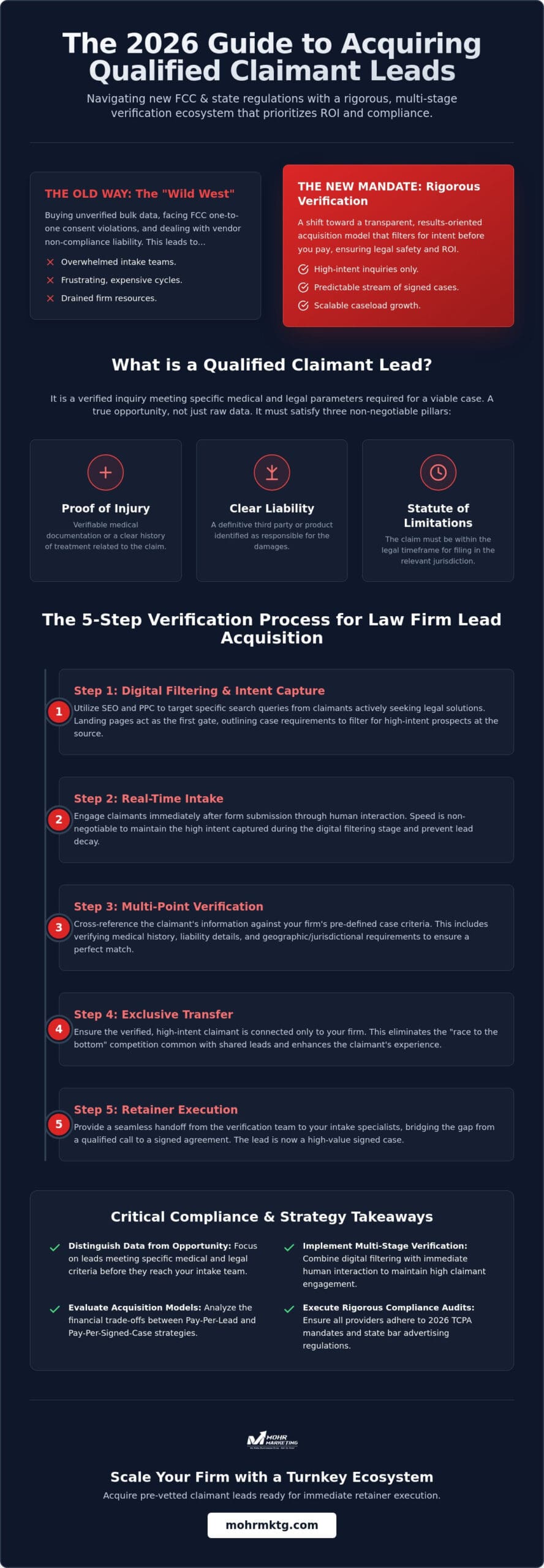
A qualified claimant lead is a verified inquiry that meets the specific medical and legal parameters required for a viable case. In a competitive legal market, firms often mistake raw data for opportunity. Buying a list of names is not lead generation; it is a data acquisition exercise that often results in wasted overhead. True qualified claimant leads are engineered through a rigorous filtering process before they reach your intake team.
You must establish strict “Case Criteria” before launching any campaign. This prevents your staff from wasting time on dead-end calls. A lead only becomes an asset when it satisfies three non-negotiable pillars:
- Proof of Injury: Verifiable medical documentation or a clear history of treatment related to the claim.
- Clear Liability: A definitive third party or product responsible for the damages.
- Statute of Limitations Compliance: The claim must be within the legal timeframe for filing in the relevant jurisdiction.
The Difference Between an Inquiry and a Qualified Claimant
A phone number is not a lead. Without verified intent, a contact record is just noise. Traditional aggregators often sell “shared” leads, where one inquiry is sent to multiple firms simultaneously. This creates a race to the bottom that devalues the claimant’s experience and lowers your conversion rate. High-intent inquiries are exclusive. They originate from individuals actively seeking specific legal remedies. For instance, mesothelioma leads serve as the industry benchmark for high-intent search data. These claimants aren’t just browsing; they’re responding to specific criteria that match your firm’s ideal case profile.
Why Lead Quality Dictates Law Firm ROI
Chasing unqualified inquiries carries a massive hidden cost in staff hours and lost momentum. When your intake team spends days vetting callers who don’t have a valid claim, your cost per signed case increases. We define ROI as the ratio of signed cases to total marketing spend. High-quality inquiries eliminate this friction. By focusing on claimants who already meet your criteria, you reduce the time from initial contact to signed retainer. This efficiency impacts your bottom line. Better leads mean faster settlement timelines and a more predictable revenue stream for your practice.
The 5-Step Verification Process for Law Firm Lead Acquisition
Acquiring qualified claimant leads requires more than just a functional website. It demands a systematic, five-step infrastructure designed to eliminate low-intent noise. This process ensures your firm only pays for inquiries that have been rigorously vetted against your specific case criteria. Efficiency here isn’t just about speed; it’s about the precision of the data delivered to your intake team.
- Step 1: Digital Filtering — Utilizing search intent to capture claimants actively seeking legal help.
- Step 2: Real-Time Intake — Engaging claimants immediately through human interaction to maintain high intent.
- Step 3: Multi-Point Verification — Cross-referencing claims against medical, legal, and geographic requirements.
- Step 4: Exclusive Transfer — Ensuring the claimant is connected only to your firm, eliminating competition.
- Step 5: Retainer Execution — Bridging the gap from a verified call to a signed agreement with seamless handoffs.
Initial Digital Filtering and Intent Capture
Search intent is the foundation of quality. SEO and PPC outperform social media because they capture users actively seeking solutions. Social media users are often browsing; searchers are acting. By targeting specific queries like “lawsuit criteria” or “eligibility for settlement,” you filter for high-intent prospects at the source. Your landing pages must act as the first gate, clearly outlining case requirements to discourage unqualified submissions. Adhering to legal advertising regulations ensures these filters remain compliant while staying effective.
Rigorous Intake and Criteria Matching
Speed is non-negotiable. We define the “Golden Hour” of intake as the first sixty minutes after an inquiry is submitted. Conversion rates drop significantly after this window. A 24/7 intake ecosystem prevents lead decay by providing immediate human interaction. This stage also involves cross-referencing claims against medical and geographic requirements. For firms handling motor vehicle accidents, using police report backed MVA cases ensures that liability is established through official documentation before the transfer occurs. This level of verification removes the guesswork for your legal team.
Once verified, the inquiry must be an exclusive transfer. Your firm shouldn’t compete with five other offices for the same claimant. The final step is bridging the gap from a verified call to a signed agreement. This requires a seamless handoff where the claimant’s momentum is maintained through to retainer execution. If your current process lacks this precision, it’s time to evaluate your lead acquisition strategy with a partner who understands these mechanics.
Leads vs. Signed Retainers: Choosing Your Growth Model
Law firms must decide where their core competency lies: marketing management or legal practice. While qualified claimant leads provide the raw material for growth, the conversion mechanism determines your final acquisition cost. Choosing between Pay-Per-Lead (PPL) and Pay-Per-Signed-Case (PPSC) isn’t just about price. It’s about risk allocation and operational capacity. You must align your model with your firm’s internal infrastructure to avoid wasting capital on inquiries that never reach your desk.
The fundamental difference between these models is who bears the cost of non-conversion. In a PPL arrangement, the firm pays for the opportunity to pitch. In a PPSC arrangement, the firm pays for the result. Navigating these options requires a clear understanding of ethical rules for lead generation to ensure your acquisition strategy remains compliant with professional conduct standards. Each model serves a distinct strategic purpose depending on your firm’s current scale and intake capabilities.
The Pay-Per-Lead Model: Flexibility and Volume
The PPL model is best suited for firms with robust, in-house intake departments. It allows for a higher volume of inquiries at a lower cost-per-entry. This model gives your team total control over the claimant experience from the first touchpoint. However, it requires a sophisticated CRM and a disciplined follow-up schedule. If your team cannot consistently hit the “Golden Hour” of response, the lower upfront cost of PPL will be offset by a high cost-per-signed-case. Choose this model if you have the personnel to manage strict lead pipelines and high-volume filtering.
The Pay-Per-Signed-Case Advantage
The PPSC model eliminates “intake friction” by delivering fully executed retainer agreements directly to your firm. This model is the most efficient path for scaling because it removes the administrative burden of vetting. For complex litigation, mass tort signed cases allow you to build a massive inventory of claimants without hiring a temporary call center. This performance-based approach is also ideal for high-stakes truck accident cases where the high case value justifies a premium for a verified, signed retainer. You only pay for the cases that meet your specific criteria, ensuring your marketing spend is always tied to a tangible asset. This model provides the highest level of financial predictability for firms focused on aggressive expansion.
How to Audit a Lead Provider for Compliance and Quality
The regulatory landscape for legal marketing has shifted fundamentally. As of 2026, law firms are no longer shielded from the actions of their marketing partners. Under mandates like California SB 37 and the FCC’s one-to-one consent rule, your firm is directly liable for the compliance failures of your vendors. Buying qualified claimant leads from an unvetted source is a strategic and legal risk you cannot afford. You must treat lead providers as an extension of your firm’s compliance department.
A rigorous audit prevents financial waste and protects your professional standing. Use this checklist to vet any potential provider before signing a retainer:
- What is the primary traffic source? Demand to know if leads originate from high-intent SEO or disruptive social media ads.
- Can you provide a TCPA-compliant consent log? Each lead must include a verifiable record of express written consent to be contacted by your specific firm.
- Is the lead exclusive? Verify that the provider isn’t reselling the same claimant data to multiple firms.
- What does the intake script look like? Ensure the vendor isn’t providing unauthorized legal advice during the qualification phase.
Verifying State Bar and Advertising Compliance
Non-compliant advertising can trigger bar grievances and permanent reputational damage. You must demand to see the actual creative assets and landing pages used to generate your inquiries. In states like Colorado, lead generation is now scrutinized under the Consumer Protection Act. If a vendor uses deceptive “award” badges or fails to disclose a bona fide office location, your firm faces the penalties. A legitimate partner maintains a “straight-talker” approach, focusing on factual criteria rather than emotional manipulation or legal promises they aren’t qualified to make.
Assessing Transparency and Reporting
Quality is maintained through data-driven feedback loops. You need transparency into how your marketing spend translates into signed retainers. Reviewing disposition reports is essential for optimizing campaign performance and identifying which channels produce the highest value. This level of granular reporting is especially critical for scaling high-value mold case acquisition, where specific environmental and medical criteria must be met. If a provider cannot show you exactly where a lead came from and why it was qualified, they’re likely an aggregator reselling recycled data.
Don’t leave your firm’s growth to chance. If you’re ready to secure a compliant, high-intent pipeline, contact Mohr Marketing today to audit your current lead acquisition strategy.
Scaling Your Firm with Mohr Marketing, LLC’s Turnkey Ecosystem
Mohr Marketing, LLC operates with a single objective: delivering tangible results for high-stakes legal practices. With over 30 years of experience in the legal and healthcare sectors, we’ve developed a turnkey ecosystem that removes the friction from case acquisition. We don’t deal in fluff or vanity metrics. Instead, we provide qualified claimant leads and signed retainers that meet rigorous, pre-defined case criteria. This isn’t just about traffic; it’s about building a predictable revenue engine for your firm.
Eliminating inefficient intermediaries is central to our philosophy. You work directly with a team that possesses deep insider knowledge of both the legal landscape and the medical realities behind claimant injuries. We act as your strategic partner, protecting your resources while aggressively pursuing your firm’s expansion. We understand that your time is best spent on litigation, not managing a fragmented marketing stack. Our turnkey approach ensures that every inquiry is filtered, verified, and delivered with the documentation your staff needs to succeed.
Targeted Mass Tort and Personal Injury Solutions
Our capabilities span the full spectrum of high-value litigation. From high-volume motor vehicle accident inquiries to complex medical malpractice claims, our data-driven engine provides national coverage. We specialize in delivering fully executed retainers ready for immediate litigation. This means your attorneys focus on law, not intake. Whether you’re looking for mass tort signed cases or specific truck accident signed cases, our ecosystem adapts to your firm’s specific growth targets. We use procedural precision to ensure every claimant is vetted against medical and geographic requirements. This isn’t a passive lead list; it’s an active pipeline of high-intent individuals.
Why Professional Practices Choose Mohr Marketing, LLC
The legal market is crowded with vendors who over-promise and under-deliver. Professional practices choose Mohr Marketing, LLC because we’re straight-talkers who prioritize financial performance. We provide transparent reporting on every lead source and intent marker, ensuring you know exactly where your marketing capital is going. Our identity verification and consent protocols are banking-grade, providing you with the security needed in a high-regulation environment. We focus on the mechanics of growth and the removal of friction in business processes.
We understand that scaling requires a balance of stability and momentum. Our long-standing industry presence provides the stability, while our modern, high-impact marketing strategies provide the momentum. It’s time to move past the inconsistent quality of aggregators and adopt a direct path to success. Scale your firm with verified claimant leads today.
Secure Your Firm’s Competitive Advantage
The transition toward high-intent acquisition is no longer a choice but a necessity for legal practices. By moving away from unverified data and embracing the rigorous filtering and auditing processes discussed, your firm mitigates the significant risks associated with modern regulatory scrutiny. Prioritizing qualified claimant leads allows your team to focus on litigation and settlement rather than administrative vetting and data entry.
Mohr Marketing, LLC provides the necessary infrastructure to scale national campaigns with precision. Our turnkey intake and marketing ecosystem is built on three decades of industry experience and an uncompromising commitment to TCPA and state bar compliance. We remove the burden of intake, ensuring your marketing spend converts into tangible legal assets rather than wasted inquiries.
Acquire High-Intent Signed Cases with Mohr Marketing, LLC
Success in 2026 belongs to firms that control their acquisition pipeline with transparency and speed. Start building your high-value inventory today with a partner who understands the mechanics of growth.
Frequently Asked Questions
What makes a claimant lead “qualified” for a mass tort case?
A lead is qualified when the claimant provides verifiable proof of exposure and a matching medical diagnosis that satisfies specific litigation criteria. Beyond basic contact data, we look for secondary markers such as pharmacy records or specific diagnostic imaging results. This level of detail ensures that the qualified claimant leads delivered to your firm are ready for immediate case filing rather than further investigation.
Is it better to buy leads or fully signed retainer agreements?
The decision typically rests on your firm’s internal opportunity cost and administrative capacity. While raw leads offer lower upfront costs, signed retainers eliminate the “intake friction” that often results in lost high-value cases. For firms looking to scale without hiring additional administrative staff, signed agreements provide the most efficient path to increasing caseload volume.
How does Mohr Marketing, LLC verify the intent of a claimant?
Mohr Marketing, LLC verifies intent by analyzing behavioral signals during the digital search phase and utilizing rigorous “knock-out” questions during intake. We don’t just rely on form submissions; we require claimants to engage in a multi-step qualification process that proves they are actively seeking legal representation. This filters out casual browsers and focuses resources on high-intent individuals.
Are these leads exclusive to my law firm?
Exclusivity is a non-negotiable standard for our delivery model. When you acquire an inquiry or signed case, that individual is never sold to another firm. Non-exclusive models lead to “lead fatigue” and a poor consumer experience, which ultimately diminishes your conversion rates and settlement potential.
How do you ensure compliance with state bar advertising rules?
Mohr Marketing, LLC ensures compliance by maintaining a permanent archive of all creative assets and providing firms with “proof of consent” certificates for every lead. We strictly adhere to one-to-one consent mandates and state-specific rules, such as California’s SB 37, ensuring that all marketing materials are factually grounded and meet the highest ethical standards.
Can you scale claimant acquisition for national mass tort campaigns?
Our infrastructure is designed to pivot and scale based on evolving litigation updates or bellwether trial results. We possess the data-driven capacity to launch and manage national campaigns across multiple mass torts simultaneously. This allows your firm to maintain a consistent inventory of cases regardless of regional market fluctuations.
What is the typical conversion rate from a verified inquiry to a signed case?
Conversion rates are heavily influenced by your firm’s internal speed to call and the use of digital retainer technology. While industry averages vary, firms utilizing our pre-vetted inquiries often achieve significantly higher conversion by bypassing the initial filtering phase. Implementing a “sign-on-the-spot” protocol during the live transfer can further maximize these outcomes.
How does the intake ecosystem handle after-hours inquiries?
The ecosystem utilizes immediate live-transfer protocols to ensure that high-intent callers are engaged regardless of the hour. We recognize that claimants seeking help at 2 AM require the same level of professional interaction as those calling during business hours. This 24/7 coverage prevents claimants from reaching out to a competitor while waiting for a callback.

Recent Posts
- NEC Baby Formula Case Acquisition: A Law Firm’s 2026 Guide
- Justifying Marketing Investment to Law Firm Partners: A Data-Driven Framework
- Roundup Cancer Lawsuit Leads: Buying Guide for Law Firms
Categories
- AI and Lead Generation
- Business Financing
- Call Verified MVA Leads
- Car Accident Help
- Car Accident Settlements
- Claimant Funding
- Compliance Program
- EMS-EMT Reports
- Geotargeting
- Google Maps Ranking
- Healthcare Practice Growth
- Law Firm Growth
- Law Office Operations
- Lead Generation
- Lead Generation For Attorneys
- Lead Generation For Chiropractors
- Lead Generation For Criminal Attorneys
- Lead Generation For D&A Treatment Centers
- Lead Generation For DUI Attorneys
- Lead Generation For Eye Doctors
- Lead Generation For Family Law Practices
- Lead Generation For PI Law Firms
- Lead Generation For Plastic Surgeons
- Leads For Healthcare Professionals
- Leads For Insurance Industry
- Legal Leads
- Legal Marketing
- Legal Updates
- Mass Tort Leads
- Medicare and Medicaid Leads
- Merchant Funding Leads
- Mold Leads
- Online Marketing Strategies
- Pre-Settlement Funding
- Signed MVA Cases
- Tort Updates
- Truck Accident Leads and Signed Cases
- Truck Accident Settlements
- Web Design