State Bar Compliant Lead Generation: The 2026 Attorney Guide to Ethical Acquisition
June 28, 2026 by Mohr Marketing
Outsourcing your marketing no longer outsources your risk. Under California’s SB 37, effective January 1, 2026, a single non-compliant advertisement can trigger statutory damages ranging from $5,000 to $100,000 per violation. You understand that aggressive growth is necessary to stay competitive, yet the fear of bar grievances or accidental fee-splitting often creates a paralyzing bottleneck. Mastering state bar compliant lead generation is no longer just a best practice; it’s a requirement for firm survival in this high-stakes regulatory environment.
You don’t have to choose between ethics and expansion. This guide promises a clear framework for vetting providers and scaling your case files without compromising your standing with the bar. We will examine the 2026 landscape, the critical advertising fee versus referral fee distinction, and the mandatory disclosure rules that now apply to all digital intake forms. You’ll learn how to build a scalable acquisition engine that stands up to the most rigorous ethics audits.
Key Takeaways
- Distinguish between paying for advertising costs and illegal fee-splitting to protect your firm from bar grievances and sanctions.
- Analyze ABA Model Rule 7.2 and the “no-profit” rule to ensure your vendor billing structures meet 2026 regulatory standards.
- Implement a procedural roadmap for state bar compliant lead generation by auditing lead source capture mechanisms and verifying mandatory disclosures.
- Identify the “recommendation factor” that separates ethical lead providers from prohibited referral services to maintain professional independence.
- Utilize search-intent-driven acquisition strategies to scale mass tort and personal injury case files through a framework that passes ethics audits.
Defining State Bar Compliant Lead Generation for Modern Law Firms
Lead generation is often conflated with referral services, but the legal distinction is absolute. A referral service recommends a specific lawyer based on a perceived level of competence. In contrast, lead generation is a purely administrative marketing function. It involves the acquisition of contact information from individuals who’ve expressed interest in legal services. Achieving state bar compliant lead generation requires you to verify that your provider doesn’t “vouch” for your firm. If a vendor claims you’re the “best” or “most qualified,” they’ve crossed into referral territory, triggering a different set of regulatory requirements.
The History of Legal Advertising demonstrates how rules have evolved to allow firms to pay for these services, provided they don’t compromise the lawyer’s independent professional judgment. Transparency in lead origin is your first line of defense. You must know exactly where a lead comes from, what the claimant was told, and how your firm was presented. Modern compliance isn’t just about the “what,” it’s about the “how.”
Advertising Fees vs. Prohibited Referral Fees
State bars generally permit lawyers to pay the “reasonable costs of advertising.” This definition excludes any payment structure that mirrors fee-splitting. You can’t pay a percentage of a settlement or a “success fee” to a marketing vendor. Flat-fee or per-lead pricing models are the standard for compliance because they decouple the marketing expense from the case outcome. If your vendor’s compensation fluctuates based on the value of the recovery, you’re likely violating fee-splitting prohibitions. Providers must remain neutral conduits rather than financial partners in your litigation.
The Requirement for Geographic and Practice Area Transparency
Maintaining state bar compliant lead generation requires strict adherence to jurisdictional boundaries. A provider that funnels out-of-state claimants to your firm without proper disclosure puts your license at risk. All lead-capture landing pages must feature clear disclaimers stating that the service is an advertisement. Verify that your provider isn’t “steering” clients through deceptive user interfaces. At Mohr Marketing, LLC, we focus on Mass Tort leads built on actual search intent. This ensures the claimant is actively seeking help rather than being manipulated by social media bait. This level of transparency ensures that every acquisition passes a rigorous ethics audit.
Navigating ABA Model Rule 7.2 and Fee-Splitting Prohibitions
ABA Model Rule 7.2(b) serves as the regulatory foundation for modern legal marketing. It explicitly prohibits a lawyer from giving “anything of value” to a person for recommending their services. However, the rule provides a critical exception: attorneys may pay the “reasonable costs of advertisements.” Achieving state bar compliant lead generation requires a precise understanding of where “advertising costs” end and “prohibited referrals” begin. The distinction often rests on whether the vendor exercises discretion in matching a claimant to a specific firm.
The “No-Profit” rule remains a point of contention in several jurisdictions. While some historical ethics opinions suggested that lead generators should only recoup actual costs, the 2026 regulatory environment generally accepts market-rate service fees. A March 2026 New York State Bar Association ethics opinion clarifies that payments are permissible if the platform uses neutral criteria for selection and the fee does not vary based on the eventual settlement amount. In contrast, Florida maintains stricter oversight, often classifying any service that “selects” a lawyer for a consumer as a prohibited referral service unless specifically registered.
The Ethics of Performance-Based Marketing
Performance models, such as purchasing Signed Retainers, offer firms a high degree of financial predictability. These models are compliant only if they respect Rule 5.4 regarding the professional independence of a lawyer. The marketing agency must never exert control over the attorney-client relationship or the legal strategy. Even when a lead arrives with a signed retainer, your firm must conduct an independent conflict check and a de novo review of the case merits. You can speak with our team to see how we maintain these boundaries during the intake process.
Common Pitfalls in Fee-Splitting Interpretations
The most dangerous trap in legal acquisition is the “percentage-of-recovery” model. Paying a non-lawyer a portion of a legal fee is a direct violation of ethics rules in almost every state. To remain compliant, you must structure contracts to reflect professional service fees or flat-rate lead costs rather than case-sharing. Professional independence requires that a lawyer maintains absolute control over legal strategy and client selection, uninfluenced by the financial interests of a third-party marketing vendor. Avoid “nominal” gifts or reciprocal referral arrangements, as these are often viewed as “something of value” under Rule 7.2(b).
- California SB 37: Holds firms directly liable for the compliance of their marketing vendors as of January 1, 2026.
- Transparency: All advertisements must include the name and contact information of at least one lawyer responsible for the content.
- Neutrality: Lead generators must not rank or recommend one firm over another based on subjective quality claims.
Lead Generation vs. Illegal Referrals: Critical Differentiators
The boundary between a legal lead and an illegal referral rests on the presence of a recommendation. A referral occurs when a third party suggests that a specific lawyer is particularly qualified for a case. In contrast, state bar compliant lead generation involves a neutral matching process based on objective criteria like geography or practice area. If a vendor represents your firm as the “best” choice, they’ve crossed into referral territory, which often requires them to be a registered lawyer referral service under state bar rules.
Control over the claimant’s data and the initial point of contact determines regulatory classification. In a compliant model, the vendor is a conduit. They collect information and deliver it to the firm without exercising qualitative judgment. Exclusivity is permissible and often preferred for high-value cases, such as mesothelioma leads, provided the exclusivity is a business arrangement rather than a qualitative endorsement. You must own the data the moment it’s captured to ensure you maintain professional independence and direct communication with the potential client.
Identifying the “Recommendation” Red Flag
Audit your vendor’s creative assets regularly. If their ad copy uses superlatives like “top-rated,” “expert,” or “most successful” to describe your firm, you’re at risk. These terms constitute a recommendation of your competence. A compliant lead generator focuses on the claimant’s problem and the firm’s availability to help. They don’t vouch for your results. Ensure your vendor’s messaging remains strictly informational. Matching a client based on their zip code and your practice area is a marketing function; telling a client you’re the most qualified choice is a referral.
The Disclosure Mandate for Lead Providers
Claimants must know they’re interacting with a marketing entity, not a law firm. This requires clear “Paid Solicitor” or “Advertising” disclosures on every landing page. The 2024 FCC “One-to-One” consent rule remains a critical pillar of compliance in 2026. This rule ended the practice of “cascading” leads to multiple firms under a single consent checkbox. Now, the claimant must provide express written consent to be contacted by your specific firm. Verification of this consent is non-negotiable for state bar compliant lead generation. Without it, you’re not just violating bar rules; you’re risking massive TCPA penalties.
- Neutrality: The provider shouldn’t rank firms or provide qualitative comparisons.
- Ownership: The firm should receive lead data directly and immediately.
- Transparency: Landing pages must clearly state that the service is an advertisement.
- Specific Consent: The claimant must explicitly agree to be contacted by your firm by name.
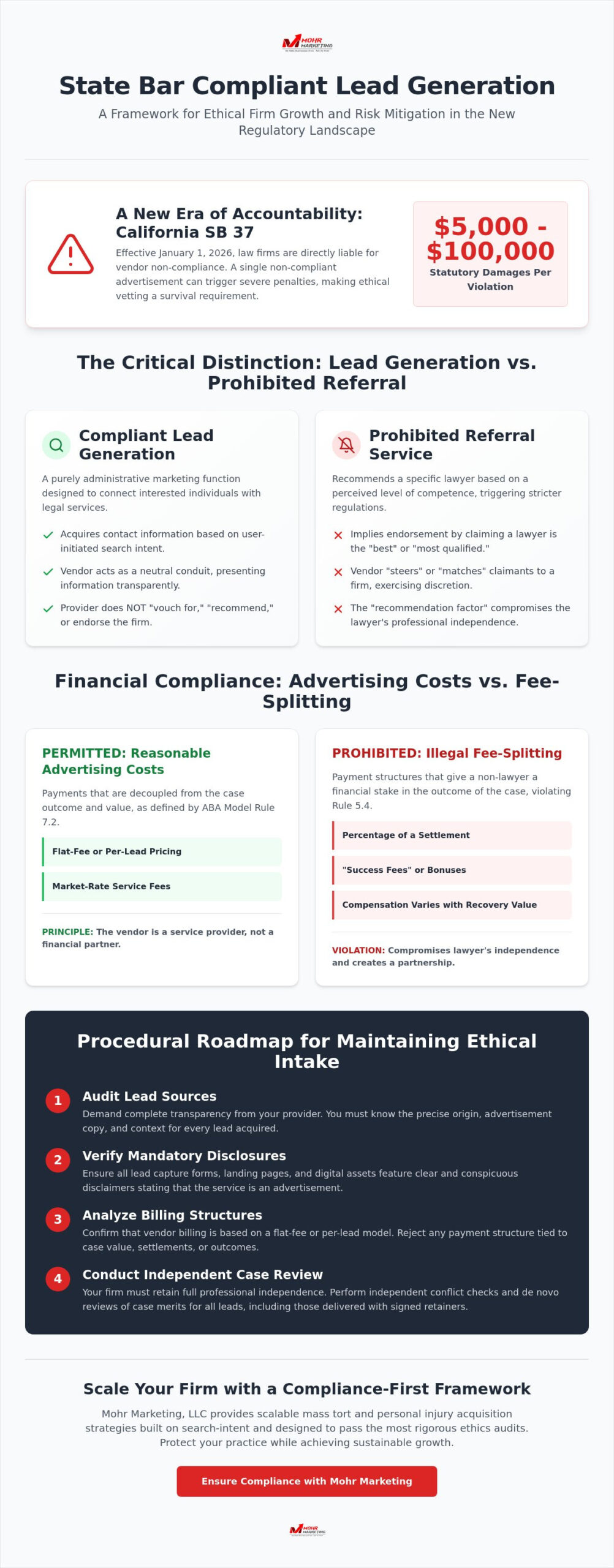
Procedural Roadmap for Maintaining Ethical Intake Standards
Compliance is not a passive state. It requires an active, documented protocol that governs every interaction between the claimant and the intake mechanism. To ensure state bar compliant lead generation, you must treat your marketing vendors as extensions of your firm’s own administrative arm. This means implementing a rigorous five step roadmap to protect your license and your firm’s reputation. You cannot delegate your ethical responsibility. If you’re paying for leads, you’re responsible for the marketing that generated them.
- Step 1: Audit the lead source. Review every landing page and ad creative. Ensure they include the required “Advertising” or “Paid Solicitor” labels.
- Step 2: Verify initial disclosures. The first automated response or text message must explicitly state that the service is free for the consumer and does not establish an attorney-client relationship.
- Step 3: Monitor intake scripts. Intake specialists must remain neutral and never provide legal advice or predict case outcomes.
- Step 4: Firm-side verification. Conduct an independent conflict check and merits review of every signed retainer before officially accepting the case.
- Step 5: Maintain a compliance file. Keep a central repository of vendor contracts, ad screenshots, and call recordings.
Optimizing Intake without Crossing Ethical Lines
The distinction between an intake specialist and a legal professional is critical. An intake specialist’s job is to gather data and qualify leads based on your firm’s specific criteria. They must never interpret the law or suggest that a claimant has a “winning case.” Crossing this line constitutes the unauthorized practice of law by the vendor and an ethical violation for the firm. Understanding the ROI of Legal Intake Services helps you see how efficiency and compliance work together. When intake is handled correctly, it filters out noise without creating liability or compromising your standing with the bar.
Documenting Vendor Compliance
Your contracts must include a “Right to Audit” clause. This allows you to request screenshots of current ads, lead capture logs, and intake scripts at any time. If you identify a non-compliant lead, implement a “Refund and Report” protocol. Return the lead to the vendor, document the reason, and require a corrective action plan. This paper trail is your best defense during a state bar audit. It proves you’ve exercised due diligence in your state bar compliant lead generation efforts. You should contact our team to discuss how we integrate these protocols into our own delivery framework to ensure your growth remains protected and predictable.
Scalable Mass Tort Acquisition with Mohr Marketing, LLC’s Compliance Framework
National mass tort campaigns often fail due to a lack of jurisdictional precision. Mohr Marketing, LLC solves this by implementing a turnkey system that prioritizes state bar compliant lead generation at scale. We avoid the deceptive “social bait” tactics that often lead to bar grievances. Instead, our acquisition strategy targets high-intent search traffic. This means claimants are already looking for help when they find your firm. This intent-driven model ensures higher conversion rates and reduces the risk of unsolicited contact violations.
Our framework provides full visibility into the claimant journey. You shouldn’t have to wonder where your cases originate. Every mass tort signed case delivered by Mohr Marketing, LLC undergoes a rigorous vetting process to meet your specific firm criteria. This transparency acts as a safeguard during fee disputes or ethics audits. You receive a complete data trail that documents consent and eligibility from the first click to the final signature. This level of detail ensures that your firm remains protected while pursuing aggressive expansion.
Verified Inquiries and Signed Retainers
Factual accuracy is the only way to protect your firm’s ROI. Our police report-backed MVA cases provide a level of verification that standard lead providers cannot match. The “Mohr Method” qualifies claimants in complex litigation by cross-referencing objective data points before delivery. This reduces the administrative burden on your intake team. You stop chasing unqualified leads and start building a portfolio of high-value retainers. We focus on the quality of the data so your attorneys can focus on the litigation.
Maintaining Authority in the 2026 Legal Market
The legal market is currently grappling with the rise of AI-generated marketing. Mohr Marketing, LLC stays ahead of these shifts by combining modern technology with 30 years of industry experience. We understand the nuances of state bar compliant lead generation in a way that purely tech-driven agencies don’t. We don’t just deliver data; we deliver a protected growth strategy. Partner with Mohr Marketing, LLC for Compliant Case Growth to ensure your firm remains a leader in 2026 and beyond.
Scale Your Practice with Ethical Precision
The 2026 legal landscape provides no room for error regarding client acquisition. By implementing the procedural roadmaps and transparency standards discussed, you transform ethical hurdles into a scalable growth engine. Mastering state bar compliant lead generation ensures that your firm’s expansion is built on a foundation of professional independence and regulatory integrity. Compliance is no longer just a defensive measure; it’s a strategic necessity for firms targeting high-value litigation.
Mohr Marketing, LLC offers the specialized expertise required to navigate these high-stakes requirements. With over 30 years of industry experience and a turnkey intake ecosystem built on strict adherence to ABA Model Rule 7.2, we remove the friction from your growth strategy. You can pursue high-value caseloads without the constant threat of bar grievances or non-compliant vendor practices. Secure Your Firm’s Growth with Compliant Mass Tort Leads and ensure your firm remains a leader in the modern marketplace. You have the tools to scale safely and aggressively.
Frequently Asked Questions
Is it legal for a law firm to pay for leads on a per-lead basis?
Yes, paying a flat fee per lead is legal under ABA Model Rule 7.2 as a “reasonable cost of advertising.” The payment must represent the fair market value of the marketing service rather than a reward for a specific case outcome. You must ensure the fee is never contingent on the lawyer being retained or the case reaching a settlement. This structure maintains the necessary separation between marketing expenses and legal fees.
What is the difference between a lead generation service and a referral service?
Lead generation services act as neutral conduits that match claimants to firms based on objective criteria like geography or practice area. Referral services differ because they typically recommend or “vouch” for a specific attorney’s competence. While lead generators provide contact data for potential clients, referral services often require state bar registration and must follow stricter qualitative ranking rules. Understanding this distinction is critical for state bar compliant lead generation.
Does paying for signed retainers violate fee-splitting rules?
Paying for signed retainers is permissible if the fee is a flat rate for intake and administrative services. It becomes a violation if the payment is a percentage of the legal fee or settlement. To remain compliant, the attorney must maintain absolute professional independence. This requires the firm to conduct its own conflict check and merits review before officially accepting the case and entering an attorney-client relationship.
How does the FCC “One-to-One” consent rule affect legal lead generation?
The “One-to-One” rule requires that a claimant gives express written consent to be contacted by one specific firm. This ended the practice of “cascading” leads where one form submission allowed dozens of firms to call the consumer. For state bar compliant lead generation, your vendor must document that the claimant explicitly selected your firm’s name. This regulation protects consumers from harassment and ensures your firm receives high-intent, exclusive inquiries.
Can I pay a marketing agency a percentage of the settlement for a mass tort case?
No, paying a percentage of a settlement to a non-lawyer is a direct violation of Rule 5.4 regarding the professional independence of a lawyer. This is classified as illegal fee-splitting in almost every jurisdiction. All compensation to marketing agencies must be structured as flat fees for professional services or per-lead costs. The financial outcome of the litigation must have no impact on the vendor’s total compensation.
What should I look for in a lead generator’s contract to ensure bar compliance?
Your contract must include a “Right to Audit” clause that allows you to review ad copy, landing pages, and intake logs. It should explicitly state that the vendor is providing marketing and intake services, not legal referrals. Ensure the agreement prohibits the vendor from providing legal advice or making qualitative recommendations. The contract should also define a flat-fee billing structure that is independent of any case results or settlement amounts.
Are exclusive leads more ethical than shared leads?
Both models are ethical, but exclusive leads are often superior for maintaining compliance with the 2024 FCC “One-to-One” consent rule. Exclusive leads ensure the claimant is only contacted by the firm they specifically authorized. This prevents the claimant from being overwhelmed by multiple firms, which can lead to bar grievances. Exclusivity simplifies the documentation of consent and ensures a cleaner chain of custody for the claimant’s data.
Do I need to disclose that I am using a lead generation service to the state bar?
Most states do not require you to register a lead generation relationship as you would with a formal referral service. However, you are responsible for the content of the advertisements generated on your behalf. Under regulations like California’s SB 37, every advertisement must identify at least one attorney responsible for the content and their office location. You must maintain records of these advertisements to prove they meet all ethical disclosure requirements.

Recent Posts
- NEC Baby Formula Case Acquisition: A Law Firm’s 2026 Guide
- Justifying Marketing Investment to Law Firm Partners: A Data-Driven Framework
- Roundup Cancer Lawsuit Leads: Buying Guide for Law Firms
Categories
- AI and Lead Generation
- Business Financing
- Call Verified MVA Leads
- Car Accident Help
- Car Accident Settlements
- Claimant Funding
- Compliance Program
- EMS-EMT Reports
- Geotargeting
- Google Maps Ranking
- Healthcare Practice Growth
- Law Firm Growth
- Law Office Operations
- Lead Generation
- Lead Generation For Attorneys
- Lead Generation For Chiropractors
- Lead Generation For Criminal Attorneys
- Lead Generation For D&A Treatment Centers
- Lead Generation For DUI Attorneys
- Lead Generation For Eye Doctors
- Lead Generation For Family Law Practices
- Lead Generation For PI Law Firms
- Lead Generation For Plastic Surgeons
- Leads For Healthcare Professionals
- Leads For Insurance Industry
- Legal Leads
- Legal Marketing
- Legal Updates
- Mass Tort Leads
- Medicare and Medicaid Leads
- Merchant Funding Leads
- Mold Leads
- Online Marketing Strategies
- Pre-Settlement Funding
- Signed MVA Cases
- Tort Updates
- Truck Accident Leads and Signed Cases
- Truck Accident Settlements
- Web Design