Law Firm Growth Strategies: The 2026 Guide to Performance-Based Scaling
June 16, 2026 by Mohr Marketing
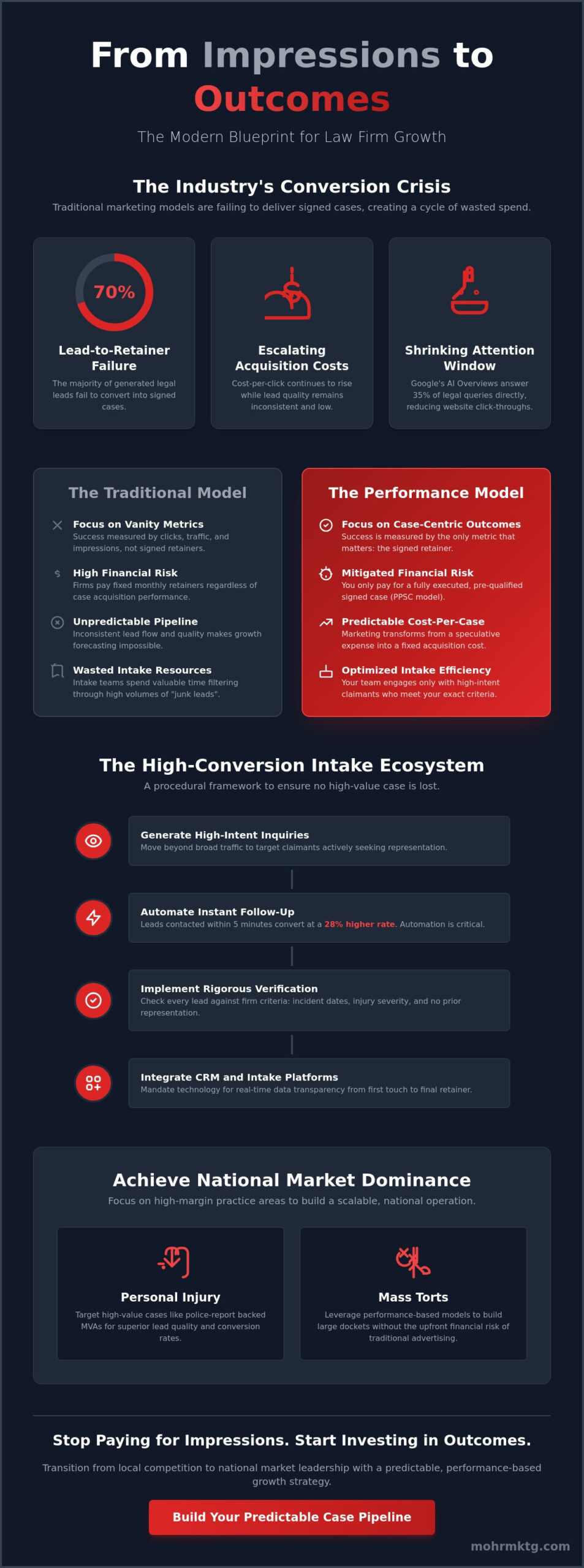
Industry benchmarks for 2026 show that approximately 70% of legal leads fail to convert into signed retainers. You’ve likely seen your cost-per-click rise while lead quality remains stubbornly inconsistent. It’s frustrating to fund a marketing engine that produces high-volume noise instead of high-value cases. Most firms are trapped in a cycle of paying for impressions rather than outcomes. With Google’s AI Overviews now answering 35% of legal queries, the window for capturing a lead’s attention has narrowed significantly.
Effective law firm growth strategies must move beyond these vanity metrics to focus on performance-based scaling. This guide provides the blueprint to master the shift from broad traffic to high-intent case acquisition. You’ll learn how to secure a predictable cost-per-signed-case and build a national scale operation in personal injury or mass torts. We’ll examine the mechanics of eliminating intake bottlenecks and the strategic integration of AI to ensure no high-value case slips through the cracks. It’s time to stop guessing and start measuring your expansion by the only metric that matters: the signed retainer.
Key Takeaways
- Implement modern law firm growth strategies that prioritize case-centric outcomes over vanity metrics and impressions.
- Understand how performance-based acquisition models mitigate financial risk compared to traditional monthly marketing retainers.
- Identify the critical components of a high-conversion intake ecosystem to prevent lost revenue from high-intent inquiries.
- Discover the mechanics of scaling national campaigns in high-margin practice areas like Mass Torts and Personal Injury.
- Leverage professional lead generation expertise to transition from local competition to national market dominance.
The Evolution of Law Firm Growth Strategies in 2026
In 2026, growth is no longer measured by impressions or website traffic. These are vanity metrics that fail to reflect the financial health of a firm. Modern The Evolution of Law Firm Growth Strategies focuses exclusively on case-centric outcomes. This means shifting your focus from top-of-funnel awareness to bottom-of-funnel conversion. Traditional SEO-only strategies are failing in hyper-competitive markets. Google’s AI Overviews now provide direct answers for approximately 35% of legal queries, which drastically reduces the click-through rate to law firm websites. Broad-spectrum digital advertising is becoming a sunk cost for many.
Firms must transition to high-intent inquiry generation. This involves moving away from casting a wide net and instead building a turnkey acquisition ecosystem. This ecosystem ensures that your marketing dollars are targeted toward individuals who are ready to sign a retainer. It’s about owning the pipeline from the initial search to the finalized contract. Relying on passive strategies is no longer a viable path to market leadership.
Beyond Clicks: The Shift to Intent-Based Acquisition
Passive traffic is a liability in 2026. In high-stakes practice areas like personal injury, a user browsing general legal information is not the same as a claimant with active intent. AI-driven search behavior now requires more precise targeting because users expect immediate, specific answers to their legal problems. With the average cost per lead for personal injury reaching as high as $600 in competitive markets, firms can’t afford to waste budget on low-intent clicks. This rising cost of PPC is driving high-performing firms to seek alternative models that guarantee results rather than just visibility. For example, firms focusing on motor vehicle accidents are increasingly relying on police report backed MVA cases to ensure lead quality. Successful law firm growth strategies now prioritize the quality of the inquiry over the quantity of the traffic.
The Role of Technology in Modern Practice Scaling
Scaling requires a rigid technological foundation. You must mandate the use of integrated CRM and intake platforms to track every inquiry from the first touchpoint to the final retainer. Real-time data transparency is non-negotiable for firms that want to remain competitive. If you can’t see exactly where your marketing spend is converting into signed cases, you’re losing money. Automation reduces friction by ensuring immediate follow-up with potential claimants. Industry data shows that leads contacted within five minutes convert at a 28% higher rate. Manual processes are a bottleneck that will throttle your growth. Use automation to handle the initial screening and verification so your team can focus on closing high-value cases. Integrated law firm growth strategies rely on these systems to maintain a predictable cost-per-signed-case.
Implementing Performance-Based Case Acquisition Models
Traditional marketing models are fundamentally broken. You pay a monthly retainer to an agency and hope for the best. This creates a misalignment of interests. The agency gets paid regardless of your caseload. Performance-based models, specifically Pay-Per-Signed-Case (PPSC), flip this dynamic. In a PPSC model, the risk shifts from the law firm to the acquisition partner. You only pay when a retainer is fully executed. This provides financial predictability that is impossible to achieve with standard agency fees. It transforms marketing from a speculative expense into a line-item acquisition cost.
The verification process is the backbone of this model. It requires a rigorous check of every claimant against your specific criteria. This includes verifying incident dates, injury severity, and the absence of existing legal representation. Only after these hurdles are cleared is the case delivered. This level of quality control ensures your intake team spends 100% of their time on viable files. It eliminates the friction of sorting through unqualified inquiries. Successful law firm growth strategies in 2026 rely on this level of procedural precision to maintain high margins.
Why Firms Are Moving to Pay-Per-Signed-Case
Standard PPC campaigns often flood your intake team with “junk leads.” These are individuals who don’t meet your specific case criteria or are simply looking for free advice. PPSC eliminates this waste. You aren’t buying clicks or “raw” leads; you’re buying a pre-qualified, signed retainer. This level of precision is essential for sophisticated law firm growth strategies. Pay-Per-Signed-Case is the most efficient way to scale national litigation because it aligns marketing costs directly with revenue-generating assets. It allows you to forecast your growth with mathematical accuracy. You no longer have to worry about fluctuating lead quality or unpredictable auction costs.
Evaluating Case Acquisition Partners
Not all lead providers are equal. While modern law firm marketing tactics emphasize digital presence, the back-end fulfillment is where most firms fail. You must vet your partners based on three pillars: transparency, compliance, and experience. Avoid providers who utilize “shared aggregators.” These services sell the same lead to multiple firms, resulting in a race to the bottom and poor conversion. Instead, look for partners who generate exclusive leads through proprietary channels. This ensures the claimant is only speaking with your firm.
The Mohr Marketing team brings over 30 years of industry-specific experience to the table. This longevity ensures a deep understanding of the regulatory environment and the nuances of high-value litigation. We focus on delivering mass tort signed cases that meet rigorous verification standards. If you’re ready to move away from unpredictable marketing spend, you can discuss your scaling goals with our specialists. Choosing a partner with a proven track record is the most effective way to safeguard your firm’s resources while pursuing aggressive expansion.
The Intake Ecosystem: Turning High-Intent Inquiries into Retainers
Stop blaming lead volume for stagnant revenue. Most firms fail because their intake systems are porous. Effective law firm growth strategies treat intake as a technical discipline, not a clerical task. If you’re spending thousands on high-intent inquiries but taking ten minutes to call them back, you’re subsidizing your competitors. In 2026, “speed to lead” is measured in seconds. A claimant who has just experienced a traumatic event or discovered a legal injury is in a state of high urgency. They will call the next firm on the list if you don’t answer immediately. Your intake process must be a frictionless machine that captures interest at its peak.
A high-conversion ecosystem requires 24/7/365 infrastructure. High-value cases don’t adhere to business hours. If your intake desk closes at 5:00 PM, you’re ignoring a significant percentage of the market. You need a system that captures, qualifies, and signs claimants the moment they reach out. This level of availability is a prerequisite for national scalability. Without it, your marketing spend is being wasted on leads that will be signed by more responsive competitors before your office opens on Monday morning.
Optimizing the Conversion Funnel
The goal of intake is to move a prospect from curiosity to commitment with minimal friction. This requires a series of rigorous screening questions designed to filter out unqualified individuals immediately. By the time a file reaches an attorney, it should be a “done deal.” Utilizing signed retainers is a critical growth lever. It shifts the burden of paperwork away from your legal team. It ensures that your billable hours are spent on litigation, not administrative follow-up. Implementing professional legal intake services for law firms provides the infrastructure needed to handle sudden spikes in lead volume without sacrificing quality.
The Human Element in Digital Intake
Technology should facilitate the connection, not replace it. Basic chatbots can handle initial data entry, but they lack the empathy required to secure a high-value personal injury or mass tort case. Claimants need to feel heard and protected. Empathetic, professional intake specialists bridge the gap between automated qualification and the final human closing. This is especially true for national campaigns where cultural nuances and language barriers can kill a deal. Bilingual intake is no longer optional. It’s a requirement for any firm serious about comprehensive law firm growth strategies. Your intake team must be able to communicate effectively with every potential claimant, regardless of their primary language, to ensure no valuable case is left behind.
Scalable Growth Through Practice Area Specialization
Generic marketing is a waste of capital. To achieve national scale, firms must pivot toward high-margin practice areas where volume and value align. Mass Torts and Personal Injury are the primary drivers of law firm growth strategies in 2026. These areas allow for the deployment of centralized intake systems and standardized litigation workflows. Scaling a national campaign requires a departure from local, broad-spectrum advertising. It demands a focus on real search intent. This ensures you are targeting claimants who are actively seeking legal remedies for specific injuries rather than just browsing general information.
The mechanics of national scaling involve moving from a “generalist” mindset to a “specialist” acquisition model. When you concentrate your resources on specific litigations, you create an economy of scale in your intake and processing. You’re no longer reinventing the wheel with every new inquiry. Instead, you’re running a high-precision operation designed to capture and convert specific case types with surgical accuracy.
Dominating the Mass Tort Market
Mass torts offer unparalleled scalability because the litigation framework is already established. Your goal is to acquire high-intent claimants at a predictable cost. For example, acquiring mesothelioma leads requires a roadmap built on verified medical history and strict case criteria. Turnkey campaigns allow you to enter these high-stakes litigations without the overhead of building a proprietary marketing engine from scratch. For a deeper dive into the mechanics of these campaigns, refer to our guide on mass tort lead generation. This approach turns your firm into a high-output litigation machine.
High-Velocity Growth in MVA and Personal Injury
Motor Vehicle Accident (MVA) growth is often hindered by the prevalence of low-value, unverified leads. You can bypass this bottleneck by utilizing police report backed MVA cases. This data provides objective verification of the incident and the parties involved before you spend a single minute on the phone. It’s the most effective way to maintain lead quality while aggressively increasing volume. This precision is equally critical when pursuing truck accident signed cases, where the stakes and acquisition costs are significantly higher. You don’t have to choose between quality and quantity. By using verified data sources, you ensure that every case in your pipeline has the potential for a high-margin settlement.
National expansion requires a partner who understands the nuances of these high-competition niches. If you’re ready to dominate your practice area, contact our growth specialists today to discuss a tailored acquisition strategy.
The Mohr Marketing Method: Your Partner in National Growth
Scaling a firm nationally is a high-stakes endeavor. It requires more than just a budget; it requires a partner who understands the mechanical precision of the 2026 legal market. Mohr Marketing serves as that strategic partner. We offer over 30 years of industry-specific lead generation expertise. Our approach is built on transparency and verifiable financial performance. Most law firm growth strategies suffer from a lack of accountability. We solve this by aligning our success directly with yours. It’s time to stop paying for clicks and start paying for cases.
Our methodology focuses on the elimination of inefficient intermediaries. We own the process from the initial search intent to the signed retainer. This ensures that every dollar you spend is protected by rigorous verification. We don’t just deliver leads. We deliver revenue-generating assets that are ready for your legal team. This transition to a performance-based model is the only way to maintain a competitive advantage as acquisition costs continue to rise. You need a partner who views your resources with the same protective aggression as you do.
Turnkey Marketing and Intake Ecosystems
The Mohr ecosystem is a complete, end-to-end solution. It handles the entire pipeline from the moment a claimant begins their search. We manage the advertising, the initial screening, and the final execution of the retainer. This includes strict compliance with state laws and bar mandates. You don’t have to worry about regulatory hurdles or intake bottlenecks. Traditional web marketing for law firms often fails because it lacks this integrated infrastructure. Without a verified intake process, clicks are just a drain on your resources. We provide the stability you need to scale without the chaos.
Next Steps for Scalable Expansion
It’s time to audit your current operations. Examine your intake and acquisition costs with absolute honesty. If you can’t attribute every marketing dollar to a signed case, your strategy is leaking capital. Transitioning to a performance-based model eliminates this financial waste. It allows you to forecast your growth with mathematical certainty. We invite you to move away from speculative marketing and toward a results-oriented pipeline. Contact Mohr Marketing to discuss a custom growth strategy and secure your firm’s position as a national leader.
Dominate the National Legal Market
The legal market in 2026 demands a departure from speculative marketing. Success requires a transition from paying for clicks to acquiring verified signed retainers. You’ve seen how a turnkey intake ecosystem and practice area specialization create the necessary foundation for national scaling. Relying on broad-spectrum advertising is no longer a viable path to market leadership. Instead, modern law firm growth strategies must focus on performance-based models that offer financial predictability and eliminate lead waste.
Mohr Marketing provides the strategic partnership needed to execute this shift. With over 30 years of legal marketing expertise, we deliver verified, high-intent inquiries and signed retainers that convert into revenue. Our turnkey intake ecosystem handles the technical friction of claimant acquisition so your team can focus on litigation. It’s time to stop guessing and start measuring your success by the only metric that matters: the signed retainer. We’re ready to help you build a more efficient, profitable practice.
Secure your law firm’s growth with verified signed cases from Mohr Marketing. Your path to national dominance begins with a results-oriented pipeline. We look forward to helping you scale.
Frequently Asked Questions
What are the most effective law firm growth strategies for 2026?
The most effective law firm growth strategies in 2026 focus on owning the pipeline from inquiry to signed retainer. You must move away from broad-spectrum digital ads that generate passive traffic. Successful firms utilize performance-based models to secure predictable acquisition costs. This involves integrating AI for rapid intake and focusing on high-intent practice areas like mass torts or personal injury.
Is pay-per-signed-case legal marketing compliant with bar associations?
Pay-per-signed-case models are compliant when executed with transparency and strict adherence to state-specific advertising rules. For instance, California’s Senate Bill 37 and Alabama’s 2026 updates mandate explicit disclosures and prohibit outcome guarantees. You must ensure your partner follows these regulations to avoid statutory damages. Always verify that your acquisition model aligns with the latest ABA Model Rules and state bar mandates.
How does a performance-based marketing agency differ from a traditional SEO firm?
Traditional SEO firms focus on visibility metrics like rankings and traffic. A performance-based agency focuses on the bottom line by delivering signed retainers. In this model, the marketing risk shifts from the law firm to the agency. You pay only for qualified, executed agreements rather than speculative monthly retainers for website clicks that may never convert into actual clients.
Why is intake optimization critical for law firm growth?
Intake optimization is critical because approximately 70% of legal leads fail to convert into signed cases. Growth is often throttled by internal bottlenecks rather than a lack of inquiries. You must respond within seconds to capture high-value claimants before they contact a competitor. A streamlined intake ecosystem ensures that your marketing spend actually translates into revenue-generating files for your firm.
What is the average cost-per-signed-case for mass tort litigation?
Industry benchmarks for 2026 indicate that competitive cost-per-signed-case (CPSC) varies significantly by market and practice area. Personal injury cases in urban markets typically range between $2,000 and $5,000. Mass tort litigation involves higher acquisition costs due to the complexity and high settlement value of these cases. Firms should focus on the lifetime value of the case rather than the initial acquisition fee to measure true ROI.
Can a small law firm use national growth strategies effectively?
Small firms can compete nationally by leveraging turnkey acquisition ecosystems. You don’t need a massive internal marketing department to scale your practice. By focusing on specific litigations and using performance-based models, smaller practices can acquire high-value cases across the country. This allows you to maintain low overhead while pursuing high-margin growth that was previously reserved for larger firms.
How do I identify high-intent personal injury leads?
High-intent leads are identified by their active search for specific legal remedies rather than general information. You should prioritize inquiries backed by objective data, such as police reports for motor vehicle accidents. These claimants have verified incident dates and clear liability. Real search intent is the strongest indicator that a lead will convert into a signed retainer with minimal friction.
What are the risks of using shared lead aggregators for law firm expansion?
Shared lead aggregators sell the same inquiry to multiple firms simultaneously. This creates an inefficient race to the bottom where speed is the only factor. It often results in lower conversion rates and wasted intake resources as your team calls leads who have already been contacted. Exclusive lead generation ensures that the claimant is only speaking with your firm, which protects your brand and increases your ROI.

Recent Posts
- Personal Injury Intake Services: A 2026 Guide to High-Conversion Case Acquisition
- Using EMS Reports to Find and Qualify Personal Injury Clients
- The Strategic Value of EMS-EMT Accident Reports in Car Accident Lawsuits
Categories
- AI and Lead Generation
- Business Financing
- Call Verified MVA Leads
- Car Accident Help
- Car Accident Settlements
- Claimant Funding
- Compliance Program
- EMS-EMT Reports
- Geotargeting
- Google Maps Ranking
- Healthcare Practice Growth
- Law Firm Growth
- Law Office Operations
- Lead Generation
- Lead Generation For Attorneys
- Lead Generation For Chiropractors
- Lead Generation For Criminal Attorneys
- Lead Generation For D&A Treatment Centers
- Lead Generation For DUI Attorneys
- Lead Generation For Eye Doctors
- Lead Generation For Family Law Practices
- Lead Generation For PI Law Firms
- Lead Generation For Plastic Surgeons
- Leads For Healthcare Professionals
- Leads For Insurance Industry
- Legal Leads
- Legal Marketing
- Legal Updates
- Mass Tort Leads
- Medicare and Medicaid Leads
- Merchant Funding Leads
- Online Marketing Strategies
- Pre-Settlement Funding
- Signed MVA Cases
- Tort Updates
- Truck Accident Leads and Signed Cases
- Truck Accident Settlements
- Web Design