Predictable Case Flow for Law Firms: Engineering a Scalable Intake Ecosystem in 2026
July 30, 2026 by Mohr Marketing
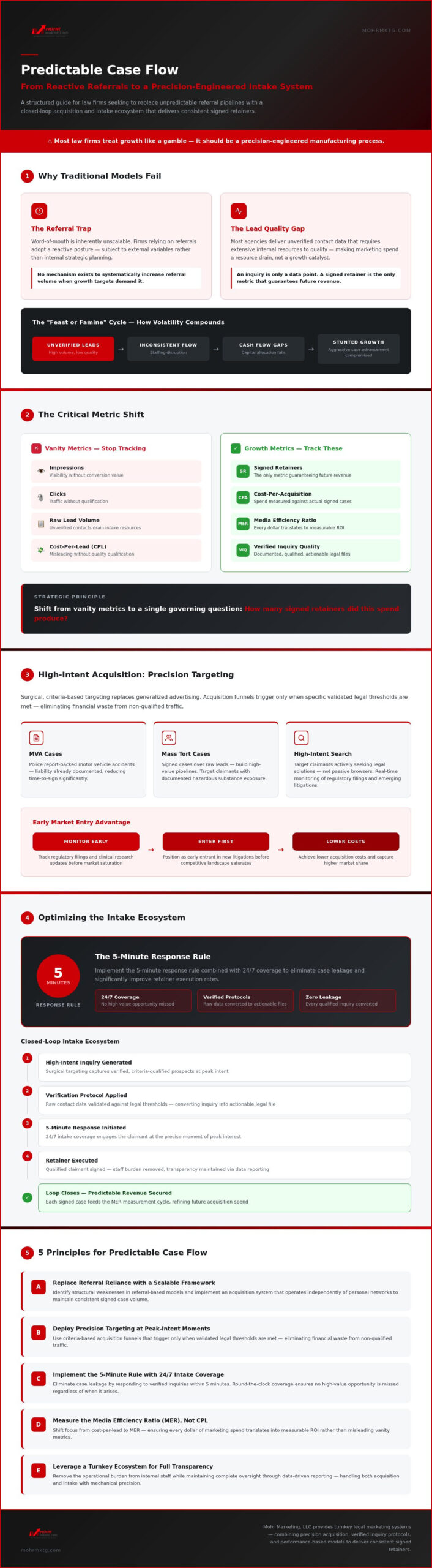
Most law firms treat business growth like a gamble. It should be a precision-engineered manufacturing process. If you’re relying on unpredictable referrals or volatile digital ad spend, you aren’t running a scalable business; you’re managing a series of expensive accidents. Achieving predictable case flow for law firms requires moving beyond raw lead generation and into the territory of a closed-loop intake ecosystem.
You already know that high cost-per-lead numbers mean nothing if your intake team misses high-value opportunities. It’s exhausting to manage inconsistent cash flow while competitors with better systems capture the high-value mass tort and personal injury files. This guide will teach you how to transform that volatility into a structured, high-conversion system that delivers a consistent stream of signed retainers. We’ll examine the technical shift toward verified inquiry protocols and performance-based models that eliminate waste and maximize your marketing ROI. By the end of this article, you’ll understand how to build a turnkey solution that handles both acquisition and intake with mechanical accuracy.
Key Takeaways
- Identify the structural weaknesses of referral-based models and how to replace them with a scalable framework for consistent signed cases.
- Deploy precision targeting techniques to secure a predictable case flow for law firms by engaging high-intent prospects at the moment of peak interest.
- Implement the 5-minute response rule and 24/7 coverage to eliminate case leakage and significantly improve your retainer execution rates.
- Shift your focus from cost-per-lead to the Media Efficiency Ratio (MER) to ensure every dollar of marketing spend translates into measurable ROI.
- Leverage a turnkey intake ecosystem to remove the operational burden from your staff while maintaining full transparency through data-driven reporting.
The Architecture of Predictable Case Flow: Why Referrals and Random Leads Fail
Predictable case flow for law firms is defined as the consistent and measurable generation of signed retainers within a specific timeframe. It represents a transition from speculative marketing to a structured business operation. Many firms operate under the misconception that a high volume of inquiries equates to growth. However, in a contingency-based model, an inquiry is merely a data point; a signed retainer is the only metric that guarantees future revenue. Establishing this flow requires a departure from traditional, fragmented methods in favor of a closed-loop acquisition system.
The “Referral Trap” remains a significant barrier to professional scaling. While word-of-mouth recommendations signify high service quality, they are inherently unscalable. Law firms lack a mechanism to systematically increase referral volume when growth targets require higher capacity. This reliance creates a reactive business posture where the firm is subject to external variables rather than internal strategic planning. To achieve sustained expansion, a firm must implement an acquisition system that operates independently of personal networks to maintain a predictable case flow for law firms.
There is also a distinct “Lead Quality Gap” present in the legal market. This gap describes the operational distance between an initial digital touchpoint and a fully executed retainer. Most marketing agencies prioritize lead volume, delivering unverified contact information that requires extensive internal resources to qualify. For a firm to scale, it must bridge this gap by implementing verification protocols that convert raw data into actionable legal files. Without this bridge, marketing expenses become a drain on resources rather than a catalyst for growth.
The Volatility of Non-Systematized Growth
Unsystematized growth inevitably leads to “feast or famine” cycles that disrupt firm operations. These fluctuations make it difficult to maintain consistent staffing levels or allocate capital for litigation funding. When cash flow is unpredictable, the ability to advance cases aggressively is compromised. Traditional digital strategies like SEO and PPC often fail to solve this issue because they focus solely on front-end traffic. Without a robust intake ecosystem to capture and qualify that traffic, these efforts result in high costs with low conversion rates.
Shifting from Lead Volume to Case Quality
Firms must transition their focus from vanity metrics, such as clicks and impressions, to growth metrics centered on signed retainers. This shift requires a demand for verified inquiries that protect the intake team’s time and resources. High-intent search strategies target claimants who are actively seeking legal solutions rather than casual browsers. For example, focusing on police report-backed MVA cases ensures that liability is already documented, which reduces the time to sign. Prioritizing mass tort signed cases over raw leads allows a firm to build a high-value pipeline with mechanical precision.
Engineering High-Intent Acquisition: Precision Targeting in 2026
Engineering a predictable case flow for law firms requires a transition from generalized advertising to surgical, criteria-based targeting. In 2026, the market rewards firms that identify prospects based on validated legal thresholds rather than broad demographic data. This involves configuring acquisition funnels to trigger only when specific indicators are met, such as documented exposure to a hazardous substance or a verified motor vehicle incident. By focusing on high-intent data points, firms eliminate the financial waste of processing non-qualified traffic and ensure that every dollar allocated to acquisition is directed toward a viable retainer.
The implementation of a turnkey marketing ecosystem is critical for capturing claimants at the moment of peak intent. This infrastructure utilizes real-time data monitoring to identify emerging mass tort opportunities before the competitive landscape becomes saturated. By analyzing regulatory filings and clinical research updates, firms can position themselves as early entrants in new litigations. This proactive strategy allows for lower acquisition costs and higher market share. Furthermore, maintaining strict compliance with state bar mandates is essential to protect the firm’s professional reputation and ensure the long-term stability of the acquisition engine.
Intent-Based Search vs. Broad Awareness
Targeting generic terms like “injury lawyer” often results in inefficient capital allocation due to extreme competition and the acquisition of low-intent inquiries. To optimize conversion, firms should prioritize “lawsuit criteria” search terms. Prospects who search for specific eligibility requirements or injury symptoms demonstrate a higher propensity to sign a retainer. This approach functions as an initial filter, ensuring that the acquisition funnel prioritizes mass tort signed cases over raw inquiry volume. By focusing on intent rather than awareness, firms can maintain a higher level of precision in their growth metrics.
Practice Area Specifics: Mass Torts and MVAs
Achieving national scale requires practice-specific acquisition strategies that account for varying legal requirements. For motor vehicle accident practices, the priority should be police report-backed MVA cases, which provide immediate verification of liability and incident details. In contrast, complex litigations require mesothelioma leads built on real search intent and rigorous medical criteria. These high-value cases demand a sophisticated verification process to ensure the legal viability of each file. If you’re prepared to modernize your growth strategy, connect with a strategic partner to evaluate your firm’s scaling potential.
Optimizing the Legal Intake Ecosystem to Prevent Case Leakage
Engineering a predictable case flow for law firms requires an intake ecosystem that never sleeps. If your firm stops processing inquiries at 5:00 PM, you’re effectively handing high-value cases to your competitors. Claimants in crisis don’t follow a schedule. They search for help when the stress becomes unbearable, which often happens late at night or on weekends. A 24/7/365 intake requirement isn’t a luxury; it’s a fundamental component of a scalable business model. Any gap in availability is a point of case leakage that directly undermines your marketing ROI.
Speed to lead is the most critical variable in the conversion equation. The legal industry operates on a strict 5-minute rule. If you don’t engage a prospect within five minutes of their inquiry, the probability of securing a signed retainer drops by more than 80%. This isn’t just about answering the phone. It’s about deploying a professional who can immediately establish authority and empathy. You must bridge the gap between a claimant’s anxiety and your firm’s solution before they move on to the next search result. A structured intake system ensures that no inquiry goes cold.
Verification protocols must be rigorous to protect your firm’s most expensive resource: your time. Every inquiry should be measured against specific medical or legal criteria before it’s passed to an attorney. Effective intake specialists act as a filter, ensuring that only viable, high-intent cases enter your pipeline. This process requires a balance of professional authority to lead the conversation and empathy to make the claimant feel heard. When these elements align, the transition from an inquiry to a signed case becomes a predictable, mechanical process.
Verification and Qualification Protocols
A “double-check” system is essential for maintaining case quality. Your intake team must verify claimant eligibility by cross-referencing statements with objective data, such as medical record summaries or police report details. This prevents non-qualified cases from cluttering your CRM and wasting legal resources. Understanding the ROI of legal intake services means recognizing that conversion efficiency is just as important as lead volume. For instance, high-value truck accident signed cases require immediate verification of liability and injury severity to maintain momentum and prevent the claimant from shopping elsewhere.
Integrating Technology with Human Touch
AI alone fails in the legal sector because it lacks the nuance required for high-stakes emotional triggers. Use automation for administrative tasks, such as initial data entry or CRM sorting, but keep human specialists on the front line for the actual interview. Human touch is non-negotiable for building the trust needed to execute a retainer. Your CRM should nurture inquiries that aren’t ready to sign immediately through automated, value-driven follow-ups. Regularly audit your calls to identify friction points. If prospects are dropping off during a specific phase of the call, your protocol needs adjustment. Precision in intake leads to precision in growth.
Measuring the Metrics that Matter: CPA, ROI, and Cash Flow
Data is the only defense against marketing waste. To maintain a predictable case flow for law firms, you must look past surface-level stats like click-through rates. These are vanity metrics that don’t reflect the health of your pipeline. Instead, focus on the Media Efficiency Ratio (MER). This is the total revenue generated divided by your total marketing spend. A healthy MER indicates that your acquisition system is functioning as a profit center rather than a cost center. If you aren’t tracking this, you’re flying blind.
Forecasting future revenue depends on your current volume of signed retainers and their average settlement value. By analyzing these figures, you can predict cash flow months in advance. This foresight allows you to make aggressive decisions regarding litigation funding and staffing. Vendors who deliver high lead volume without corresponding conversions are the primary source of marketing waste. Eliminate them immediately. Every dollar spent on unverified inquiries is a dollar taken away from high-intent acquisition.
Calculating Your True Cost Per Signed Case
Your true Cost Per Signed Case (CPA) includes more than just the invoice from your lead provider. You must factor in the labor costs of your intake team and the overhead of your verification protocols. Use this formula: (Total Marketing Spend + Intake Overhead) / Total Signed Retainers. This provides a clear picture of your acquisition efficiency. It also highlights the strategic advantage of performance-based models. When comparing Pay-Per-Lead vs. Pay-Per-Signed-Case models, firms often find that paying for the result, the retainer, removes the financial risk of low-quality data. MVA cases typically have a lower CPA but require higher volume; mass torts demand a higher investment for significantly larger returns.
Budget Allocation for National Scaling
Scaling requires a tactical distribution of capital. Focus your primary budget on high-intent search channels where claimants are actively looking for help. Secondary funds should go toward social proof channels that validate your firm’s authority. You’ve reached the scaling threshold when your local ROI plateaus and your intake ecosystem can handle additional volume without losing efficiency. At this point, moving to national acquisition is the only way to sustain growth. Ensure you balance this spend with your litigation costs. A firm that overextends on acquisition but can’t afford to advance its cases will eventually face a cash flow crisis.
The Mohr Marketing, LLC Method: Implementing a Turnkey Performance System
Implementing a scalable intake infrastructure requires more than just software; it requires a specialized operational framework. The turnkey ecosystem provided by Mohr Marketing, LLC removes the internal administrative burden of inquiry management. This system operates with absolute transparency, utilizing data-driven reporting and a direct supply chain that eliminates inefficient intermediaries. By integrating this method, law firms gain full visibility into the origin and verification status of every potential case, ensuring that internal resources remain focused on litigation rather than administrative oversight. Most firms suffer from fragmented processes that lack cohesion; this method provides a centralized solution designed for precision.
Reliability in the legal marketing sector is established through longevity and rigorous adherence to standards. The 30-year history of Mohr Marketing, LLC provides a stable foundation for firms navigating complex market shifts. This experience ensures that all acquisition strategies remain in strict compliance with state bar mandates, protecting the firm’s professional standing and long-term viability. To execute this transition, firms should begin by auditing their current intake protocols to identify points of inefficiency. Replacing fragmented, non-verified processes with a centralized, performance-oriented system facilitates rapid national expansion while maintaining strict quality control.
The Pay-Per-Signed-Case Advantage
Traditional marketing models often require law firms to assume the financial risk of poor lead quality. Performance-based models, such as those utilized by Mohr Marketing, LLC, align the interests of the agency with the revenue objectives of the firm. Through the Pay-Per-Signed-Case model, capital is allocated only toward fully executed retainers that satisfy specific medical and legal criteria. This financial structure allows firms to scale from regional operations to national prominence by converting marketing expenditures into guaranteed legal assets. It eliminates the economic waste associated with unqualified inquiries and ensures that every dollar spent contributes directly to the firm’s caseload.
Partnering for Sustainable Firm Expansion
Effective growth necessitates a strategic partnership rather than a traditional vendor relationship. While a vendor provides a static service, a strategic partner provides a competitive advantage by identifying exclusive opportunities in high-value sectors. This includes specialized acquisition for high-value mold cases and truck accident signed cases. By outsourcing the mechanics of acquisition and verification to Mohr Marketing, LLC, law firms can prioritize their core legal functions while maintaining a consistent pipeline of high-value files. This strategic alignment is the final step in engineering a truly scalable and predictable legal business.
Engineer Your Firm’s Growth Trajectory
Success in 2026 depends on your ability to replace volatility with mechanical precision. You’ve learned that relying on referrals is a defensive strategy that limits your firm’s ceiling. To achieve a predictable case flow for law firms, you must integrate high-intent acquisition with a 24/7 intake ecosystem. This combination ensures that every dollar of marketing spend is optimized for conversion rather than just visibility. Moving from raw leads to verified, signed retainers is the only path to sustainable national scaling.
Mohr Marketing, LLC provides the specialized infrastructure needed to execute this shift. With 30+ years of legal marketing expertise, we offer a turnkey solution that prioritizes strict bar mandate compliance and verified, high-intent signed cases. Our performance-based models remove the financial uncertainty of acquisition, allowing you to advance your practice with confidence. Stop managing marketing accidents and start leading a structured growth engine.
Take the first step toward a scalable, structured pipeline today. Your firm’s expansion is waiting for a better system.
Frequently Asked Questions
What is a predictable case flow system for law firms?
A predictable case flow system is a data-driven framework that replaces the volatility of referrals with a mechanical acquisition process. It uses verified inquiry protocols and an automated intake ecosystem to ensure a consistent volume of signed retainers every month. This structure allows firm partners to treat growth as a measurable manufacturing process rather than a series of unpredictable marketing experiments.
How do I calculate my law firm’s cost per signed case?
Calculate your true cost per signed case by dividing your total marketing spend plus intake overhead by the number of fully executed retainers. Looking at cost per lead alone is deceptive because it ignores the labor required for conversion. This comprehensive formula reveals your actual acquisition efficiency and helps you identify which channels are delivering a genuine return on investment.
Why is my intake team losing qualified leads?
Most case leakage happens because of slow response times or limited availability. If your team doesn’t engage a prospect within the first five minutes of their inquiry, your chances of signing them drop by over 80%. Failing to provide 24/7/365 coverage also creates gaps where high-value claimants are forced to contact your competitors who are ready to answer the phone.
What is the difference between pay-per-lead and pay-per-signed-case?
Pay-per-lead models charge you for raw inquiries, which often include junk data or non-qualified prospects. Pay-per-signed-case models shift the financial risk to the provider because you only pay for fully executed retainers. This performance-based approach ensures that you’re investing in predictable case flow for law firms rather than just buying a list of names that may never convert.
Can a law firm scale nationally without a massive marketing team?
You can scale nationally by leveraging a turnkey intake ecosystem that removes the operational burden from your internal staff. Partnering with an expert who handles acquisition and initial verification allows you to manage national volume with a lean team. This model provides the specialized infrastructure needed to maintain high standards of case quality without the overhead of a massive in-house marketing department.
How do you verify the quality of a mass tort lead before it reaches the firm?
Quality is verified through rigorous inquiry protocols that measure each claimant against specific medical and legal criteria. Intake specialists conduct detailed interviews to confirm exposure windows and injury severity before a case is ever passed to your firm. This mechanical accuracy filters out non-qualified inquiries, ensuring your legal team only spends time on viable, high-intent cases.
What are the most common bottlenecks in legal case acquisition?
The primary bottlenecks are unverified lead sources and the “referral trap.” Relying on unscalable word-of-mouth or junk lead providers creates inconsistent cash flow. Additionally, a lack of structured follow-up protocols often results in qualified prospects falling through the cracks. Eliminating these friction points requires a closed-loop system that handles everything from the initial search intent to the final signed retainer.
Is performance-based legal marketing compliant with state bar rules?
Performance-based marketing is compliant as long as it adheres to strict state bar mandates regarding advertising and fee-sharing. Maintaining a predictable case flow for law firms requires a partner who stays ahead of regulatory shifts. This includes ensuring all marketing materials are transparent, verified, and follow the specific compliance standards set for 2026 to protect your firm’s reputation and license.

Recent Posts
- Personal Injury Signed Retainers: The Strategic Guide to Scalable Case Acquisition in 2026
- Motor Vehicle Accident Leads: A 2026 Guide to High-Intent Case Acquisition
- Legal Intake Solutions: The 2026 Guide to Maximizing Law Firm ROI
Categories
- AI and Lead Generation
- Business Financing
- Call Verified MVA Leads
- Car Accident Help
- Car Accident Settlements
- Claimant Funding
- Compliance Program
- EMS-EMT Reports
- Geotargeting
- Google Maps Ranking
- Healthcare Practice Growth
- Law Firm Growth
- Law Office Operations
- Lead Generation
- Lead Generation For Attorneys
- Lead Generation For Chiropractors
- Lead Generation For Criminal Attorneys
- Lead Generation For D&A Treatment Centers
- Lead Generation For DUI Attorneys
- Lead Generation For Eye Doctors
- Lead Generation For Family Law Practices
- Lead Generation For PI Law Firms
- Lead Generation For Plastic Surgeons
- Leads For Healthcare Professionals
- Leads For Insurance Industry
- Legal Leads
- Legal Marketing
- Legal Updates
- Mass Tort Leads
- Medicare and Medicaid Leads
- Merchant Funding Leads
- Online Marketing Strategies
- Pre-Settlement Funding
- Signed MVA Cases
- Tort Updates
- Truck Accident Leads and Signed Cases
- Truck Accident Settlements
- Web Design