Cost Per Signed Case: The 2026 Benchmarking Guide for Law Firms
June 13, 2026 by Mohr Marketing
What if your marketing budget wasn’t a gamble on raw leads but a direct investment in signed retainers? You likely recognize the mounting pressure of rising digital auction costs and the inefficiency of an intake team overwhelmed by unqualified inquiries. In the 2026 legal landscape, generating volume without verified outcomes is a liability. Mastering your cost per signed case legal is the only way to move past vanity metrics and secure a definitive competitive advantage.
We promise to provide the financial clarity required to transform your acquisition strategy from volatile lead spending into a predictable engine for docket growth. This benchmarking guide delivers the exact metrics needed to audit your current spend and transition to performance-based results. We will analyze practice-area specific costs, break down the hidden expenses within the intake ecosystem, and demonstrate how Mohr Marketing, LLC enables firms to secure fixed-cost assets. By following this roadmap, you can eliminate the friction of “junk” leads and focus your firm’s resources on high-value litigation.
Key Takeaways
- Learn why shifting your focus from raw lead volume to verified assets is the only way to eliminate marketing waste.
- Access updated 2026 data to benchmark your cost per signed case legal across high-value practice areas like Mass Tort and Personal Injury.
- Identify the hidden friction in your intake ecosystem that causes 70% of legal leads to fail before reaching the retainer stage.
- Discover how to transfer financial risk to providers by transitioning from unpredictable media buys to fixed-cost signed retainers.
- Establish a performance-based acquisition strategy that secures predictable docket growth while protecting your firm’s resources.
Defining Cost Per Signed Case (CPSC) vs. Cost Per Lead (CPL)
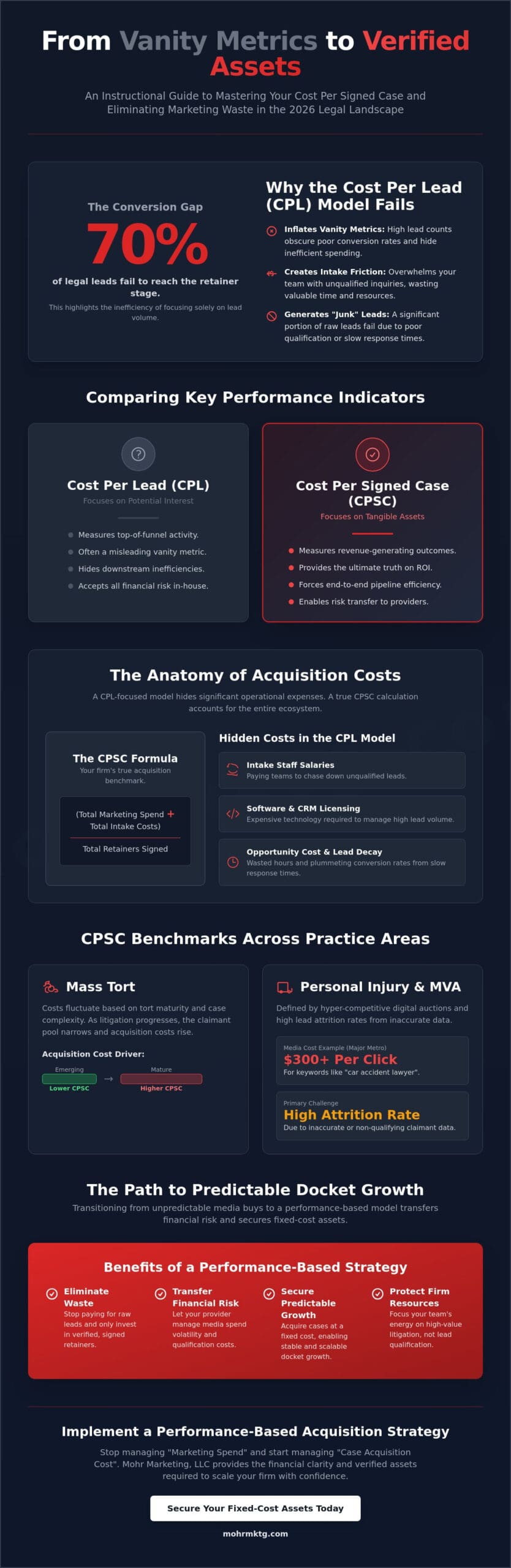
A lead represents potential interest, but a signed retainer represents a tangible business asset. While many agencies prioritize Cost Per Lead (CPL) due to its high volume, this metric often obscures the true efficiency of your marketing spend. To evaluate the actual health of your firm, you must track your cost per signed case legal. This metric is a precise application of Cost Per Action (CPA), focusing on the final conversion rather than the initial inquiry. Relying on CPL alone allows inefficient agencies to hide behind high lead counts that never translate into a growing docket.
The “Conversion Gap” is the primary reason why CPL is a misleading KPI. Industry data shows that roughly 70% of legal leads fail to reach the retainer stage due to poor qualification, lack of insurance coverage, or slow response times. CPSC provides the ultimate truth by filtering out these failed attempts. It forces a firm to look beyond the top of the funnel to the only outcome that generates revenue. Measuring the cost of a finished retainer ensures that your capital is allocated to results, not just activity.
Calculating your CPSC requires a comprehensive audit of your expenditures. Use the formula: (Total Marketing Spend + Total Intake Costs) / Total Retainers Signed. This calculation ensures that every dollar, including staff salaries, CRM software, and administrative overhead, is accounted for in your acquisition benchmark. Without including intake costs, your data will remain artificially low and prevent you from identifying the true friction in your acquisition pipeline.
The Hidden Costs of the CPL Model
Managing raw leads requires a massive infrastructure that most firms fail to audit correctly. Beyond the media buy, you’re paying for intake staff salaries and expensive software licensing fees. There’s also a significant opportunity cost. Every hour your team spends chasing “junk” inquiries is an hour they aren’t dedicated to high-value claimants. Lead decay is another silent killer; if your intake team doesn’t respond within minutes, the conversion rate plummets, driving your real CPSC into unsustainable territory.
Why 2026 Requires a Shift to CPSC Benchmarking
The legal market in 2026 is defined by extreme saturation in digital auctions. PPC and LSA costs have reached a point where clicks are often unaffordable for firms without massive, optimized budgets. AI-driven lead filtering has become a necessity to survive, but it adds another layer of technological cost. Transitioning to a model built on Mass Tort Signed Retainers through Mohr Marketing, LLC allows you to stop managing “Marketing Spend” and start managing “Case Acquisition Cost.” This shift provides the stability required to scale in a hyper-competitive environment.
Benchmarking CPSC Across Primary Legal Practice Areas
Establishing a competitive cost per signed case legal requires an understanding of practice-area volatility. A single-event personal injury case operates on a different financial scale than a complex mass tort. High-competition keywords, such as “car accident lawyer” in major metropolitan markets, can drive media costs to $300 per click. When these costs are paired with strict case criteria, the acquisition expense inevitably rises. However, integrating verified inquiries into your funnel mitigates this by filtering out non-qualifying claimants before they reach your intake team. Mass Tort CPSC typically fluctuates based on the current MDL status, with costs often rising as the litigation reaches maturity and the pool of eligible claimants narrows.
Mass Tort Case Acquisition Benchmarks
Emerging torts offer a lower entry point for firms looking to build a docket quickly. As a tort matures and national advertising increases, the pool of available claimants shrinks, which drives up the acquisition cost. The complexity of the case also dictates the price. For instance, cases requiring immediate medical record retrieval involve higher upfront costs but result in a more stable docket. You should evaluate your risk tolerance before selecting a tort. If you require a predictable volume, look for programs focused on Mass Tort signed cases and criteria that align with your firm’s specific litigation strengths.
Motor Vehicle Accident (MVA) and Personal Injury Costs
Standard MVA cases often suffer from high attrition rates due to inaccurate claimant data, which negatively impacts your average cost per signed case legal. This is why police-report backed MVA cases command a premium. They provide verified proof of liability and insurance coverage, which significantly lowers the conversion gap. There’s also a distinct financial gap between soft tissue claims and catastrophic injuries. While soft tissue cases are easier to acquire, the lower settlement value necessitates a leaner acquisition spend. Conversely, the high settlement potential of truck accident signed cases justifies a more aggressive investment to secure the retainer.
Efficiency in case acquisition isn’t about finding the cheapest lead. It’s about securing the most profitable retainer at a fixed, predictable cost. If your current marketing efforts are producing high volume but low conversion, it’s time to audit your acquisition model. You can consult with our team to review current market benchmarks and optimize your docket growth strategy.
The Anatomy of Case Acquisition Costs: Where the Money Goes
Case acquisition is not a single line item. It is a complex chain of events where each link carries a specific cost. Understanding the anatomy of your cost per signed case legal requires a granular breakdown of the entire pipeline. A media buy is only the starting point. You are paying to capture attention across Search, Social, and Display platforms. However, the raw cost of a click is irrelevant if the claimant does not meet your specific, rigorous case criteria. Verification is the filter that protects your budget. It ensures that your intake team only engages with individuals who have a viable claim. Without this layer, your acquisition spend will be consumed by unqualified inquiries.
The final hurdle is document execution. In the current legal market, getting a retainer signed is a logistical race. You must secure the signature in minutes, not days. This requires a seamless transition from the initial qualification to the digital retainer. Any delay in this process increases the likelihood of a claimant signing with a competitor, which effectively doubles your acquisition cost for that single matter. Every component of this process must be audited to ensure maximum capital efficiency.
The PPC Trap: How Clicks Erode Profitability
Pay-Per-Click (PPC) advertising is often a primary driver of volume, but it is also a significant source of waste. High-value niches, such as mesothelioma, are frequently targeted by click fraud and “looky-loo” traffic. These are individuals who click on expensive ads with no intention of pursuing a claim. To protect your cost per signed case legal, you must implement aggressive negative keyword management. A high Cost Per Click (CPC) does not always correlate to a high-value signed case. If you’re paying $200 per click for broad terms, you’re subsidizing your competitors’ research. Focus on search intent over raw volume.
Intake Optimization: The CPSC Multiplier
Your intake ecosystem is the bridge between a lead and a signed retainer. It requires 24/7/365 coverage. Missing a call at 2:00 AM is a direct loss of investment. Professional intake requires more than just answering phones. It demands a combination of precise scripting and empathy to reduce “ghosting” during the document execution phase. Your tech stack plays a vital role here. CRM integration and automated follow-up sequences ensure that no claimant falls through the cracks. If your intake process is manual, your acquisition costs will remain high and unpredictable. Automation is the only way to scale without proportional increases in overhead.
Pay-Per-Signed-Case vs. In-House Lead Management
Law firms face a fundamental choice: manage the marketing machine in-house or purchase verified outcomes. The traditional Pay-Per-Lead (PPL) model is inherently risky. You pay for the opportunity to speak with someone, but the provider bears no responsibility for the result. This forces your firm to absorb the cost of non-converting inquiries. In contrast, a Pay-Per-Signed-Case model shifts the financial risk to the provider. You only pay when a retainer is fully executed. This creates a predictable cost per signed case legal, allowing you to budget for a specific number of clients rather than a variable media spend. It is the core of a Performance-Based Growth Engine for Law Firms in 2026. By purchasing outcomes, you eliminate the “paying for air” phenomenon where thousands of dollars are spent on leads that never answer the phone.
Predictability is the primary advantage of this procurement model. When you manage campaigns in-house, your acquisition costs are at the mercy of platform algorithms and fluctuating click prices. One bad month of PPC performance can derail your quarterly projections. Buying signed retainers allows for linear scaling. If you need 50 new cases to meet your revenue targets, you simply purchase 50 retainers. This level of financial control is impossible when managing raw lead flow through traditional digital auctions.
The “Total Cost of Ownership” for a Signed Case
A $50 lead is never just $50. You must factor in the “Total Cost of Ownership” (TCO). This includes the management fees for your agency, CRM software costs, and the labor required for your intake team to chase that lead. When you audit these hidden expenses, the net cost per signed case legal of a cheap lead often exceeds the price of a premium, turnkey retainer. For smaller or specialized firms, the “zero-waste” approach is a strategic necessity. It eliminates the overhead of a large-scale marketing department. Buying a $1,000 signed retainer is often more capital-efficient than spending $5,000 on raw leads that result in only three signatures after weeks of effort. You are paying for a finished product, not raw materials that require extensive processing.
Operational Speed: The Turnkey Advantage
Entering a new practice area traditionally requires months of setup. You have to build landing pages, test creative, and train your intake staff on specific criteria. A performance-based provider eliminates this ramp-up period. For example, firms can instantly acquire high-value mold cases without any in-house technical setup. This turnkey approach allows your partners and associates to focus on litigation and case resolution rather than marketing logistics. It provides the agility to pivot toward emerging torts the moment they become viable. If you’re ready to stop paying for leads and start purchasing results, request a consultation for our signed retainer programs.
Implementing a Performance-Based Strategy with Mohr Marketing, LLC
Transitioning to a performance-based model requires a structured deployment of resources. The first step is to define your specific case criteria and target monthly volume. This precision ensures that your cost per signed case legal remains fixed and predictable from the outset. Whether your firm specializes in Mass Tort, MVA, or Personal Injury, the onboarding process is designed to align with your litigation capacity. Once your parameters are set, you can stop managing individual lead vendors and start managing a pipeline of verified outcomes.
Integration with the Mohr Marketing, LLC turnkey intake ecosystem is the next phase. We handle the entire lifecycle of the claimant journey, from the initial inquiry through the rigorous verification process. Because our system is built for compatibility, fully executed retainers are delivered directly into your firm’s CRM. This removes the manual labor of data entry and document tracking. You are no longer chasing signatures; you are receiving ready-to-file cases that meet your exact specifications.
The Mohr Marketing, LLC Verification Process
Our verification process is built on a foundation of strict adherence to state laws and bar mandates. We utilize multi-step screening protocols to ensure that every claimant not only meets your criteria but is also legally eligible to pursue a claim. These direct-to-retainer protocols are engineered to maximize retention by securing the signature while the claimant is most engaged. Transparency is maintained through data-driven reporting, providing your firm with a comprehensive audit trail for every signed matter we deliver.
Scalability for National Growth
This model provides the agility required for national expansion without the overhead of local offices or regional marketing campaigns. It is a proven roadmap for Mass Tort lead generation, allowing firms to enter new markets instantly as litigation trends shift. By leveraging our established infrastructure, you can scale your docket aggressively while protecting your firm’s capital. This strategic partnership is why leading firms have relied on Mohr Marketing, LLC for decades to drive their most critical growth initiatives.
Secure Your Firm’s Growth with Performance-Based Acquisition
Transitioning to a performance-based model represents a fundamental shift in your firm’s operational efficiency. By prioritizing your cost per signed case legal, you’ve established a benchmark that protects your capital from market volatility. This strategic move allows you to move beyond the management of raw data and refocus your internal resources on the high-stakes litigation that drives your firm’s reputation and revenue. You’re no longer subsidizing market research for your competitors; you’re acquiring verified assets.
Mohr Marketing, LLC provides the necessary infrastructure to maintain this momentum. With over 30 years of industry experience, we offer a turnkey intake and verification ecosystem that operates with strict compliance to state laws and bar mandates. This partnership ensures that your docket continues to grow without the traditional friction of in-house lead management or the unpredictability of digital auctions. We handle the logistical complexities so your attorneys can focus on the practice of law.
Secure Your Signed Cases Now with Mohr Marketing, LLC. Take the final step toward a performance-based growth model that secures your firm’s competitive advantage and ensures a predictable return on your acquisition investment.
Frequently Asked Questions
What is a good cost per signed case for personal injury in 2026?
A competitive cost per signed case legal in urban markets typically ranges between $2,000 and $5,000 for standard personal injury matters. Smaller markets may see benchmarks between $1,000 and $3,000. These figures fluctuate based on the specific litigation value; catastrophic injury cases can justify acquisition costs between $5,000 and $10,000. Your firm should aim for an acquisition cost that remains within 5% to 10% of the average attorney fee to maintain healthy margins.
How does pay-per-signed-case differ from traditional lead generation?
Pay-per-signed-case shifts the financial risk from your firm to the provider. Traditional lead generation requires you to pay for raw inquiries regardless of their quality or conversion potential. In a performance-based model, you only pay for fully executed retainers. This eliminates the “paying for air” phenomenon where firms subsidize non-responsive or unqualified leads. It transforms a variable marketing expense into a fixed, predictable asset acquisition.
Why are signed retainers more expensive than raw leads?
Signed retainers carry a higher price point because they represent a finished product rather than raw material. The cost includes the media buy, multi-step verification, 24/7 intake coverage, and the logistics of document execution. You aren’t just buying a name; you’re buying the labor and technology required to convert a claimant into a client. This turnkey approach ultimately lowers your total cost of ownership by removing internal overhead and intake burnout.
Can I specify custom criteria for my signed cases?
You must define specific case criteria to ensure the docket matches your litigation strengths. Performance-based acquisition allows you to filter for factors such as liability proof, injury severity, or insurance minimums. We use these parameters during the verification phase to reject claimants who don’t meet your standards. This precision ensures that your budget is only allocated to high-value matters that align with your firm’s growth objectives and resource capacity.
What is the average conversion rate from a legal lead to a signed case?
Industry benchmarks indicate that approximately 70% of legal leads fail to convert into signed retainers. For personal injury firms using Google Local Services Ads, the average conversion rate is roughly 25%, or one in four leads. This gap is why tracking your cost per signed case legal is more vital than monitoring raw lead volume. High attrition rates in traditional funnels often hide the true expense of client acquisition and waste your team’s time.
Is performance-based legal marketing compliant with state bar rules?
Performance-based marketing is compliant when handled by providers who adhere strictly to state laws and bar mandates. We maintain rigorous protocols to ensure that all intake and verification processes respect professional conduct rules regarding solicitation and fee-sharing. Our 30 years of experience allow us to navigate these regulations while delivering verified outcomes. You should always verify that your provider understands the specific mandates of your jurisdiction to protect your license.
How long does it take to start receiving signed cases?
You can begin receiving signed cases almost immediately once your criteria and target volume are established. Because we utilize a turnkey intake ecosystem, there’s no “ramp-up” period required for building landing pages or testing creative. We leverage existing infrastructure to identify and qualify claimants who meet your standards. This operational speed allows your firm to enter new practice areas or scale existing dockets without the delays associated with traditional digital campaigns.
What happens if a signed case does not meet my firm’s criteria?
Verification protocols are designed to prevent unqualified cases from reaching your CRM. If a delivered retainer fails to meet the specific, pre-defined criteria established at the start of the campaign, it is typically subject to a replacement or credit process. This accountability is what differentiates performance-based models from traditional agencies. You aren’t paying for mistakes; you’re paying for verified assets that satisfy your litigation requirements and contribute to your firm’s revenue.

Recent Posts
- Personal Injury Intake Services: A 2026 Guide to High-Conversion Case Acquisition
- Using EMS Reports to Find and Qualify Personal Injury Clients
- The Strategic Value of EMS-EMT Accident Reports in Car Accident Lawsuits
Categories
- AI and Lead Generation
- Business Financing
- Call Verified MVA Leads
- Car Accident Help
- Car Accident Settlements
- Claimant Funding
- Compliance Program
- EMS-EMT Reports
- Geotargeting
- Google Maps Ranking
- Healthcare Practice Growth
- Law Firm Growth
- Law Office Operations
- Lead Generation
- Lead Generation For Attorneys
- Lead Generation For Chiropractors
- Lead Generation For Criminal Attorneys
- Lead Generation For D&A Treatment Centers
- Lead Generation For DUI Attorneys
- Lead Generation For Eye Doctors
- Lead Generation For Family Law Practices
- Lead Generation For PI Law Firms
- Lead Generation For Plastic Surgeons
- Leads For Healthcare Professionals
- Leads For Insurance Industry
- Legal Leads
- Legal Marketing
- Legal Updates
- Mass Tort Leads
- Medicare and Medicaid Leads
- Merchant Funding Leads
- Online Marketing Strategies
- Pre-Settlement Funding
- Signed MVA Cases
- Tort Updates
- Truck Accident Leads and Signed Cases
- Truck Accident Settlements
- Web Design