Legal Intake Process Best Practices: The 2026 Guide to Case Conversion
August 15, 2026 by Mohr Marketing
Your firm isn’t losing cases to better lawyers. You’re losing them to faster, more disciplined intake systems. You likely recognize the frustration of a high cost per lead that fails to yield signed cases. If your team isn’t responding within seconds, your competitors are already sending the digital retainer. Implementing legal intake process best practices isn’t just about answering the phone. It’s about building a high-velocity verification engine that eliminates friction and captures high-intent claimants before they move on to the next search result.
This 2026 guide teaches you how to master the rigorous protocols and technological standards required to transform raw inquiries into fully executed signed retainers. We’ll break down the mechanics of a scalable intake ecosystem, from AI-driven qualification to the strategic advantages of a performance-based model. You’ll learn how to secure verified, litigation-ready cases while maximizing the ROI on your digital marketing spend. This is an instructional roadmap for professionals who demand mechanical accuracy and a more streamlined, direct path to firm growth.
Key Takeaways
- Shift from passive data entry to a strategic acquisition model that treats every legal inquiry as a high-stakes financial asset.
- Implement high-velocity legal intake process best practices by establishing “Speed to Lead” protocols that target response times under five minutes.
- Establish rigorous, case-specific verification standards to filter out non-qualified inquiries and ensure leads meet strict litigation requirements.
- Deploy specialized intake teams and immediate digital retainer technology to capture high-volume mass tort and personal injury claimants during the initial contact.
- Scale firm operations efficiently by transitioning to a “Pay-Per-Signed-Case” model that eliminates the administrative friction of internal intake departments.
Defining the Legal Intake Process as a Strategic Asset
Legal intake is the systematic engine of firm growth. It encompasses the precise capture, qualification, and onboarding of potential claimants. Too many firms treat this as a back-office administrative task. That’s a fundamental error. High-stakes practices view intake as strategic case acquisition. This distinction separates market leaders from firms suffering from “leaky bucket” syndrome. When your intake protocols are weak, you’re effectively burning your marketing budget on leads that will never sign. Implementing legal intake process best practices ensures that every dollar of your digital marketing spend converts into a verified, litigation-ready case. Beyond financial ROI, a rigorous intake system maintains ethical compliance and ensures your firm adheres to strict state bar mandates. It’s the vital first phase of legal case management, dictating the quality and success of the entire litigation lifecycle.
The Economic Impact of Intake Efficiency
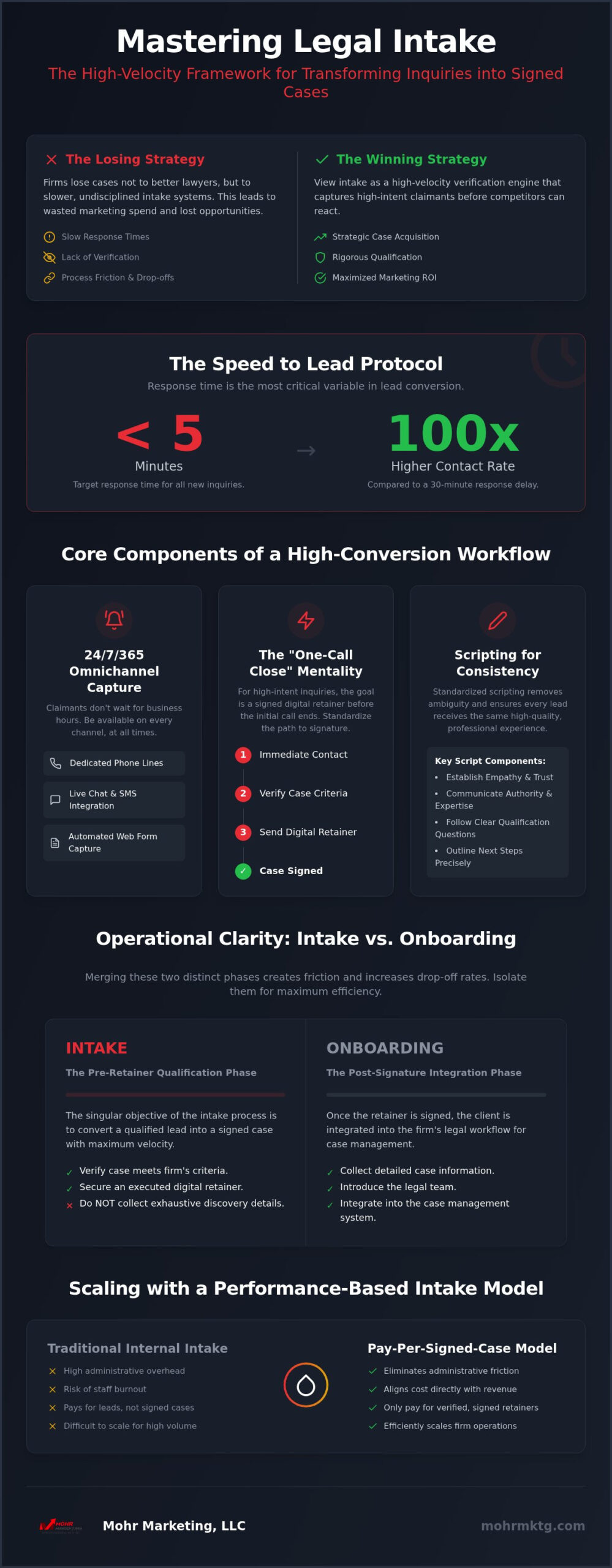
Response time is the most critical variable in lead conversion. In 2026, claimants expect immediate engagement. If your team doesn’t respond within minutes, the lead is already looking at your competitor’s digital retainer. This speed directly influences the lifetime value of a case. High-quality intake filters out low-intent inquiries, protecting your attorneys from wasting billable hours on non-viable files. Inefficient systems carry heavy hidden costs, including administrative overhead and staff burnout. Precision in the intake phase isn’t a luxury; it’s a requirement for maintaining a competitive advantage in mass tort and personal injury markets.
Intake vs. Onboarding: Knowing the Difference
Operational clarity requires a hard boundary between intake and onboarding. Intake is the pre-retainer qualification phase. Its objective is singular: verify the case criteria and secure a signature. Onboarding is the post-signature process of integrating the client into the firm’s legal workflow. Merging these phases often creates unnecessary friction. Forcing a claimant to provide exhaustive discovery details before they’ve signed a retainer leads to high drop-off rates. Successful firms use legal intake process best practices to isolate these stages. They keep the initial contact lean, focused, and designed for one outcome: the executed retainer.
Core Components of a High-Conversion Intake Workflow
Efficiency in case conversion is a race against time and competition. To dominate the 2026 market, firms must move from passive collection to aggressive acquisition by adopting legal intake process best practices. The foundation of this transition lies in “Speed to Lead” protocols. Research consistently indicates that responding to an inquiry within five minutes increases the likelihood of contact by 100 times compared to a 30-minute delay. This isn’t a suggestion; it’s a mechanical requirement for ROI. If you’re not the first to call, you’re likely the last to be considered.
High-conversion workflows prioritize the “one-call close” mentality. For high-intent inquiries, such as those in motor vehicle accident cases, the objective is to secure a digital signature before the initial call ends. This requires a seamless integration of intake personnel, case criteria verification, and e-signature technology. You shouldn’t hang up without a signed retainer or a clear, scheduled next step. Standardizing this workflow ensures that every lead is treated with the same level of urgency and precision, regardless of which staff member handles the call.
Omnichannel Capture Strategies
National firms cannot afford to go dark. A 24/7/365 availability is non-negotiable because claimants don’t wait for business hours to seek help. Your capture strategy must be omnichannel. This means integrating SMS, live chat, and dedicated phone lines into a single, unified queue. SMS is particularly effective for re-engaging silent leads immediately. When a web form is submitted, an automated, personalized text message should fire instantly. This keeps the claimant engaged while your intake staff prepares for the call. Integrating web forms directly into your queue eliminates manual entry errors and ensures data integrity. If you’re struggling to manage this volume internally, you might consider how specialized legal intake services can bridge the gap.
Scripting for Empathy and Authority
Consistency requires standardized scripting that leaves no room for ambiguity. Your intake staff must balance professional decorum with the need for rapid information gathering. Effective legal intake process best practices rely on declarative statements that build trust with often-traumatized claimants. Instead of asking “Can you tell me what happened?”, use authoritative prompts like “Describe the incident so we can verify your eligibility.” This approach establishes you as the expert and keeps the conversation focused on qualification. Training must also focus on identifying “red flag” responses early. If a claimant’s details don’t align with the statute of limitations or specific injury criteria, the call should be professionally terminated. This saves your resources for high-value, viable files.
Advanced Qualification and Case Verification Standards
Precision is the final barrier between a marketing lead and a viable case. While speed captures the inquiry, rigorous verification determines the ROI. Implementing legal intake process best practices requires a shift from simple data collection to proactive forensic qualification. You must establish non-negotiable criteria, such as the exact date of injury and the applicable statute of limitations, before a lead ever reaches an attorney’s desk. This prevents your firm from wasting resources on “window shoppers” or individuals with low search intent who are merely seeking general information rather than legal representation.
A dual-layer verification model is the gold standard for high-volume firms. First, use automated logic to filter out inquiries that fail basic eligibility requirements. Second, deploy trained intake specialists to conduct a nuanced human review. This two-step process ensures that only high-intent, qualified claimants move forward. For personal injury firms, prioritizing police report-backed MVA cases ensures maximum accuracy and significantly reduces the risk of pursuing non-viable claims. Accuracy at this stage dictates the success of the entire litigation lifecycle.
Medical and Incident Verification
Verification protocols must be tailored to the specific litigation area. In mesothelioma cases, for instance, you must verify specific medical treatments and diagnoses early in the conversation. Cross-reference claimant statements against public records to confirm incident details. This level of scrutiny eliminates fraudulent or duplicate claims through rigorous data scrubbing. It protects your firm’s reputation and ensures your litigation team focuses only on verified, high-value assets. Don’t take a claimant’s word as fact; verify it against objective data points.
Conflict Checking and Ethical Screening
Automation is essential for conflict checking. Manual processes are prone to human error and can lead to severe ethical breaches. Integrate your intake system with your firm’s database to flag potential conflicts instantly. Additionally, ensure all intake staff are trained on state-specific bar advertising mandates to maintain compliance. Document every rejected lead with specific reasons for the denial. This creates an audit trail that mitigates malpractice risk and provides clarity if a lead questions their rejection. Strategic intake isn’t just about saying “yes” to the right cases; it’s about having a defensible process for saying “no” to the wrong ones.
Optimizing Intake for High-Volume Mass Tort and PI Cases
High-stakes litigation demands industrial-grade scalability. When national TV or social media campaigns trigger a lead surge, your infrastructure must hold. Relying on generalist staff for complex matters like Camp Lejeune or MVA is a strategic failure. You need specialized teams trained in the specific nuances of each litigation area. This specialization ensures that high-value opportunities, such as truck accident signed cases, receive the technical scrutiny they require. These files involve higher complexity and significant financial stakes; they shouldn’t be handled by entry-level personnel. Implementing legal intake process best practices at this scale means your system adapts to volume without sacrificing verification quality.
The Digital Retainer Revolution
The days of mailing physical retainer packages are over. In 2026, e-signatures are the non-negotiable standard for securing mass tort signed cases. Digital retainer technology reduces the “time to sign” from several days to mere minutes. This speed is vital for preventing claimant “shopping” or second-guessing. Your system must be secure and fully compliant with state-specific legal standards for digital agreements. Securing a signature during the initial call isn’t just a goal; it’s a requirement for maintaining a high case conversion rate. If you aren’t closing the deal while the claimant is on the phone, you’re giving them permission to call your competitor.
Managing Lead Velocity
Surge volume requires a tiered response system. Use AI-driven chatbots for the initial screening phase. These tools handle basic eligibility questions, such as incident dates and injury types, freeing your human agents to focus on high-intent claimants. For those not ready to sign immediately, implement automated lead nurturing via SMS and email. This keeps your firm top-of-mind through consistent, professional follow-ups that don’t drain your staff’s time. You must also analyze conversion data in real-time. If a specific campaign is delivering low-quality leads that fail verification, adjust your marketing spend instantly. This data-driven agility is a hallmark of legal intake process best practices in high-volume environments.
Scaling with Performance-Based Intake and Signed Retainers
The shift from “Pay-Per-Lead” to a “Pay-Per-Signed-Case” model represents the final evolution of legal intake process best practices. Traditional lead generation forces your firm to absorb the risk of non-conversion. You’re paying for inquiries that might never materialize into viable files. By contrast, a performance-based model aligns the partner’s incentives with your firm’s growth. You only pay for verified, signed retainers. This transition eliminates the “middleman” friction and ensures your marketing budget is spent only on assets that have already cleared the qualification bar. It’s a strategic move that transforms a variable marketing expense into a fixed cost per acquisition.
Specialized agencies remove the massive overhead associated with internal intake departments. Managing a 24/7/365 team requires constant training, management, and technological updates. It’s an operational drain. Outsourcing to a turnkey provider allows your attorneys to focus on litigation while the partner handles the mechanical accuracy of acquisition. When evaluating the ROI of legal intake services, firms often find that the cost of a signed case from a specialized partner is significantly lower than the true cost of an internal conversion when factoring in overhead and lost opportunity. This model provides a more streamlined, direct path to success than traditional alternatives.
The Turnkey Intake Ecosystem
A high-velocity ecosystem integrates marketing, screening, and retainer execution into one seamless flow. This prevents “lead rot,” where qualified claimants lose interest due to response delays. Professional intervention happens in seconds, not hours. This data-driven approach offers transparency that internal departments often lack. You gain a partner who is aggressive in pursuing your expansion and protective of your resources. The result is a litigation-ready file delivered directly to your case management system, fully verified and ready for discovery. This ecosystem is built on 30+ years of industry experience, ensuring strict compliance with state laws and bar mandates.
Future-Proofing Your Firm for 2026
AI and machine learning are now central to predictive lead scoring. These tools analyze historical data to identify which inquiries are most likely to result in high-value settlements. In the competitive 2026 market, firms using performance-based models will consistently outpace those stuck in traditional, inefficient cycles. Implementing these legal intake process best practices isn’t just about growth; it’s about survival. Your next step is an audit of your current conversion rates. Identify the gaps where leads are falling through the cracks. If your internal team isn’t hitting the five-minute response mark or securing signatures on the first call, it’s time to shift to a partner who prioritizes results over raw lead volume.
Dominate the 2026 Litigation Market
The transition from administrative intake to strategic case acquisition is a requirement for firm growth. Mastering legal intake process best practices involves more than just answering phones. It requires a high-velocity verification engine that eliminates lead rot and maximizes marketing ROI. Firms that prioritize speed to lead and rigorous medical verification consistently secure the highest-value mass tort and personal injury files. You must move away from passive collection and toward aggressive, data-driven acquisition.
Stop absorbing the financial risk of non-converting leads. Leveraging performance-based models allows you to focus on litigation while a partner delivers verified, litigation-ready signed cases. With 30+ years of industry-leading expertise, Mohr Marketing provides the turnkey ecosystem necessary to scale your firm with precision and mechanical accuracy. It’s time to replace inefficient intermediaries with a direct path to growth.
Take control of your conversion funnel and build a scalable, repeatable ecosystem for long-term expansion.
Frequently Asked Questions
What is the ideal response time for a legal lead in 2026?
The ideal response time for a legal lead is under five minutes. In the competitive 2026 legal market, speed is the primary driver of conversion. If your firm fails to respond within this critical window, the claimant will likely engage a competitor who is faster. High-velocity intake systems utilize automated SMS and instant call routing to meet this standard. This immediate intervention prevents lead rot and ensures your marketing spend translates into signed retainers.
Should legal intake be handled by attorneys or specialized staff?
Legal intake should be handled by specialized staff rather than attorneys. Using billable hours for initial qualification is an inefficient use of firm resources. Specialized teams are trained specifically in legal intake process best practices, focusing on rapid response and rigorous verification. This allows your attorneys to focus exclusively on litigation and case strategy. A dedicated intake department ensures consistency, higher conversion rates, and better data integrity across all inquiries.
How do you ensure ethical compliance during a high-volume intake process?
Ethical compliance is ensured through automated conflict checking and rigorous staff training on state-specific bar mandates. Every inquiry must be screened against your firm’s database to prevent conflicts of interest before a retainer is issued. Additionally, all communications should follow standardized scripts to avoid making unauthorized legal promises. Maintaining an audit trail of all rejected leads further mitigates malpractice risk and ensures your high-volume intake remains fully compliant with complex industry regulations.
What are the most important questions to ask during a personal injury intake?
The most critical questions focus on the date of the incident, the specific nature of the injuries, and the parties involved. You must verify the statute of limitations immediately to ensure the case is still viable. Other essential questions include:
- What is the location of the accident?
- Was a police report filed?
- Have you already received medical treatment?
- Are you currently represented by another attorney?
These questions establish the foundational criteria for a litigation-ready case.
Are digital retainer agreements legally binding for mass tort cases?
Digital retainer agreements are fully legally binding for mass tort cases when they comply with the Electronic Signatures in Global and National Commerce (ESIGN) Act and the Uniform Electronic Transactions Act (UETA). These standards ensure that electronic signatures carry the same legal weight as traditional ink. Using secure, compliant e-signature technology allows firms to secure signatures instantly during the initial call. This significantly reduces the time to sign and prevents claimants from shopping for other representation.
How does a performance-based intake model differ from traditional lead generation?
A performance-based model differs by shifting the financial risk from the law firm to the marketing partner. In traditional lead generation, you pay for raw inquiries regardless of their quality or conversion potential. In a performance-based model, you only pay for verified, signed retainers. This approach ensures a higher ROI and eliminates the administrative burden of qualifying low-intent leads. It’s the gold standard for firms looking to scale mass tort or PI practices with precision.
What technology is essential for a modern law firm intake department?
Essential technology includes a robust CRM, integrated VoIP systems, and secure e-signature platforms. Modern legal intake process best practices also require AI-driven screening tools and automated lead nurturing software. These technologies work together to ensure no lead is missed and that every inquiry is qualified based on objective criteria. Real-time data analytics are also vital for monitoring staff performance and adjusting marketing spend. This tech stack creates a scalable, mechanical engine for consistent firm growth.
How can I reduce the number of unqualified leads reaching my attorneys?
You can reduce unqualified leads by implementing a dual-layer verification process that combines automated logic with human review. Initial screening should use AI or chatbots to filter out inquiries that fail basic criteria, such as the date of injury. Following this, trained intake specialists should conduct a nuanced review to verify medical details or incident reports. This rigorous filtering ensures that only high-intent, litigation-ready files reach your attorneys, protecting their time and maximizing firm efficiency.

Recent Posts
- NEC Baby Formula Case Acquisition: A Law Firm’s 2026 Guide
- Justifying Marketing Investment to Law Firm Partners: A Data-Driven Framework
- Roundup Cancer Lawsuit Leads: Buying Guide for Law Firms
Categories
- AI and Lead Generation
- Business Financing
- Call Verified MVA Leads
- Car Accident Help
- Car Accident Settlements
- Claimant Funding
- Compliance Program
- EMS-EMT Reports
- Geotargeting
- Google Maps Ranking
- Healthcare Practice Growth
- Law Firm Growth
- Law Office Operations
- Lead Generation
- Lead Generation For Attorneys
- Lead Generation For Chiropractors
- Lead Generation For Criminal Attorneys
- Lead Generation For D&A Treatment Centers
- Lead Generation For DUI Attorneys
- Lead Generation For Eye Doctors
- Lead Generation For Family Law Practices
- Lead Generation For PI Law Firms
- Lead Generation For Plastic Surgeons
- Leads For Healthcare Professionals
- Leads For Insurance Industry
- Legal Leads
- Legal Marketing
- Legal Updates
- Mass Tort Leads
- Medicare and Medicaid Leads
- Merchant Funding Leads
- Mold Leads
- Online Marketing Strategies
- Pre-Settlement Funding
- Signed MVA Cases
- Tort Updates
- Truck Accident Leads and Signed Cases
- Truck Accident Settlements
- Web Design