Cost Per Retained Case: A Guide for Law Firms
August 7, 2026 by Mohr Marketing
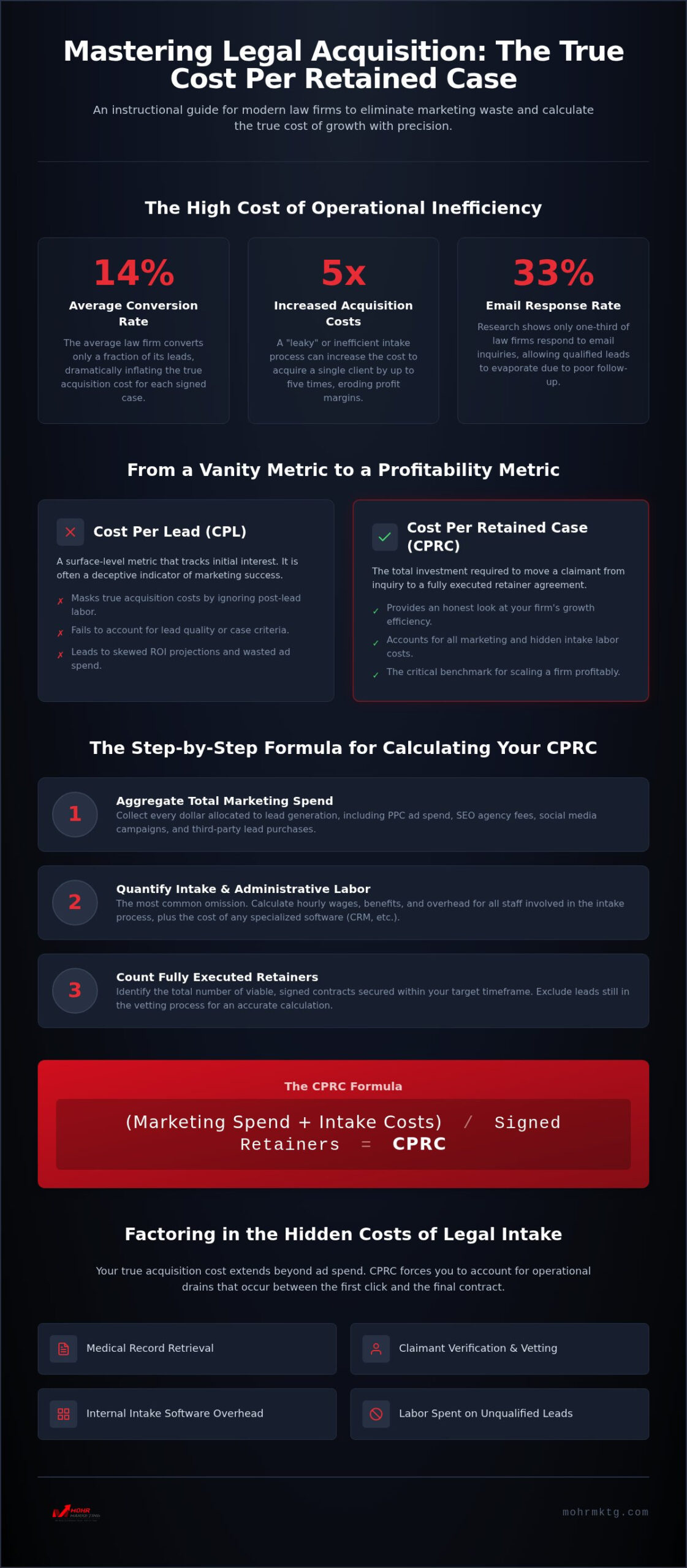
The US legal advertising market is projected to surpass $3 billion by 2026; however, much of this investment is wasted on operational inefficiency. Research shows that only 33% of law firms respond to email inquiries, while a “leaky” intake process can increase acquisition costs by five times. You already understand that a high volume of raw leads is useless if your conversion rate remains stagnant. High lead costs are a common burden, but true profitability depends on calculating cost per retained case with surgical precision.
This guide provides the exact formula you need to determine your firm’s true acquisition costs and eliminate marketing waste. You’ll learn how to account for hidden intake labor and ensure your budget only supports leads that meet strict case criteria. By mastering these metrics, you’ll create a repeatable system for lowering your overall cost of acquisition while securing higher-quality retainers. We’ll start by breaking down the CPRC formula and identifying the friction points that are currently draining your resources.
Key Takeaways
- Shift focus from surface-level metrics to the total investment required to move a claimant from initial inquiry to a fully executed agreement.
- Learn the precise process for calculating cost per retained case by combining direct marketing spend with administrative and intake labor.
- Quantify hidden operational drains such as medical record retrieval, claimant verification, and internal intake software overhead.
- Establish performance benchmarks to identify when high acquisition costs are actively eroding your firm’s projected settlement margins.
- Explore the strategic advantages of the pay-per-signed-case model to secure pre-vetted retainers and eliminate the risk of unqualified leads.
Defining Cost Per Retained Case (CPRC) for Modern Law Firms
Profitability in a high-stakes law firm depends on your ability to measure the distance between a click and a contract. Cost Per Retained Case (CPRC) represents the total investment required to move a claimant from the initial inquiry to a fully executed retainer agreement. While basic metrics track interest, CPRC tracks revenue potential. It’s a specific evolution of Customer Acquisition Cost tailored for the legal industry’s unique intake requirements.
The 2026 market demands this level of precision because the legal industry now faces the highest cost per lead of any sector. While a general paid search CPL might average $131.63, specific personal injury leads often exceed $1,000. Many firms suffer from “conversion decay,” where poor follow-up allows qualified leads to evaporate. Statistics show the average law firm has a lead-to-client conversion rate of only 14%. This low efficiency doesn’t just lose a case; it dramatically inflates your true acquisition costs by wasting the initial marketing spend. Mastering the process of calculating cost per retained case is the only way to identify where these financial leaks occur and stop the drain on your firm’s capital.
CPRC vs. CPL: Why Leads Are a Vanity Metric
Cost Per Lead (CPL) is often a deceptive indicator of success. A low CPL typically masks an unsustainable CPRC because it fails to account for the labor required to filter out “junk volume.” In mass tort and personal injury campaigns, raw lead volume often includes individuals who don’t meet strict case criteria. For instance, SEO leads have a higher average CPL of $456 but maintain a superior close rate of 14.6%. If your intake team spends 40 hours a week chasing 100 cheap leads to sign a single case, your true cost isn’t the price of those leads. It’s the combined cost of the media and the wasted labor. Focusing on the top of the funnel while ignoring the labor involved in calculating cost per retained case leads to skewed ROI projections. You must focus on the end of the intake funnel to protect your margins.
The Legal Retainer as the Critical Milestone
A retained case is more than a signed document; it’s a verified, high-intent claimant who has passed through a rigorous vetting process. In legal marketing, “retention” isn’t about how long a client stays. It’s about the quality of the acquisition. Every step from medical record retrieval to claimant verification adds to the total cost. To stay profitable, use this fundamental benchmark: CPRC is the total marketing and intake spend divided by the number of signed retainers. This figure provides the only honest look at your firm’s growth efficiency and its ability to scale in a competitive environment.
The Step-by-Step Formula for Calculating Your CPRC
Determining the actual cost of growth requires moving beyond the surface metrics of a digital dashboard. You need a formula that accounts for every dollar spent before a file is opened. Calculating cost per retained case involves a four-step process designed to expose inefficiency and highlight your most profitable acquisition channels. This methodical approach ensures your firm doesn’t just buy leads, but builds a sustainable caseload.
- Step 1: Aggregate total marketing spend. Collect every dollar allocated to lead generation, including PPC ad spend, SEO agency fees, and third-party lead purchases.
- Step 2: Quantify intake and administrative labor. This is the most common omission. You must calculate the hourly wages and benefits of your intake staff, plus the cost of any specialized software used to manage the funnel.
- Step 3: Count fully executed retainers. Identify the number of viable, signed contracts secured within your target timeframe. Exclude any leads that are still in the vetting process.
- Step 4: Apply the formula. Divide the sum of your marketing spend and intake costs by the total number of signed retainers.
The resulting figure is your true Cost Per Retained Case. If your internal calculations reveal an unsustainable CPRC, you may need to consult with an acquisition specialist to refine your intake funnel and reduce wasted spend.
Identifying Your Total Marketing Investment
Your marketing spend must be granular to be effective. Tracking aggregate spend is a strategic error; you must separate high-volume motor vehicle accident cases from specialized mass tort campaigns. For long-term investments like SEO, which has an average CPL of $456, you should amortize the agency fees over a 12-month period. This prevents artificial spikes in your monthly CPRC and provides a more accurate view of the channel’s long-term ROI compared to the immediate, often higher-cost volatility of paid search.
Isolating the “Retained” Variable
The “retained” variable in calculating cost per retained case is binary. A claimant is either signed or they are not. You must exclude leads currently in the “pending” or “review” phase to avoid inflating your success metrics. Industry data from 2026 shows that the average firm only converts 14% of leads into clients. This significant drop-off between a verbal agreement and a signed contract is where most firms lose visibility. Ensure your calculation timeframe aligns with your average intake cycle, typically 30 to 60 days, to ensure you are matching costs to the actual results they produced.
Factoring in the Hidden Costs of Legal Intake and Vetting
Many firms fail at calculating cost per retained case because they treat intake as a fixed overhead rather than a variable acquisition expense. Your marketing spend is only the first half of the equation. The true cost of a signed retainer includes the labor, technology, and verification processes required to convert a raw inquiry into a viable case. Ignoring these “hidden” costs leads to an artificial inflation of your ROI and prevents you from making informed scaling decisions.
Beyond simple wages, you must account for the specialized workflows required in modern litigation. This includes the retrieval of medical records, claimant verification, and the opportunity cost of attorney time spent reviewing files that never reach settlement. If your senior partners are spending hours vetting unqualified leads, your acquisition cost isn’t just the price of the lead; it’s the lost revenue from their billable time. A robust technology stack, including CRM licenses, e-signature platforms, and call tracking software, further compounds these operational expenses.
The Real Cost of Internal Intake Teams
An efficient intake department requires more than just a receptionist. To achieve high conversion, you need 24/7 coverage. Research indicates that responding to a lead within five minutes makes you 21 times more likely to convert than waiting 30 minutes. However, maintaining this level of responsiveness internally is expensive. You must calculate your “cost per minute” for intake specialists by including wages, payroll taxes, and benefits. When you factor in the 72% of firms that fail to respond within five minutes, the waste becomes apparent. Understanding the ROI of legal intake services is essential for firms looking to bridge this gap without ballooning their internal payroll.
Verification and Compliance Expenses
In high-stakes mass tort litigation, verification is a non-negotiable expense. You cannot rely on a claimant’s word alone. Third-party data verification is necessary to prevent fraud and ensure every case meets strict criteria. These procedural steps are vital for calculating cost per retained case accurately. Without them, you risk filling your pipeline with “junk volume” that will eventually be dismissed, rendering your initial acquisition spend a total loss. Key expenses in this category include:
- Medical Record Retrieval: The fees paid to providers and the labor spent chasing documentation to prove injury.
- Compliance Audits: Regular reviews of advertising materials and intake scripts to ensure legal and ethical standards are met.
- Identity Verification: Using specialized software to confirm the claimant is a real person with a legitimate claim.
By quantifying these costs, you move from guessing your profitability to knowing it. This level of precision allows you to identify which campaigns are truly generating value and which are simply creating work for your staff.
Benchmarking Your Firm’s Performance and Identifying Waste
Benchmarking allows you to measure your firm’s operational health against current market realities. Calculating cost per retained case across different litigation categories reveals which departments are driving growth and which are merely consuming capital. Without these benchmarks, you cannot distinguish between a high-performing campaign and a financial liability. In 2026, the most successful firms use CPRC as the primary filter for determining which marketing channels to scale or terminate.
The most critical red flag occurs when your CPRC approaches or exceeds the projected net settlement value of a case. This often happens in high-competition environments where speed-to-lead is neglected. If your response time exceeds five minutes, your conversion rate can drop by more than 80%, effectively doubling your final acquisition cost. You must audit your funnel to ensure that marketing spend is aligned with case quality rather than raw volume.
Case-Specific Benchmarks for 2026
Marketing economics vary significantly by practice area. For motor vehicle accident cases, the strategy relies on high-volume, immediate response to maintain a low CPRC. These cases are relationship-driven and urgent, requiring a “tight” intake process to prevent claimants from contacting a competitor. Conversely, mass tort signed cases require a much higher initial investment due to the complex vetting and medical verification involved. While the upfront cost is greater, the ROI is often superior because the settlement values are significantly higher. Comparing your internal intake performance against outsourced, performance-based models frequently reveals that external providers can deliver lower CPRCs by eliminating your firm’s fixed labor and software overhead.
Calculating Conversion Efficiency
Conversion efficiency is the multiplier that determines your profitability. To find your Lead-to-Retainer conversion rate, divide your total signed retainers by your total raw leads and multiply by 100. This metric is the most powerful lever in calculating cost per retained case. A modest 5% increase in your conversion rate doesn’t just result in a few more cases; it can slash your CPRC by double digits because it maximizes the value of your existing media spend. Audit your intake scripts monthly to identify friction points where claimants lose interest. Removing a single unnecessary question or improving the tone of your initial contact can drastically reduce your waste and improve your bottom line.
Optimizing ROI with a Pay-Per-Signed-Case Model
Traditional lead generation forces your firm to gamble on the quality of raw inquiries. When you buy raw leads, your intake team must still perform the heavy lifting of filtering and chasing signatures. This model reverses that dynamic. By purchasing fully executed retainers, you bypass the operational failure points that often compromise your ROI. Mohr Marketing, LLC provides a direct solution that simplifies calculating cost per retained case because the acquisition cost is fixed at the point of delivery. You no longer need to account for the lead-to-client failure rate that plagues most firms.
The turnkey intake ecosystem utilized by Mohr Marketing, LLC ensures every retainer meets your specific compliance and intent markers. This removes the volatility of internal labor costs and software overhead discussed in previous sections. Instead of managing the complexities of PPC campaigns, you receive pre-vetted cases ready for immediate litigation. This level of financial predictability allows you to set aggressive growth targets with absolute confidence, knowing your exact cost per case before the campaign starts.
Eliminating the Risk of Junk Leads
Performance-based models transfer the conversion risk from your firm to the provider. When you utilize verified call transfer leads, you’re engaging with claimants who’ve already been rigorously vetted. This strategy is essential for personal injury lead generation where competition drives raw lead costs to unsustainable levels. By receiving signed retainers, you eliminate the labor cost of chasing leads that don’t meet your criteria, ensuring every dollar spent results in a viable file.
Scaling Your Firm with Confidence
Scalability in a high-stakes legal market requires outcome-based spending. Using a fixed CPRC allows you to forecast annual revenue and growth with high precision. You can integrate performance-based cases into your existing litigation workflow without expanding your internal intake payroll or increasing your administrative burden. This model supports rapid expansion while maintaining a lean operational footprint. It’s the most direct path to maintaining a leadership position without the risk of marketing waste.
Partner with Mohr Marketing, LLC for verified signed cases
Secure Your Firm’s Scalability in 2026
Shifting from vanity metrics to actual signatures is the only way to protect your firm’s margins in a hyper-competitive legal landscape. You’ve identified how hidden labor and slow response times inflate acquisition costs. You now have the necessary formula to audit your funnel and eliminate the sources of conversion decay. Mastering the process of calculating cost per retained case allows you to pivot from speculative lead buying to predictable, results-oriented growth.
Mohr Marketing brings over 30 years of industry expertise to your acquisition strategy. Our turnkey intake ecosystem handles the vetting and verification, ensuring strict compliance with state bar mandates while delivering high-intent claimants. We eliminate the risk of junk volume so you can focus on litigation.
Take control of your acquisition costs today. By focusing on verified outcomes instead of raw data, you’ll build a more profitable and resilient practice for years to come.
Frequently Asked Questions
What is the difference between Cost Per Lead and Cost Per Retained Case?
Cost Per Lead (CPL) measures the price of an initial inquiry, while Cost Per Retained Case (CPRC) calculates the total investment required to secure a signed contract. CPL is a top of funnel metric that ignores the labor and vetting costs needed for conversion. CPRC provides a more accurate reflection of firm profitability by accounting for the entire journey from the first click to the final signature.
How do I calculate the labor cost of my internal legal intake team?
Identify the hourly wages and benefits for every staff member involved in lead response and vetting. You must also include payroll taxes and any management time dedicated to intake oversight. Divide this total monthly labor cost by the number of signed retainers to find the labor portion of your acquisition expense. This granular approach is essential for accurately calculating cost per retained case.
What is a good conversion rate from lead to signed retainer in 2026?
The average law firm sees a lead to client conversion rate of approximately 14% in 2026. However, top performing firms with optimized intake ecosystems often achieve conversion rates between 40% and 50%. If your conversion rate is below 15%, your intake process likely has significant friction points or slow response times that are inflating your overall acquisition costs and wasting marketing budget.
Should I include medical record retrieval costs in my CPRC calculation?
Yes, you must include medical record retrieval fees and the labor costs associated with chasing that documentation. These are variable costs directly linked to the acquisition of a viable case. Excluding them creates a false sense of profitability. A comprehensive CPRC includes every dollar spent to move a claimant from a raw inquiry to a fully vetted, signed, and viable case ready for litigation.
How does a pay-per-signed-case model lower my overall marketing risk?
This model transfers the conversion risk from the law firm to the marketing provider. Instead of paying for raw inquiries that may never convert, you only pay for fully executed retainers. This eliminates the financial loss associated with unqualified leads and provides total predictability for your marketing budget. It ensures that every dollar spent results in a tangible asset for your firm’s pipeline.
Why is CPRC higher for mass tort cases compared to personal injury?
Mass tort cases require more extensive vetting, medical verification, and compliance checks than standard personal injury matters. The criteria for a qualified claimant are often much stricter, leading to higher labor costs during the intake phase. While the CPRC is higher, the potential settlement values in mass tort litigation typically justify the increased investment, provided the firm maintains a high conversion efficiency.
How often should my law firm audit its cost per retained case?
Perform a formal audit of your CPRC at least once per month to identify shifting market trends and campaign performance. High growth firms often track these metrics weekly to make real time adjustments to their ad spend and intake workflows. Regular audits prevent spend creep and ensure your marketing channels remain profitable. Consistent monitoring is the only way to maintain accuracy when calculating cost per retained case.
Can legal intake software help reduce my cost per case?
Specialized intake software reduces CPRC by automating lead qualification and speeding up the signature process. Automated follow ups and e-signature integrations prevent leads from going cold, which significantly improves conversion rates. By reducing the amount of manual labor required to vet a claimant, you lower the administrative costs that often drive up the total price of a signed retainer.

Recent Posts
- The Hidden Risks of Cheap Personal Injury Leads: A Law Firm’s Guide to Quality Acquisition
- Mass Tort Digital Marketing Agency
- Personal Injury Signed Retainers: The Strategic Guide to Scalable Case Acquisition in 2026
Categories
- AI and Lead Generation
- Business Financing
- Call Verified MVA Leads
- Car Accident Help
- Car Accident Settlements
- Claimant Funding
- Compliance Program
- EMS-EMT Reports
- Geotargeting
- Google Maps Ranking
- Healthcare Practice Growth
- Law Firm Growth
- Law Office Operations
- Lead Generation
- Lead Generation For Attorneys
- Lead Generation For Chiropractors
- Lead Generation For Criminal Attorneys
- Lead Generation For D&A Treatment Centers
- Lead Generation For DUI Attorneys
- Lead Generation For Eye Doctors
- Lead Generation For Family Law Practices
- Lead Generation For PI Law Firms
- Lead Generation For Plastic Surgeons
- Leads For Healthcare Professionals
- Leads For Insurance Industry
- Legal Leads
- Legal Marketing
- Legal Updates
- Mass Tort Leads
- Medicare and Medicaid Leads
- Merchant Funding Leads
- Online Marketing Strategies
- Pre-Settlement Funding
- Signed MVA Cases
- Tort Updates
- Truck Accident Leads and Signed Cases
- Truck Accident Settlements
- Web Design