Commercial Vehicle Accident Client Acquisition: A Law Firm’s 2026 Guide
October 18, 2026 by Mohr Marketing
More leads do not automatically create more viable cases. In commercial vehicle accident client acquisition, volume can conceal gaps in verification, evidence quality, consent records, and intake readiness. A firm needs a process that distinguishes a documented opportunity from a name and number that still requires qualification.
That distinction matters in commercial truck matters, where timely follow-up and clear case criteria help intake teams evaluate potential cases efficiently. This guide explains how to assess acquisition processes using concrete verification standards, signed retainers, and documented consent, then align those standards with your firm’s intake workflow before scaling.
You will also learn how to define campaign responsibilities and evaluate delivery. Mohr Marketing’s Commercial Truck Accident Leads are police-report verified and delivered with signed retainers. Every delivery includes Scammer Scrub™ fraud filtering, and truck accident leads use FMCSA-informed sourcing. These features support review, but do not guarantee case outcomes. Your firm remains responsible for its advertising compliance and should obtain its own legal counsel. The goal is a disciplined acquisition process built around evidence, readiness, and accountability, not lead volume alone.
Key Takeaways
- Build commercial vehicle accident client acquisition around written case-acceptance criteria, not lead volume alone.
- Distinguish an inquiry, a qualified lead, and a signed-retainer delivery when evaluating each opportunity.
- Assess verification, screening, consent records, delivery details, and reporting against your firm’s intake requirements.
- Before scaling, assign intake ownership, confirm review capacity, and establish consistent record-handling procedures.
- Keep advertising compliance responsibilities with your firm and consult your own legal counsel.
What commercial vehicle accident client acquisition requires from a law firm
Commercial vehicle accident client acquisition is the process of moving a prospective client from initial interest through screening, documentation, and the law firm’s own intake and representation decisions. It is a connected workflow, not a count of calls, forms, or marketing interactions. Define each stage so your firm can assess fit and decide what action to take next.
Keep four stages distinct. Marketing activity creates visibility or prompts a response. An inquiry is a person’s expression of interest. A qualified opportunity has been screened against the firm’s stated criteria and has supporting information for review. A signed retainer documents an agreement with the firm; it does not guarantee a particular legal outcome or mean every case will proceed in the same way.
Commercial vehicle incidents form a case category, not a promise of greater claim value. The commercial vehicle definition can help establish the broad subject, but your firm still needs to define which incident types and potential clients fit its practice. Set criteria that reflect the firm’s focus, staffing, review capacity, and intake approach. Keep practice-specific standards distinct. For example, criteria for high-value mold case acquisition should not automatically determine whether a commercial vehicle inquiry fits.
How commercial vehicle cases differ from general accident inquiries
The incident label alone is not enough to assess fit. During initial review, the firm needs information that helps it understand what happened and whether the inquiry matches its case criteria. This may include the incident description, available report information, and other documentation supplied for review. These materials inform evaluation; they do not replace it. A consistent screening framework helps staff identify missing information and route inquiries for appropriate review.
What a case-ready acquisition opportunity means
A case-ready opportunity is more developed than an unreviewed inquiry, but it is not a legal conclusion. Screening organizes relevant information against the firm’s stated criteria. Documentation gives the firm material for its independent assessment, while a signed retainer records an agreement with the firm. These are separate checkpoints, not interchangeable labels.
Set the decision boundary clearly: marketing and intake processes can collect, screen, and present information, but the law firm determines whether to accept a matter and enter a representation relationship. Before acquisition activity begins, define what qualifies for review, what information staff need to collect, and who makes the firm’s decision. This discipline helps teams measure process readiness without treating a lead, supporting document, or signed agreement as a guarantee of case outcome.
How to evaluate commercial vehicle accident acquisition providers
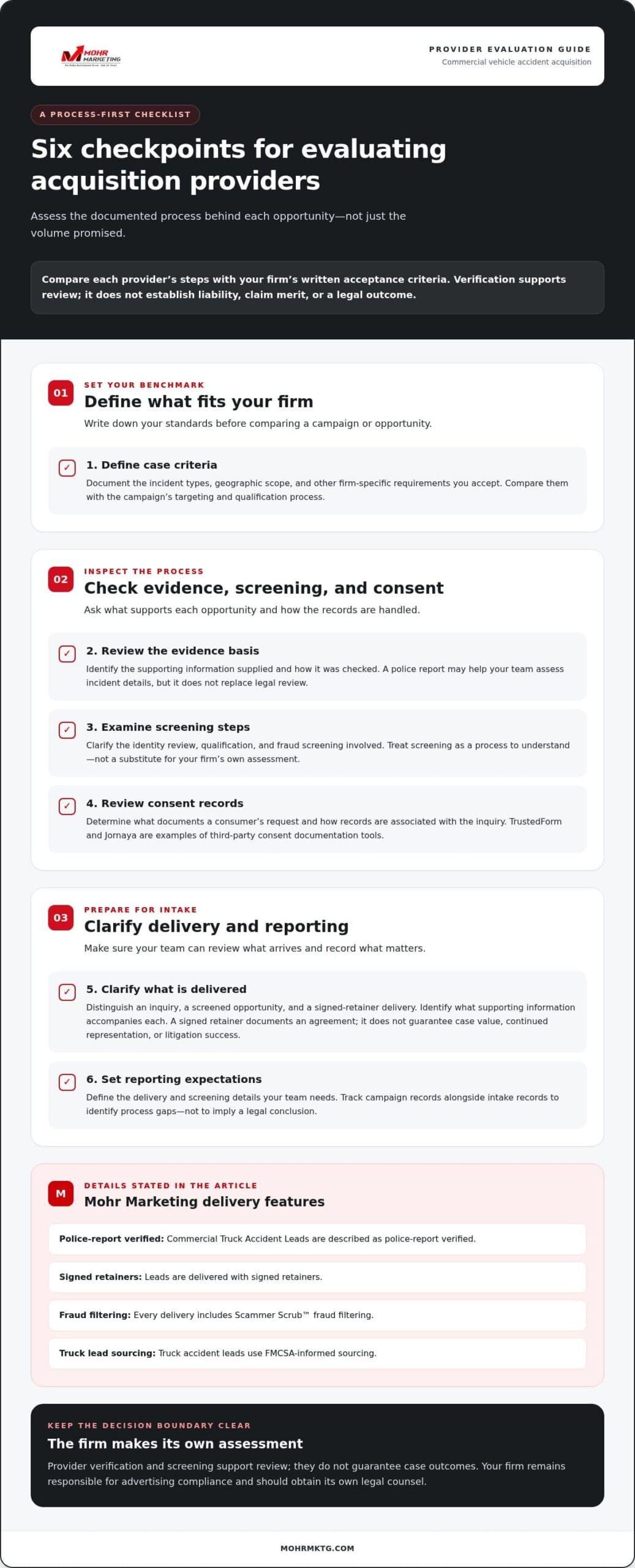
Assess the process, not just the promised volume. For commercial vehicle accident client acquisition, compare documented steps with your firm’s written acceptance criteria. Review how each opportunity is identified, screened, documented, delivered, and reported. Verification can support an independent review, but it does not establish liability, determine whether a claim has merit, or predict a legal outcome.
Use this sequence to structure the evaluation:
- Define case criteria. Document the incident types, geographic scope, and other firm-specific requirements you accept. Compare those standards with the campaign’s targeting and qualification process. Clear criteria make mismatches easier to identify before intake staff spend time on an opportunity.
- Review the evidence basis. Identify what supporting information accompanies a delivery and how it was checked. A police report, for example, may help your team assess incident details, but it does not replace legal review. Mohr Marketing’s motor vehicle accident leads are police-report verified, and its police-report-backed MVA cases page explains that delivery approach.
- Examine screening steps. Identify the identity review, qualification, and fraud screening involved. Mohr Marketing applies Scammer Scrub™ fraud filtering to every delivery. Treat screening as a process to understand, not a substitute for your firm’s own assessment.
- Review consent records. Determine what records document a consumer’s request and how those records are associated with the inquiry. TrustedForm and Jornaya are examples of third-party consent documentation tools. Evaluate the actual records and process used for each campaign.
- Clarify delivery. Distinguish an inquiry, a screened opportunity, and a signed-retainer delivery, and identify what supporting information accompanies each. Mohr Marketing delivers signed retainers with its leads. A signed retainer documents an agreement, but does not guarantee case value, continued representation, or litigation success.
- Set reporting expectations. Define the delivery and screening details your team needs to review consistently. Use campaign records to track the information collected and compare it with your firm’s intake records. Useful reporting should help identify process gaps, not imply a legal conclusion.
Which verification and screening details should firms examine?
Look for a clear explanation of what each check covers and what it does not establish. Identity review, fraud filtering, qualification, and consent records address different parts of intake; they should not be treated as interchangeable proof. Document the evidence staff receive and how it connects to the inquiry, so attorneys can conduct an independent review without confusing process verification with a decision on the case.
How to assess case fit and delivery terms
Before comparing acquisition processes, write down your firm’s accepted incident types, geographic scope, and case criteria. Then map each criterion to campaign targeting, screening, and delivery. Record what information your team receives and how it is organized. This makes gaps visible and helps intake staff route opportunities consistently without treating screening as the firm’s acceptance decision.
Use these criteria to assess whether an acquisition process fits your practice and intake capacity. To define a process for your firm, discuss your firm’s acquisition goals.
How commercial truck sourcing, reports, and signed retainers fit together
In commercial vehicle accident client acquisition, sourcing, report verification, and retainer documentation answer different questions. Sourcing describes how an opportunity is identified. A report may help verify incident information. A signed retainer documents an agreement with a law firm. Keeping these functions distinct makes it easier to understand what a delivery supports and what still requires the firm’s independent review.
Mohr Marketing uses FMCSA-informed sourcing for truck accident leads. This describes the sourcing approach only. It does not mean the Federal Motor Carrier Safety Administration certifies, endorses, or supplies the leads. Nor does a sourcing methodology determine whether a claim has merit. The firm must assess the facts, documentation, and fit through its own review process.
| Delivery type | What it indicates | What it does not establish |
|---|---|---|
| Inquiry | A person has expressed interest or made a request for information. | That the inquiry has been qualified, supported by a report, or accepted by a law firm. |
| Police-report-verified lead | The lead has been checked against a police report as part of the verification process. | That the report proves fault, establishes liability, or confirms case merit. |
| Signed-retainer delivery | The delivery includes signed retainer documentation, according to the described service scope. | That the firm will continue representation, that a case will succeed, or that a particular recovery will result. |
What FMCSA-informed sourcing does, and does not, mean
FMCSA-informed sourcing describes Mohr Marketing’s process for truck accident leads, not an agency approval or legal finding. It provides context for how leads are sourced, but the law firm still evaluates the incident and related material independently. Treat the sourcing description as one process detail, not a substitute for legal analysis.
Why report verification and retainer documentation are distinct
A police report addresses an incident-verification question; retainer documentation addresses whether an agreement has been signed. Mohr Marketing’s leads are signed and include a signed retainer, and its motor vehicle accident leads are police-report verified. Firms reviewing commercial truck accident signed cases should still assess the supporting information and agreement through their own intake process. Neither document guarantees acceptance, recovery, or a particular result.
Use these distinctions to set expectations for intake staff. A report can support fact gathering, while a retainer records an agreement; neither replaces the firm’s evaluation of the matter. Make sure each item is presented clearly in the delivery and that your internal workflow keeps verification, documentation, and legal decisions separate. This makes acquisition records more useful without overstating what they prove.
Prepare your firm’s intake and compliance workflow before scaling
Acquisition activity can outpace a firm’s ability to review and manage new opportunities. Before increasing volume, prepare the intake process that receives them. Commercial vehicle accident client acquisition works best when ownership, capacity, records, and compliance responsibilities are clear before a campaign begins.
Use this readiness checklist to identify gaps:
- Acceptance criteria: Record the incident types, geographic scope, and other requirements your firm uses to assess fit. Make the criteria accessible to the people who screen incoming opportunities.
- Response ownership: Assign responsibility for receiving new inquiries, recording them, and routing them to the appropriate reviewer. Establish a backup process for periods when the primary owner is unavailable.
- Review capacity: Confirm that staff and attorneys have capacity to assess incoming information. Intake capacity affects how consistently opportunities can be reviewed, so consider the relationship between available resources and the ROI of legal intake services.
- Record handling: Decide where intake details, consent documentation, and supporting materials will be stored, who can access them, and how staff will maintain consistent records.
Set intake ownership and case-review criteria
Define the handoff from initial receipt to attorney review. Document the qualification questions staff should use, what information they should capture, and when a matter needs escalation because it falls outside routine criteria. Track outcomes by source and case fit to identify where the workflow is working or creating delays. Use those records to improve process decisions, not to assume a particular conversion rate.
Review campaign structure and compliance responsibilities
Before launch or expansion, review campaign structure, creative, and the intake workflow together. Check that the message, information collected, and routing process align with the firm’s criteria. Consent records can be documented with tools such as TrustedForm or Jornaya. Confirm how records are associated with the relevant inquiry and handled by your team. These tools support documentation, but do not replace the firm’s own compliance review.
Outbound calls and texts must comply with applicable TCPA requirements. Law firms remain responsible for ensuring their advertising complies with applicable rules and should consult their own legal counsel. Marketing support is not legal advice and does not replace counsel. Set these responsibilities clearly before campaign activity begins, and maintain a process for reviewing the materials and records your firm uses.
Scale only when the operation is ready. Revisit acceptance criteria, staff ownership, review capacity, and record handling as the campaign develops. If your workflow cannot reliably receive and assess opportunities, resolve that constraint before expanding activity.
How Mohr Marketing supports commercial vehicle accident client acquisition
After defining acceptance criteria and intake responsibilities, a firm can assess whether a specific acquisition model fits its practice. Mohr Marketing offers Commercial Truck Accident Leads through a direct-to-firm model. Each lead is police-report verified and includes a signed retainer. Every delivery also receives Scammer Scrub™ fraud filtering. Truck accident leads use FMCSA-informed sourcing, a process detail rather than an FMCSA endorsement.
These features address different points in the acquisition workflow. Fraud filtering supports screening. Police-report verification provides incident documentation for the firm’s review. A signed retainer documents an agreement. None of these features, alone or together, guarantees that a matter will be accepted, result in recovery, or achieve a particular outcome.
What the Mohr Marketing delivery model includes
Direct-to-firm delivery gives the law firm access to the opportunity and related documentation for its intake process, without reseller markup. Mohr Marketing applies Scammer Scrub™ to every delivery, and its leads are police-report verified and include signed retainers. The firm can review the materials against its own case criteria and decide how to proceed. For more detail on the service-page scope, see truck accident signed cases and verified call transfer leads.
Mohr Marketing has more than 30 years of experience and has served more than 1,000 law firms. These facts provide background for evaluating the acquisition model; they are not a forecast of volume, case acceptance, or results for an individual firm. Assess the stated process alongside your own written requirements, including the supporting records your team needs and how intake staff will receive and review each delivery.
When this acquisition approach may fit a firm
This approach may suit a firm whose practice includes commercial truck matters, whose written case criteria align with the opportunity type, and whose intake team has capacity to assess incoming documentation. It may be less operationally useful if ownership is unclear or the firm has not established who reviews matters and makes acceptance decisions. Readiness depends on the firm’s workflow, not simply on the presence of a signed retainer.
The law firm remains responsible for deciding whether to accept a matter and for ensuring its advertising complies with applicable rules. Mohr Marketing’s acquisition services are not legal advice and do not create an attorney-client or legal representation relationship. Firms should consult their own legal counsel on compliance responsibilities and evaluate campaign structure and intake workflow in that context.
Mohr Marketing’s experience and stated delivery process provide a starting point for evaluating fit. Focus on case criteria, documentation, campaign structure, and how the firm will handle intake, without assuming a particular lead volume or outcome.
Make your next acquisition decision with a clear baseline
Commercial vehicle accident client acquisition should develop through measured decisions, not automatic expansion. Before changing campaign scope, establish a baseline for how your firm handles incoming opportunities. Note where review slows, which information is most useful to attorneys, and what recurring gaps prevent timely assessment. Use those observations to refine the workflow and make future adjustments deliberate.
Keep the next step practical: identify one intake process improvement, assign responsibility for it, and assess whether it helps staff review opportunities consistently. Use what you learn to guide decisions about campaign structure and fit. A disciplined feedback loop gives your firm a clearer basis for deciding what to maintain, adjust, or scale, without treating lead volume as the measure of success.
With clear criteria and a process your team can sustain, your firm can pursue growth with greater focus. Contact Mohr Marketing to discuss commercial vehicle accident client acquisition for your firm.
Frequently Asked Questions
What qualifies as a commercial vehicle accident lead?
A commercial vehicle accident lead is an inquiry connected to an incident involving a vehicle used for commercial purposes, with enough initial information for a firm to assess whether it fits its practice. The exact threshold is firm-specific. For example, one firm may require the incident type and basic contact details before routing an inquiry, while another may need additional screening information before attorney review. A lead is not a legal finding.
Are commercial truck accident leads the same as signed cases?
No. A lead describes an opportunity or inquiry; a signed case generally refers to an opportunity accompanied by an executed retainer agreement. The distinction matters operationally: intake staff should know whether they are expected to complete initial screening, route documentation for review, or process an agreement already signed with the firm. A retainer records an agreement, but it does not establish case merit, predict litigation success, or guarantee a particular recovery.
Does a police report prove who was responsible for a truck accident?
No. A police report can provide incident information for review, but its existence or contents do not by themselves prove responsibility or determine whether a claim has merit. Treat the report as one source of information. If it leaves important questions unresolved or differs from information provided elsewhere, the firm’s legal team can assess what additional review is appropriate before making a case decision.
How should a law firm compare commercial vehicle acquisition providers?
For commercial vehicle accident client acquisition, use a written comparison record rather than relying on broad descriptions. Record what the service delivers, which supporting records accompany delivery, and how screening and consent documentation are handled. Then compare those details with your firm’s acceptance criteria and intake workflow. Note process gaps separately from case-fit concerns so the team can make a consistent decision.
Can a lead provider guarantee that a commercial vehicle case will succeed?
No. A provider can describe its sourcing, screening, and delivery process, but cannot guarantee that a law firm will accept a matter or that litigation will produce a particular result. Case outcomes depend on the facts and the firm’s independent legal assessment. Evaluate acquisition services by their documented process and the information they deliver, not by promises of case success, revenue, or a specific result.
Who is responsible for a law firm’s advertising compliance?
The law firm remains responsible for ensuring its advertising complies with applicable rules and should consult its own legal counsel. A practical safeguard is to assign an internal owner to review campaign creative and intake materials before use, and to retain the approved versions with related records. Outbound calls and texts must also comply with applicable TCPA requirements. Marketing support does not replace the firm’s compliance review or legal advice.
Recent Posts
- Commercial Vehicle Accident Client Acquisition: A Law Firm’s 2026 Guide
- Mass Tort Claimant Acquisition: A Practical Framework for Law Firms
- Signed Cases for Attorneys: A 2026 Evaluation Guide
Categories
- AI and Lead Generation
- Business Financing
- Call Verified MVA Leads
- Car Accident Help
- Car Accident Settlements
- Claimant Funding
- Compliance Program
- EMS-EMT Reports
- Geotargeting
- Google Maps Ranking
- Healthcare Practice Growth
- Law Firm Growth
- Law Office Operations
- Lead Generation
- Lead Generation For Attorneys
- Lead Generation For Chiropractors
- Lead Generation For Criminal Attorneys
- Lead Generation For D&A Treatment Centers
- Lead Generation For DUI Attorneys
- Lead Generation For Eye Doctors
- Lead Generation For Family Law Practices
- Lead Generation For PI Law Firms
- Lead Generation For Plastic Surgeons
- Leads For Healthcare Professionals
- Leads For Insurance Industry
- Legal Leads
- Legal Marketing
- Legal Updates
- Mass Tort Leads
- Medicare and Medicaid Leads
- Merchant Funding Leads
- Mold Leads
- Online Marketing Strategies
- Pre-Settlement Funding
- Signed MVA Cases
- Tort Updates
- Truck Accident Leads and Signed Cases
- Truck Accident Settlements
- Web Design