Signed Cases for Attorneys: A 2026 Evaluation Guide
October 15, 2026 by Mohr Marketing
A signed agreement is not the same as an accepted case. A retainer documents a prospective client’s decision to engage a firm, but your team still needs to assess eligibility, source, consent, and fit with current capacity. For firms evaluating signed cases for attorneys, that distinction separates a documented opportunity from an appropriate intake.
Marketing inquiries can consume staff time when they fall outside your criteria. A signed retainer alone also does not answer every question about screening or handoff. Set acceptance standards before reviewing opportunities, then use them to assess the evidence and information provided with each file.
This guide explains what to review in a signed case, including its source, qualification details, and consent documentation. It also covers how to compare acquisition approaches with your firm’s practice focus and intake capacity. Mohr Marketing delivers signed leads with signed retainers, police-report verification, and Scammer Scrub fraud filtering. A clear review process helps your firm decide which opportunities merit further consideration.
Key Takeaways
- Use written acceptance criteria, disqualifiers, and required records to assess signed cases for attorneys consistently.
- Separate identity and fraud screening from legal qualification and your firm’s final decision on representation.
- Compare signed-case acquisition, raw inquiries, and in-house advertising by documentation, workload, control, and review needs.
- Track acquisition and intake indicators without treating them as proof of legal merit, case value, or revenue.
What Signed Cases for Attorneys Actually Include
A signed case is an acquisition opportunity accompanied by an executed retainer. The document records a prospective client’s agreement to engage a firm. It does not establish that the matter meets the firm’s criteria or that the firm has accepted representation.
A signature is one part of an intake file, not a complete assessment. The opportunity’s practical value depends on its fit with the firm’s practice focus, the information and records available for review, and whether its source and consent records are documented clearly. Without that context, a signed retainer can leave staff with unanswered questions and additional follow-up work.
Signed agreement versus accepted case
An executed retainer does not prove that a claim is viable, establish every relevant fact, or guarantee a legal or financial outcome. The firm must independently review the person’s information, reported circumstances, available records, and fit with its acceptance criteria before deciding whether to proceed.
Acquisition screening and legal assessment serve different purposes. Screening can gather information, check for fraud indicators, and organize documentation against campaign criteria. It does not replace the firm’s own review of eligibility, facts, or potential representation. Make the handoff explicit so staff know what has been screened and what still requires attorney review.
Review consent documentation alongside the retainer. Determine what communication or information-sharing permission is recorded and how that record is connected to the inquiry. These process questions intersect with professional conduct, a topic introduced in Legal Ethics; firms should apply their own counsel’s guidance to their practices.
What firms should expect to review
Use a consistent file-review checklist. The materials may differ by campaign and practice area, so define required items before evaluating opportunities. A practical review may include:
- Retainer: Confirm the executed agreement is included and associated with the correct prospective client.
- Claimant information: Review the information collected and identify gaps that may affect the firm’s initial evaluation.
- Consent records: Locate the available documentation of the person’s consent and understand its scope.
- Verification details: Review the checks or supporting records provided, while distinguishing fraud screening from legal qualification.
Do not treat one campaign’s checklist as universal. Relevant facts and records vary by matter type, and screening criteria can vary across campaigns. For example, firms assessing mass tort signed cases should assess the materials against the applicable campaign criteria rather than assume every signed opportunity contains identical information.
For signed cases for attorneys, provenance connects the inquiry to its source, screening process, and accompanying records. When that trail is organized, the firm can focus its review on fit and judgment instead of reconstructing how the opportunity arrived.
How Verification, Consent, and Intake Shape a Signed Case
A signed opportunity is easier to assess when its path from inquiry to delivery is documented. For firms evaluating signed cases for attorneys, the key question is not simply whether checks occurred. It is what each check covered and what remains for the firm to decide.
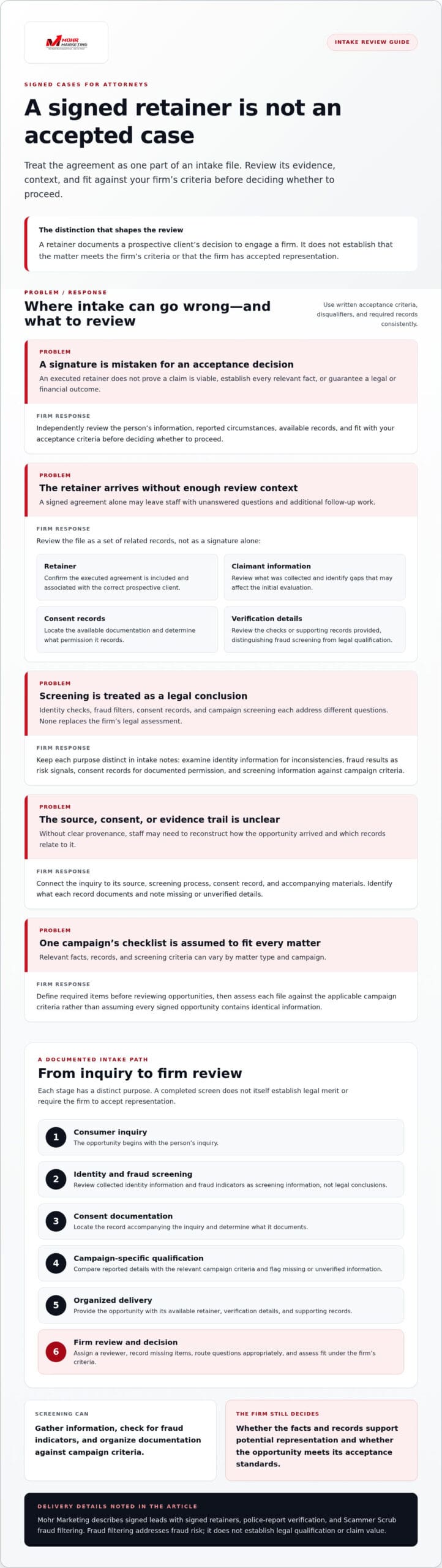
A practical sequence moves from consumer inquiry to identity and fraud screening, consent documentation, campaign-specific qualification, organized delivery, and firm review. Each step serves a different purpose. An identity check may help identify inconsistencies; a fraud filter may flag suspicious information; consent records may document permission; qualification screening may compare reported details with campaign criteria. None of these steps, alone or together, establishes legal merit or requires the firm to accept representation.
The evidence trail behind a delivered opportunity
Review each evidence type separately. Confirm what identity information was collected and whether it aligns across the file. Examine fraud-screening results as risk signals, not legal conclusions. Locate the consent record and determine which inquiry it relates to. Then compare screening information with the relevant campaign criteria, noting any missing or unverified details.
Consent may be recorded through a form or supported by documentation tools such as TrustedForm or Jornaya, where applicable. Identify the record that accompanies the inquiry and what it documents. For background on the legal concept, Cornell Law School’s Legal Information Institute explains Informed Consent in Legal Practice. The available record is part of the intake file, not a substitute for the firm’s own assessment.
Mohr Marketing applies Scammer Scrub fraud filtering to every delivery. The filter addresses fraud risk; it does not establish that a claim meets legal criteria or has a particular value. Keep those judgments distinct in intake notes.
The handoff from acquisition to firm review
Intake screening organizes information against campaign criteria; a law firm’s legal evaluation determines whether the facts and records support potential representation. Make that boundary explicit in the handoff so staff do not mistake a completed screen for an attorney decision.
Before delivery, align the file with the firm’s documented criteria. On receipt, assign a reviewer, record missing items, and route questions to the appropriate staff member or attorney. A consistent workflow helps the firm compare opportunities on the same basis and identify follow-up needs without treating screening outcomes as legal conclusions.
- Match: Compare the reported facts with the firm’s criteria and relevant campaign parameters.
- Gaps: Note absent records or unclear information that needs follow-up.
- Ownership: Assign responsibility for initial review, escalation, and the acceptance decision.
Clear ownership also helps firms assess intake operations. Teams can see where information is complete, where review slows, and where the process needs refinement. The firm’s review remains decisive.
How to Compare Signed Cases with Other Acquisition Options
Compare acquisition models by the work completed before an opportunity reaches your firm, the records delivered with it, and the decisions your team still owns. Signed cases for attorneys, raw inquiries, and internally managed advertising distribute operational tasks differently. None is universally superior. The right fit depends on your practice focus, staff capacity, desired control, and ability to review what each channel produces.
What changes between an inquiry and a signed retainer
A raw inquiry may arrive with limited information, leaving your team to make initial contact, gather details, and determine whether the prospect fits basic criteria. A signed-retainer opportunity has progressed further before delivery, but your firm still reviews the information and decides whether to accept the matter. With internally managed advertising, your staff controls campaign strategy and intake while also managing the work needed to turn responses into opportunities for review.
| Factor | Signed-case acquisition | Raw inquiries | In-house advertising |
|---|---|---|---|
| Documentation | May include a signed retainer and supporting records, depending on the arrangement. | May begin with basic contact and inquiry details. | Your firm determines what it collects and records through its own process. |
| Screening | Some screening may occur before delivery; review its scope and criteria. | Your team generally handles more initial qualification work. | Your team defines campaign and intake screening. |
| Firm workload | Can reduce some pre-delivery intake tasks, while leaving firm-side review. | Requires staff time to gather and assess information. | Includes campaign management as well as inquiry follow-up. |
| Control | Depends on the campaign structure and documented arrangement. | Your team controls follow-up after receiving the inquiry. | Your firm directs campaign decisions and intake. |
| Review requirements | Assess fit, records, and acceptance independently. | Assess fit and gather information before deciding next steps. | Review performance and individual inquiries through your process. |
Questions that reveal whether the model fits
Look beyond headline performance claims. Ask what stage a reported result measures, what documentation accompanies delivery, and which screening steps are included. Then compare those details with your own criteria. A campaign that attracts interest outside your practice focus or exceeds your review capacity can add workload without improving operational fit.
Before choosing an approach, define who owns each handoff and what information must be available for review. Clarify whether opportunities are exclusive, how consent and screening records are delivered, and which tasks remain with your staff. Under Mohr Marketing’s Joint Advertising model, inquiries are exclusive to the participating firm. The program is an advertising and administrative-support structure, not a lawyer referral service or payment for referrals.
Use the comparison as an operations check, not a promise of case quality or business outcomes. Review documented processes alongside your team’s capacity and practice priorities. This gives you a consistent basis for deciding whether a model’s workload, control, and evidence trail match the way your firm evaluates opportunities.
How Attorneys Can Set Acceptance Criteria and Measure Fit
Set the firm’s review standard before evaluating signed cases for attorneys. A written framework makes it easier to compare delivered opportunities consistently, identify mismatches early, and determine whether the acquisition process fits the team’s capacity. It also gives staff a clear basis for routing an opportunity instead of relying on informal assumptions.
Build the framework with the attorneys and intake staff who will use it. Separate requirements that determine whether a matter can be considered from preferences that may warrant individual review. Keep criteria specific to the practice area and campaign. Standards for one matter type may not apply to another, so avoid using a single checklist across unrelated campaigns.
Build criteria around practice area and capacity
Document four elements before launch: the matter types the firm handles, the conditions that rule an opportunity out, the records needed for initial review, and the person responsible for each review stage. Then compare the expected intake workload with available staff time and attorney review capacity. A campaign may align with the practice focus yet strain the team if handoff, follow-up, or review responsibilities are unclear.
- Required criteria: Identify conditions the opportunity must meet to proceed to review.
- Disqualifiers: Record clear reasons for declining or routing an opportunity elsewhere within the firm.
- Review preferences: Flag details that need judgment rather than automatic rejection.
- Required records: Specify what staff need to assess the opportunity and identify gaps.
- Review ownership: Assign responsibility for initial screening, escalation, and the firm’s decision.
This distinction improves consistency without turning a checklist into a substitute for professional judgment. It also sets a practical boundary: screening can organize information against defined criteria, while the firm retains responsibility for evaluating potential representation.
Use operational measures without promising outcomes
Measure how reliably the process works, not just how many opportunities arrive. Track delivered opportunities, review completion, missing information, reasons for acceptance or decline, and delays between handoff and review. These indicators can reveal whether criteria are clear, documentation is usable, or staff need a more efficient routing process.
Interpret the measures carefully. A higher delivery count does not establish legal merit, revenue, or case value. A lower acceptance rate may reflect campaign fit, firm criteria, available capacity, or information gaps. Review the pattern alongside reason codes and workflow notes before changing standards. Compare periods only when campaign criteria and the review process are sufficiently consistent; otherwise, differences may reflect a changed process rather than meaningful performance.
Use the findings to refine the firm’s acceptance framework and intake ownership. Keep operational indicators separate from legal outcomes and financial results, which depend on factors beyond acquisition and initial screening.
How Mohr Marketing Delivers Signed Cases to Law Firms
Mohr Marketing’s direct-to-firm model connects acquisition and intake support without reseller intermediaries. For firms evaluating signed cases for attorneys, this structure provides a direct handoff and visibility into screening evidence. It does not promise that every delivered opportunity will meet the firm’s legal criteria or produce a particular result.
Every lead delivered by Mohr Marketing is signed, police-report verified, and includes a signed retainer. Its process also includes identity review, consent and qualification screening, and Scammer Scrub fraud filtering. These steps provide information for the firm’s review. They do not replace the firm’s independent assessment or determine whether it will accept representation.
A direct-to-firm process with screening built in
Direct delivery avoids reseller markup and brings the acquisition handoff closer to the firm’s intake workflow. Mohr applies Scammer Scrub to filter for fraud concerns, while identity review and screening organize information for evaluation. Consent is included in the screening process. Each measure has a defined role; no single check establishes legal merit, case value, or acceptance.
Mohr provides a proposal in one business day. Firms can use the proposal to consider whether the campaign’s focus and intake structure align with documented criteria and available review capacity. The Joint Advertising & Compliance Program is an advertising and administrative-support structure, not a lawyer referral service. Firms remain responsible for assessing their own advertising and professional-conduct obligations, with guidance from their legal counsel.
Match signed-case programs to practice focus
Verification and screening should be understood in the context of the campaign. For motor vehicle accident matters, police-report verification is a relevant part of the documented review. Mohr’s police-report-backed MVA cases illustrate how a practice-specific verification element can support the firm’s intake assessment. The report is evidence to review, not a conclusion about legal eligibility or case value.
Mass tort acquisition is a distinct campaign type, with its own focus and qualification parameters. It is not interchangeable with an MVA workflow. The information used to screen one type of opportunity may not answer the questions a firm needs to review another. Define the required information and acceptance criteria for each practice area, then compare the delivered file against those standards.
After delivery, the firm still owns the decision. Assign a reviewer, identify missing information, and document whether the opportunity fits the firm’s criteria. This keeps acquisition screening separate from legal evaluation and gives the intake team a consistent handoff process. Mohr’s services support acquisition and intake; they do not provide legal advice or legal representation.
Turn Your Criteria into a Clear Acquisition Decision
Put your firm’s decision rules into practice. Align attorneys and intake staff on what qualifies for review, who owns the handoff, and how the team will record its decisions. This foundation makes it easier to assess whether signed cases for attorneys fit your practice focus and operational capacity, without confusing a signed agreement with a legal or business outcome.
Mohr Marketing has served law firms and professional practices for more than 30 years and reports working with thousands of law firms across more than 50 active tort campaigns. Use your documented criteria to guide a conversation about campaign fit, screening, and the review process your team needs. Your firm retains responsibility for legal evaluation and applicable advertising compliance.
A disciplined decision process helps your team pursue growth while protecting its time and attention. To discuss signed-case acquisition, contact Mohr Marketing and review how a campaign can align with your firm’s criteria and intake workflow.
Frequently Asked Questions
Can a signed retainer guarantee that a case will be accepted or produce a recovery?
No. A signed retainer does not guarantee that a firm will accept the matter, that a claim will succeed, or that it will generate revenue. Treat the document as one item in the file, then assess the opportunity under your firm’s criteria. Mohr Marketing does not guarantee case counts, revenue, or business outcomes unless expressly stated in a signed written agreement.
How can a law firm document consent for an advertising inquiry?
Consent records may be documented through third-party tools such as TrustedForm or Jornaya. For practical recordkeeping, connect the available consent documentation to the specific inquiry and retain it with the campaign materials your firm uses for review. Identify the records that accompany the campaign and discuss your firm’s advertising and communications practices with its own legal counsel. Documentation supports review but does not replace that counsel.
Can more than one attorney receive the same inquiry through Joint Advertising?
Mohr Marketing’s Joint Advertising inquiries are exclusive to the participating firm, and budgets are not shared with other attorneys. The program is structured around advertising and administrative services, not lawyer referrals. As you review participation, consider how the campaign structure, intake workflow, and assigned review responsibilities fit your firm’s documented process. Those details clarify how an inquiry moves from campaign activity into firm review.
How quickly can a law firm receive a proposal from Mohr Marketing?
Mohr Marketing delivers a proposal in one business day. Use it to evaluate campaign fit, practice focus, and your firm’s requirements before making an acquisition decision. A proposal is not a promise of lead volume, signed-case count, revenue, or another business outcome. Do not assume any such commitment unless it is expressly stated in a signed written agreement.
Does signed-case acquisition replace a law firm’s own intake review?
No. Acquisition screening can prepare information for the firm, but your team still needs to decide what follow-up is appropriate and whether the opportunity fits its practice. For example, intake staff might flag an incomplete record for follow-up, then route the file for attorney review under the firm’s process. Screening is not legal advice, and it does not create an attorney-client relationship with Mohr Marketing.
Can a signed-case campaign be adapted to different practice areas?
Yes. Mohr Marketing’s Joint Advertising Program can be adapted for mass tort, mesothelioma, motor vehicle accidents, and other practice areas. Adaptation does not mean every campaign uses identical screening standards or records. Define the criteria your firm will apply to each matter type, then align the review process with available intake capacity. This gives staff a clear way to assess signed cases for attorneys across distinct campaigns.

Recent Posts
- Signed Cases for Attorneys: A 2026 Evaluation Guide
- How to Get More Personal Injury Cases: A 2026 Growth Guide
- How to Reduce Client Acquisition Cost for Law Firms Without Sacrificing Case Quality
Categories
- AI and Lead Generation
- Business Financing
- Call Verified MVA Leads
- Car Accident Help
- Car Accident Settlements
- Claimant Funding
- Compliance Program
- EMS-EMT Reports
- Geotargeting
- Google Maps Ranking
- Healthcare Practice Growth
- Law Firm Growth
- Law Office Operations
- Lead Generation
- Lead Generation For Attorneys
- Lead Generation For Chiropractors
- Lead Generation For Criminal Attorneys
- Lead Generation For D&A Treatment Centers
- Lead Generation For DUI Attorneys
- Lead Generation For Eye Doctors
- Lead Generation For Family Law Practices
- Lead Generation For PI Law Firms
- Lead Generation For Plastic Surgeons
- Leads For Healthcare Professionals
- Leads For Insurance Industry
- Legal Leads
- Legal Marketing
- Legal Updates
- Mass Tort Leads
- Medicare and Medicaid Leads
- Merchant Funding Leads
- Mold Leads
- Online Marketing Strategies
- Pre-Settlement Funding
- Signed MVA Cases
- Tort Updates
- Truck Accident Leads and Signed Cases
- Truck Accident Settlements
- Web Design