NEC Baby Formula Case Acquisition: A Law Firm’s 2026 Guide
September 28, 2026 by Mohr Marketing
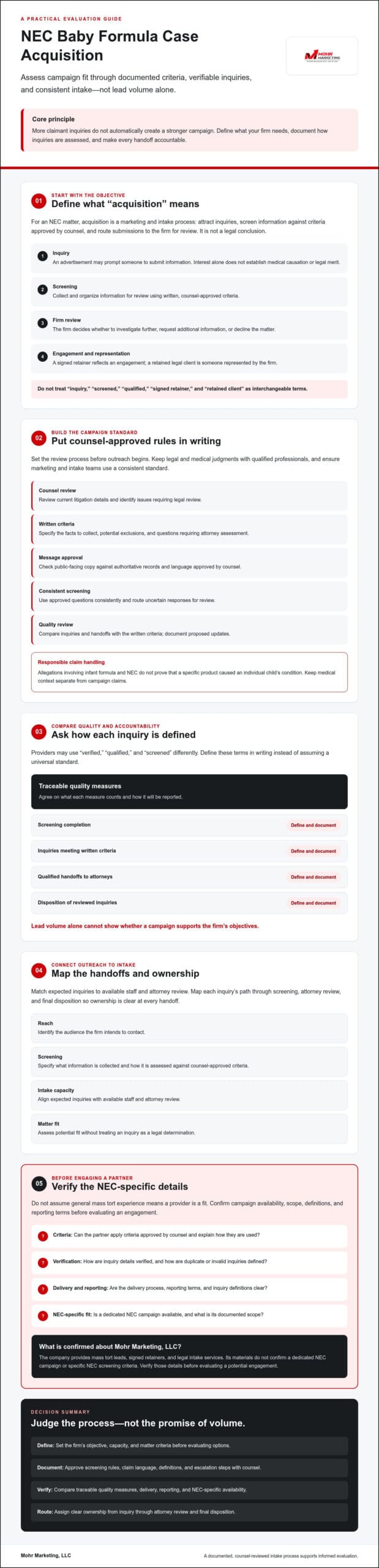
More claimant inquiries do not automatically create a stronger NEC campaign. Effective NEC baby formula case acquisition depends on written screening criteria, verifiable inquiry details, and an intake process that moves submissions forward consistently. These safeguards matter when a campaign concerns litigation: allegations and case outcomes should be described carefully, not presented as established medical or legal conclusions.
Before engaging an acquisition partner, ask whether it can apply criteria approved by counsel, explain how inquiries are verified, and provide clear delivery and reporting terms. A mismatch can use staff time and budget without advancing the firm’s objectives. Mohr Marketing, LLC provides mass tort leads, signed retainers, and legal intake services, but its materials do not confirm a dedicated NEC campaign or specific NEC screening criteria. Verify those details before evaluating a potential engagement.
This 2026 guide explains how to assess campaign fit, document screening standards with counsel, compare acquisition processes using traceable quality measures, and connect claimant outreach with consistent intake. It also outlines what to request before investing, so decisions are based on documented processes rather than lead volume alone.
Key Takeaways
- Define what your firm is seeking before evaluating NEC baby formula case acquisition. Distinguish an inquiry from a signed retainer or retained client.
- Have counsel review campaign definitions, screening criteria, messaging, and escalation steps before outreach begins.
- Compare acquisition options by how they define and document verified, qualified, duplicate, and invalid inquiries, not by volume alone.
- Map each inquiry’s path through screening, attorney review, and final disposition, with clear ownership at every handoff.
- Confirm a potential partner’s NEC-specific campaign availability, scope, and reporting terms. Do not assume general mass tort experience means a provider is a fit.
NEC Baby Formula Case Acquisition: Define the Firm’s Objective First
Before evaluating a vendor or setting an inquiry target, define what acquisition means for your firm. For NEC matters, NEC baby formula case acquisition means attracting claimant inquiries, screening them against criteria approved by counsel, and routing them to the firm for review. It describes a marketing and intake process, not a legal conclusion.
Keep each stage distinct. An advertisement may prompt someone to submit an inquiry. Screening gathers information for review. The firm then decides whether to investigate further, request additional information, or decline the matter. A signed retainer reflects an engagement; a retained legal client is someone represented by the firm. Interest, submitted information, and screening responses do not establish medical causation or legal merit.
What does NEC case acquisition mean for a law firm?
Think of acquisition as a handoff process: outreach leads to an inquiry, screening organizes information for review, and the firm decides on next steps and possible engagement. Providers may use terms such as “verified,” “qualified,” and “screened” differently. Define each term in writing rather than assuming there is a universal standard.
For medical background, consult a neutral overview of Necrotizing Enterocolitis (NEC). Keep medical context separate from campaign claims. Allegations involving infant formula and NEC do not prove that a specific product caused an individual child’s condition. Counsel should assess current records, allegations, and the firm’s criteria before approving public messaging or screening questions.
Which internal goals should the firm set?
Start with the firm’s capacity and objectives, not a vendor’s volume forecast. Counsel should define the matter criteria and approve the claimant profile before outreach begins. Intake staff and attorneys can then determine how many inquiries the firm can screen, review, and follow up on without creating a backlog.
Choose measures that show how the process is working, such as screening completion, the share of inquiries that meet the firm’s written criteria, qualified handoffs to attorneys, and the disposition of reviewed inquiries. Agree on what counts for each measure and how it will be reported. A separate high-value mold case acquisition overview concerns a different campaign and does not establish NEC availability or criteria.
Set an operating objective across four areas:
- Reach: Identify the audience the firm intends to contact.
- Screening: Specify what information is collected and how it is assessed against counsel-approved criteria.
- Intake capacity: Match expected inquiries to available staff and attorney review.
- Matter fit: Define how the firm will assess potential fit without treating an inquiry as a legal determination.
These decisions give the firm a baseline for evaluating acquisition options. Without them, lead volume alone cannot show whether a campaign supports the firm’s objectives.
Build an NEC Campaign Around Verified Criteria and Responsible Claims
Document the review process before a campaign reaches prospective claimants. For NEC baby formula case acquisition, the firm should control its definitions, screening rules, and approved language. This gives marketing and intake teams a consistent standard while reserving legal and medical judgments for qualified professionals.
Use a staged workflow:
- Counsel review: Check current litigation details and identify issues that require legal review.
- Written criteria: Document the facts to collect, potential exclusions, and questions that need attorney assessment.
- Message approval: Review public-facing copy against current authoritative records and counsel-approved language.
- Inquiry screening: Use approved questions consistently and route uncertain responses for review.
- Quality review: Compare actual inquiries and handoffs with the written criteria, then document proposed updates.
How should a firm define screening criteria?
Have counsel create a campaign-specific brief that separates required information, potential exclusions, and unresolved questions. Screening collects information for initial review; it does not replace evidence gathering or an attorney’s evaluation. Specify who may approve changes, how revisions are recorded, and how current versions reach marketing and intake staff. This helps prevent inconsistent screening when campaign details change.
The brief should also set escalation rules. For example, mark an incomplete or unclear response for attorney review rather than treating it as a qualification decision. Keep criteria specific to the firm’s approved approach. A vendor should not apply a universal case definition without the firm’s direction.
How can campaign messaging stay accurate?
Separate promotional language from medical findings, litigation allegations, and legal conclusions. The National Institute of Child Health and Human Development provides background on NEC as a serious gastrointestinal disease. That medical context does not establish that a particular product caused an individual child’s condition. Avoid implying that formula exposure alone proves injury, causation, eligibility, or legal merit.
Assign an approver, record the approval date, and retain the reviewed version of each advertisement or intake script. Recheck copy when material campaign facts change. Have qualified counsel review current litigation information and applicable attorney advertising requirements. Do not assume a general template fits every campaign or jurisdiction.
Before launch, ask a prospective acquisition or intake partner to confirm whether it can support the proposed NEC-specific workflow. Mohr Marketing’s materials describe mass tort leads and legal intake services, but do not confirm a dedicated NEC campaign or established NEC criteria. Firms can ask about current service scope and request campaign-specific criteria and terms before deciding.
Compare NEC Acquisition Options by Quality, Verification, and Accountability
For NEC baby formula case acquisition, compare providers against the firm’s written criteria, not a headline inquiry count. A larger volume says little about where inquiries came from, how consistently they were screened, or whether the firm can review them promptly. Ask each provider how inquiries are sourced, what verification means in practice, what information accompanies a handoff, and how concerns are resolved.
What should a firm ask an acquisition provider?
Request specific answers in writing. Ask how inquiries are generated and routed, which screening steps are performed, and what records support those steps. Clarify whether “verified” refers to contact details, submitted information, or another documented check. Define “qualified,” “duplicate,” and “invalid” before comparing performance. These terms are not interchangeable, and a provider’s definitions may differ from the firm’s.
Review source transparency, available consent documentation, reporting access, and issue-resolution procedures. Confirm delivery terms and any replacement policy in writing; do not infer them from a sales discussion. Record what the provider confirms, what remains unanswered, and what the firm requires before proceeding.
| Comparison area | Confirmed terms | Questions to resolve | Firm-specific requirements |
|---|---|---|---|
| Inquiry source | Channels and referral path described | Can the source be identified in reporting? | Sources the firm will accept |
| Verification | Checks and supporting records specified | What does “verified” mean for each inquiry? | Evidence needed for attorney review |
| Duplicates and invalids | Definitions and handling process stated | How are disputed records reviewed? | Firm-approved definitions and resolution steps |
| Delivery and reporting | Delivery method, reporting access, and terms documented | How are changes or interruptions communicated? | Fields and reporting cadence the team can use |
Which measures reveal downstream quality?
Track outcomes through the firm’s own intake process. Useful measures include contactability, screening completion, match to the approved criteria, handoff to attorney review, and progression to a signed retainer. A retainer is a separate outcome from an inquiry or screening result, so report each stage distinctly.
Where data allows, segment results by source and campaign period. This can help show whether differences arise from inquiry provenance, screening, or the firm’s follow-up process. Establish a baseline from the firm’s own experience; conversion benchmarks are not universal and should not be treated as promised outcomes.
Before committing, have relevant staff test whether provider reports answer practical questions: which inquiries met the defined screening standard, which need follow-up, and how disputed submissions were handled. A traceable process makes acquisition options easier to compare and gives the firm a clearer basis for adjusting its approach.
Turn NEC Inquiries Into Consistent, Counsel-Reviewed Intake
Acquisition quality also depends on what happens after an inquiry arrives. Map the handoff from receipt to screening, attorney review, and final disposition. Assign an owner to each stage, set response expectations that match actual staffing, and define where unresolved or incomplete information goes. A documented workflow helps the firm distinguish a targeting issue from a follow-up or review bottleneck.
How should intake teams handle campaign inquiries?
Use a counsel-approved script that gathers information relevant to the firm’s screening criteria without implying that representation is available or that a particular outcome is likely. Intake staff should consistently record the inquiry source, responses, missing information, contact attempts, and next step. Route medical questions to an appropriately qualified professional and legal questions to an attorney.
Keep the process practical. If a response is incomplete, for example, record what is missing and assign follow-up rather than marking the inquiry as a confirmed fit. Attorney review remains a separate stage. This separation supports consistent claimant communication while preserving the boundary between intake and legal evaluation.
How can firms diagnose intake bottlenecks?
Track the progression from inquiry receipt through first contact, completed screening, attorney review, and final disposition. Review each stage separately. If inquiries are difficult to reach, investigate contactability and source quality. If screening is complete but few inquiries match the firm’s criteria, revisit campaign targeting or the approved definitions. If matters stall after handoff, examine ownership, workload, and review capacity.
For NEC baby formula case acquisition, consistent status labels make this analysis possible. Use shared definitions for outcomes such as “awaiting information,” “referred for attorney review,” and “closed after review.” Avoid combining all non-retained inquiries into one category; that obscures whether the issue arose during outreach, screening, or firm review. Evaluate results against the firm’s own criteria and operating capacity, not an assumed universal benchmark.
Separate acquisition reporting from intake performance. Marketing teams can assess source and screening patterns, while the firm evaluates contact attempts, review progression, and signed-retainer outcomes. This distinction helps identify where a process needs adjustment without treating every decline as a lead-quality failure. For a broader view of campaign planning, see mass tort lead generation guidance. Firms reviewing intake performance can also consult legal intake conversion analysis.
Evaluate an NEC Acquisition Partner Before You Commit
Do not select a provider on general mass tort experience alone. For NEC baby formula case acquisition, first confirm that the provider can support the specific campaign your firm has defined. Mohr Marketing provides mass tort leads, signed retainers, and legal intake services, but its available materials do not confirm a dedicated NEC campaign or NEC-specific criteria. Treat campaign fit as a question to verify, not an assumption.
Assess service scope alongside your firm’s operating model. Lead delivery and signed-retainer arrangements are different acquisition options, so clarify what the provider supplies, what your staff must handle, and how performance will be measured. Review the mass tort signed-case services for general service context, but confirm directly whether any relevant option applies to NEC matters.
What should be confirmed during provider diligence?
Ask the provider to confirm campaign availability, scope, screening criteria, and exclusions in writing. Request precise definitions for verification, delivery, reporting, and any performance terms, including how questions or disputed submissions are handled. Before activation, have counsel review the campaign’s screening process and applicable compliance considerations. Do not proceed based on assumptions from a general service description.
What should the firm prepare for a consultation?
Bring counsel-approved criteria, an estimate of intake and attorney review capacity, intended outcomes, and reporting requirements. List unresolved questions, such as what supports an inquiry’s verification status or how campaign changes will be communicated. Use the discussion to assess operational fit. A provider conversation or proposed process does not establish eligibility or guarantee a signed retainer.
Use a short diligence checklist to keep the evaluation focused:
- Campaign fit: Is NEC-specific work currently available, and what does the provider’s scope include?
- Criteria: Can the firm’s written definitions and exclusions be reflected in screening and reporting?
- Verification: What does the provider check, and what information or documentation accompanies an inquiry?
- Delivery and accountability: How are inquiries delivered, results reported, and issues addressed under the written terms?
- Model fit: Does lead delivery or a signed-retainer model better match the firm’s staffing, review process, and measurement needs?
Shortlist providers that can answer these questions clearly and document the relevant terms. Then compare those terms with your intake workflow and capacity. If campaign availability, criteria, or verification remain unclear, resolve those gaps before committing. Discuss campaign fit and verification requirements with Mohr Marketing before considering an engagement.
Make Your Next Acquisition Decision With Confidence
A disciplined NEC baby formula case acquisition process starts with counsel-approved criteria, responsible messaging, and a clear path from inquiry to attorney review. Compare providers by documented verification, delivery, and reporting terms. Then measure acquisition quality separately from intake performance and signed-retainer progression.
Mohr Marketing reports more than 30 years of industry experience and provides mass tort leads, signed retainers, and legal intake services nationally. Its services include verified inquiries, but its materials do not confirm a dedicated NEC campaign or specific NEC criteria. Confirm current campaign fit and terms directly before making a decision.
With clear standards and a workflow built around your firm’s capacity, you can evaluate opportunities carefully and make each next step more informed.
Frequently Asked Questions
What is NEC baby formula case acquisition?
NEC baby formula case acquisition is a campaign process for attracting inquiries from people who may want to discuss a potential claim with a law firm. An inquiry is not proof of eligibility, injury, causation, or legal merit. Before outreach, the firm should have counsel define screening criteria, document how inquiries are verified, and establish how submissions reach the firm. Direct medical or legal questions to qualified professionals.
How can a law firm evaluate an NEC lead provider?
Ask for written details about campaign availability, inquiry sources, screening criteria, verification steps, duplicate handling, reporting, and delivery terms. Clarify how the provider distinguishes an inquiry from a screened opportunity or signed retainer, and what documentation accompanies each. Have counsel review campaign claims and applicable requirements. Compare providers against the firm’s documented criteria and capacity, not lead-volume promises or unsupported claims about outcomes.
What information should an NEC campaign screen for?
There is no universal NEC screening checklist established by the information available here. The firm’s counsel should define campaign-specific criteria, relevant questions, exclusions, and escalation rules. Keep initial screening information separate from evidence needed for legal evaluation. Before using proposed criteria in outreach or intake, confirm current litigation details and relevant facts against authoritative records. Treat unclear or incomplete responses as matters for review, not automatic qualification decisions.
Can an inquiry confirm that someone has a valid NEC case?
No. An inquiry or screening response does not establish legal eligibility, a medical diagnosis, causation, or the merits of a claim. Those issues require case-specific evidence and appropriate professional review. Campaign materials should accurately describe allegations without presenting them as established fact or promising a result. Route legal and medical questions to qualified professionals, and make clear that marketing language is not a determination about an individual’s circumstances.
How should firms measure NEC case acquisition quality?
Track each stage separately: inquiry receipt, contactability, screening completion, match to the firm’s criteria, attorney review, and signed-retainer progression. Where reporting permits, compare outcomes by campaign source and period. Separate acquisition performance from intake operations so a drop in attorney reviews is not automatically attributed to lead quality. Define each measure in advance and use the firm’s own data to establish a baseline rather than treating provider benchmarks as universal.
Should a firm choose leads or signed retainers for NEC acquisition?
The appropriate model depends on the firm’s screening capacity, intake resources, review process, and reporting needs. Compare what each option includes, how qualification is defined, and what information is delivered. Mohr Marketing provides mass tort leads and signed retainers, but its materials do not confirm NEC-specific availability or criteria. Confirm campaign scope and terms directly. Neither model guarantees representation, case acceptance, or a particular outcome.
How can a firm improve conversion from NEC inquiries to attorney review?
Assign intake ownership, use counsel-approved questions, document contact attempts, and set response expectations that fit available staffing. Record where each inquiry pauses, such as awaiting information or attorney review. Then assess whether the cause is targeting, contactability, criteria mismatch, or workflow capacity. Review scripts and escalation procedures with counsel. Consistent records help the firm assess acquisition and intake separately without overstating what marketing information can establish.
Recent Posts
- NEC Baby Formula Case Acquisition: A Law Firm’s 2026 Guide
- Justifying Marketing Investment to Law Firm Partners: A Data-Driven Framework
- Roundup Cancer Lawsuit Leads: Buying Guide for Law Firms
Categories
- AI and Lead Generation
- Business Financing
- Call Verified MVA Leads
- Car Accident Help
- Car Accident Settlements
- Claimant Funding
- Compliance Program
- EMS-EMT Reports
- Geotargeting
- Google Maps Ranking
- Healthcare Practice Growth
- Law Firm Growth
- Law Office Operations
- Lead Generation
- Lead Generation For Attorneys
- Lead Generation For Chiropractors
- Lead Generation For Criminal Attorneys
- Lead Generation For D&A Treatment Centers
- Lead Generation For DUI Attorneys
- Lead Generation For Eye Doctors
- Lead Generation For Family Law Practices
- Lead Generation For PI Law Firms
- Lead Generation For Plastic Surgeons
- Leads For Healthcare Professionals
- Leads For Insurance Industry
- Legal Leads
- Legal Marketing
- Legal Updates
- Mass Tort Leads
- Medicare and Medicaid Leads
- Merchant Funding Leads
- Mold Leads
- Online Marketing Strategies
- Pre-Settlement Funding
- Signed MVA Cases
- Tort Updates
- Truck Accident Leads and Signed Cases
- Truck Accident Settlements
- Web Design