Tracking Law Firm Marketing: A Practical Guide
September 25, 2026 by Mohr Marketing
What if your highest-volume marketing channel is also your least valuable one? Tracking marketing effectiveness for law firms means looking beyond clicks and calls to see which efforts produce qualified inquiries, signed cases, and measurable business outcomes. Without that connection, reports can show activity while leaving the most important question unanswered: which channels are bringing in the right cases?
Lead volume is worth monitoring, but a call or form submission is only one step in the client acquisition journey. Inconsistent source tracking can make channel comparisons unreliable, and more leads don’t automatically mean better results.
This guide lays out a practical framework for connecting marketing activity to intake outcomes and case acquisition. You’ll learn how to define lead quality, track conversions consistently, and compare channels using metrics that reflect outcomes, not just volume. The result is a clearer basis for budget decisions and a more dependable view of what’s working across your firm’s marketing.
Key Takeaways
- Tracking marketing effectiveness for law firms means linking investment to qualified opportunities and signed cases, not treating clicks or inquiry volume as proof of value.
- Map metrics across exposure, response, qualification, intake, and signed engagement to see where prospects progress or drop off.
- Compare channels using consistent reporting periods and attribution definitions. Treat first-touch, last-touch, and multi-touch models as different perspectives.
- Standardize campaign names and source records so marketing activity can be connected more reliably to intake and case outcomes.
- Use findings to guide tests and budget decisions, while separating channel performance from intake or qualification issues.
Why Tracking Marketing Effectiveness for Law Firms Requires More Than Clicks
A campaign can generate traffic and inquiries without producing suitable opportunities for a firm. The practical test is whether marketing investment is associated with qualified prospects moving through intake and becoming signed engagements. That means following the acquisition journey, while recognizing that performance data can inform decisions without proving that one campaign alone caused a result.
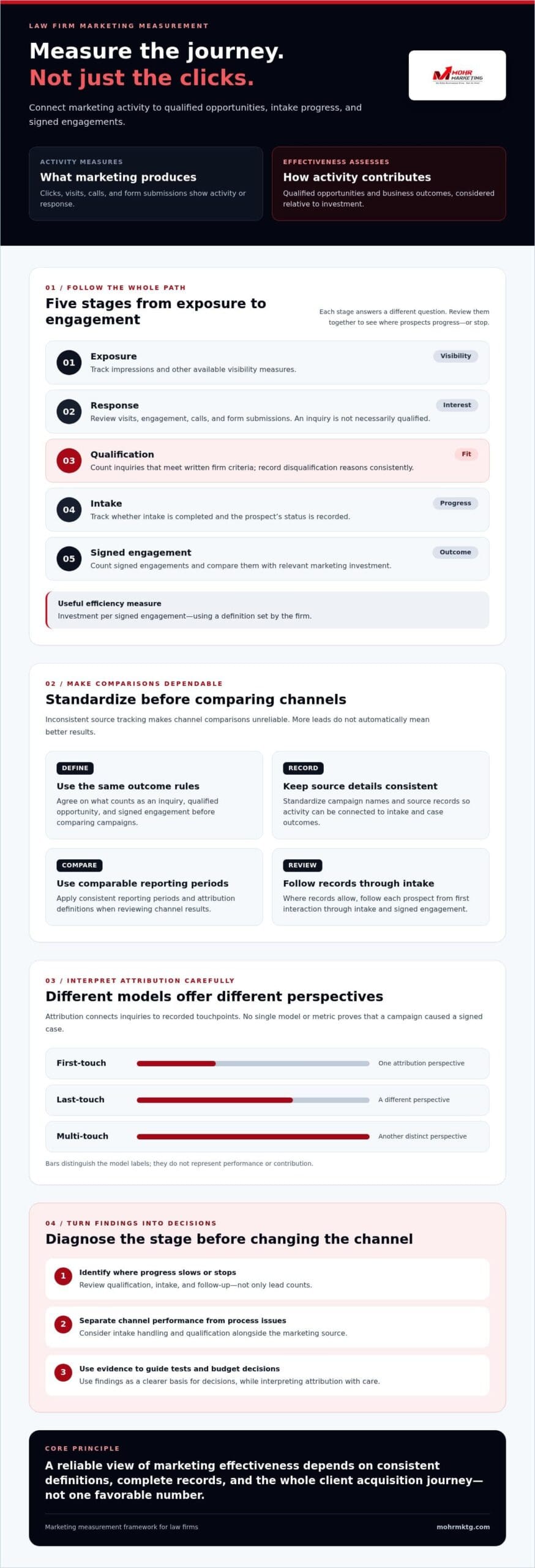
Marketing activity measures what a campaign produces; marketing effectiveness assesses how that activity contributes to qualified opportunities and business outcomes relative to the investment. This builds on the broader concept of Marketing effectiveness, which considers marketing’s contribution to short- and long-term results.
What does marketing effectiveness mean for a law firm?
For a law firm, effectiveness means having evidence that marketing contributes to opportunities that fit the firm’s objectives. A website visit, ad click, or call is an activity or response metric. Qualification, intake progression, and a signed case are closer to business outcomes. Decide which outcomes matter for the firm’s practice and goals, then define them consistently before comparing campaigns.
For example, a firm may track whether an inquiry matches its practice focus, whether intake confirms it is qualified, and whether the prospect signs an engagement. Each measure answers a different question. Together, they show more than a click count, but they still need careful interpretation.
Why do clicks and lead volume create an incomplete picture?
High traffic or inquiry volume can coexist with weak qualification or intake results. A channel may attract visitors who aren’t seeking the firm’s services, while another produces fewer inquiries that better fit its criteria. Raw counts hide those differences. To compare channels fairly, use the same definitions for an inquiry, a qualified opportunity, and a signed engagement, and review comparable reporting periods.
Follow each prospect from first interaction through intake and signed engagement where records allow. This helps identify where progress slows or stops, such as at qualification or follow-up. It also helps separate marketing findings from operational factors, including how intake is handled.
Use the data as evidence, not a verdict. Attribution methods can connect an inquiry to recorded touchpoints, but no single metric or model proves that a campaign caused a signed case. Reliable tracking marketing effectiveness for law firms depends on consistent definitions, complete records, and a view of the whole journey, not one favorable number.
Map Law Firm Marketing Metrics to Every Stage of the Acquisition Funnel
A useful measurement framework follows prospects from initial exposure to a signed engagement. Each stage answers a different question: Did the right audience see the marketing? Did someone respond? Did the inquiry meet the firm’s criteria? Did intake progress? Did the prospect sign? Tracking these stages together helps explain where results are developing and where the process may need closer review.
Law firms should measure outcomes across the entire acquisition funnel because activity at one stage does not show whether prospects advance to a qualified opportunity or signed engagement. The indicators below are options, not universal benchmarks. Select measures that fit the firm’s objectives, and apply their definitions consistently across campaigns.
Which metrics belong at each stage?
- Exposure: Track impressions and other available measures of visibility to understand whether a campaign is reaching an audience.
- Response: Review visits, engagement, calls, and form submissions as indicators of interest. An inquiry is a response, not necessarily a qualified opportunity.
- Qualification: Count inquiries that meet the firm’s written criteria. Record disqualification reasons consistently to identify patterns.
- Intake: Track whether intake is completed and the prospect’s status is recorded. This helps distinguish an inquiry that never progresses from one that reaches a decision point.
- Signed engagement: Count signed engagements and compare them with the relevant marketing investment using a firm-defined acquisition-efficiency measure, such as investment per signed engagement.
Keep status labels clear. Define “inquiry,” “qualified,” “intake completed,” and “signed” so staff and reporting systems use the same terms. Otherwise, one campaign’s “lead” may mean a submitted form while another’s means a screened prospect, making comparisons unreliable.
How should a firm define a qualified inquiry?
Write qualification criteria that reflect the firm’s practice areas and case requirements. Specify what information is needed to classify an inquiry, who records its status, and how incomplete or unresponsive inquiries are handled. Apply the same criteria across channels to create a more dependable basis for assessing lead quality.
Keep verification status separate from legal merit. Verification indicates whether submitted information has been checked according to the firm’s process; it does not determine whether a matter has legal merit. These are distinct fields and shouldn’t be reported as interchangeable. For an example of outcome-focused acquisition, consider mass tort signed cases, where tracking a prospect through qualification and a signed retainer provides more insight than counting initial inquiries alone.
Consistent funnel definitions make tracking marketing effectiveness for law firms more actionable. They help teams locate where prospects progress or stall without treating any single stage as the whole result. Firms reviewing their lead acquisition or intake needs can discuss their objectives with Mohr Marketing.
Compare Marketing Channels Without Confusing Attribution With Performance
A channel report shows which source received credit for an inquiry. It doesn’t, by itself, prove that the source caused a signed engagement. Prospects may interact with several channels before contacting a firm, and gaps in source records can obscure that journey. Compare channels using consistent outcome definitions, attribution rules, and reporting periods. Treat the results as evidence for decisions, not definitive proof of causation.
Which attribution approach should a law firm use?
Choose an attribution view that answers the question you’re asking, and document its limits. First-touch attribution credits the first recorded interaction. It can show where prospects initially discovered the firm, but may overlook later interactions that influenced their decision. Last-touch attribution credits the final recorded interaction before an inquiry or engagement. It can clarify what preceded conversion, but may over-credit that interaction and ignore earlier influence.
Multi-touch attribution distributes credit across multiple interactions. It can offer a broader view of the recorded journey, but only when touchpoints are captured reliably and consistently. None of these models provides a complete account of cause and effect. If source data is missing or inconsistent, label that limitation rather than presenting the attribution as certain.
How can firms compare SEO, paid media, and lead sources fairly?
Use the same reporting period and definitions for every channel. Select an attribution window that reflects the firm’s decision cycle, document it, and apply it consistently. Don’t assume one window fits every practice or campaign. A longer consideration period can mean an interaction and its eventual signed engagement fall into different reporting periods, so interpret short-term comparisons with care.
A simple comparison table can make assumptions visible. Include one row per channel and columns for:
- Marketing spend during the selected period
- Inquiries and qualified inquiries, using the firm’s established definitions
- Signed engagements attributed under the chosen model
- Data limitations, including missing sources or incomplete journey records
Review SEO, paid media, and other lead sources using the same fields. Then distinguish observed contribution from correlation: a channel may be associated with inquiries without being their sole cause. Intake can also affect whether an inquiry progresses, so review channel data alongside intake outcomes. For context on that connection, see legal intake services and conversion efficiency.
Consistent comparisons make tracking marketing effectiveness for law firms more useful. They show what the data supports, where uncertainty remains, and which questions deserve further review before budget decisions are made.
Build a Reliable Marketing Tracking Workflow for Your Law Firm
A tracking system is useful only if it connects business goals to consistent records and decisions. Set up the workflow in sequence: decide what the firm needs to learn, define the stages to measure, capture source information, check data quality, then review results and assign follow-up actions.
Set up consistent campaign and intake data
Start with a firm objective, such as understanding which sources contribute to qualified inquiries or signed engagements. Choose measures that answer that question before selecting tools or building dashboards. Then standardize campaign names across channels so the same campaign is identifiable in reports and intake records.
Use UTM parameters, which add source and campaign details to a URL, to help identify visits from tagged links. Call tracking can help associate calls with a marketing source when configured to capture that information. CRM or other intake records can preserve the source alongside later interactions and status changes. These methods depend on consistent setup and data entry. Confirm that the firm’s systems capture and retain the fields it needs. Don’t assume a tool automatically provides complete attribution.
Define each status in writing. Specify what qualifies as an inquiry, a qualified opportunity, completed intake, and a signed engagement. Record the original source and, where feasible, later touchpoints separately. This helps the firm distinguish how someone first arrived from what happened during the rest of the acquisition journey.
Create a reporting cadence that leads to action
Review operational indicators on a routine schedule, then assess signed engagements over a period appropriate to the firm’s decision cycle. Assign responsibility for maintaining records, interpreting reports, and deciding what to investigate or change. A report without an owner or next step is just a record of past activity.
- Check for duplicates: Confirm repeat calls or forms aren’t being counted as separate prospects without a clear reason.
- Find missing sources: Flag records with blank, unknown, or conflicting source information.
- Review status consistency: Look for records classified differently despite similar progress through intake.
- Check update delays: Identify whether intake outcomes are being entered late, which can distort current comparisons.
Document changes to campaign naming, status definitions, attribution settings, or reporting periods. Otherwise, a shift in the numbers may reflect a change in tracking rather than a change in marketing performance. Reliable tracking marketing effectiveness for law firms also requires appropriate review of privacy, data access, and jurisdiction-specific advertising considerations. Ask qualified professionals to assess the firm’s practices rather than assuming one approach applies everywhere.
Turn Marketing Effectiveness Findings Into Better Law Firm Decisions
Measurement matters when it changes what the firm does next. Use findings to decide what to investigate, test, maintain, or adjust. Avoid making a major budget decision from one metric or a short reporting period. First confirm that the data is complete and that you’re comparing similar campaigns, definitions, and timeframes.
How should firms respond when marketing metrics disagree?
If inquiry volume rises but qualified inquiries or signed engagements don’t, investigate before concluding that the channel has failed. Check whether source capture is consistent, whether duplicate inquiries are affecting counts, and whether intake records have been updated. Then compare lead quality and signed outcomes alongside visits, calls, and forms.
Separate marketing performance from operational factors. A channel may generate suitable inquiries, while intake speed or qualification processes affect how many progress. Where practical, test a defined change, such as adjusting a campaign element while holding other conditions steady. Record the change, assumptions, reporting period, and results. Treat the findings as evidence for the next decision, not a promise of future performance.
When can outside marketing support help?
Consider additional support when no one clearly owns campaign records, intake statuses, or performance reviews. Before working with a marketing partner, ask for clear answers to four questions:
- Definitions: How are inquiries, qualified opportunities, and signed engagements classified?
- Source data: What information connects a prospect to a recorded marketing source, and what is unavailable?
- Reporting limits: Which attribution assumptions or data gaps affect interpretation?
- Review cadence: How often are results reviewed, and who is responsible for follow-up decisions?
These questions help establish whether reports can support decisions and where the firm may need to improve its records or processes. Mohr Marketing, LLC provides verified legal inquiries, signed retainers, and legal intake services. A discussion about measurement needs can help clarify which acquisition stages the firm wants to assess and what information it needs to evaluate them.
Use tracking marketing effectiveness for law firms to build a decision process grounded in consistent evidence. The goal isn’t to claim certainty from imperfect data. It’s to understand what the records show, identify what they can’t show, and choose the next step accordingly.
Turn Clear Measurement Into Confident Marketing Decisions
A sound measurement system gives your firm a stronger basis for deciding what to review and where to focus next. Use consistent records to distinguish meaningful evidence from tracking gaps, then apply what you learn to future marketing decisions.
For firms seeking support, Mohr Marketing, LLC offers verified legal inquiries, signed retainers, and intake services. These offerings can be considered in the context of your firm’s specific measurement needs.
To take the next step, contact Mohr Marketing to discuss your firm’s marketing measurement needs.
Frequently Asked Questions
How do law firms measure marketing effectiveness?
Law firms measure marketing effectiveness by connecting marketing investment to qualified inquiries, completed intake, and signed engagements. Start by defining each stage and recording prospects’ sources consistently. Then compare channels over a firm-selected reporting period, accounting for incomplete data and attribution limits. Tracking marketing effectiveness for law firms is most useful when reports show how prospects progress through the acquisition journey, not just how many people clicked or contacted the firm.
Which marketing metrics should law firms track?
Track indicators across the acquisition funnel: impressions and visits for visibility, calls and form submissions for response, qualified inquiries for lead quality, completed intake for process progression, and signed engagements for outcomes. Pair outcome counts with marketing investment to assess acquisition efficiency. Define every metric in advance, including what qualifies as an inquiry or signed engagement. These measures are options, not universal benchmarks, so select those that align with the firm’s practice and objectives.
Can a law firm use Google Analytics 4 to track signed cases?
Google Analytics 4 can help record website interactions, but it won’t know by itself whether an inquiry later became a signed engagement. To connect online activity with that outcome, a firm needs consistent source records and a way to associate intake or case status data with the initial interaction. Review the setup with qualified technical and privacy professionals, and avoid sending sensitive information into analytics systems unless the firm has assessed whether that use is appropriate.
What is the difference between a marketing lead and a qualified legal inquiry?
A marketing lead is a response or contact generated through a marketing source, such as a call or form submission. A qualified legal inquiry is one that meets the firm’s written criteria for practice area and case requirements. The terms shouldn’t be used interchangeably. Set clear classification rules and record verification status separately from legal merit. This lets the firm compare lead volume with the share of inquiries that meet its criteria.
How much does it cost to track marketing effectiveness for a law firm?
There is no single cost that applies to every firm. The resources required depend on existing analytics and intake tools, source-capture processes, staff responsibilities, and whether outside support is needed. Separate the cost of measurement from marketing campaign spend or lead acquisition fees. Before committing, identify what the firm already has, what data gaps need attention, and request a clear breakdown of any proposed tracking-related fees.
What happens if marketing reports show leads but few signed cases?
Investigate the full path before concluding that a channel is underperforming. Check whether leads meet the firm’s qualification criteria, whether source records are complete, and whether intake statuses are current. Then review operational factors, such as follow-up and intake handling, that may affect progression. Compare qualified inquiries and signed engagements alongside lead volume. If you test a change, document the adjustment, reporting period, and assumptions so the result can be interpreted consistently.
Should law firms use first-touch or last-touch attribution?
Neither model is definitive. First-touch credits the first recorded interaction and can help identify discovery sources, but it may overlook later influence. Last-touch credits the final recorded interaction before an inquiry or engagement, but it can over-credit that touchpoint. Choose the model based on the question being reviewed, document its limitations, and apply it consistently. Multi-touch attribution is another option when journey data is reliably captured across interactions.
Recent Posts
- Tracking Law Firm Marketing: A Practical Guide
- High-Value Mold Case Acquisition: A Strategic Guide
- High-Quality Mold Leads: Scale Your Toxic Tort Practice
Categories
- AI and Lead Generation
- Business Financing
- Call Verified MVA Leads
- Car Accident Help
- Car Accident Settlements
- Claimant Funding
- Compliance Program
- EMS-EMT Reports
- Geotargeting
- Google Maps Ranking
- Healthcare Practice Growth
- Law Firm Growth
- Law Office Operations
- Lead Generation
- Lead Generation For Attorneys
- Lead Generation For Chiropractors
- Lead Generation For Criminal Attorneys
- Lead Generation For D&A Treatment Centers
- Lead Generation For DUI Attorneys
- Lead Generation For Eye Doctors
- Lead Generation For Family Law Practices
- Lead Generation For PI Law Firms
- Lead Generation For Plastic Surgeons
- Leads For Healthcare Professionals
- Leads For Insurance Industry
- Legal Leads
- Legal Marketing
- Legal Updates
- Mass Tort Leads
- Medicare and Medicaid Leads
- Merchant Funding Leads
- Mold Leads
- Online Marketing Strategies
- Pre-Settlement Funding
- Signed MVA Cases
- Tort Updates
- Truck Accident Leads and Signed Cases
- Truck Accident Settlements
- Web Design