High-Value Mold Case Acquisition: A Strategic Guide
September 25, 2026 by Mohr Marketing
What if the biggest threat to high-value mold case acquisition isn’t a lack of leads, but a process that fails to separate credible claims from noise? High lead costs, fraudulent inquiries, and intake delays can drain budget before a firm reaches a viable case. The strategy behind https://www.mohrmktg.com/high-value-mold-case-acquisition/ starts with a different standard: qualify intent, screen for fraud, and assess whether medical and environmental evidence supports further review.
Firms already know that lead volume alone doesn’t create a dependable pipeline. The challenge is building a clean path from intent to intake, without wasting time on unverified claimants or losing strong prospects to inefficient follow-up. This guide explains how a turnkey acquisition ecosystem can support national scaling, what to evaluate in a lead and intake process, and how to track performance transparently. It also examines Mohr Marketing, LLC’s direct-to-firm model, Scammer Scrub™ fraud filtering, and performance-based options, including Pay-Per-Signed-Case. The objective is practical: a more consistent flow of signed retainers and a clearer view of acquisition results.
Key Takeaways
- Distinguish high-value toxic tort claims from general property-damage inquiries by assessing intent and the strength of potential exposure evidence.
- Set clear evaluation criteria for mold litigation leads, and consider how fraud screening can reduce time spent on unqualified inquiries.
- Compare lead sources by their path to a signed retainer, not by volume alone; shared leads may create added competition for claimant attention.
- Use https://www.mohrmktg.com/high-value-mold-case-acquisition/ to explore how a turnkey intake approach can support national case acquisition.
- Align case volume targets with firm capacity, then plan how new inquiries and signed retainers will be tracked alongside existing systems.
Defining High-Value Mold Case Acquisition in 2026
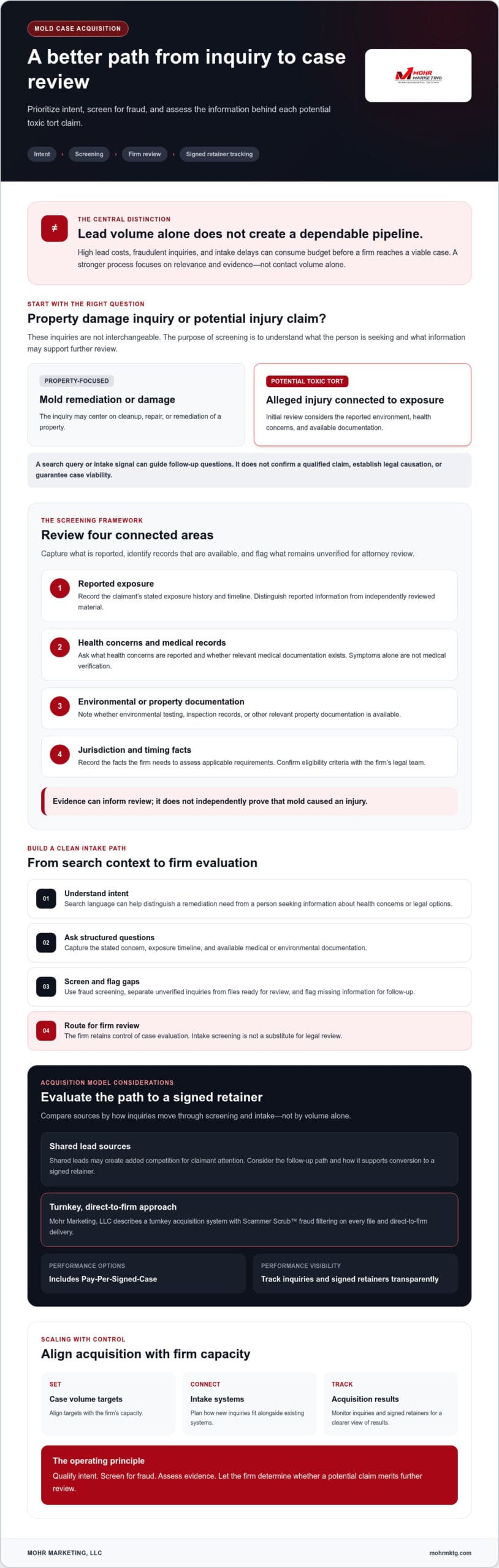
Generic mold inquiries and potential toxic tort claims are not interchangeable. A property-damage inquiry may focus on cleanup, repair, or remediation. A potential toxic tort claim centers on alleged injury connected to exposure, making the relationship among the reported environment, the person’s health concerns, and available documentation central to initial case evaluation. A toxic tort claim involves alleged harm caused by exposure to a substance; an intake screen can identify information for review, but it cannot establish legal causation or guarantee a viable case.
For firms, “high-value” should describe the quality and relevance of a potential claim, not promise a particular outcome. In 2026, a disciplined acquisition process needs more than a contact form submission. It should gather enough information to help the firm assess exposure history, reported health issues, and supporting records, then route the inquiry for appropriate review. No single intake signal establishes merit. Legal standards and case requirements can depend on the facts and jurisdiction.
The Anatomy of a High-Value Toxic Tort Claim
High-value mold acquisition is a targeted effort to secure plaintiffs with documented medical and environmental evidence for a firm’s evaluation. Useful initial materials may include environmental testing or inspection records, relevant medical documentation, and a timeline connecting reported exposure with health concerns. Intake teams should record what evidence exists and what remains unverified. These materials can inform review, but they don’t independently prove that mold caused an injury.
Why Intent-Driven Marketing Outperforms Broad Advertising
Search language offers an early clue to a person’s needs. Someone searching for “mold removal” may be seeking remediation, while a person searching for “toxic mold injury” may be looking for information about health concerns or legal options. Neither query confirms a qualified claim. It does, however, help shape relevant follow-up questions and reduce avoidable mismatch between the inquiry and the firm’s intake process.
Broad advertising can generate contact volume without revealing whether a person has a legal inquiry, relevant exposure information, or supporting records. Intent-driven acquisition starts with the search context, then uses structured intake and verification to help firms assess fit. The objective is a clean path from intent to intake, not a shortcut around legal review.
Set a consistent screening framework: capture the claimant’s stated concern, exposure timeline, and available medical or environmental documentation; flag missing information for follow-up; and separate unverified inquiries from files ready for firm review. Mohr Marketing, LLC describes its high-value mold case acquisition approach as a turnkey system with Scammer Scrub™ fraud filtering on every file and direct-to-firm delivery. The focus shifts from raw lead volume to verified inquiries and signed retainers, with the firm retaining control of case evaluation.
Evaluation Criteria for Toxic Mold Litigation Leads
Treat mold inquiries as a distinct screening category, not as generic personal injury leads. A useful initial review connects four areas: the claimant’s reported exposure, the health concerns and medical records, available environmental or property documentation, and the facts needed to assess jurisdiction and timing. These indicators help a firm decide whether to investigate further. They do not establish liability or prove that mold caused an injury.
Set criteria before acquisition begins. For an individual suit or a matter that may fit a coordinated proceeding, confirm the current eligibility requirements directly with the firm’s legal team. Don’t assume that a potential connection to an MDL makes an inquiry viable. Record the relevant facts consistently so attorneys can assess fit against the applicable criteria.
Medical Evidence and Causation Requirements
Ask what health concerns the claimant reports and whether medical records document them. Depending on the claim, the person may describe respiratory, neurological, or immunological symptoms, but a symptom list alone is not medical verification. Capture treating-provider information, available records, and a timeline of reported symptoms and exposure for attorney review. Medical documentation can strengthen an initial file, but it doesn’t by itself establish causation.
Demand evidence-backed inquiries. Separate information the claimant reports from records that have been received or independently reviewed. This distinction helps intake teams avoid treating an allegation as a verified fact and gives attorneys a clearer basis for follow-up.
Environmental Testing and Property Records
Request available inspection, sampling, or remediation reports, along with photographs and records of prior water intrusion or repair. If a report identifies a species such as Stachybotrys, capture the report’s source and context. A species name alone doesn’t prove the level or duration of exposure, establish that exposure caused an illness, or resolve the legal merits. Property records and written communications may help establish the reported exposure history and what relevant parties knew.
Use a consistent verification checklist before routing an inquiry for legal review:
- Exposure: Document where and when the claimant reports exposure, its duration, and any supporting records.
- Medical: Identify reported conditions and distinguish claimant statements from available medical documentation.
- Environment: Note testing, inspection, remediation, and property records, including what remains unverified.
- Timing and jurisdiction: Record key dates and the location relevant to the claim. Limitation periods and other legal requirements vary, so counsel should assess deadlines and jurisdiction rather than relying on a generic intake rule.
- Integrity: Screen for inconsistent details, duplicate submissions, or other indicators that warrant review.
Mohr Marketing, LLC states that its Scammer Scrub™ fraud filter is applied to every file. That screening can support intake quality, but firms should still evaluate the evidence and legal criteria independently. A focus on verified legal inquiries helps distinguish documented information from unconfirmed claims. For firms assessing how this process could fit their intake needs, discuss mold case acquisition with Mohr Marketing, LLC.
The Mechanics of a Turnkey Mold Case Acquisition System
A turnkey system connects the steps that are often managed separately: attracting relevant search traffic, screening inquiries, conducting intake, and delivering a verified inquiry or signed retainer to the firm. The value is in making each handoff clear. Advertising can identify people searching for mold-related legal help, but intent signals are not proof of exposure, injury, or case viability. Intake must collect and distinguish reported information from evidence that has been received or reviewed.
From Search Intent to Signed Retainer
A practical funnel moves from relevant search activity to an initial inquiry, structured screening, follow-up on missing information, and firm review. If the firm determines the matter meets its criteria, the intake process can proceed toward an executed agreement. Reduce avoidable delays between inquiry and follow-up, while preserving careful review. Speed matters because a slow or unclear handoff can lose a prospective claimant, but it should never replace verification or legal judgment.
AI-supported advertising may help identify and respond to high-intent search patterns in near real time. Treat those patterns as signals for campaign and intake prioritization, not as automatic qualification. A search about toxic mold injury, for example, may indicate a legal concern; staff still need to establish what the person reports, what documentation is available, and whether the firm wants to evaluate the matter.
For transparency, define what happens at each stage and what information moves forward. If ReportLink is used in the workflow, clarify which intake details and documents it carries, how the firm receives them, and how missing or unverified items are identified. The client information provided does not specify ReportLink’s features, so firms should confirm its actual capabilities before relying on it for data transfer or case tracking.
Eliminating the Middleman: Direct-to-Firm Acquisition
Direct delivery can remove reseller layers and their markup, while giving the firm a clearer view of the source and status of an inquiry. Before choosing any acquisition model, establish whether inquiries are exclusive or shared, what verification has been completed, and what performance data will be reported. These details help firms compare lead volume with the outcomes that matter, including verified inquiries and signed retainers. For broader context on evaluating exclusivity, review the article’s discussion of exclusive mass tort leads.
Build compliance review into the funnel rather than treating it as a final check. Have appropriate counsel assess advertising, intake language, disclosures, and referral or fee arrangements against applicable state bar requirements and the UCPMP standards relevant to the campaign. Requirements can vary, so avoid relying on a generic checklist as a substitute for legal review. Mohr Marketing, LLC describes its processes as state-bar vetted and its delivery as direct to firms. Its mold case acquisition approach centers on a clean path from intent to intake, with fraud screening and clearer handoffs.
Comparing Lead Aggregators vs. Case Acquisition Agencies
A low cost per lead can conceal the actual cost of acquisition. A shared inquiry may reach multiple firms, require repeated attempts to verify basic details, or fall outside the firm’s case criteria. Compare providers by what happens after the inquiry arrives: how it was sourced, what was verified, whether it is exclusive, and whether it progresses to a signed retainer.
To assess ROI, track the full intake effort alongside acquisition outcomes. Include staff time spent contacting, screening, and following up with prospects. Then compare total costs with the number of inquiries that meet your criteria and the number that become signed retainers. This gives a more useful picture than lead volume alone.
The Hidden Costs of Raw Legal Leads
Unverified data shifts work to the firm. Intake staff may need to confirm contact details, identify duplicate submissions, establish whether the person is seeking legal help, and gather basic exposure and medical information. Delays can also reduce the chance of reaching a prospective claimant while the inquiry is still active. The scale of that effect depends on the firm’s process, so measure it using your own follow-up and conversion records.
Audit a provider before relying on its claims. Ask how it defines a qualified inquiry, what checks are performed, how shared or duplicate leads are disclosed, and what source and verification records accompany each file. Confirm how performance is reported and how disputes about lead quality are handled. Require clear answers, not just volume promises.
Performance-Based Acquisition: Aligning Cost With Outcomes
A Pay-Per-Signed-Case model ties payment to a signed retainer rather than an unconverted inquiry. That can align provider and firm incentives around completed intake, but it isn’t automatically risk-free or a guarantee of case quality. Review the model’s terms, qualification criteria, and reporting process. Then evaluate signed retainers against the firm’s independent legal and evidentiary review.
Fraud screening and structured qualification can reduce time spent on questionable submissions, but they don’t replace the firm’s own evaluation. Mohr Marketing states that Scammer Scrub™ is applied to every file and that inquiries or signed retainers are delivered directly to firms. For a closer look at its signed-retainer approach, see Mass Tort Signed Cases. The high-value mold case acquisition framework also emphasizes a direct path from intent to intake, with clearer sourcing and performance visibility.
- Track: Inquiry source, verification status, staff follow-up, and signed-retainer outcomes.
- Compare: Shared versus exclusive delivery, screening standards, and total intake effort.
- Review: Provider reporting against your firm’s criteria and case evaluations.
Implementing a Scalable Mold Litigation Growth Strategy
Scale case acquisition at the pace your firm can evaluate and serve. Start by setting an intake volume target that reflects attorney capacity, staff availability, and the firm’s approved acquisition budget. Then increase or adjust volume using actual pipeline results, not assumptions. Track inquiries received, verified information, follow-up completion, signed retainers, and files accepted for legal review. This makes growth measurable and helps distinguish a capacity issue from a lead-quality issue.
Before launching or expanding a campaign, map how new inquiries will move into existing systems. Decide which fields intake staff need, where supporting documents should be stored, who owns follow-up, and how status changes will be recorded in the firm’s CRM and litigation software. Agree on a consistent handoff format with the acquisition partner, and test it before increasing volume. Clear data ownership and reporting reduce manual re-entry and make performance easier to audit.
Prepare Intake Before Increasing Volume
Confirm that trained staff can review incoming information, follow the firm’s screening process, and route potential matters to the appropriate attorney. Set escalation rules for missing records, potential duplicates, and time-sensitive questions. A fast transfer has limited value if responsibility is unclear. Audit your intake efficiency to ensure no high-value cases slip through during handoffs or follow-up.
Use ongoing performance reviews to refine the process. If inquiries often lack a particular type of information, adjust intake questions or discuss the gap with the provider. If qualified inquiries stall before attorney review, examine follow-up steps and system handoffs. Keep the firm’s legal team responsible for changing case criteria, and use campaign and intake data to identify where adjustments may be useful.
Scale Nationally, Then Diversify Deliberately
A national strategy can expand reach, but it also requires consistent screening and clear ownership across the pipeline. Establish a common intake framework, then review results regularly to see whether volume, evidence quality, and signed-retainer outcomes remain aligned with firm capacity. Build the acquisition relationship around transparent reporting and planned adjustments, rather than pursuing volume for its own sake.
For environmental firms considering additional practice-area growth, evaluate each opportunity against its own claimant profile, evidence needs, and operational capacity. Mesothelioma leads may be a logical area to assess; they require their own criteria and should not be treated as interchangeable with mold inquiries. See mesothelioma leads for law firms for related context.
Mohr Marketing positions its turnkey mold litigation system for national scaling, with direct-to-firm delivery of signed retainers or verified inquiries. Use this framework to plan a clean path from intent to intake, then evaluate whether the firm’s systems and capacity can support the next stage. The high-value mold case acquisition resource outlines the approach.
Build a More Reliable Mold Case Pipeline
High-value mold case acquisition depends on more than generating inquiries. Define case criteria around the information attorneys need, distinguish reported details from verified evidence, and track each handoff through intake. Measure outcomes by verified inquiries and signed retainers, not lead volume alone. Then use performance data to adjust acquisition targets to your firm’s capacity.
Mohr Marketing’s turnkey approach includes Scammer Scrub™ fraud filtering on every file, direct-to-firm delivery, and performance-based Pay-Per-Signed-Case models. With 30+ years of legal marketing experience, the team focuses on creating a clean path from intent to intake. Explore the high-value mold case acquisition approach to assess how a structured system could support your firm’s growth.
A disciplined process can help your firm pursue national growth while keeping qualification, capacity, and performance in view. Take the next step with a strategy built around your intake priorities.
Frequently Asked Questions
What makes a mold case “high-value” for a law firm?
A high-value mold case has facts and documentation that warrant careful legal review, not merely a report of property damage or mold exposure. Relevant information may include an exposure timeline, available environmental records, documented health concerns, and medical records for attorney evaluation. These indicators can help a firm assess potential fit, but they don’t prove that mold caused an injury or guarantee a particular case value or outcome.
How does Mohr Marketing verify the medical criteria for mold cases?
Mohr Marketing states that its system delivers signed retainers or verified inquiries and applies Scammer Scrub™ fraud filtering to every file. The available business information doesn’t specify which medical records are independently verified or what medical criteria are confirmed before delivery. Firms should ask what documentation accompanies an inquiry, which details are claimant-reported, and what verification steps have been completed before treating medical information as established.
Is the mold case acquisition process compliant with state bar rules?
Mohr Marketing describes its processes as state-bar vetted, but firms should not treat that description as a blanket compliance guarantee for every campaign or jurisdiction. Advertising and intake requirements can vary. Before launching, have appropriate counsel review campaign materials, intake language, and the proposed acquisition arrangement for the jurisdictions involved. Confirm how responsibilities are allocated and raise any jurisdiction-specific questions with counsel before relying on a general process description.
What is the difference between a mold lead and a signed mold case?
A mold lead is an inquiry from someone who may be seeking legal help; it is not necessarily qualified or supported by complete documentation. A signed mold case generally refers to a claimant who has executed a retainer agreement with a firm. A signed retainer is a distinct acquisition outcome, but it doesn’t determine whether the claim has legal merit or will succeed. The firm must assess the facts and evidence independently.
Can my firm scale mold case acquisition nationally?
Yes, Mohr Marketing identifies its focus as national, and firms can plan acquisition across a national footprint. Scale volume in line with attorney and intake capacity, available budget, and the firm’s ability to review inquiries promptly. Establish a consistent screening process, clarify how files enter your existing systems, and monitor verified inquiries and signed retainers. The high-value mold case acquisition approach should support the firm’s criteria, not replace legal review.
How does Scammer Scrub™ protect my firm’s marketing budget?
Scammer Scrub™ is Mohr Marketing’s stated fraud-filtering process, applied to every file. Its purpose is to screen for fraudulent inquiries before delivery, helping firms limit time spent on submissions that may not be genuine. Filtering can support lead quality, but it can’t guarantee that every inquiry is valid, medically supported, or legally viable. Ask how the screening works, what it flags, and how those results appear in file reporting.
What documentation is provided with a verified mold inquiry?
The available business information confirms delivery of verified inquiries or signed retainers directly to firms, but it doesn’t specify a standard document package for each mold inquiry. Before engaging a provider, confirm what information and records are included, such as claimant-reported exposure details or available medical and environmental documents. Ask how verified facts are distinguished from unconfirmed statements, and identify any records your intake team must request separately.
How quickly can a firm start receiving signed mold retainers?
No specific start time is confirmed. Timing can depend on campaign setup, intake processes, firm criteria, and whether prospective claimants complete the required steps. Ask Mohr Marketing to explain the anticipated onboarding and delivery process for your firm, including what needs to be in place before acquisition begins. Avoid planning around an assumed launch date or retainer volume until the provider has confirmed those details for your arrangement.
Recent Posts
- High-Value Mold Case Acquisition: A Strategic Guide
- High-Quality Mold Leads: Scale Your Toxic Tort Practice
- Scaling Your Firm with High-Quality Mold Case Leads
Categories
- AI and Lead Generation
- Business Financing
- Call Verified MVA Leads
- Car Accident Help
- Car Accident Settlements
- Claimant Funding
- Compliance Program
- EMS-EMT Reports
- Geotargeting
- Google Maps Ranking
- Healthcare Practice Growth
- Law Firm Growth
- Law Office Operations
- Lead Generation
- Lead Generation For Attorneys
- Lead Generation For Chiropractors
- Lead Generation For Criminal Attorneys
- Lead Generation For D&A Treatment Centers
- Lead Generation For DUI Attorneys
- Lead Generation For Eye Doctors
- Lead Generation For Family Law Practices
- Lead Generation For PI Law Firms
- Lead Generation For Plastic Surgeons
- Leads For Healthcare Professionals
- Leads For Insurance Industry
- Legal Leads
- Legal Marketing
- Legal Updates
- Mass Tort Leads
- Medicare and Medicaid Leads
- Merchant Funding Leads
- Mold Leads
- Online Marketing Strategies
- Pre-Settlement Funding
- Signed MVA Cases
- Tort Updates
- Truck Accident Leads and Signed Cases
- Truck Accident Settlements
- Web Design