Scaling Your Firm with High-Quality Mold Case Leads
September 23, 2026 by Mohr Marketing
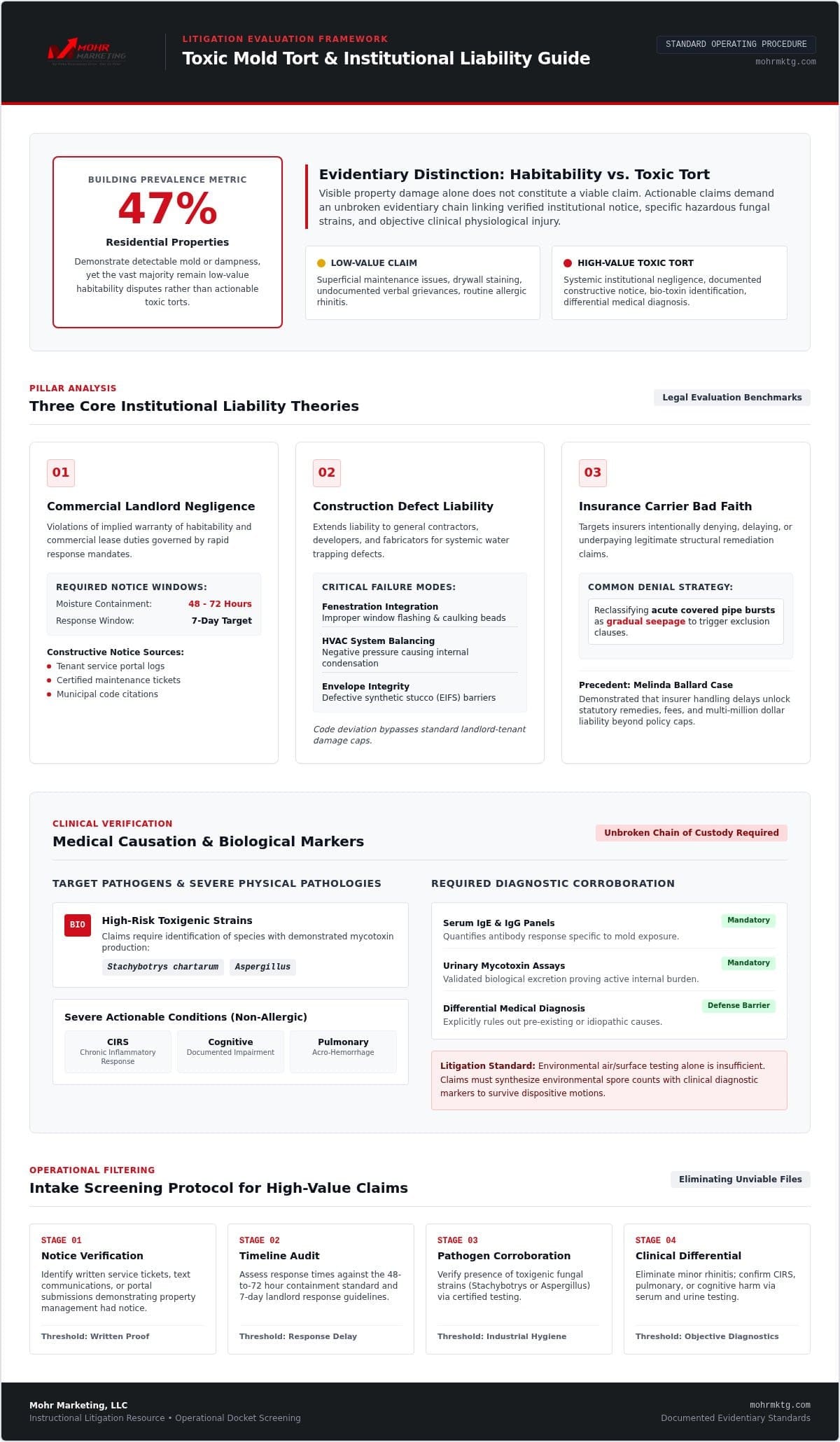
Visible property damage doesn’t make a toxic tort claim; verified medical causation does. While nearly 47% of residential buildings show detectable mold or dampness, the vast majority of caller inquiries represent low-value habitability disputes rather than catastrophic personal injury. If your team evaluates mold cases based on stained drywall or surface photos alone, you’re burning valuable billable hours on unviable files that will never survive rigorous defense challenges.
You already know that separating actionable exposure claims from routine tenant grievances is one of the most resource-intensive bottlenecks in modern litigation. Between demanding scientific defense tactics and complex pre-existing respiratory histories, unqualified inquiries drain firm capital fast. Discover how leading practices rigorously evaluate, build, and acquire high-value toxic mold litigation cases that hold negligent property managers accountable. This instructional guide details the precise screening thresholds, liability multipliers, and acquisition protocols required to scale a trial-ready docket with confidence.
Key Takeaways
- Learn how to satisfy stringent evidentiary standards by pairing verified environmental testing with differential medical diagnoses in complex mold cases.
- Identify actionable institutional liability triggers, including failure to meet rapid containment timelines and clear documentation of constructive notice.
- Uncover the primary valuation drivers and gross negligence multipliers that elevate basic property claims into multi-million-dollar personal injury dockets.
- Implement objective intake screening protocols to eliminate non-viable habitability complaints before they drain partner review time.
- Deploy modern performance-based acquisition models to secure pre-screened claimants and fully executed retainers ready for active litigation.
Understanding Toxic Mold Cases: Core Legal Theories and Institutional Liability
Toxic mold litigation represents a specialized intersection of personal injury, real property damage, and statutory breach claims requiring verified proof of a legal duty, hazardous bio-contamination, and quantifiable physical or economic harm. Unlike routine habitability disputes, high-value mold cases target systemic institutional failure rather than superficial maintenance oversights. Proving liability demands establishing that corporate defendants held demonstrable institutional knowledge of water intrusion yet failed to intervene before mycotoxin production escalated. Firms scaling these dockets often integrate established operational workflows, such as those used for mass tort signed cases, to effectively handle complex multi-party institutional defendants.
Commercial Landlord Negligence and Habitability Breaches
Actionable claims against property management entities hinge on breaches of the implied warranty of habitability and commercial lease duties. While standard landlord liability turns on duty of care, modern courts increasingly hold landlords liable when they fail to meet emerging operational timelines, including 7-day response windows or 48-to-72-hour moisture containment rules. Documented tenant service portals, certified maintenance tickets, and municipal code citations convert informal complaints into irrefutable constructive notice, eliminating defense arguments regarding unnotified structural deterioration.
Construction Defects and Developer Accountability
Institutional liability frequently extends past property managers to developers, general contractors, and material fabricators. Structural defect disputes center on systemic construction shortcuts that trap water inside structural assemblies, such as:
- Improperly integrated window flashing and substandard caulking beads
- Poorly engineered HVAC ventilation creating negative pressure condensation
- Defective synthetic stucco (EIFS) and compromised weather-resistive building envelope barriers
When general contractors deviate from mandatory municipal building codes, these design and installation failures provide direct grounds for long-tail defect claims that bypass standard landlord-tenant damage limitations.
First-Party Property Insurance Bad Faith
The third primary litigation avenue targets property insurers that deliberately deny, delay, or underpay legitimate environmental remediation claims. Insurers frequently mischaracterize acute, covered pipe bursts as long-term gradual seepage to trigger mold exclusion clauses. Litigating these bad-faith denials unlocks statutory remedies, legal fees, and punitive damages beyond standard policy caps. This principle gained national recognition through the landmark Melinda Ballard case, which proved that an insurer’s intentional handling delays can generate tens of millions in enterprise liability when toxic contamination ruins a structure.
Medical Causation and Environmental Evidence Standards in Mold Litigation
Environmental contamination alone does not yield a successful settlement. In high-stakes mold cases, proving biological exposure requires building an unbroken chain of custody between quantified fungal mycotoxins and specific physiological damage. Defense counsel routinely attempts to dismiss symptoms as idiopathic or related to past medical histories. Surviving dispositive motions requires corroborating qualitative tenant complaints with clinical diagnostic testing, rigorous air-sampling metrics, and documented differential diagnoses.
Proving Biological Causation and Severe Health Pathologies
Actionable physical injuries extend far beyond temporary allergic rhinitis. High-value dockets center on severe pathologies triggered by species such as Stachybotrys chartarum and Aspergillus. Exposure to these toxigenic strains can result in chronic inflammatory response syndrome (CIRS), cognitive impairment, and pulmonary hemorrhage. Objective medical diagnostic tests, such as serum IgE and IgG panels alongside validated urinary mycotoxin assays, are strictly required to establish that systemic inflammatory cascades stem directly from the target property.
Environmental Testing Standards and Industrial Hygiene
Subjective visual inspections fail under defense scrutiny. Trial-ready claims require objective industrial hygiene reports detailing spore counts, relative humidity, and hidden moisture reservoirs. Effective evidence gathering relies on three distinct testing tiers:
- Calibrated Volumetric Air Testing: Quantifies airborne spore traps against outdoor baseline controls to measure active inhalation risks.
- ERMI (Environmental Relative Moldiness Index): Employs DNA-based MSQPCR testing to analyze historical indoor dust and detect latent toxic strains.
- Surface Tape-Lift Sampling: Confirms direct colonization on building substrates, demonstrating adherence to or deviation from established EPA mold remediation guidelines.
Overcoming Daubert and Frye Admissibility Challenges
Judges act as strict evidentiary gatekeepers under both Daubert and Frye standards. Opposing counsel will file omnibus motions to exclude medical toxicologists whose methodologies lack peer-reviewed grounding. Defeating these challenges requires two non-negotiable steps. First, your medical expert must perform a thorough differential diagnosis, ruling out alternate occupational, lifestyle, and pre-existing respiratory factors. Second, counsel must demonstrate a tight temporal relationship between occupancy dates and symptom onset, bolstered by clinical improvement once the plaintiff vacates the premises. Firms looking to expand their trial capacity often work with specialized partners; you can reach our intake team to discuss how structured case parameters elevate docket value.
Key Settlement Drivers and Precedents Shaping Modern Mold Case Valuation
Accurate case valuation balances hard economic losses against long-term physical impairment within an established toxic tort legal framework. Simple property damage claims rarely support the litigation expenses required to defeat defense experts. Instead, seven-figure recoveries emerge when plaintiff attorneys tie physical injuries directly to institutional indifference. In toxic mold cases, top-tier settlements reflect corporate bad-faith conduct rather than mere structural dampness.
Economic Losses Versus Permanent General Damages
Litigators must quantify both tangible expenditures and lifelong earning deficits to establish baseline claim value. Structural moisture intrusion ruins more than wallboards; airborne mycotoxins cause total cross-contamination of porous personal property. High-value damage models incorporate three primary financial pillars:
- Direct Medical Care: Past emergency interventions, hyperbaric oxygen treatments, ongoing immunotherapy, and anticipated future pulmonary regimens.
- Cross-Contamination Losses: Total destruction of furniture, soft goods, clothing, and the high expense of emergency professional relocation.
- Earning Impairments: Vocational rehabilitation assessments, missed promotional tracks, and permanent disability stemming from cognitive deficits and chronic fatigue.
Corporate Culpability as a Punitive Damage Multiplier
Punitive damages represent the primary bridge from standard habitability adjustments to multi-million-dollar outcomes. Recent trials illustrate substantial juror hostility toward corporate delay. In February 2026, a jury awarded $6.6 million for chronic health problems caused by neglected apartment mold, while another February 2026 verdict yielded $2.3 million against a non-compliant property owner. Multipliers materialize during electronic discovery. Internal property emails proving management hid lab results, ignored certified work orders, or prioritized short-term cost cuts over habitability dismantle defense arguments and drive settlement value.
Navigating Policy Limits and Insurance Coverage Defenses
Insurance coverage realities dictate practical recovery caps. Commercial General Liability (CGL) carriers routinely trigger absolute mold and micro-organism exclusions to avoid personal injury payouts. Effective litigators counter by anchoring claims to the initial covered water loss event, such as sudden plumbing bursts, rather than the resulting biological colonization. Counsel must also examine excess umbrella policies and additional insured endorsements across third-party remediation vendors. If you want to expand your inventory with pre-qualified files, explore our dedicated model for high-value mold case acquisition designed around actionable coverage triggers.
Intake Screening Protocols: How Law Firms Filter Actionable Mold Retainers
Unscreened caller inquiries drain litigation resources faster than almost any other intake category. Hundreds of inbound calls describe property disputes or transient coughs, but only a narrow fraction represent viable personal injury actions. Successfully managing toxic mold cases requires an objective, multi-stage screening gate. Setting hard elimination criteria protects partner billable hours, preserves trial budgets, and ensures your staff focuses strictly on claimants with verified exposure, solvent defendants, and documented clinical injuries.
Step 1: Documenting Exposure Duration and Verified Medical Diagnoses
Screeners must demand proof of concurrent medical care before proceeding with any prospective claimant. Self-reported symptoms without treating physician documentation fail immediately during defense depositions. Require three objective baseline indicators during initial call handling:
- Active Medical Charting: Immediate records from a pulmonologist, allergist, or toxicologist demonstrating physical symptoms treated during property occupancy.
- Duration of Inhabitation: A confirmed minimum exposure timeline, eliminating callers with casual, brief visits or intermittent exposure.
- Documented Physical Pathology: Measurable diagnoses such as toxic encephalopathy, asthma aggravation, or pulmonary bleeding rather than subjective malaise.
Step 2: Validating Written Notice and Defendant Indifference
Liability requires concrete evidence of property management indifference. Verbal complaints made to onsite maintenance workers are useless in court. Intake staff must verify that the claimant submitted dated, written notifications regarding water intrusion via tenant portals, emails, or certified correspondence. Review should immediately flag any independent municipal code enforcement citations or building inspector reports issued against the target property. Conversely, reject inquiries immediately if records reveal the tenant denied landlord entry, refused industrial dehumidifiers, or blocked remediation teams from correcting the moisture intrusion.
Step 3: Confirming Applicable Insurance Coverage and Solvent Defendants
A catastrophically injured plaintiff paired with an insolvent, judgment-proof landlord produces a zero recovery. Intake personnel must instantly examine deed ownership registries, tax assessor databases, and corporate entity filings to identify commercial solvency. Screeners must verify open statutes of limitations for both negligence and bodily injury claims before requesting full medical histories. Running these rigorous operational checks preserves firm capital and directly improves the roi of legal intake services across your entire litigation staff.
Scaling a Toxic Mold Docket with Performance-Based Case Acquisition
Traditional legal advertising channels flood intake lines with low-value habitability grievances. When firms pay for generic impressions or raw clicks, staff waste valuable time screening callers who lack verified diagnoses or viable insurance targets. Scaling viable mold cases requires pivoting to performance-based acquisition models that deliver fully vetted claimants directly to your docket. Litigation practices that partner with specialized personal injury lead generation companies insulate themselves from marketing waste and focus partner hours exclusively on building trial leverage.
Deploying High-Intent Search Marketing for Toxic Exposure
Broad search campaigns capturing terms like “mold in apartment” attract tenant disputes with minimal settlement upside. High-converting pipelines target specific search intent centered on clinical conditions, such as toxic encephalopathy, mycotoxin exposure, or chronic inflammatory response syndrome. This approach filters prospective claimants before they ever reach an intake specialist. Direct-intent funnels also bypass open-market aggregators that sell non-exclusive, recycled inquiries to multiple competing firms.
Eliminating Waste Through Pay-Per-Signed-Case Models
Speculative pay-per-click campaigns force firms to shoulder all the conversion risk. Performance models eliminate this financial friction by delivering fully executed retainers based on strict, predefined criteria. Each file arrives with documented duration of exposure, confirmed landlord notice, and active medical records already verified. Leveraging specialized high-value mold case acquisition ensures your capital goes directly toward litigation-ready files that survive early motions to dismiss.
Accelerating Case Velocity via the Mohr Marketing Ecosystem
Speed to contact determines retention rates in competitive tort categories. Mohr Marketing applies over 30 years of legal marketing and lead generation experience to streamline claimant capture. By utilizing dedicated, compliant legal intake services, qualified claimants are verified and signed the moment they demonstrate intent. This operational infrastructure integrates the disciplined qualification standards proven in mass tort lead generation while maintaining strict adherence to state bar advertising mandates. Build immediate equity in high-stakes mold cases: Request a Consultation.
Scale Your Toxic Tort Practice with High-Velocity Retention
Building a high-margin toxic tort docket requires operational discipline and absolute evidentiary rigor. Viable mold cases demand verified differential medical diagnoses, objective environmental testing, and clear proof of institutional notice before committing extensive firm capital. Filtering unqualified property complaints manually doesn’t just drain staff resources; it stalls your firm’s litigation momentum.
Partnering with a proven acquisition provider eliminates this intake bottleneck entirely. Backed by over 30 years of legal marketing and intake expertise, Mohr Marketing delivers pre-screened, fully executed retainers ready for active litigation. Our turnkey infrastructure adheres strictly to state bar advertising mandates, ensuring your firm captures verified, high-intent claimants without absorbing speculative conversion risk.
Position your practice to challenge institutional negligence and command premium settlements with a predictable pipeline of verified claimants.
Frequently Asked Questions
What elements are required to prove liability in toxic mold cases?
Proving liability requires establishing a legal duty of care, demonstrable notice of moisture intrusion, breach of maintenance duties, and proximate medical causation. The plaintiff must show the defendant knew or should have known about the water intrusion and failed to contain it within reasonable operational windows. Additionally, the claim must connect quantified environmental toxicity to specific physiological impairment through differential medical diagnosis.
Can individuals sue their landlords for chronic black mold exposure?
Yes, tenants can sue landlords under theories of negligence, constructive eviction, and breach of the implied warranty of habitability. Actionable claims require showing the landlord received written notice of leaks or contamination but failed to conduct proper remediation. Successful plaintiffs must present contemporaneous medical records documenting chronic respiratory conditions or inflammatory disorders directly caused by remaining in the compromised rental unit.
How much compensation can a plaintiff expect from a mold lawsuit settlement?
Settlement values vary dramatically based on the severity of physical injury, proven economic losses, and corporate culpability. Minor property damage claims often resolve for small remediation costs, whereas actions involving permanent respiratory illness, cognitive decline, or gross landlord negligence can yield six- or seven-figure recoveries. Case value escalates when internal discovery proves management actively concealed environmental contamination reports or ignored municipal housing citations.
What happens if a property insurance policy contains an absolute mold exclusion?
Counsel can often bypass absolute mold exclusions by establishing that a covered peril directly triggered the biological growth. If an unexcluded event like an acute burst pipe or sudden roof collapse initiated the moisture intrusion, proximate cause doctrine frequently preserves coverage for ensuing damages. Litigators also evaluate commercial excess umbrellas and target third-party remediation contractors whose negligent drying protocols allowed mycotoxin colonies to flourish.
Is professional environmental air testing mandatory to pursue a mold claim?
While not legally mandatory to file an initial complaint, objective environmental testing is virtually indispensable to survive dispositive defense motions. Calibrated volumetric air samples and tape-lift analyses establish baseline spore concentrations that visual inspections cannot match. Without quantitative lab data from a certified industrial hygienist, plaintiff toxicologists face insurmountable evidentiary hurdles under modern Daubert and Frye gatekeeping standards during trial preparation.
How can law firms efficiently screen out frivolous mold claims during intake?
Law firms filter non-viable mold cases by applying strict threshold gates that require documented medical treatment and preserved written notice. Intake protocols should instantly disqualify inquiries lacking active physician charting, objective diagnostic tests, or proof of landlord communication. Deploying structured legal intake services ensures staff identify solvent commercial defendants and open statutes of limitations before allocating expensive attorney hours to review unproductive property complaints.
Why should litigation practices utilize pay-per-signed-case acquisition for mold torts?
Pay-per-signed-case models eliminate speculative financial exposure by shifting marketing spend strictly toward fully executed, pre-screened retainer agreements. Toxic exposure dockets attract thousands of non-viable inquiries that exhaust internal resources. Utilizing a performance-driven acquisition partner allows firms to secure verified claimants who meet stringent diagnostic and liability criteria, enabling attorneys to focus billable time entirely on active litigation and high-stakes brief drafting.

Recent Posts
- Scaling Your Firm with High-Quality Mold Case Leads
- The Hidden Risks of Cheap Personal Injury Leads: A Law Firm’s Guide to Quality Acquisition
- Mass Tort Digital Marketing Agency
Categories
- AI and Lead Generation
- Business Financing
- Call Verified MVA Leads
- Car Accident Help
- Car Accident Settlements
- Claimant Funding
- Compliance Program
- EMS-EMT Reports
- Geotargeting
- Google Maps Ranking
- Healthcare Practice Growth
- Law Firm Growth
- Law Office Operations
- Lead Generation
- Lead Generation For Attorneys
- Lead Generation For Chiropractors
- Lead Generation For Criminal Attorneys
- Lead Generation For D&A Treatment Centers
- Lead Generation For DUI Attorneys
- Lead Generation For Eye Doctors
- Lead Generation For Family Law Practices
- Lead Generation For PI Law Firms
- Lead Generation For Plastic Surgeons
- Leads For Healthcare Professionals
- Leads For Insurance Industry
- Legal Leads
- Legal Marketing
- Legal Updates
- Mass Tort Leads
- Medicare and Medicaid Leads
- Merchant Funding Leads
- Online Marketing Strategies
- Pre-Settlement Funding
- Signed MVA Cases
- Tort Updates
- Truck Accident Leads and Signed Cases
- Truck Accident Settlements
- Web Design