Motor Vehicle Accident Leads: A 2026 Guide to High-Intent Case Acquisition
September 17, 2026 by Mohr Marketing
Volume is no longer a competitive advantage in personal injury marketing. If your firm is still competing for raw motor vehicle accident leads against every other practice in your market, you’re overpaying for friction. You’ve likely seen the cost-per-click for car accident terms skyrocket while the actual quality of inquiries drops. It’s frustrating to watch your intake team waste hours on claimants who lack insurance or clear liability. This inefficiency doesn’t just drain your budget; it stalls your firm’s growth.
You deserve a marketing engine that prioritizes signed retainers over simple phone pings. This 2026 guide teaches you how to differentiate between low-value data and high-intent cases so you can scale your practice with precision. We’ll break down the mechanics of a turnkey intake ecosystem, the importance of rigorous verification, and how to transition toward a model that focuses on tangible results. It’s time to stop funding the lead aggregators and start securing the high-value cases that drive firm revenue. By the end of this article, you’ll understand how to eliminate wasted spend and build a steady stream of case-ready claimants.
Key Takeaways
- Understand why traditional shared models don’t work and how to secure high-intent motor vehicle accident leads in a saturated 2026 marketplace.
- Identify the non-negotiable qualification markers, including rigorous liability screening and insurance verification, that separate raw inquiries from viable cases.
- Evaluate the financial benefits of transitioning from a high-risk pay-per-lead model to a performance-based pay-per-signed-case strategy.
- Master the mechanics of a high-conversion intake ecosystem that uses 24/7 coverage and immediate speed-to-lead to capture claimants before competitors.
- Discover how a turnkey marketing and intake framework lets your firm scale caseloads without increasing administrative friction.
The 2026 Landscape of Motor Vehicle Accident Lead Generation
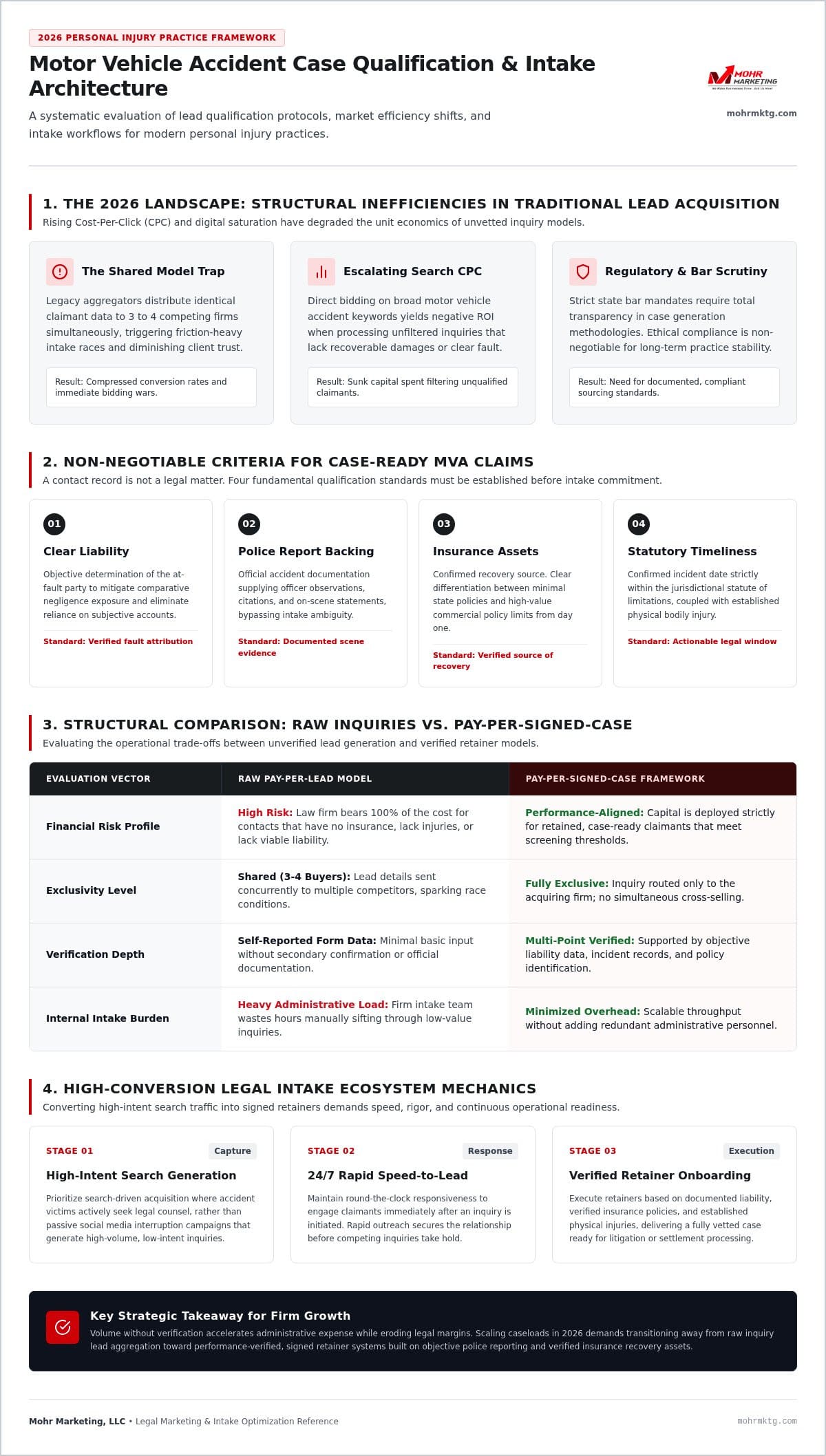
Digital saturation has fundamentally changed how law firms acquire motor vehicle accident leads. By 2026, the search market for high-intent keywords has reached a tipping point where traditional bidding strategies often yield negative returns. Many firms find themselves trapped in “shared lead” models that sell the same inquiry to three or four competitors simultaneously. This creates a friction-heavy experience for the claimant and a low-conversion environment for the attorney. Modern firms are moving away from these legacy systems, favoring exclusive inquiries generated through search rather than social media interrupt marketing. While platforms like Facebook can generate volume, they don’t offer the immediate intent found when a victim actively searches for legal recourse after an accident.
Compliance is another critical factor in the current market. Strict state bar mandates now require rigorous transparency in how cases are sourced and vetted. Firms must ensure their lead generation partners operate with the same ethical standards as the firm itself to avoid regulatory scrutiny. Transparency in the acquisition process isn’t just a legal requirement; it’s a competitive advantage that builds trust before the first phone call.
Why MVA Leads Remain the Gold Standard for PI Firms
Motor vehicle accidents continue to anchor the personal injury sector because they operate within a highly predictable personal injury legal framework. Unlike complex medical malpractice or niche product liability cases, MVA claims often feature clearer liability structures that simplify the path to settlement. The high frequency of incidents ensures a continuous market supply, while case values remain relatively predictable based on established insurance policy limits. These factors make motor vehicle accident leads the most reliable asset for scaling a practice, provided the firm can filter out low-value noise through rigorous intake.
The Rising Cost of Raw Traffic and the Need for Efficiency
The average Cost-Per-Click (CPC) for “car accident lawyer” in 2026 search markets has forced a shift from quantity to quality. Bidding on raw traffic is no longer sustainable for firms without massive budgets. Every “junk” lead, specifically those involving no insurance, no injury, or no liability, represents a direct hit to your ROI. Efficiency is the only way to survive these rising costs. Lead waste is the cumulative loss of capital and labor hours spent processing inquiries that lack the legal or financial criteria required for a viable retainer. To maintain growth, firms must utilize police-report backed MVA cases and other verified sources to ensure their intake teams focus only on high-value opportunities.
Defining High-Quality Criteria for MVA Case Qualification
Acquiring motor vehicle accident leads requires more than a high marketing budget; it demands a surgical approach to qualification. A name and a phone number are not a case. For an inquiry to be considered “case-ready,” it must meet a set of non-negotiable criteria that protect your firm’s time and capital. This includes verified incident dates within the statute of limitations, clear physical injury, and a definitive source of financial recovery. Without these pillars, your intake team is merely processing data rather than building a docket.
Liability and Fault Determination
Establishing clear liability is the first hurdle in case acquisition. You can’t afford to build a practice on “he said, she said” disputes that lead to protracted litigation with uncertain outcomes. Effective screening identifies the at-fault party through objective evidence before the retainer is even sent. This is especially vital in jurisdictions with comparative negligence rules, where even a small percentage of fault attributed to your client can drastically reduce the settlement value. Utilizing police report-backed MVA cases allows your firm to skip the guesswork. These reports provide the officer’s observations, witness statements, and any citations issued at the scene, offering a level of liability clarity that claimant interviews alone cannot provide.
Insurance Coverage and Policy Limit Verification
A lead is worthless without a viable source of recovery. Your intake process must prioritize the identification of insurance assets from the outset. We differentiate between minimum state limits and high-value commercial policies, such as those held by trucking companies or delivery fleets. A sophisticated intake strategy also identifies opportunities in hit-and-run scenarios or accidents involving uninsured motorists by looking for UM/UIM coverage. This level of verification ensures that every signed case has the financial depth to justify your firm’s investment of labor and resources.
Objective documentation of injuries provides the necessary leverage for settlement negotiations. While motor vehicle accident statistics highlight the sheer volume of road incidents, firms must focus on those with objective medical evidence. We screen for immediate hospital visits, diagnostic imaging, and ongoing treatment plans. This rigorous filtering ensures that the motor vehicle accident leads entering your pipeline are not just inquiries, but high-value legal assets. If your current intake process feels like a revolving door of unqualified callers, it may be time to evaluate a more disciplined acquisition model.
Comparing Lead Models: Raw Inquiries vs. Pay-Per-Signed-Case
The financial structure of your case acquisition determines your firm’s scalability. Traditional Pay-Per-Lead (PPL) models function on a volume-first basis. In this scenario, you purchase raw motor vehicle accident leads that consist of basic contact data. The provider’s job ends once the data is delivered, leaving the risk of non-conversion entirely on your shoulders. Conversely, the Pay-Per-Signed-Case (PPSC) model is a performance-based alternative. Here, the provider manages the marketing, screening, and intake, and you only pay when a qualified claimant signs a retainer. This shift in incentives ensures that the provider is as invested in the case quality as your firm is.
When analyzing ROI over a 12-month period, the differences become stark. PPL models often appear cheaper on a per-unit basis, but they carry hidden volatility. You might buy 100 leads and only sign five cases, making your actual cost-per-case unpredictable. With signed retainers, your acquisition cost is fixed. This predictability allows for precise budgeting and aggressive expansion without the fear of a sudden drop in lead quality draining your cash flow.
The Hidden Costs of Raw Lead Acquisition
Processing raw inquiries creates what we call an “Intake Tax.” This is the cumulative cost of labor hours your team spends chasing unresponsive or unqualified callers. Speed-to-lead is a factor here; a lead that isn’t contacted within minutes loses significant value as the claimant moves on to a competitor. Understanding car accident statistics and trends reveals that while incident volume is high, the percentage of cases with clear liability and sufficient insurance is much smaller. Calculating the financial impact of chasing the “wrong” motor vehicle accident leads is essential for any firm looking to optimize growth. You can find a deeper breakdown of these mechanics in our analysis of The ROI of Legal Intake Services.
Signed Retainers: The Zero-Waste Acquisition Strategy
Signed retainers represent the ultimate friction-reduction strategy. By receiving a case that has already been vetted for liability, insurance, and injury, your firm skips the most labor-intensive part of the sales funnel. Firms scaling nationally often prefer the model used for mass tort signed cases, applying that same rigorous efficiency to MVA acquisition. This zero-waste approach means your attorneys spend their time on litigation and settlements rather than managing a call center. It’s a methodical path to growth that prioritizes secured assets over speculative inquiries.
Optimizing the Legal Intake Ecosystem for MVA Conversion
Speed-to-lead is the single most critical factor in MVA conversion. In a competitive digital market, motor vehicle accident leads lose a staggering 80% of their value if they aren’t contacted within the first five minutes. Claimants are often in a state of high stress; if they reach a voicemail or a delayed response, they’ll simply call the next firm on their list. Your intake ecosystem must operate 24/7/365 to capture these opportunities as they happen. We utilize a “Warm Transfer” process for high-intent callers to eliminate the “chase” phase of lead management. This method ensures a seamless handoff between the initial inquiry and a qualified intake professional while the claimant’s intent is at its peak.
Capturing verified call transfer leads allows your firm to capitalize on immediate momentum. This process removes the friction of outbound dialing and allows your team to focus exclusively on qualification and closing. Executing a digital retainer immediately upon qualification is the standard for firms scaling their caseload. If you allow a claimant to hang up without a signed agreement, you’ve essentially handed that lead back to the open market.
The Mechanics of a High-Conversion Intake Script
A high-conversion script prioritizes clinical efficiency over open-ended conversation. You must confirm three key data points within the first 60 seconds: the date of the accident, the presence of physical injury, and the insurance status of the parties involved. This approach prevents your team from wasting time on non-viable inquiries while identifying high-value cases early. When a claimant expresses hesitation, your intake professionals should address the objection with empathy while pivoting back to the urgency of securing evidence. Balancing a serious, business-like demeanor with a supportive tone builds the trust necessary to move toward a signature.
Leveraging Technology for Immediate Case Capture
Technology eliminates the gap between an inquiry and a secured legal asset. SMS and email automation keep the claimant engaged if they can’t speak immediately, ensuring your firm remains their primary point of contact. Use e-signature platforms to execute retainers while the claimant is still on the phone. This “one-call close” mentality is essential for processing motor vehicle accident leads at scale. You must implement an automated digital follow-up sequence that triggers the moment an inquiry enters your system to maintain engagement.
Scaling Your Firm with Mohr Marketing’s MVA Solutions
Scaling a law firm requires a predictable engine, not a series of marketing experiments. Mohr Marketing, LLC provides a turnkey ecosystem that removes the operational burden of sourcing motor vehicle accident leads. With over 30 years of industry experience, Michael Mohr has refined a methodology that prioritizes compliance and high intent. This isn’t a standard lead-buying arrangement; it’s a strategic partnership designed to replace inefficient internal processes with a streamlined, external acquisition team. By leveraging this ecosystem, firms can shift their focus from administrative intake to high-level litigation and settlement negotiations.
Transitioning to a performance-based model eliminates the financial risk inherent in traditional marketing. Instead of paying for raw inquiries that may never convert, firms can secure signed retainers that represent immediate legal assets. This approach allows you to scale your national presence or dominate a specific niche with absolute budget certainty. Whether you’re targeting standard passenger vehicle collisions or catastrophic commercial incidents, the goal remains the same: high-value results with zero lead waste.
Custom Funnels for Specialized MVA Categories
Specialization is the key to higher settlement values. We develop custom funnels tailored to specific incident types, ensuring that the messaging resonates with high-intent claimants. This includes acquiring truck accident signed cases where policy limits are significantly higher than standard auto policies. We also apply these rigorous standards to motorcycle and pedestrian accidents, as well as complex litigation like high-value mold case acquisition. Each funnel is built to filter for the specific liability and injury markers your firm requires, ensuring your docket remains filled with viable cases.
Getting Started with a Performance-Based Partnership
The onboarding process is designed for speed and precision. We begin by establishing your specific case criteria, including geographic targeting and minimum injury thresholds. Once your volume requirements are set, our turnkey system begins delivering verified, case-ready claimants directly to your firm. This is the most direct path to scaling without increasing your firm’s internal overhead or administrative friction. If you’re ready to stop gambling on raw motor vehicle accident leads, it’s time to take the next step. Contact Mohr Marketing, LLC to audit your current acquisition strategy and see how a performance-based model can transform your firm’s growth trajectory.
Secure Your Competitive Advantage in MVA Acquisition
The 2026 market doesn’t reward firms that simply spend the most; it rewards those with the most efficient intake systems. Transitioning from raw data to a performance-based model is the only sustainable way to scale in a high-CPC environment. By focusing on signed retainers, your firm eliminates the “intake tax” and ensures that every dollar spent translates into a secured legal asset.
Success in this landscape requires a partner who understands the nuances of liability and insurance verification. Mohr Marketing leverages over 30 years of industry experience to provide a state bar compliant ecosystem built for results. Our turnkey approach delivers verified high-intent case acquisition, allowing you to bypass the noise of low-quality motor vehicle accident leads and focus on litigation.
You have the tools to move beyond raw inquiries and build a more resilient practice. Implementing a zero-waste strategy ensures your firm remains agile and profitable as digital competition continues to intensify. Take control of your growth trajectory by adopting a model that prioritizes case-ready claimants over speculative contact data.
Frequently Asked Questions
What is the difference between an MVA lead and a signed case?
An MVA lead is an initial inquiry containing contact data and incident details that requires further screening and intake. A signed case is a performance-based asset where the claimant has already passed all qualification hurdles and executed a retainer agreement. This model removes the risk of non-conversion from the law firm and places it on the provider, ensuring you only pay for litigation-ready opportunities.
How do you verify the liability of a motor vehicle accident lead?
We verify liability through a rigorous screening process conducted by intake professionals. This includes questioning claimants on the specifics of the incident, such as points of impact, witness availability, and any citations issued at the scene. For maximum clarity, we often utilize police-report backed data to confirm the at-fault party before a case is delivered. This objective verification prevents your firm from wasting resources on disputes.
Are your MVA leads exclusive to my law firm?
Yes, all motor vehicle accident leads and signed cases delivered through our turnkey ecosystem are exclusive to your law firm. We don’t utilize shared lead models where the same inquiry is sold to multiple competitors simultaneously. Exclusive delivery is essential for maintaining high conversion rates and ensuring your intake team isn’t forced into a race against other firms, which often degrades the claimant experience and ROI.
What insurance criteria do you use to qualify MVA claimants?
Qualification requires the identification of a viable source of recovery. We screen for active liability coverage from the at-fault party and verify if the claimant has Uninsured/Underinsured Motorist coverage for hit-and-run or uninsured scenarios. Our intake team also differentiates between standard personal policies and high-value commercial policy limits. This ensures that every case your firm acquires has the financial depth necessary to justify the investment of legal labor.
How quickly are leads delivered after an accident occurs?
We prioritize speed-to-lead through a 24/7/365 intake infrastructure. Inquiries are processed the moment they enter our system, often resulting in a warm transfer or a signed retainer within minutes of the claimant’s initial search. Real-time delivery is the only way to maintain a competitive advantage in the 2026 legal market. Delaying contact by even one hour can result in a significant drop in conversion as claimants continue their search.
Do you provide MVA leads for specific niches like trucking or Uber accidents?
Yes, our marketing ecosystem creates custom funnels for specialized categories including commercial trucking, motorcycle accidents, and rideshare incidents like Uber or Lyft. These cases often involve complex liability frameworks and higher policy limits, requiring specific intake scripts to ensure proper qualification. By targeting these high-value niches, your firm can diversify its docket and increase the average settlement value across your entire portfolio of motor vehicle accident leads.
What is the typical conversion rate for a signed retainer model?
The conversion rate for the signed retainer model is effectively 100% because the firm only pays for cases that have already executed a retainer agreement. Unlike raw lead models where conversion might hover between 5% and 15% depending on intake efficiency, the pay-per-signed-case model eliminates the intake tax. This performance-based structure provides absolute predictability for your marketing spend and allows your attorneys to focus on litigation rather than chasing unresponsive data.
How does Mohr Marketing ensure compliance with state bar advertising rules?
Mohr Marketing maintains strict compliance with state bar advertising rules and mandates through a transparent, data-driven approach. With over 30 years of experience, founder Michael Mohr ensures that all marketing materials and intake processes adhere to ethical guidelines regarding claimant solicitation and transparency. Our turnkey ecosystem is designed to protect your firm’s reputation while delivering high-intent opportunities, providing a reliable path to growth that meets all regulatory requirements.
Recent Posts
- Motor Vehicle Accident Leads: A 2026 Guide to High-Intent Case Acquisition
- Legal Intake Solutions: The 2026 Guide to Maximizing Law Firm ROI
- Tampon Mass Tort: A Professional Guide to Litigation Trends and Case Acquisition
Categories
- AI and Lead Generation
- Business Financing
- Call Verified MVA Leads
- Car Accident Help
- Car Accident Settlements
- Claimant Funding
- Compliance Program
- EMS-EMT Reports
- Geotargeting
- Google Maps Ranking
- Healthcare Practice Growth
- Law Firm Growth
- Law Office Operations
- Lead Generation
- Lead Generation For Attorneys
- Lead Generation For Chiropractors
- Lead Generation For Criminal Attorneys
- Lead Generation For D&A Treatment Centers
- Lead Generation For DUI Attorneys
- Lead Generation For Eye Doctors
- Lead Generation For Family Law Practices
- Lead Generation For PI Law Firms
- Lead Generation For Plastic Surgeons
- Leads For Healthcare Professionals
- Leads For Insurance Industry
- Legal Leads
- Legal Marketing
- Legal Updates
- Mass Tort Leads
- Medicare and Medicaid Leads
- Merchant Funding Leads
- Online Marketing Strategies
- Pre-Settlement Funding
- Signed MVA Cases
- Tort Updates
- Truck Accident Leads and Signed Cases
- Truck Accident Settlements
- Web Design