Emergency vehicle response to accident Best Practices and Expert Advice
September 11, 2026 by Mohr Marketing
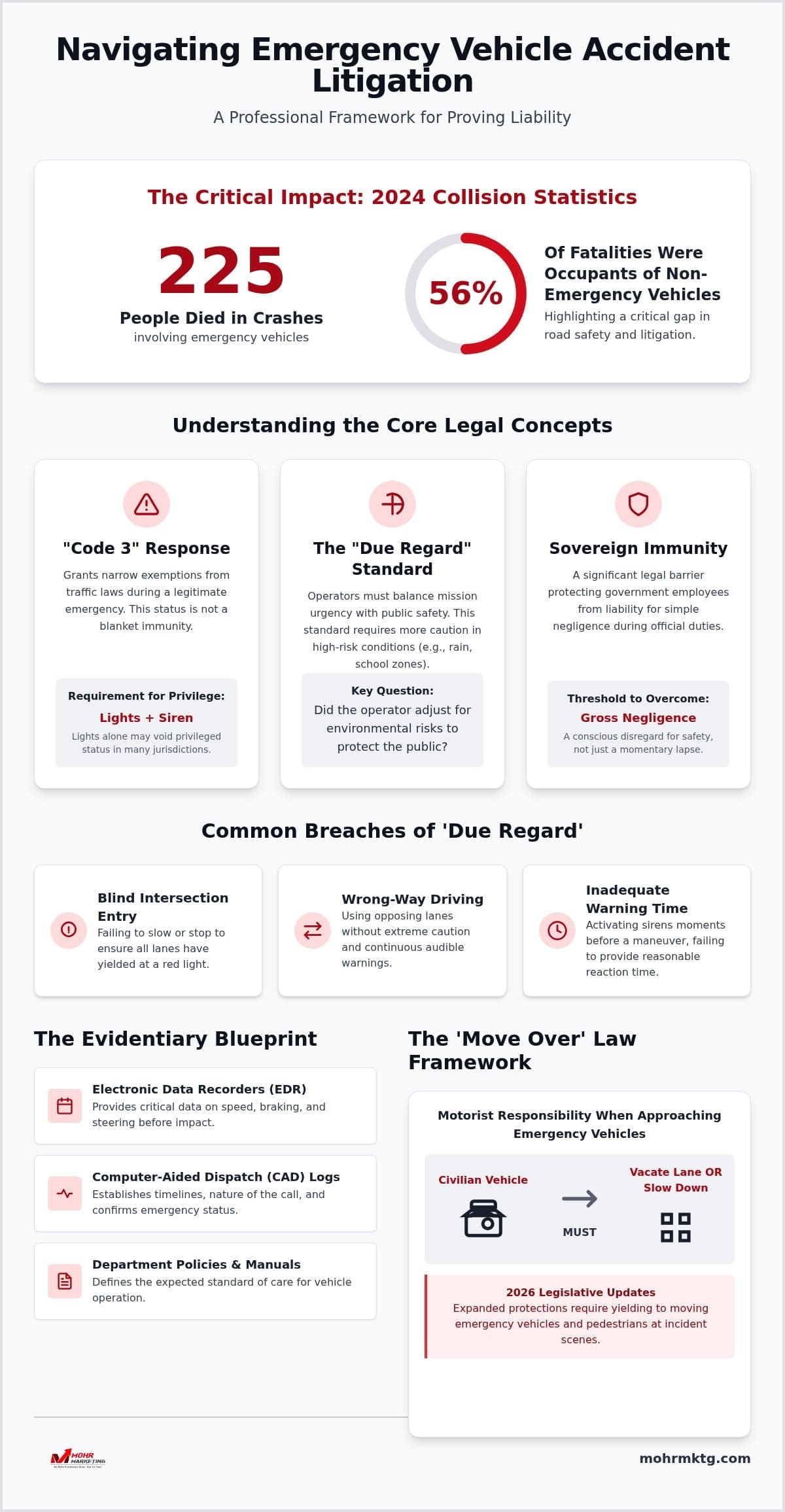
In 2024, 225 people died in crashes involving emergency vehicles, and 56% of those fatalities were occupants of non-emergency vehicles. These statistics highlight a critical gap in road safety and a complex area of litigation. You’ve likely faced the difficulty of proving liability when an emergency vehicle response to accident results in a secondary collision. Sovereign immunity often acts as an impassable wall for firms without a precise investigative framework.
This guide provides a professional framework for navigating the legal complexities and response protocols surrounding these high-stakes incidents. You’ll learn how to distinguish between simple negligence and the “gross negligence” threshold required to overcome immunity. We’ll examine the “due regard” standard, the impact of 2026 legislative shifts like the expanded Scott’s Law, and strategies for identifying high-value MVA leads. This article delivers a scalable strategy for investigating these cases and securing the evidence needed for a successful recovery.
Key Takeaways
- Understand how “Code 3” status activates legal privileges during an emergency vehicle response to accident and why lights alone don’t grant total immunity.
- Master the “Due Regard” standard to effectively challenge the legal defenses used by government agencies in secondary collision cases.
- Learn the specific procedural hurdles for overcoming sovereign immunity under the Federal Tort Claims Act and state-level equivalents.
- Identify the critical technical evidence required for successful litigation, including Electronic Data Recorders and Computer-Aided Dispatch logs.
- Implement a rigorous intake process to identify high-value MVA leads with clear liability and manageable immunity profiles.
Defining Emergency Vehicle Response Protocols at Accident Scenes
Emergency response status isn’t a blanket authorization for traffic violations; it’s a specific legal state. It grants responders narrow exemptions from standard traffic codes, such as speed limits and signal obedience, provided they’re engaged in a legitimate emergency vehicle response to accident. These privileges are contingent upon the nature of the dispatch and the immediate necessity of the mission. When an officer or paramedic is in standard transit or returning from a scene, they operate under the same rules of the road as any civilian driver. Failing to distinguish between these states is a common pitfall in liability assessment.
The distinction between “Code 3” and standard transit is the primary pivot for legal protection. Code 3 requires the simultaneous use of emergency lights and sirens to signal a high-priority response. If a responder operates with lights only, they may lose their privileged status in many jurisdictions. The right-of-way hierarchy at an active scene prioritizes the safety of the responders and the victims already on-site. First-arriving units often position their vehicles to create a physical buffer, a tactic known as “fend-off” positioning. Motorists who breach this perimeter face severe liability, especially as national legislative trends shift toward stricter roadside protections.
Visual and Audible Warning Requirements
Standardized protocols require sirens to be audible from at least 500 feet and lighting systems to provide 360-degree visibility. Privilege only exists when these warning devices are activated in a manner that provides “effective warning” to the public. If a responder activates their siren only seconds before entering an intersection, they’ve failed to provide adequate notice. Courts look for a consistent warning pattern that allows a reasonable driver time to react and yield. Negligence often stems from “silent” responses where a driver relies solely on lights in a high-traffic environment.
The Move Over Law Framework
National standards mandate that motorists vacate the lane closest to an emergency vehicle or reduce speed significantly if a lane change is unsafe. Legislative updates effective in 2026 have expanded these protections in several jurisdictions, requiring drivers to yield to moving emergency vehicles and pedestrians at incident scenes. These changes are often backed by strict penalties, including minimum fines for first and second offenses to deter negligence. This framework is a critical component in police-report-backed MVA cases. When a motorist fails to move over during an emergency vehicle response to accident, the burden of liability often shifts away from the responder, provided the emergency vehicle was following established lighting and positioning protocols.
The Legal Standard of Care: Due Regard vs. Gross Negligence
The “Due Regard” standard is the legal pivot for every emergency vehicle response to accident. While responders possess exemptions from standard traffic codes, they don’t have a license for recklessness. Due regard requires operators to balance the urgency of their mission against the safety of the public. It is a flexible standard that tightens as environmental risks increase. For instance, a responder must exercise a higher level of caution in heavy rain or congested school zones than on a clear, empty highway. Failing to adjust speed or warning patterns to these conditions often constitutes a breach of this duty.
Litigation in this space typically moves beyond simple negligence. Because most responders are government employees, plaintiffs must often meet the higher threshold of “Gross Negligence” or “Reckless Disregard.” Simple negligence involves a failure to use ordinary care, such as a momentary lapse in attention. Gross negligence, however, requires a conscious and voluntary disregard of the need to use reasonable care, which is likely to cause foreseeable harm. Identifying where a responder’s actions crossed this line is the foundation of any successful liability claim against a municipality.
Navigating the ‘Due Regard’ Threshold
Evaluating driver actions requires a methodical comparison against both state law and internal department policies. To determine if a driver maintained due regard, investigate these common violations:
- Blind Intersection Entry: Responders must slow down or stop to ensure all lanes have yielded before proceeding through a red light.
- Wrong-Way Driving: Utilizing opposing lanes of travel requires extreme caution and a continuous audible warning.
- Inadequate Warning Lead Time: Activating sirens only moments before a maneuver fails the “effective warning” test.
Internal Standard Operating Procedures (SOPs) often set a higher bar than state law. If a department policy mandates a full stop at red lights and the driver only rolled through, that violation serves as a powerful indicator of a breach in the standard of care. To optimize your case selection, connect with our intake specialists to discuss verifying these critical liability markers during the initial lead screening.
Gross Negligence in Emergency Scenarios
Proving gross negligence is the only way to pierce the shield of sovereign immunity in many jurisdictions. Conduct that exceeds simple negligence includes driving at extreme speeds in low-visibility conditions or responding to a non-emergency call with Code 3 protocols. Establishing a pattern of reckless behavior within the department can also strengthen a claim. If a specific driver has a history of preventable accidents that the department failed to address, the liability may extend to negligent supervision or retention. This systemic failure transforms a single accident into a high-value claim with clear evidence of institutional disregard for public safety.
Sovereign Immunity and Liability in Emergency Situations
Sovereign immunity is the most formidable barrier in litigation involving an emergency vehicle response to accident. This doctrine generally shields government entities and their employees from civil liability. To pursue a claim, you must find a waiver of this immunity. The Federal Tort Claims Act (FTCA) provides this framework at the federal level, while state-level Tort Claims Acts govern local police, fire, and EMS departments. These statutes often limit the amount of recoverable damages and impose strict notice requirements. Missing a “Notice of Claim” deadline, which can be as short as 60 or 90 days, will terminate a case before it begins.
The core of these cases often rests on the “Ministerial vs. Discretionary” test. A ministerial act is one performed under a specific mandate or rule that leaves nothing to the responder’s judgment. For example, if a department policy explicitly requires a full stop at all red lights, that act is ministerial. Conversely, a discretionary act involves the exercise of personal judgment or choice. Sovereign immunity typically protects discretionary decisions made in the heat of an emergency but fails when a responder violates a clear, non-discretionary protocol.
The Discretionary Function Exception
Responders often argue that their speed and route choices are discretionary. However, this protection evaporates if their conduct violates a specific safety mandate. If a driver bypasses a mandatory safety check during an emergency vehicle response to accident, the discretionary shield no longer applies. Proving these violations requires deep dives into training manuals and standard operating procedures. When systemic failures in these protocols lead to widespread injury, firms often leverage mass tort lead generation to identify multiple claimants affected by the same departmental negligence.
Liability of Non-Governmental Responders
Private ambulance services and towing companies don’t enjoy the same immunity as government agencies. These entities are private contractors and are usually subject to standard commercial liability and negligence laws. They must maintain substantial commercial insurance policies to operate. Because they lack the sovereign shield, cases involving private responders are often more straightforward to litigate. These incidents frequently overlap with heavy vehicle litigation, making truck accident signed cases involving private response fleets high-value targets for growth-oriented firms. Verifying the commercial status of the responder is a critical first step in your intake process.
Critical Evidence in Emergency Vehicle Accident Investigations
Police reports serve as a foundational document, but in cases involving an emergency vehicle response to accident, they often reflect the perspective of the responding agency. Objective litigation requires a focus on digital evidence that cannot be altered or influenced by departmental bias. Prioritize the immediate recovery of Electronic Data Recorders (EDRs). These “black boxes” capture critical telemetry, including speed, braking force, and steering input, in the five seconds preceding a collision. This data often refutes the “official” speed estimates provided in the initial accident report and provides the mechanical proof needed to challenge a driver’s account of the incident.
Dashcam and bodycam footage provide the necessary visual and audible context for warning device activation. It’s not enough for a driver to claim their sirens were on; the footage must prove they were activated in a manner that provided effective warning to other motorists. Secure this footage through a formal preservation letter immediately. Many departments have short retention cycles, and critical video can be overwritten within 30 days. Additionally, interview independent eyewitnesses before the department’s narrative is solidified. Civilian accounts often highlight erratic driving or delayed siren usage that may be omitted from internal investigative summaries.
Leveraging Telematics and GPS Data
Modern emergency fleets utilize advanced telematics that track more than just basic velocity. GPS breadcrumbs allow you to reconstruct the entire response route, revealing if the operator chose a high-risk path when safer, more direct alternatives existed. This reconstruction is essential for refuting claims of “Due Regard” when a driver enters a blind intersection or travels the wrong way on a one-way street. Rapid evidence preservation is mandatory in these MVA cases. Once a vehicle is sent for repairs or decommissioned, the digital trail often disappears, leaving you with only subjective testimony to support your claim.
Evaluating Dispatch and Radio Communications
Secure Computer-Aided Dispatch (CAD) logs and radio communications to verify the actual urgency level assigned to the initial call. Discrepancies between the dispatcher’s assigned priority and the driver’s response mode can eliminate the legal privileges associated with an emergency vehicle response to accident. If a call was logged as a low-priority “Code 2” but the driver utilized “Code 3” lights and sirens, they may have exceeded their legal authority. Cross-referencing radio traffic with physical scene evidence allows you to detect inconsistencies in response times and driver statements. These logs provide a timestamped, unalterable record of the mission’s true nature.
Strategic Case Acquisition for Complex Motor Vehicle Accidents
Complex MVA claims involving government or private responders represent high-stakes assets for growth-oriented firms. It’s a surgical focus on liability and immunity status that defines profitability from the moment of first contact. Success depends on your ability to filter for “gross negligence” markers before committing significant legal resources. Partnering with personal injury lead generation companies allows your firm to target these incidents without the overhead of broad-spectrum marketing. By focusing on signed retainers, you ensure immediate ROI and litigation readiness in cases stemming from a negligent emergency vehicle response to accident. Adopting this framework ensures your firm captures high-value leads where the “due regard” standard was breached. Mohr Marketing, LLC acts as the strategic partner to facilitate this high-precision transition.
The ROI of Legal Intake Services
In cases involving an emergency vehicle response to accident, speed-to-lead is a critical performance indicator. Evidence like dashcam footage and electronic data recorders is often subject to short retention cycles. If your intake process doesn’t move immediately, you’ll lose the technical proof required to overcome sovereign immunity. Understanding the ROI of legal intake services is essential for maximizing conversion efficiency. A rigorous verification process eliminates low-value inquiries, such as those where the claimant was clearly at fault for failing to yield. This level of scrutiny ensures your team only handles cases with a high probability of recovery and clear liability markers, effectively triaging immunity hurdles before they drain your firm’s resources.
Scaling with Mohr Marketing, LLC’s Performance Model
Scaling a practice focused on complex MVA claims requires a predictable flow of high-intent cases. Mohr Marketing, LLC provides a turnkey ecosystem that delivers verified inquiries meeting strict legal criteria. Our Pay-Per-Signed-Case model removes the financial risk of traditional lead generation. You aren’t paying for raw data; you’re paying for a secured client ready for the litigation process. With 30 years of industry experience, we understand the nuances of departmental protocols and state-specific mandates. Our deep insider knowledge allows us to identify high-value opportunities that standard agencies often miss. We focus on the mechanics of growth, removing friction from your business processes and providing a sustainable path for expansion in the competitive MVA landscape while ensuring strict compliance with bar mandates.
Scale Your Practice Through Rigorous Liability Analysis
Successfully litigating a secondary collision requires more than just proving a traffic violation. It demands a surgical approach to the emergency vehicle response to accident, focusing on the narrow exceptions to sovereign immunity. By leveraging the technical evidence and legal standards discussed, your firm can transform these complex MVAs into predictable revenue streams. The competitive advantage belongs to firms that eliminate the friction of manual intake and low-quality lead filtering.
Mohr Marketing, LLC provides a Verified, High-Intent Lead Ecosystem built on 30+ Years of Legal Marketing Expertise. Our Transparent, Data-Driven Performance Models ensure you only pay for cases that meet your specific litigation criteria. This partnership allows you to focus on the courtroom while we secure the high-value retainers necessary for sustainable firm expansion.
Our team is ready to help you implement this scalable acquisition strategy and dominate the complex MVA landscape.
Frequently Asked Questions
What is the ‘Due Regard’ standard for emergency vehicle drivers?
The ‘Due Regard’ standard requires emergency vehicle operators to drive with the safety of all persons in mind. While state laws grant exemptions for speed and traffic signals, these privileges don’t authorize reckless behavior. Drivers must constantly evaluate traffic density, weather, and intersection visibility. If a driver fails to balance the urgency of the mission with public safety, they breach this duty. This standard is the primary metric used to determine liability.
Can you sue a police department for an accident during a high-speed chase?
You can sue a police department if the pursuit involved reckless disregard for safety. Most jurisdictions require proving gross negligence rather than simple negligence to overcome sovereign immunity. Courts examine whether the pursuit’s risk outweighed the need to apprehend the suspect immediately. Factors include the speed of the chase, the nature of the alleged crime, and whether the department’s internal pursuit policies were followed during the emergency vehicle response to accident.
Does sovereign immunity protect all emergency responders nationally?
Sovereign immunity is a national legal doctrine, but its application varies significantly between federal, state, and local agencies. Federal responders are governed by the Federal Tort Claims Act, while local departments follow state-specific tort claims acts. These laws often provide a limited waiver of immunity for motor vehicle accidents. However, many states still require a showing of willful or wanton misconduct to hold a government entity liable for damages.
How do dashcams influence liability in emergency vehicle accidents?
Dashcams provide objective evidence of whether a responder provided effective warning to other motorists. They capture the exact moment sirens were activated and the visibility of emergency lighting. This footage can refute a driver’s claim that they stopped at a red light or slowed down before entering an intersection. In many cases, dashcam data is the only way to challenge an official police report that inaccurately describes the scene’s conditions.
What is the difference between Code 2 and Code 3 response levels?
Code 2 response typically indicates an urgent call where the driver follows normal traffic laws without using lights or sirens. Code 3 is a true emergency response that utilizes both audible and visual warning devices. Legal privileges and traffic law exemptions only apply during a Code 3 response. If a driver causes an accident while responding at Code 2 but driving like it’s Code 3, they lose their legal protections.
Who is liable if a private ambulance causes an accident?
Private ambulance companies are generally treated as commercial entities and don’t enjoy the protection of sovereign immunity. Liability rests with the private corporation and its insurance provider. These cases are often governed by standard negligence rules rather than the higher gross negligence threshold required for government agencies. Because they operate for profit, their internal training records and maintenance logs are fully discoverable during litigation to establish a pattern of safety failures.
How do ‘Move Over’ laws affect personal injury claims?
Move Over laws create a statutory duty for civilians to yield or change lanes for responders. If a motorist violates these laws, the burden of liability often shifts to them, even if the emergency vehicle was speeding. However, if the responder failed to provide an effective warning, the civilian may still have a valid claim. These laws are increasingly used by defense counsel to argue comparative negligence in responder-involved accidents.
What evidence is most critical in an emergency vehicle collision case?
The most critical evidence includes Electronic Data Recorders (EDRs) and Computer-Aided Dispatch (CAD) logs. EDRs provide precise data on braking and velocity in the seconds before impact. CAD logs and radio recordings verify the true priority level of the call. Additionally, internal department Standard Operating Procedures are essential. Violating a specific department mandate during an emergency vehicle response to accident can transform a discretionary act into a ministerial failure.

Recent Posts
- Emergency vehicle response to accident Best Practices and Expert Advice
- 2026 Law Firm Marketing Budget: Performance-First Guide
- EMS Data Mining: High-Intent Case Acquisition Guide
Categories
- AI and Lead Generation
- Business Financing
- Call Verified MVA Leads
- Car Accident Help
- Car Accident Settlements
- Claimant Funding
- Compliance Program
- EMS-EMT Reports
- Geotargeting
- Google Maps Ranking
- Healthcare Practice Growth
- Law Firm Growth
- Law Office Operations
- Lead Generation
- Lead Generation For Attorneys
- Lead Generation For Chiropractors
- Lead Generation For Criminal Attorneys
- Lead Generation For D&A Treatment Centers
- Lead Generation For DUI Attorneys
- Lead Generation For Eye Doctors
- Lead Generation For Family Law Practices
- Lead Generation For PI Law Firms
- Lead Generation For Plastic Surgeons
- Leads For Healthcare Professionals
- Leads For Insurance Industry
- Legal Leads
- Legal Marketing
- Legal Updates
- Mass Tort Leads
- Medicare and Medicaid Leads
- Merchant Funding Leads
- Online Marketing Strategies
- Pre-Settlement Funding
- Signed MVA Cases
- Tort Updates
- Truck Accident Leads and Signed Cases
- Truck Accident Settlements
- Web Design