Getting Medical Malpractice Cases: 2026 Law Firm Guide
September 6, 2026 by Mohr Marketing
Most law firms are burning capital on high-volume lead generation while drowning in non-meritorious inquiries that never reach a courtroom. You’ve likely seen the data showing that medical malpractice acquisition is significantly more expensive than standard motor vehicle accident work. The real challenge isn’t just finding volume; it’s mastering how to get medical malpractice cases that survive rigorous clinical review.
You need a predictable stream of signed cases, not a pile of raw data. With medical malpractice verdicts exceeding $10 million more than doubling in recent years, the stakes for your acquisition strategy have never been higher. This guide delivers a professional blueprint for law firms to identify, qualify, and acquire high-value cases through a scalable digital infrastructure. We’ve optimized this approach to eliminate the friction that typically stalls growth in this practice area.
We’ll walk through the mechanics of a verified intake process designed to filter out frivolous claims before they waste your staff’s time. You’ll learn how to leverage performance-based models to mitigate financial risk and secure exclusive retainers. By the end of this guide, you’ll have the tactical knowledge to lower your acquisition costs and build a more resilient, high-margin practice for 2026.
Key Takeaways
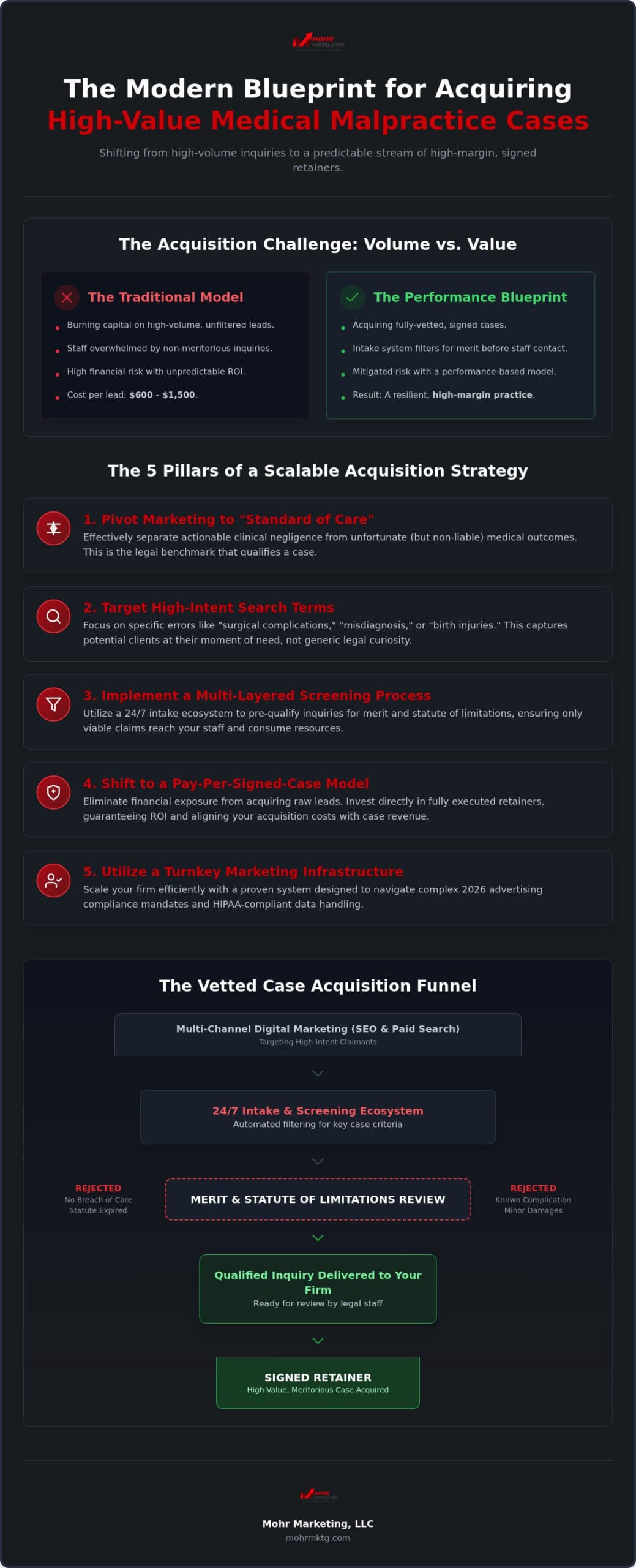
- Leverage the “Standard of Care” as your primary marketing pivot to effectively separate clinical negligence from unfortunate medical outcomes.
- Master how to get medical malpractice cases by targeting high-intent search terms related to specific errors, such as misdiagnosis and surgical complications.
- Implement a multi-layered screening process within a 24/7 intake ecosystem to filter for merit and statute of limitations before inquiries reach your staff.
- Reduce financial exposure by shifting from raw lead acquisition to a Pay-Per-Signed-Case model that delivers fully executed retainers.
- Scale your firm efficiently by utilizing a 30-year turnkey marketing infrastructure designed to navigate complex 2026 advertising compliance mandates.
The Complexity of Medical Malpractice Case Acquisition
Medical malpractice litigation presents a significantly higher barrier to entry than standard personal injury work. While motor vehicle accidents often rely on clear-cut police reports and traffic laws, malpractice requires a deep dive into clinical protocols. Mastering how to get medical malpractice cases begins with a shift in perspective: you aren’t just looking for injured people, you’re looking for clinical breaches. Your marketing must pivot around the “Standard of Care,” which is the legal benchmark determining whether a practitioner’s actions aligned with what a reasonably prudent professional would have done. Understanding the framework of Medical Malpractice in the United States is a prerequisite for identifying viable claims that can withstand a defense motion.
Search intent in this field is notoriously fragmented. Potential clients rarely start with broad legal terms. Instead, they search for specific medical failures like “anesthesia errors” or “failure to diagnose.” This fragmentation makes the question of how to get medical malpractice cases much more complex than standard accident litigation. To succeed, firms must account for the clinical nuances required at the intake stage. Dominating this space often requires a national perspective. Local markets are frequently too thin to provide the volume necessary to support highly specialized clinical niches like birth injuries or complex surgical errors.
The High Cost of Non-Meritorious Inquiries
Reviewing medical records is a major financial drain. Every hour your staff spends on a case that lacks clear causation is capital lost. Your marketing funnel must distinguish between “unhappy patients” who experienced a known complication and “actionable negligence” where a breach occurred. The merit gap is the difference between inquiry volume and signed case ROI. Without a rigorous filter, your firm will spend more on record acquisition and expert review than it recovers in settlements. You need a system that identifies high-value opportunities before they consume your billable hours.
Regulatory and Compliance Considerations in 2026
Compliance is a moving target that requires constant vigilance. In 2026, state bar mandates have tightened around how firms present medical outcomes and potential awards in advertising. You must maintain transparent, data-driven marketing to meet these ethical standards and protect your firm’s reputation. HIPAA-compliant data handling is also mandatory from the very first digital touchpoint. Every inquiry phase must secure protected health information to shield the firm from regulatory penalties. This technical precision ensures you can scale your acquisition efforts without creating professional liability for your own practice.
Building a Multi-Channel Digital Marketing Funnel
Capturing high-value cases requires more than broad visibility. You must intercept potential claimants at the exact moment they realize a clinical error occurred. Mastering how to get medical malpractice cases involves building a multi-channel funnel that combines the immediate reach of paid search with the long-term authority of search engine optimization. Your strategy should focus on high-intent search terms like “surgical errors” or “oncology misdiagnosis” rather than generic legal queries. This approach positions your firm as an expert resource capable of navigating the clinical complexities detailed in this Introduction to Medical Malpractice.
SEO for Medical Malpractice: Intent over Volume
Volume is a vanity metric in medical malpractice. Success depends on ranking for long-tail conditions and specific negligent acts that indicate a breach of duty. High-authority content builds trust with skeptical claimants who are often overwhelmed by medical jargon. By providing clear, instructional resources on specific injuries, you establish credibility before the first phone call. This specialized approach mirrors the high-intent model we use for mesothelioma leads, where search intent and strict case criteria are paramount.
Paid Search Strategies for Immediate Case Flow
Paid search offers immediate entry into the market, but it’s capital-intensive. With personal injury Google Ads leads often costing between $600 and $1,500 in 2026, waste is not an option. You must aggressively manage high CPCs through negative keyword optimization, stripping out “free” or “pro bono” queries that don’t fit your model. Design your landing pages to prioritize case qualification over simple contact collection. Ask specific questions about the date of the incident and the type of injury to filter out non-meritorious claims at the source.
Integrating “Call-to-Transfer” leads can significantly reduce response times. The “Golden 5 Minutes” rule is critical; your conversion rate drops sharply if you don’t connect with a lead immediately. Social media also plays a role in awareness-based acquisition, particularly for mass tort-style medical cases where a specific device or drug has caused widespread harm. If your current funnel is producing low-quality inquiries, it’s time to evaluate a more rigorous acquisition infrastructure that emphasizes lead quality over raw volume.
Optimizing the Legal Intake and Case Qualification Process
Intake is the stage where your marketing investment is either converted into revenue or lost to a competitor. Understanding how to get medical malpractice cases is only half the battle; the other half is qualifying those cases through a rigorous, high-speed ecosystem. You must establish a 24/7 intake infrastructure to capture leads the moment they arrive. In 2026, claimants expect immediate responses, and the “Golden 5 Minutes” remains the industry benchmark for conversion. If your firm isn’t equipped for instant engagement, you are effectively subsidizing your competitors’ growth.
Qualification in medical malpractice requires more than a standard script. You need specialized intake professionals who can navigate medical terminology and identify the difference between a known complication and actionable negligence. Automating the initial data collection allows your senior legal staff to focus on high-level clinical review rather than manual entry. This layered approach ensures that only cases with a high probability of merit reach your desk. By refining this phase, you eliminate the bottleneck of reviewing non-meritorious claims that drain your firm’s resources.
The 5-Step Qualification Framework
To maximize conversion efficiency, follow this structured screening process for every inquiry to ensure you are only pursuing high-value litigation:
- Step 1: Immediate conflict check and statute of limitations verification. Filter out cases that are legally barred or present professional conflicts before investing further time.
- Step 2: Determining the specific breach of the standard of care. Identify the specific clinical failure rather than general patient dissatisfaction.
- Step 3: Quantifying damages to ensure case viability. Focus on cases with significant incurred costs or long-term disability to justify the high cost of litigation.
- Step 4: Confirming the availability of medical records. Assess the claimant’s ability to provide the necessary documentation for expert review.
- Step 5: Securing the signed retainer while intent is high. Execute the retainer immediately once the case meets your internal criteria to lock in the lead.
The Role of Outsourced Intake in Conversion Efficiency
Standard office staff often fail at high-stakes intake because they lack the clinical background and the availability to manage inquiries in real-time. Speed-to-lead is the primary driver of signed case volume. Dedicated legal intake services ensure that high-intent leads are handled by professionals trained in the nuances of medical malpractice. This strategy shifts the burden of screening away from your firm while maintaining a high conversion rate for meritorious claims. When you master how to get medical malpractice cases through professional intake, you lower your overall acquisition costs and build a more predictable case pipeline.
Evaluating Performance-Based Case Acquisition Models
Many firms fail because they focus on vanity metrics like lead volume. In the medical malpractice vertical, raw leads are often a liability rather than an asset. Pay-Per-Lead (PPL) models frequently flood your intake team with non-meritorious claims, creating a bottleneck that wastes expensive legal resources. Mastering how to get medical malpractice cases in 2026 requires a shift to performance-based models that prioritize signed retainers over raw data.
The Pay-Per-Signed-Case (PPSC) model shifts the acquisition risk away from your firm. You only pay for fully executed retainers that meet your specific clinical and legal criteria. This strategy protects your capital and ensures your staff spends their time on litigation, not chasing unresponsive prospects. Exclusivity is a non-negotiable requirement for this to work. While non-exclusive leads lead to price wars and lower conversion, exclusive high-intent inquiries typically convert at rates between 15% and 30%.
Signed Retainers vs. Raw Leads
A “Signed Case” in medical malpractice is an inquiry that has passed clinical screening and executed your firm’s retainer agreement. This model eliminates the intake burden entirely. Your staff doesn’t need to explain the statute of limitations or perform initial conflict checks. This turnkey approach allows you to scale with the same efficiency found in high-volume Mass Tort Signed Cases. You receive a ready-to-file case file instead of a phone number and a hope.
Calculating ROI in High-Stakes Litigation
Your primary growth metric must be the Cost Per Signed Case (CPSC). In 2026, the average CPSC for medical malpractice ranges from $15,000 to $50,000 depending on the complexity and market. While this sounds high compared to MVA, the ROI is driven by case value. Statistics show that medical malpractice verdicts exceeding $10 million more than doubled between 2015 and 2023. Verified inquiries reduce administrative waste by ensuring every case has a documented audit trail of consent and merit. This performance-based marketing allows you to scale a national practice with surgical precision and predictable margins.
Scaling Your Firm with a Strategic Lead Generation Partner
Scaling a firm in the medical malpractice space is a logistics challenge that requires a specialized partner. You can’t rely on generalist agencies that treat these high-stakes claims like standard personal injury leads. A high-quality partner provides a turnkey marketing ecosystem that delivers high-intent opportunities without the burden of internal overhead. By integrating external case acquisition with your internal litigation workflows, you can focus on trial preparation while maintaining a predictable pipeline of signed retainers. This integration ensures that your legal team receives cases that are already vetted for clinical merit and liability.
Understanding how to get medical malpractice cases at scale means looking beyond raw volume and prioritizing the mechanics of lead verification. With over 30 years of industry experience, Mohr Marketing has navigated every major market shift and regulatory update. This longevity provides a strategic advantage in 2026, where advertising compliance and data handling are more complex than ever. We understand that a firm’s reputation is built on the quality of its cases, which is why our ecosystem focuses on strict adherence to state bar mandates and rigorous intake protocols.
The Mohr Marketing Advantage: Precision and Transparency
We emphasize verified inquiries over bulk volume. Our custom funnels are tailored to specific medical practice areas to ensure clinical relevance and high conversion. This precision-based approach is also applied to our strategies for High-Value Mold Case Acquisition, ensuring that every inquiry meets strict case criteria before it reaches your intake team. Transparency is our baseline; we provide clear audit trails and documented consent to protect your firm’s resources. You don’t have to guess the origin of your cases when you have a partner who prioritizes data integrity and mechanical accuracy.
Next Steps: Transitioning to a Performance Model
Audit your current intake process for leakages to identify where potential cases are falling through the cracks. Most firms lose significant ROI due to delayed follow-ups or untrained staff failing to recognize clinical negligence during the first call. Setting up a consultation for a custom acquisition strategy allows you to transition to a performance model that eliminates marketing waste and shifts the financial risk away from your firm. This transition allows you to scale without the need to hire additional marketing staff or specialized intake specialists. Act on high-intent data immediately to ensure your firm captures the market share it deserves.
Dominating the Medical Malpractice Market in 2026
The legal landscape in 2026 requires a departure from traditional, high-waste lead generation. Success depends on your ability to distinguish between general patient dissatisfaction and actionable clinical negligence at the point of entry. By implementing a multi-layered qualification framework and shifting to a performance-based acquisition model, you protect your firm’s capital while securing high-value litigation. Mastering how to get medical malpractice cases is no longer a volume game; it’s a precision operation that demands a scalable, compliant infrastructure.
Transitioning to a turnkey ecosystem eliminates the administrative burden of record review and intake bottlenecks. You don’t have to build this complex infrastructure from scratch. Leveraging a strategic partner allows your senior staff to focus on the courtroom while maintaining a predictable stream of signed retainers. With 30+ years of industry experience and a focus on verified, high-intent inquiries, Mohr Marketing provides the national scalability your firm needs to lead the market.
Take the next step toward a more efficient, high-margin practice and start acquiring the cases your firm is built to win.
Frequently Asked Questions
How do I qualify a medical malpractice case for merit?
Qualification requires verifying a breach of the standard of care that directly caused significant damages. You must confirm the practitioner-patient relationship and establish that the injury was not a known complication. Effective intake teams use clinical screening to filter for these elements before a case file reaches an attorney. This process reduces administrative waste and ensures your firm only invests in cases with high litigation value.
What is the average cost per signed medical malpractice case?
The cost to acquire a signed medical malpractice case in 2026 varies significantly based on the complexity of the clinical error and the competitiveness of the specific niche. While the acquisition cost is higher than motor vehicle accidents, the return is driven by rising verdict values. Strategic firms focus on the cost per signed case (CPSC) rather than the cost per lead to measure true profitability and ensure sustainable growth.
Can I buy medical malpractice leads on a national level?
You can absolutely acquire medical malpractice leads on a national level. In fact, scaling nationally is often necessary to find sufficient volume in specialized niches like birth injuries or anesthesia errors. Mohr Marketing utilizes a turnkey marketing ecosystem to deliver high-intent opportunities across the United States. This broad reach allows firms to dominate specific practice areas without being limited by the thin volume of a single local market.
How does a pay-per-signed-case model work for lawyers?
A pay-per-signed-case model is a performance-based arrangement where the firm only pays for fully executed retainer agreements. Instead of buying raw data or unverified inquiries, you receive qualified claimants who have already passed clinical screening. This model shifts the marketing risk away from the law firm and onto the provider. It’s the most efficient way to understand how to get medical malpractice cases while maintaining predictable acquisition margins and eliminating intake overhead.
What are the most common types of medical malpractice leads?
The most common medical malpractice leads involve failure to diagnose, surgical errors, and birth injuries. Other frequent inquiries include anesthesia complications and medication errors. Successful firms target these specific high-intent categories because they often correlate with clear breaches of the standard of care. By focusing on these defined niches, you can build a more specialized practice and improve your conversion rates from initial inquiry to final settlement.
How long does it take to see ROI from medical malpractice marketing?
ROI timelines in medical malpractice are longer than other personal injury areas due to the complexity of record review and litigation. While digital campaigns can generate inquiries immediately, the conversion to a signed case takes days or weeks. The ultimate financial return often takes months or years as the case moves through discovery. Using a performance-based model accelerates this by delivering signed retainers, reducing the time spent on initial qualification and intake.
Are medical malpractice leads exclusive or shared?
Medical malpractice leads should always be exclusive to ensure high conversion rates. Shared leads often result in price wars and lower claimant trust as multiple firms reach out simultaneously. High-intent inquiries delivered in real-time to a single firm convert significantly better, often reaching rates between 15% and 30%. Mohr Marketing prioritizes exclusivity to protect the firm’s investment and ensure a professional experience for the potential claimant during the intake process.
How do I ensure my medical malpractice advertising is compliant?
Ensuring compliance involves strictly following state bar mandates and federal regulations like the TCPA and HIPAA. Every inquiry must have a documented audit trail of consent to protect your firm from litigation. Advertising must be transparent and data-driven, avoiding prohibited outcome guarantees. Working with a partner who has 30 years of experience ensures that your campaigns for how to get medical malpractice cases remain ethically sound and legally compliant in 2026.

Recent Posts
- Attorney Search Engine Marketing: Do It Yourself or Hire Help
- Improving Law Firm Marketing ROI: A Practical Measurement Framework
- 4 Ways to Assess Unqualified Legal Leads and Their Costs
Categories
- AI and Lead Generation
- Business Financing
- Call Verified MVA Leads
- Car Accident Help
- Car Accident Settlements
- Claimant Funding
- Compliance Program
- EMS-EMT Reports
- Geotargeting
- Google Maps Ranking
- Healthcare Practice Growth
- Law Firm Growth
- Law Office Operations
- Lead Generation
- Lead Generation For Attorneys
- Lead Generation For Chiropractors
- Lead Generation For Criminal Attorneys
- Lead Generation For D&A Treatment Centers
- Lead Generation For DUI Attorneys
- Lead Generation For Eye Doctors
- Lead Generation For Family Law Practices
- Lead Generation For PI Law Firms
- Lead Generation For Plastic Surgeons
- Leads For Healthcare Professionals
- Leads For Insurance Industry
- Legal Leads
- Legal Marketing
- Legal Updates
- Mass Tort Leads
- Medicare and Medicaid Leads
- Merchant Funding Leads
- Mold Leads
- Online Marketing Strategies
- Pre-Settlement Funding
- Signed MVA Cases
- Tort Updates
- Truck Accident Leads and Signed Cases
- Truck Accident Settlements
- Web Design