Avoiding Bar Association Advertising Violations: The 2026 Compliance Checklist for Law Firms
August 1, 2026 by Mohr Marketing
A single non-compliant digital advertisement can dismantle years of brand equity and trigger a state bar audit that halts your firm’s momentum. In the high-stakes world of mass tort and personal injury litigation, your growth strategy is only as secure as its weakest compliance link. You likely feel the pressure of managing conflicting state regulations while trying to maintain a competitive edge in case acquisition. It’s a delicate balance between aggressive expansion and the constant threat of disciplinary action.
Mastering the mechanics of avoiding bar association advertising violations isn’t a barrier to your success; it’s a strategic safeguard. This article provides a professional, instructional roadmap designed to protect your practice while you scale. You’ll gain a clear framework for auditing your digital assets and the confidence to vet third-party lead providers with precision. We’ll examine the specific 2026 compliance requirements that allow for national growth without the ethical friction that slows down your competitors.
Key Takeaways
- Differentiate between ABA model suggestions and enforceable state-specific mandates to ensure your firm remains in good standing across all jurisdictions.
- Identify and eliminate material misrepresentations or omissions of fact in digital campaigns to mitigate the risk of state bar disciplinary action.
- Implement mandatory actor disclaimers and verify local rules regarding paid endorsements to maintain transparent and ethical communication.
- Establish rigorous vetting procedures for third-party partnerships to ensure your firm is avoiding bar association advertising violations when scaling case acquisition.
- Standardize internal operations by appointing a compliance officer and maintaining comprehensive archives of all advertisements and broadcast schedules.
The Regulatory Landscape: State Bar Rules vs. ABA Model Rules
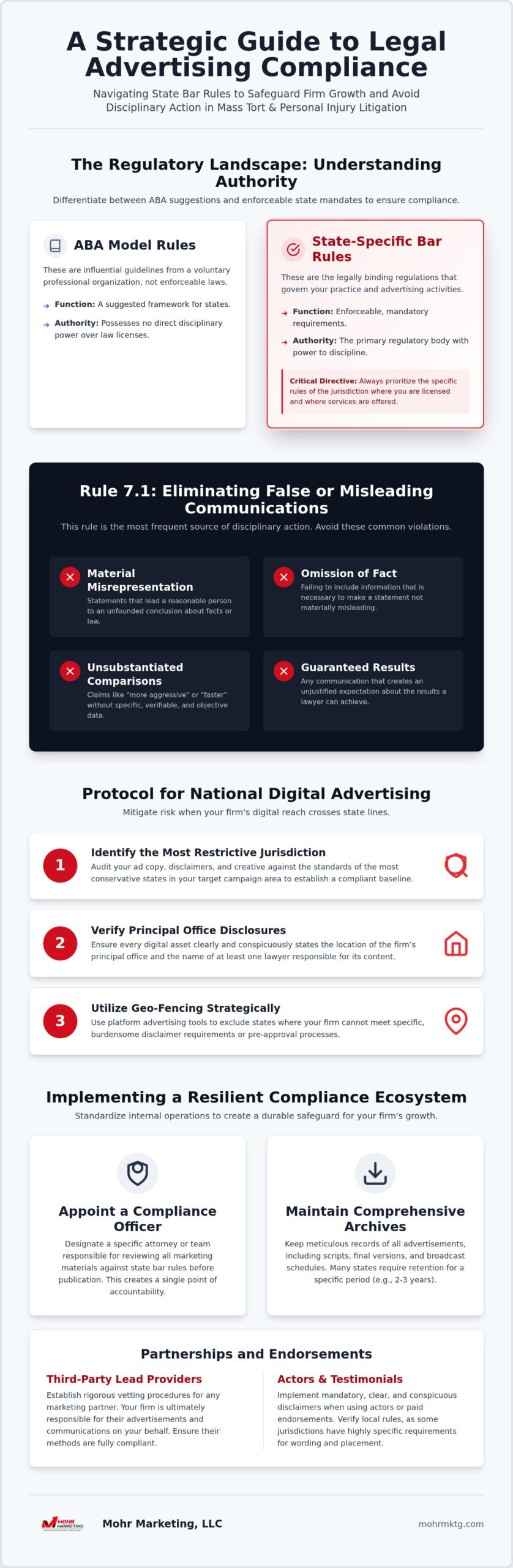
The American Bar Association (ABA) Model Rules of Professional Conduct are often mistaken for enforceable legislation. They are not. The ABA functions as a voluntary professional organization; it possesses no disciplinary authority over your law license. The primary regulatory body remains the state bar association in every jurisdiction where you are admitted to practice. While most states adopt versions of the ABA guidelines, they frequently modify or expand them with local nuances that can lead to significant exposure. Avoiding bar association advertising violations requires a shift in focus from broad national standards to the specific, granular mandates of individual state bars.
Rule 7.1 serves as the universal foundation for all legal marketing. This rule prohibits any communication about a lawyer’s services that is false or misleading. A communication is misleading if it contains a material misrepresentation of fact or law, or omits a fact necessary to make the statement as a whole not materially misleading. In 2026, the digital landscape has complicated this simple premise. What constitutes a “misleading” claim in one state might be standard practice in another, creating a jurisdictional trap for firms attempting to scale their reach through digital channels.
The Supremacy of State-Specific Mandates
Relying solely on ABA Model Rules is a dangerous strategy for any firm. States like Florida and Texas maintain rigorous pre-approval processes or specific disclaimer requirements that far exceed the ABA’s baseline. You must prioritize the rules of the jurisdiction where you are licensed and where the services are offered. To ensure compliance, identify your state bar’s Ethics Counsel. Most jurisdictions provide a department specifically for informal ethics opinions. You can typically contact these offices via telephone or a dedicated email portal to receive guidance on proposed ad copy. This proactive step is essential when your marketing strategy involves aggressive case acquisition in restrictive states.
Multi-State Advertising and Choice of Law
Digital advertising does not respect state boundaries. When a firm targets mass tort signed cases on a national level, the “Choice of Law” rule becomes critical. Under ABA Model Rule 8.5, which many states have adopted, a lawyer is subject to the disciplinary authority of the jurisdiction where the conduct occurred or where its predominant effect is felt. If your digital ad targets residents in California, the California State Bar likely has jurisdiction over that communication, regardless of where your principal office is located.
Firms targeting claimants nationally should follow these instructional steps to mitigate risk:
- Identify the most restrictive jurisdiction: Audit your ad copy against the standards of the most conservative states in your target area.
- Verify Principal Office disclosures: Ensure every digital asset clearly states the location of the firm’s principal office and the name of at least one lawyer responsible for the content.
- Utilize geo-fencing: Use platform tools to exclude states where your firm cannot meet specific, burdensome disclaimer requirements.
By treating compliance as a mechanical process rather than a vague ethical hurdle, you protect your firm’s ability to scale without the threat of a state bar audit. Avoiding bar association advertising violations is about precision, not just intent.
Eliminating False or Misleading Communications (Rule 7.1)
Rule 7.1 is the most frequent source of disciplinary action. In 2026, a “material misrepresentation” includes any statement that leads a reasonable consumer to reach an unfounded conclusion. This extends beyond active lies to include the “omission of fact.” If you advertise a high success rate but fail to mention it only applies to a narrow subset of cases, you risk a state bar audit. Avoiding bar association advertising violations requires total transparency in how data is presented to the public.
Avoid unsubstantiated comparisons. Claiming your firm is “more aggressive” or “faster” than a competitor without specific, verifiable data is a direct violation. State bars view these claims as subjective and potentially deceptive. Instead, focus on objective performance metrics and verified case data. If you need to refine your acquisition strategy to meet these rigorous standards, you can consult with our team to review your intake and compliance protocols.
The danger of “guaranteed results” cannot be overstated. Any language that implies a certain outcome is a violation in nearly every jurisdiction. Your marketing must remain grounded in fact-based reporting. If you cite a 98% success rate, you must maintain the underlying data to prove that figure represents actual case outcomes, not just a curated sample.
The “No Fee Unless You Win” Minefield
The phrase “No fee unless you win” is a regulatory lightning rod. Most state bars require you to clarify the difference between attorney fees and litigation costs. While you might waive your fee, the client is often still liable for court costs, expert witness fees, and medical records expenses. To comply, your ad must include a clear, conspicuous disclaimer. Use phrasing like: “Client remains responsible for costs and expenses,” or “Fees calculated before or after expenses,” depending on your specific state mandate. This distinction is critical to prevent misleading a client about their financial obligations.
Handling Past Results and Verdicts
Showcasing a multi-million dollar settlement is effective for case acquisition but dangerous without context. State bars fear these figures create “unjustified expectations.” You must accompany every specific recovery amount with a disclaimer stating that “results depend on the facts of each case” and that “past performance does not guarantee future outcomes.” Use data-heavy reporting rather than emotional narratives. List the case type, the year, and the specific venue to ground the claim in fact. This methodical approach ensures you are avoiding bar association advertising violations while still demonstrating your firm’s track record of success.
Navigating Testimonials, Endorsements, and Actors
Testimonials are high-conversion assets. They are also primary targets for regulatory scrutiny. Most jurisdictions maintain a strict prohibition against paid testimonials. If you provide any form of compensation, including fee credits or gift cards, you’ve crossed an ethical line. Avoiding bar association advertising violations in this area requires a commitment to organic, uncompensated feedback. You must ensure that every endorsement reflects the actual experience of a real client without promising a specific financial outcome.
Distinguishing between “client experiences” and “guaranteed outcomes” is a mechanical requirement. A client can state they were “treated with respect” or “kept informed.” However, if a testimonial focuses on a specific dollar amount, it must be accompanied by the same rigorous disclaimers discussed in previous sections. You’re responsible for auditing third-party platform feedback. While you don’t control what a client writes on Google, you do control what you highlight on your own landing pages and social media feeds.
Video Content and Dramatization Rules
Video marketing often requires actors to represent clients or simulate legal scenarios. If you use a non-client to speak on camera, you must use an “Actor Portrayal” or “Dramatization” disclaimer. This text should be conspicuous. It must appear in a font size that’s easily readable and remain on screen for the duration of the actor’s appearance. Don’t attempt to hide this disclosure in the footer or use a color that blends into the background.
Be precise with your environment. Using stock footage of a high-rise office when your firm operates out of a retail suite can be flagged as misleading. Similarly, avoid portrayals of judge or jury interactions that suggest a “special relationship” or a guaranteed victory. These dramatizations often trigger audits because they create unjustified expectations in the mind of the consumer. Stick to actual office environments or clearly labeled studio sets to maintain transparency and compliance.
The Ethics of Online Reviews
Curating reviews on your firm’s website is a Rule 7.1 liability. If you only display 5-star reviews while suppressing negative feedback, you’re creating a material misrepresentation of your firm’s track record. This “selective reporting” is a violation. You should either display all reviews or clearly state that the testimonials shown are a curated selection. This protects the firm from claims of deceptive marketing practices during a state bar review.
Responding to negative reviews requires extreme caution. You cannot disclose confidential client information to “win” an online argument. Even if a client attacks your firm publicly, your duty of privilege remains intact. Finally, never incentivize reviews. Offering discounts or prizes in exchange for a Google Review is a direct violation of bar advertising mandates. It compromises the integrity of the feedback and invites disciplinary action. Audit your review acquisition process to ensure every entry is voluntary and uncompensated. This methodical approach is essential for avoiding bar association advertising violations while building social proof.
The Checklist for Lead Generation and Third-Party Marketing
Delegating lead acquisition to a third-party provider doesn’t insulate your firm from ethical liability. State bar associations hold the attorney responsible for every communication made on their behalf. The “Non-Interference” rule is the cornerstone of these partnerships. Your marketing agency must never dictate legal strategy, influence your professional judgment, or interfere with the attorney-client relationship. Avoiding bar association advertising violations requires a high level of oversight into how your partners represent your firm to the public.
Transparency regarding lead exclusivity is a mechanical requirement for compliance. If you’re purchasing shared leads, the consumer must be aware that multiple firms may contact them. Additionally, every lead-capture landing page must clearly display an “Advertising Material” tag. This label should be prominent and not buried in the footer. This ensures the consumer understands the commercial nature of the interaction from the first click. Failure to label these digital assets can trigger a solicitation audit under Rule 7.3.
Vetting Your Lead Generation Partner
You must audit your partner’s ad copy with the same rigor you apply to your own website. When scaling mass tort lead generation, ensure the ads don’t promise specific outcomes or use prohibited superlatives. Every advertisement must identify the specific lawyer or firm responsible for its content. This isn’t just a best practice; it’s a mandatory disclosure in nearly every jurisdiction.
Verify that your provider delivers verified inquiries rather than raw, unvetted data. A partner who eliminates inefficient intermediaries reduces your firm’s exposure to non-compliant intake practices. Ask for a copy of the ad templates and the specific targeting parameters used. If a provider refuses to share their creative assets for your review, they’re a liability to your law license.
Compliance in High-Volume Intake
The intake phase is a high-risk zone for the Unauthorized Practice of Law (UPL). You must train your intake teams to avoid giving even basic legal advice during the screening process. Their role is to gather facts, not interpret them. Utilizing professional legal intake services can help maintain these ethical boundaries by using standardized, attorney-approved scripts.
Monitor your call scripts for compliance with Rule 7.3 regarding solicitation. In-person or live telephonic contact is generally prohibited unless the person is a lawyer or has a prior relationship with the firm. Ensure your intake process is reactive to a consumer’s inquiry rather than proactive “cold calling,” which is a direct violation. Avoiding bar association advertising violations in high-volume environments requires constant script auditing and staff training to ensure no ethical lines are crossed during the initial contact.
Safeguarding Your Firm: Implementing a Compliance Ecosystem
Establishing a dedicated “Compliance Officer” role is no longer optional for firms operating at scale. This individual should be responsible for the final sign-off on all creative assets. Their primary mandate is avoiding bar association advertising violations by ensuring every ad aligns with the most current state mandates. Beyond oversight, you must implement a rigorous record-keeping system. Most state bars require firms to maintain archives of all advertisements for a minimum of two to three years. These archives must include the actual content, the dates of broadcast or publication, and the specific geographic targeting used.
Systematize your review of landing pages, social media posts, and PPC copy. Manual checks are prone to human error. Use automated tools to monitor live pages for unauthorized changes. Many firms are transitioning to a pay-per-signed-case model to reduce this direct oversight burden. By acquiring signed retainers rather than raw inquiries, you shift the initial compliance heavy-lifting to a specialized partner while maintaining ultimate control over the final case selection. This mechanical approach protects your license while allowing for aggressive national scaling.
The Annual Advertising Audit
Perform a comprehensive audit of every digital touchpoint annually. This process should follow a strict instructional path to ensure no legacy content remains a liability. Review every digital asset for outdated claims. Verify that case values or success statistics haven’t changed since the original publication. You must adjust your disclaimers to reflect 2026 state-specific requirements, as these rules evolve frequently. Finally, identify and delete “zombie” landing pages or social media profiles that are no longer active but remain indexed. Broken links to mandatory disclosures are a frequent trigger for audits; ensure every link is functional and points to the correct internal page.
Leveraging Performance-Based Partnerships
High-growth firms are moving toward signed retainers to mitigate marketing risk. In a performance-based partnership, compliance is baked into the lead flow from the start. A turnkey ecosystem eliminates the friction of vetting individual ads because the provider handles the rigorous verification processes. This allows your firm to focus on litigation rather than monitoring marketing vendors. Avoiding bar association advertising violations becomes a byproduct of your business model rather than a constant manual task. To secure your firm’s growth without ethical risk, contact a strategic partner to audit your current acquisition strategy at Mohr Marketing, LLC.
Strategic Scaling Through Rigorous Compliance
Compliance isn’t a barrier to your firm’s expansion; it’s the mechanical safeguard that allows for aggressive, low-risk national scaling. You’ve seen how state-specific mandates and Rule 7.1 transparency form the foundation of a secure marketing strategy. Relying on outdated ABA suggestions or unvetted lead providers creates a vulnerability you can’t afford. Avoiding bar association advertising violations requires a systematized ecosystem that prioritizes transparency and meticulous record-keeping.
Mohr Marketing brings 30+ years of strategic legal marketing experience to your acquisition efforts. Our turnkey intake ecosystem utilizes strict verification processes to eliminate inefficient intermediaries and ensure every lead meets high-intent criteria. By transitioning to performance-based signed case acquisition, you protect your firm’s resources while scaling with confidence. It’s time to shift the heavy-lifting of compliance oversight to a partner with deep insider knowledge.
Your firm’s trajectory depends on high-quality opportunities that respect ethical boundaries. Take the next step toward a more efficient and protected path to success.
Frequently Asked Questions
Is it a violation if a marketing agency writes my ad copy?
It’s not a violation for an agency to draft copy, but the ultimate ethical responsibility rests with you. You must review and approve every word before publication. State bars treat agency-produced content as your own professional communication. If the agency makes a false claim, you face the disciplinary consequences, not the vendor. Maintain a documented approval process for all external marketing materials to demonstrate your active oversight.
Can I use “The Best” or “The Most Experienced” in my law firm advertising?
Using subjective superlatives like “the best” or “the most experienced” is prohibited in most jurisdictions. These claims are considered inherently misleading because they cannot be factually substantiated. You should instead use objective data, such as the number of years in practice or specific, verified settlement amounts. Focus on quantifiable achievements rather than qualitative self-praise to ensure your messaging remains grounded in verifiable facts and avoids regulatory scrutiny.
Do I need to include my office address in every digital advertisement?
Most state bar rules require you to include the city and state of your firm’s principal office in all advertisements. This includes digital assets like landing pages and social media ads. Some states allow for a link to a website that contains this information, but the safest approach is to list the responsible attorney’s name and office location directly. This transparency ensures the public can identify the source of the legal communication.
What happens if my lead provider uses a misleading landing page?
You are liable for the content of any landing page used to generate leads for your firm. If a lead provider makes material misrepresentations, the state bar will hold you accountable for the violation. This is why avoiding bar association advertising violations requires a rigorous vetting process for all third-party marketing partners. You must maintain oversight of the entire funnel to ensure every claim is factually accurate and compliant with local mandates.
Can I use client testimonials if I provide a disclaimer?
You can use client testimonials in most states, provided they are accompanied by a clear and conspicuous disclaimer. The disclaimer must state that past results don’t guarantee future outcomes. Some states have much stricter requirements for the placement and font size of these disclosures. Ensure the testimonial is uncompensated and reflects a genuine client experience. You’re responsible for verifying that no testimonial creates unjustified expectations about a case’s potential value.
What is the difference between advertising and solicitation under bar rules?
Advertising is a general communication directed to the public, while solicitation is a targeted communication directed at a specific person known to need legal services. Solicitation is subject to much stricter regulations, particularly Rule 7.3. Real-time, live contact for the purpose of pecuniary gain is generally prohibited unless the person is a lawyer. You must distinguish between broad brand awareness and direct outreach to avoid aggressive solicitation violations that trigger disciplinary audits.
Is “no fee unless we win” still a compliant phrase in 2026?
The phrase “no fee unless we win” is only compliant if you also disclose the client’s potential liability for litigation costs. Many state bars require you to clarify that while attorney fees are contingent, court costs and expert fees may still be the client’s responsibility. avoiding bar association advertising violations in contingency marketing requires this explicit distinction. You must prevent misleading the consumer about their financial risks through clear and conspicuous disclaimers.
Can I advertise in a state where I am not licensed if I intend to refer the cases?
Advertising in a state where you aren’t licensed is highly restricted and often prohibited. Most states require you to be admitted to practice in that jurisdiction to advertise legal services there. If you intend to refer cases, you must still comply with the Choice of Law rules. You cannot imply you’ll personally handle a case in a jurisdiction where you don’t hold a license. Verify local rules before targeting out-of-state claimants through digital channels.

Recent Posts
- Personal Injury Intake Services: A 2026 Guide to High-Conversion Case Acquisition
- Using EMS Reports to Find and Qualify Personal Injury Clients
- The Strategic Value of EMS-EMT Accident Reports in Car Accident Lawsuits
Categories
- AI and Lead Generation
- Business Financing
- Call Verified MVA Leads
- Car Accident Help
- Car Accident Settlements
- Claimant Funding
- Compliance Program
- EMS-EMT Reports
- Geotargeting
- Google Maps Ranking
- Healthcare Practice Growth
- Law Firm Growth
- Law Office Operations
- Lead Generation
- Lead Generation For Attorneys
- Lead Generation For Chiropractors
- Lead Generation For Criminal Attorneys
- Lead Generation For D&A Treatment Centers
- Lead Generation For DUI Attorneys
- Lead Generation For Eye Doctors
- Lead Generation For Family Law Practices
- Lead Generation For PI Law Firms
- Lead Generation For Plastic Surgeons
- Leads For Healthcare Professionals
- Leads For Insurance Industry
- Legal Leads
- Legal Marketing
- Legal Updates
- Mass Tort Leads
- Medicare and Medicaid Leads
- Merchant Funding Leads
- Online Marketing Strategies
- Pre-Settlement Funding
- Signed MVA Cases
- Tort Updates
- Truck Accident Leads and Signed Cases
- Truck Accident Settlements
- Web Design