Law Firm Marketing Compliance Checklist: The 2026 Guide to Risk-Free Scaling
July 31, 2026 by Mohr Marketing
In 2026, marketing compliance isn’t a bureaucratic hurdle; it’s the only way to protect your firm’s license while scaling case volume. Aggressive TCPA litigation and shifting FCC rulings have turned traditional lead generation into a minefield. You’re right to worry about Bar association audits or the financial drain of non-compliant inquiries. To navigate this, you need a rigorous law firm marketing compliance checklist that ensures every signed retainer and lead is 100% defensible. Scaling your practice shouldn’t feel like a gamble with your professional reputation.
This guide delivers a comprehensive framework for risk-free growth. You’ll learn how to align your digital presence with 2026 mandates and secure a repeatable SOP for high-volume acquisition. We’re moving beyond vague ethics opinions to provide a mechanical framework for verifying every inquiry. From one-to-one consent protocols to state-specific advertising disclosures, you’ll gain the clarity needed to dominate your market without the risk of regulatory friction. Let’s look at the specific steps required to turn compliance into your firm’s strongest competitive advantage.
Key Takeaways
- Identify why the 2026 regulatory environment makes traditional lead arbitrage a liability for your firm’s license.
- Utilize our law firm marketing compliance checklist to verify that every digital asset contains mandatory disclaimers and transparent results.
- Learn the essential due diligence questions to ask marketing partners to eliminate the “black box” of lead origin.
- Secure your intake funnel with standardized scripts that prevent staff from providing unauthorized legal advice.
- Build a repeatable SOP for high-volume case acquisition that is fully defensible against Bar association audits.
The 2026 Legal Marketing Compliance Landscape: Why Risk is Rising
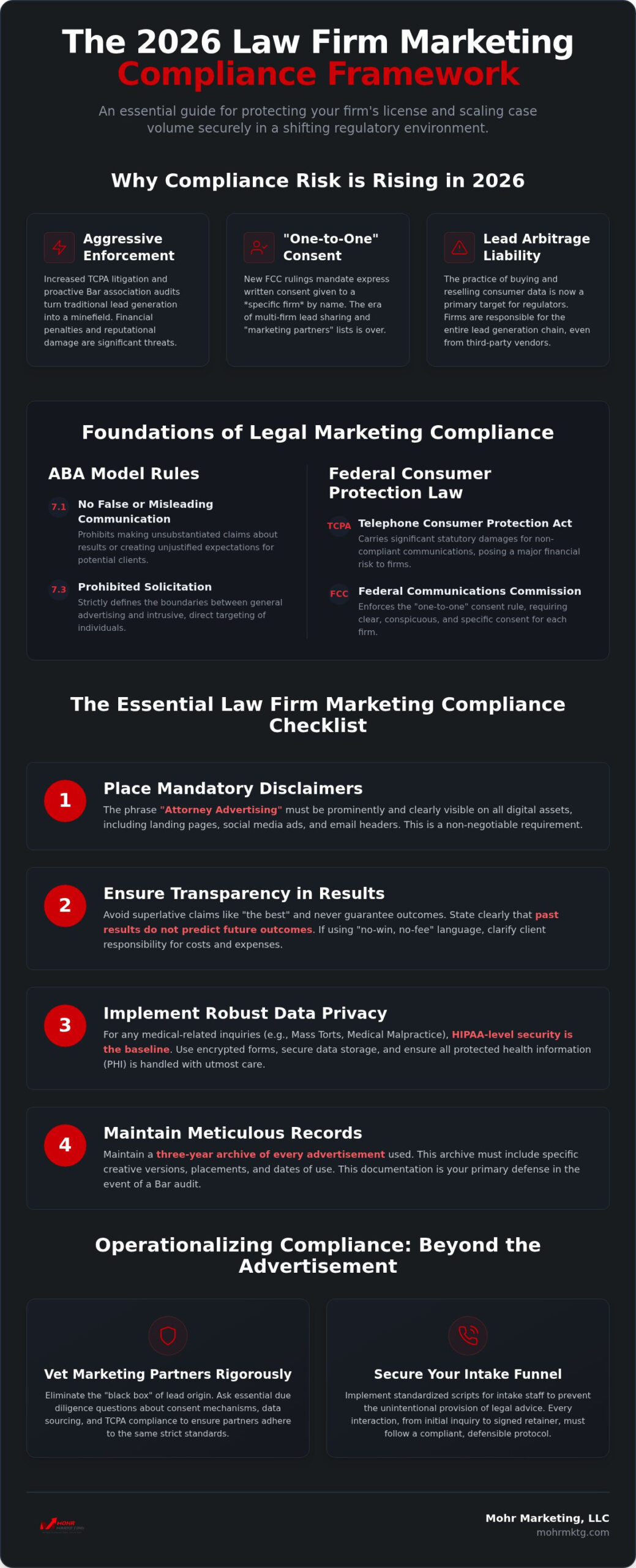
Legal marketing compliance is the critical intersection of ABA Model Rules and federal consumer protection laws. It’s the mechanical process of ensuring every digital touchpoint respects both professional ethics and statutory privacy requirements. In 2026, the regulatory environment has shifted from passive oversight to aggressive enforcement. State Bars and federal agencies are specifically targeting lead arbitrage, the practice of buying and reselling consumer data through multiple intermediaries. For high-volume firms, this means that a single non-compliant campaign can trigger a domino effect of litigation and disciplinary action.
The financial stakes are absolute. TCPA violations now carry statutory damages that can bankrupt a firm scaling without oversight. Beyond fines, the threat of reputation damage and Bar audits creates a permanent stain on a firm’s legacy. However, viewing compliance solely as a defensive measure is a mistake. High-performing firms use a law firm marketing compliance checklist as a growth lever. Clean, verified data leads to higher conversion rates and lower cost-per-acquisition because it eliminates the friction of low-quality, non-consented inquiries.
ABA Model Rules 7.1 through 7.3: The Foundation
Modern regulations are rooted in the history of legal advertising, which evolved to prevent the exploitation of vulnerable claimants. ABA Model Rule 7.1 prohibits any communication that is false or misleading. This includes making unsubstantiated claims about results or creating unjustified expectations. Rule 7.3 strictly defines the boundaries between general advertising and prohibited solicitation. You must distinguish between a consumer seeking help and a firm intrusively targeting an individual. Failure to maintain this distinction is the most common trigger for Bar grievances in digital lead acquisition.
The Federal Impact: TCPA and FCC One-to-One Consent
The 2026 FCC rulings have fundamentally altered the lead generation landscape. The “one-to-one” consent rule is now the industry standard. This mandate requires that a consumer must give express written consent to a specific firm, not a general list of “marketing partners.” The era of the multi-firm lead sharing model is over. To remain compliant, your marketing funnels must provide clear and conspicuous disclosures. Every lead must be tied to a specific, documented consent event that identifies your firm by name. Adopting a rigorous law firm marketing compliance checklist ensures that every inquiry you receive is 100% defensible under these federal mandates.
The Essential Law Firm Marketing Compliance Checklist
Scaling a practice requires a mechanical approach to verification. A comprehensive law firm marketing compliance checklist acts as a firewall against litigation and disciplinary action. It’s not about stifling your growth; it’s about ensuring every dollar spent on Mass Tort Leads or personal injury acquisition is fully defensible. High-stakes marketing demands precision in both creative execution and data management.
- Mandatory Disclaimers: You must place “Attorney Advertising” prominently on all creative assets. This isn’t a suggestion. It should be clearly visible on landing pages, social ads, and email headers.
- Transparency in Results: Avoid guarantees. State clearly that past results don’t predict future outcomes. If you use “no-win, no-fee” language, you must clarify whether the client remains responsible for court costs and expenses.
- Data Privacy: For medical-related inquiries, HIPAA-level security is the baseline. Use encrypted forms and secure storage for all protected health information. This is especially critical for firms targeting high-value Medical Malpractice Leads.
- Record Keeping: Maintain a three-year archive of every advertisement. This includes specific placements, versions, and dates of use. If a Bar audit occurs, your ability to produce these records is your primary defense.
These requirements align with the broader FTC advertising guidelines, which mandate that all commercial speech be truthful and non-deceptive. In the legal sector, the burden of proof is even higher.
Digital Asset Compliance: Websites and PPC
Audit your landing pages for superlative claims. Words like “the best” or “the most experienced” are red flags for regulators unless they’re backed by verifiable data. Ensure all stock imagery includes a “dramatization” or “not an actual client” disclaimer if it depicts legal scenarios. Mobile responsiveness is also a compliance factor. If the mandatory legal footer isn’t accessible or readable on a smartphone, your ad is non-compliant. Every pixel must serve the dual purpose of conversion and protection.
Social Media and Content Marketing Rules
Attorney-authored blog posts are considered advertisements under most state rules. They must follow Rule 7.1 prohibitions against misleading content. Testimonials are powerful, but you can’t use reviews that create an unjustified expectation of results. When responding to public comments on forums, don’t provide specific legal advice or inadvertently create an attorney-client relationship. If you’re unsure if your current funnel meets these standards, request a compliance review to identify and patch vulnerabilities before they become liabilities. Maintaining a law firm marketing compliance checklist ensures your digital footprint remains an asset rather than a risk.
Evaluating Lead Generation Providers for Compliance and Risk
Your firm is legally responsible for the conduct of your marketing partners. If a vendor violates federal regulations while generating inquiries for you, the liability rests on your shoulders. Many providers operate a “black box” model, where they hide the actual source of their traffic. This lack of transparency is a primary trigger for regulatory scrutiny. To scale safely, you must know exactly where your leads originate and how the data moves through the chain of custody. Every partner you engage should be subjected to a rigorous law firm marketing compliance checklist audit before a single dollar is committed.
Effective due diligence starts with consent capture. You must ask every provider for a live demonstration of their user journey. Does the consumer see your firm’s name before they submit their information? If they are being sold to a “network of partners,” you are likely in violation of 2026 FCC mandates. This is why the industry is shifting away from shared aggregators. Choosing exclusive mass tort leads ensures that the consent is one-to-one and fully defensible. High-intent opportunities are built on clear disclosures, not deceptive click-bait or bot-driven traffic.
Auditing Lead Origin and Chain of Custody
Real-time delivery is a non-negotiable requirement for TCPA compliance. If a lead sits in a database for hours or days, the validity of the initial consent begins to erode. You should require TrustedForm or Jornaya certificates for every digital inquiry. These third-party recordings provide a visual record of the consumer’s interaction with the site, proving they took an affirmative action to be contacted. When reviewing contracts, watch for indemnification clauses that attempt to shift all legal risk back to the law firm. A transparent partner will share the risk because their processes are fundamentally sound.
Performance Models: Pay-Per-Lead vs. Pay-Per-Signed-Case
The model you choose affects your compliance burden. Pay-per-lead models often incentivize volume over quality, which can lead to aggressive and non-compliant marketing tactics by the provider. Conversely, acquiring signed retainers streamlines the process by consolidating marketing and initial intake. This model reduces the risk of “fee-splitting” violations as long as the payment is for a completed administrative service rather than a percentage of the legal fee. Ensure your fee structures are flat rates or per-unit costs to stay within ethical boundaries. Using a law firm marketing compliance checklist to evaluate these models prevents your firm from inadvertently violating Bar rules regarding non-lawyer partnerships.
Compliance in the Intake Process: From Inquiry to Retainer
Compliance doesn’t end once the lead enters your system. The transition from inquiry to signed retainer is a high-risk phase where firms often overlook audit requirements. A robust law firm marketing compliance checklist must govern every interaction within your intake ecosystem. Intake staff must disclose their non-attorney status at the beginning of every call. This prevents confusion and protects the firm from allegations of unauthorized legal advice or the unauthorized practice of law. It’s a simple disclosure that carries significant weight during a Bar audit.
Standardized scripts are essential for maintaining procedural control. These scripts guide intake professionals through qualifying questions without crossing into legal interpretation. Verifying case criteria is a mechanical necessity, not a suggestion. For firms targeting high-value cases, the team must confirm specific exposure or injury markers before the retainer is sent. This level of precision ensures your budget is allocated only to cases that meet your firm’s specific litigation requirements. It also prevents the ethical pitfall of signing claimants who don’t actually qualify for the specific tort.
Safeguarding Personally Identifiable Information (PII) is a non-negotiable statutory mandate. Your intake ecosystem must utilize end-to-end encryption and secure storage protocols. Data should never reside in unsecured spreadsheets or accessible email threads. Maintaining a clean chain of custody for PII is as important as the lead’s origin. In mass tort and personal injury litigation, you’re often handling sensitive medical data that requires HIPAA-level security. Failure to secure this data can lead to federal fines that far outweigh the cost of compliant software.
Optimizing the Intake Workflow for Speed and Ethics
Speed is vital, but ethical boundaries are absolute. Adopt a double-opt-in method for all SMS and email communications to ensure ongoing TCPA compliance. When processing MVA police report-backed cases, intake teams require specialized training to cross-reference report data with claimant statements in real-time. This rigor builds a clear audit trail from the initial digital click to the final signature. It proves that the claimant was qualified through a logical, transparent process rather than a rushed or deceptive one.
Managing the Retainer Execution
Retainer execution requires transparency and documented intent. Your e-signature platform must record the signer’s IP address and timestamp to prove the agreement’s validity. Claimants must receive a fully executed copy of the agreement immediately upon completion. Never employ high-pressure tactics. If a claimant feels coerced, the retainer can be invalidated, creating significant legal exposure for the firm. A compliant law firm marketing compliance checklist ensures your growth is built on a foundation of valid, defensible contracts that stand up to the highest levels of scrutiny.
Scaling Securely with the Mohr Marketing Compliance Ecosystem
Mohr Marketing has spent over 30 years navigating the shifting mandates of state Bars and federal agencies. We don’t just provide data; we provide a verified chain of custody that protects your firm’s professional standing. Our turnkey ecosystem is designed to eliminate the compliance headache by automating the verification steps required in a modern law firm marketing compliance checklist. By the time a case reaches your desk, the consent is documented, the criteria are met, and the record is 100% defensible. We act as a strategic partner that prioritizes your firm’s long-term stability over short-term volume spikes.
Transparency is our primary service. Unlike aggregators who hide their sources, we offer full visibility into lead origin and qualification. This shift toward performance-based results ensures your firm receives inquiries that are ready for litigation, not just names in a database. We focus on high-intent acquisition for Signed Retainers and verified leads. This mechanical approach to growth ensures every dollar spent on Truck Accident Leads or personal injury cases contributes to a sustainable, low-risk strategy. We eliminate inefficient intermediaries to deliver a more streamlined path to success.
Strategic Partnership for National Growth
Expanding your firm’s reach requires a roadmap to scalable growth that accounts for varying state regulations. We build custom funnels tailored to high-stakes practice areas, such as mesothelioma, where precision is paramount. Our team provides proactive compliance updates. When the FCC or a state Bar issues a new ruling, we adapt our infrastructure immediately. This proactive stance allows your partners to focus on litigation while we manage the complexities of regulatory alignment. We ensure your MVA cases and tort inquiries are always generated through verified, “clean” channels.
Next Steps: Auditing Your Current Funnel
If your firm currently relies on shared lead aggregators, you’re likely sitting on a significant liability. You must transition to a performance-based intake model that prioritizes quality and consent over raw volume. Start by auditing your current providers against a rigorous law firm marketing compliance checklist. Demand to see their consent recordings and disclosure placements. If they can’t provide them in real-time, it’s time to find a partner who values your license. Growth without compliance isn’t expansion; it’s just a liability waiting to happen. Secure your firm’s future by demanding mechanical accuracy in every lead you acquire.
Secure Your Competitive Advantage Through Compliance
Compliance is the foundation of sustainable high-volume acquisition. Firms that ignore the 2026 regulatory shifts risk more than just administrative fines; they risk their professional standing and future growth. Implementing a rigorous law firm marketing compliance checklist ensures every lead is defensible and every signed retainer is valid. By auditing lead origin and intake workflows, you transform regulatory adherence from a bottleneck into a formidable competitive advantage in a crowded market.
Mohr Marketing offers 30+ years of industry-leading expertise to help you navigate these complex mandates with precision. Our transparent, data-driven verification process eliminates the “black box” of traditional lead generation, ensuring you know exactly where your data originates. We provide zero-risk, performance-based models that allow you to scale your case volume with absolute confidence in your firm’s security and ethical alignment.
Scaling your firm doesn’t have to be a regulatory gamble. With the right systems in place, you can pursue aggressive growth with total confidence in your compliance. Take the first step toward a more secure, results-oriented marketing strategy today.
Frequently Asked Questions
Is it ethical for law firms to pay for leads on a per-case basis?
Yes, provided the fee is a flat rate for administrative marketing services and not a percentage of the legal fee. Paying for the generation of a case is generally permitted, whereas fee-splitting with non-lawyers is prohibited under ABA Model Rule 5.4. Firms must ensure the contract specifies payment for marketing labor and intake execution rather than the outcome of the litigation. This distinction keeps your acquisition model within ethical boundaries.
What are the most common Bar violations in law firm marketing today?
The most frequent violations involve misleading claims of expertise and the failure to include mandatory disclaimers. Many firms use superlatives like “best” or “top-rated” without verifiable data, violating Rule 7.1. Another common pitfall is failing to label communications as “Attorney Advertising,” especially on digital landing pages and social media advertisements. These errors often trigger audits that can lead to public reprimands or severe fines.
How do the 2026 FCC rules impact attorney lead generation?
The 2026 FCC rulings mandate “one-to-one” consent, effectively ending the practice of sharing leads among multiple firms. Consumers must now provide express written consent to a single, specifically named entity. This makes a law firm marketing compliance checklist essential for auditing how vendors capture and document this individualized consent before you contact a prospect. It’s a mechanical shift that requires total transparency from your marketing partners.
Does my firm need to include a disclaimer on every social media post?
Yes, any post that constitutes a communication about your services for the purpose of case acquisition must be labeled as “Attorney Advertising.” While organic, non-promotional posts may have more leniency, any content used in a paid capacity or designed to solicit clients requires clear and conspicuous disclosures. This satisfies both state Bar requirements and federal consumer protection laws regarding the transparency of commercial speech.
What is the difference between a lead and a signed retainer in terms of compliance?
A lead is a verified inquiry where a consumer has consented to contact, while a signed retainer is a fully executed legal agreement. Compliance for leads focuses on TCPA consent and data origin. For signed retainers, the focus shifts to ensuring the intake process was non-coercive and that the claimant received a copy of the agreement immediately upon execution. Both stages require rigorous documentation to survive a regulatory audit.
How can I verify that my marketing agency is following TCPA guidelines?
Require your agency to provide third-party verification certificates, such as TrustedForm or Jornaya, for every inquiry. These certificates provide a visual record of the consumer’s interaction with the site and their affirmative consent. Including these verification steps in your law firm marketing compliance checklist protects your firm from statutory damages associated with non-consented automated calls or texts. Never accept an agency’s verbal assurance without this digital proof.
Are testimonials allowed in personal injury and mass tort advertising?
Testimonials are permitted but must be accompanied by prominent disclaimers stating that results aren’t guaranteed. You cannot use testimonials that create an unjustified expectation of a specific outcome. If you use a spokesperson or an actor instead of a real client, the advertisement must explicitly disclose that the presentation is a dramatization. Transparency regarding the nature of the testimonial is the only way to avoid Rule 7.1 violations.
What specific language is required for ‘Attorney Advertising’ disclaimers?
Most jurisdictions require the exact phrase “Attorney Advertising” to appear prominently on the first page or at the start of a digital communication. Some states also require the name of at least one attorney responsible for the content and the firm’s principal office address. Always check your specific state Bar rules as requirements for font size and placement vary by jurisdiction. Accuracy in these disclosures is a non-negotiable requirement for scaling safely.

Recent Posts
- Personal Injury Intake Services: A 2026 Guide to High-Conversion Case Acquisition
- Using EMS Reports to Find and Qualify Personal Injury Clients
- The Strategic Value of EMS-EMT Accident Reports in Car Accident Lawsuits
Categories
- AI and Lead Generation
- Business Financing
- Call Verified MVA Leads
- Car Accident Help
- Car Accident Settlements
- Claimant Funding
- Compliance Program
- EMS-EMT Reports
- Geotargeting
- Google Maps Ranking
- Healthcare Practice Growth
- Law Firm Growth
- Law Office Operations
- Lead Generation
- Lead Generation For Attorneys
- Lead Generation For Chiropractors
- Lead Generation For Criminal Attorneys
- Lead Generation For D&A Treatment Centers
- Lead Generation For DUI Attorneys
- Lead Generation For Eye Doctors
- Lead Generation For Family Law Practices
- Lead Generation For PI Law Firms
- Lead Generation For Plastic Surgeons
- Leads For Healthcare Professionals
- Leads For Insurance Industry
- Legal Leads
- Legal Marketing
- Legal Updates
- Mass Tort Leads
- Medicare and Medicaid Leads
- Merchant Funding Leads
- Online Marketing Strategies
- Pre-Settlement Funding
- Signed MVA Cases
- Tort Updates
- Truck Accident Leads and Signed Cases
- Truck Accident Settlements
- Web Design