2026 Marketing Guide for Personal Injury Lawyers
July 28, 2026 by Mohr Marketing
Stop paying for clicks and start paying for cases. The traditional model of bidding on high-competition keywords has become a financial drain where only the advertising platforms see a guaranteed return. You’re likely tired of exorbitant CPCs and an endless stream of junk leads that waste your intake staff’s time. Finding cost-effective marketing for personal injury lawyers in 2026 requires a total departure from the inefficient lead generation tactics of the past. It’s time to demand transparency and performance over raw volume.
This guide provides the framework to eliminate marketing waste and acquire high-intent personal injury cases through a performance-based acquisition and intake system. We’ll show you how to shift the financial risk away from your firm by focusing on a predictable cost-per-signed-case. You’ll learn the mechanics of a verified intake ecosystem that delivers fully executed retainer agreements for MVA and Mass Tort claims. We’re moving beyond simple lead generation to provide a scalable, results-oriented roadmap that prioritizes your firm’s bottom line and operational efficiency.
Key Takeaways
- Identify and close the “Waste-Gap” by auditing the discrepancy between high-cost lead volume and actual signed retainers.
- Shift financial risk away from your firm by adopting performance-based models like Pay-Per-Signed-Case instead of traditional Managed Retainers.
- Implement a 24/7/365 legal intake ecosystem to maximize speed-to-lead and ensure no high-intent inquiries are lost to competitors.
- Discover how to achieve cost-effective marketing for personal injury lawyers by targeting police-report-backed MVA cases and scalable mass tort opportunities.
- Transition from unpredictable marketing spend to a turnkey investment strategy that delivers fully executed retainer agreements directly to your firm.
Auditing the Efficiency Gap in Personal Injury Marketing
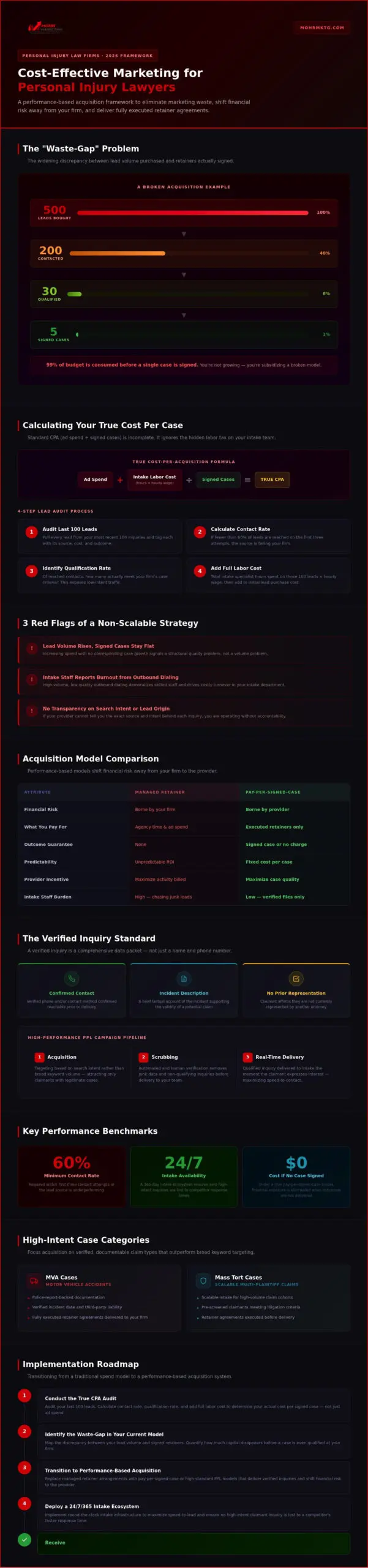
Marketing efficiency isn’t measured by the number of inquiries hitting your inbox. It’s measured by the number of signed cases hitting your desk. Many firms fall into the “Waste-Gap,” which is the widening discrepancy between the lead volume you pay for and the actual retainers you secure. If your firm is buying 500 leads to sign five cases, you aren’t growing; you’re subsidizing a broken acquisition model. Achieving cost-effective marketing for personal injury lawyers requires a ruthless audit of where your capital disappears before a case is even qualified.
The Rising Cost of High-Volume Keywords
Keyword auctions for “car accident lawyer” and “personal injury attorney” reached a breaking point in 2026. High-intent search terms now command CPCs that make traditional PPC unsustainable for most mid-sized firms. Broad targeting often attracts “looky-loos” who are researching insurance rules or seeking free legal advice without a viable claim. For new firms in 2026, traditional SEO delivers a diminishing ROI because the time-to-market and capital required to displace established incumbents often exceed the lifetime value of the cases acquired. You cannot outspend the giants on broad terms; you must outmaneuver them by focusing on police-report-backed MVA cases and high-intent inquiries.
Calculating Labor-Adjusted Cost Per Case
Most firms calculate their Cost Per Acquisition (CPA) by dividing their ad spend by signed cases. This formula is incomplete. It ignores the heavy burden placed on your intake team. If your staff spends 40 hours a week chasing unverified leads that never pick up the phone, that labor cost must be added to your marketing spend. Unverified inquiries are a hidden tax on your firm’s productivity. To find your true CPA, follow these steps:
- Audit your last 100 leads.
- Calculate the “Contact Rate.” If you can’t reach 60% of leads on the first three attempts, the source is failing.
- Identify the “Qualification Rate.” How many reached contacts actually met your firm’s case criteria?
- Add the total hourly wages of your intake specialists spent on these 100 leads to the initial purchase price.
When you account for labor, “cheap” leads often become your most expensive asset. A truly cost-effective marketing for personal injury lawyers strategy focuses on Mass Tort and MVA retainers where the verification is handled before the file reaches your office.
Watch for these three red flags of a non-scalable strategy:
- Lead volume increases while your signed case count remains stagnant.
- Your intake staff reports burnout from high-volume, low-quality outbound dialing.
- You lack transparency regarding the specific search intent or origin of your inquiries.
Transitioning to Performance-Based Acquisition Models
Traditional agency retainers are a relic of a less competitive era. They prioritize “activity” over outcomes; you pay for the agency’s time and ad spend regardless of whether a single case is signed. Performance-based models invert this dynamic. By shifting the financial risk to the lead provider, you ensure that every dollar spent is tied to a tangible asset. This shift is the cornerstone of cost-effective marketing for personal injury lawyers who prioritize financial performance over vanity metrics like impressions or clicks. Managed retainers often leave firms holding the bag when campaigns underperform, whereas performance models force the provider to deliver or lose the account.
A Pay-Per-Lead (PPL) model functions as a professional filter for your firm. The instructional flow of a high-performing PPL campaign involves three distinct stages: acquisition, scrubbing, and real-time delivery. Acquisition focuses on search intent rather than broad volume. Scrubbing involves both automated and human verification to remove “junk” data and non-qualifying inquiries. Real-time delivery ensures your intake team receives the inquiry the moment the claimant expresses interest. This system forces providers to prioritize quality; if the leads don’t convert into cases, the firm stops buying.
Top-tier agencies utilize a “Verified Inquiry” standard to protect your resources. A verified inquiry isn’t just a name and a phone number. It’s a comprehensive data packet that includes a confirmed contact method, a brief incident description, and an affirmation that the claimant isn’t already represented. This level of detail separates professional case acquisition from amateur list-buying, ensuring your intake staff spends their time on viable claimants instead of chasing dead-ends.
Pay-Per-Lead vs. Pay-Per-Signed-Case
PPL delivers verified inquiries. It’s the ideal model for firms with a robust, high-speed intake department capable of closing cases internally. Pay-Per-Signed-Case is a more advanced solution. Here, you only pay for fully executed retainer agreements. If your firm has liquid capital but limited administrative bandwidth, paying for the finished product is the most efficient path. You should evaluate your internal closing ratio before choosing. If your team converts fewer than 15% of inquiries to retainers, the signed-case model is your most strategic risk-mitigation tool.
The Strategic Advantage of Signed Retainers
Signed retainers eliminate the friction between your marketing spend and your litigation team. Instead of chasing prospects, your attorneys receive a file that is ready for the demand phase. This turnkey approach is particularly effective for scaling complex dockets without increasing your internal overhead. Learn more about mass tort signed cases to see how this model accelerates growth by delivering pre-vetted, ready-to-litigate claimants directly to your firm. It’s the most direct route to predictable case acquisition in a crowded market.
If you’re ready to stop gambling on clicks and start investing in outcomes, speak with a performance acquisition specialist to discuss a tailored roadmap for your firm.
Optimizing the Legal Intake Ecosystem for Maximum ROI
A high-performance marketing campaign is useless if your intake process is a sieve. Intake is the critical bridge between an inquiry and a signed retainer. To achieve truly cost-effective marketing for personal injury lawyers, you must view intake as a conversion engine rather than a clerical task. Every minute a lead sits untouched increases the likelihood that they’ll call a competitor. Building a 24/7/365 ecosystem ensures that your firm is always open when disaster strikes, capturing high-intent claimants at their moment of peak urgency.
Auditing your current process is the first step toward optimization. Review your last month of inquiries and compare the lead arrival timestamp with the first outbound call. If that gap exceeds five minutes, you’re losing cases. Data-driven intake allows you to identify high-value cases early, ensuring your senior staff focuses on the most promising files while automated systems handle the initial screening. A rigorous audit is the only way to ensure your strategy remains a cost-effective marketing for personal injury lawyers solution over the long term.
Speed-to-Lead: The 5-Minute Conversion Rule
Industry data indicates that the odds of qualifying a lead drop by 10 times if contacted after the first five minutes compared to a response within the first 60 seconds. In the personal injury space, claimants are often in a state of crisis and will continue calling firms until someone answers. Implementing an automated or outsourced intake solution ensures that no lead goes cold. Your goal is immediate engagement. If your internal team cannot maintain a sub-five-minute response time around the clock, you’re effectively throwing away your marketing budget.
Leveraging Verified Call Transfers
Verified call transfers represent the gold standard of intake efficiency. Instead of receiving a static web form, your team receives a live call with a pre-vetted claimant on the line. A marketing partner screens the lead against your specific criteria, verifies their intent, and then bridges the call directly to your office. These “live transfers” result in significantly higher retainer rates because the initial friction of the first contact has already been overcome. To integrate these into your workflow, ensure you have a dedicated “hotline” for transfers and a staff member ready to execute the retainer immediately. This turnkey approach is essential for scaling truck accident signed cases and other high-stakes litigation where the claimant’s needs are immediate.
Leveraging High-Intent Case Acquisition for Scalable Growth
Scaling a firm in 2026 requires more than a higher lead volume. It requires higher-intent data. Truly cost-effective marketing for personal injury lawyers is built on the foundation of high-intent acquisition. You need claimants who aren’t just browsing; they must be actively seeking legal resolution for specific, documented injuries. Filtering at the point of origin is the only way to maintain a lean operation while pursuing aggressive expansion.
Transparency in your acquisition funnel is non-negotiable. With tightening state bar mandates and privacy laws, you must know exactly where your leads originate and how they were vetted. This protects your firm’s professional standing and ensures your marketing capital is reaching qualified individuals rather than bots or unverified inquiries. A transparent funnel allows you to audit the quality of your cases in real-time, ensuring your ROI remains consistent as you scale.
MVA Case Acquisition: Beyond the Basic Inquiry
Standard MVA inquiries often lack the documentation necessary for a quick settlement. Explore police-report-backed MVA cases to understand the strategic difference. These cases arrive with pre-verified liability, which reduces your discovery time and increases the probability of a high-value settlement. To optimize your acquisition, you must define your firm’s Ideal Case Criteria (ICC). Follow these steps to refine your targeting:
- Identify specific jurisdictions where your firm has the highest litigation success.
- Set minimum injury thresholds and policy limit requirements for incoming inquiries.
- Prioritize cases where an official accident report has already been filed to confirm the facts of the loss.
Filtering for these variables ensures your litigation team only processes files with high settlement potential, directly improving your bottom line.
Mass Tort Scalability in 2026
Scaling mass tort volume traditionally required massive call centers and immense administrative overhead. In 2026, successful firms utilize turnkey acquisition systems to bypass this burden. By following a Mass Tort Lead Generation roadmap, you can acquire high volumes of claimants without increasing your internal staff. The economics of mass torts allow for a lower labor-adjusted cost per case when handled through a performance-based system.
For high-value dockets like mesothelioma or commercial trucking, filtering for real search intent is vital. Claimants searching for specific medical complications or accident report filings are high-value targets. They are far more likely to sign a retainer than those searching for general legal advice. This precision is the key to maintaining cost-effective marketing for personal injury lawyers even in high-competition niches.
Executing Your Cost-Effective Marketing Roadmap
Transitioning to a performance-based model marks the definitive shift from marketing as an expense to marketing as an investment. You aren’t gambling on search engine visibility; you’re purchasing verified legal assets. Achieving cost-effective marketing for personal injury lawyers requires a strategic partner that manages the entire intake ecosystem from the first click to the signed retainer. This turnkey approach allows your attorneys to focus on litigation while your acquisition engine runs autonomously. Stop spending on clicks and start investing in outcomes.
Choosing a partner is about more than lead volume. You need an authoritative expert with deep insider knowledge. Mohr Marketing leverages over 30 years of industry experience to help firms navigate the volatile 2026 market shifts with precision. By eliminating inefficient intermediaries, we deliver high-intent opportunities directly to your firm. This ensures your capital is preserved for the cases that move the needle. A results-oriented roadmap is the only path to sustainable growth in a hyper-competitive legal landscape.
Integrating Performance Marketing into Your Practice
Don’t overhaul your entire budget overnight. Start with a Pay-Per-Lead pilot program to test the quality and contact rates of the inquiries. This phased approach allows you to align your marketing spend with your firm’s current intake capacity. If your staff is overwhelmed, maintain your current volume; if they’re hungry for more, scale the program aggressively. The goal is to create a frictionless flow of high-intent claimants that matches your operational tempo. Precision and scalability must work in tandem to ensure cost-effective marketing for personal injury lawyers remains a reality.
The Mohr Marketing Advantage: Verified Results
Efficiency is the enemy of the intermediary. We bypass the middlemen to provide verified, high-intent opportunities for litigation. This direct path ensures you receive the most accurate data and the highest probability of a signed case. Whether you’re targeting MVA or Mass Tort, our 30-year-proven ecosystem is designed to remove the waste that plagues traditional agency models. We provide the transparency and reliability required by high-stakes professionals who value tangible outcomes.
Before you scale, use this final checklist to ensure your firm is ready:
- Audit your current intake closing ratio to establish a performance baseline.
- Define your firm’s Ideal Case Criteria (ICC) for every practice area.
- Confirm your partner provides transparent lead-origin and intent data.
- Verify that your intake team is equipped to respond within the critical five-minute window.
- Transition from a “spend” mindset to a “cost-per-signed-case” investment strategy.
Contact Mohr Marketing to discuss your case acquisition goals
Scale Your Firm with Performance-Driven Acquisition
Dominating the legal market in 2026 requires a total departure from outdated, high-risk advertising models. You’ve identified the “Waste-Gap” in your current spend and recognized the necessity of a 24/7 intake ecosystem. By prioritizing performance-based acquisition, you shift financial risk back to the provider and focus your resources on litigation rather than lead chasing. This strategic shift ensures your firm remains competitive while maintaining strict operational efficiency.
Establishing cost-effective marketing for personal injury lawyers isn’t about finding the cheapest leads; it’s about securing the highest-intent cases with predictable acquisition costs. Mohr Marketing brings over 30 years of industry experience to this challenge. We provide verified inquiries and fully executed retainers through a turnkey intake ecosystem that ensures seamless conversion. Our process eliminates inefficient intermediaries, delivering strategic value directly to your bottom line.
Take control of your firm’s growth by moving beyond the uncertainty of standard keyword auctions. Your path to a scalable, high-value practice starts with a commitment to verified results and professional transparency.
Frequently Asked Questions
What is the most cost-effective marketing for personal injury lawyers in 2026?
Performance-based acquisition models are the most cost-effective marketing for personal injury lawyers in 2026. This strategy shifts the financial risk from the law firm to the marketing partner by focusing on verified inquiries rather than raw clicks. By eliminating wasted spend on high-competition keywords that produce low-intent traffic, firms can allocate their capital toward qualified claimants who are ready to sign a retainer immediately.
How does pay-per-signed-case marketing work for law firms?
Pay-per-signed-case is a turnkey solution where the marketing partner manages the entire acquisition and intake funnel. The provider identifies high-intent claimants, verifies their eligibility against your firm’s specific criteria, and facilitates the execution of the retainer agreement. Your firm only pays for the fully executed contract. This model removes the uncertainty of lead quality and the internal labor costs associated with chasing unverified inquiries.
Is pay-per-lead legal marketing compliant with state bar mandates?
Yes, performance-based marketing is compliant as long as it is structured as an advertising service and not a fee-splitting arrangement. Professional providers ensure that all acquisition methods adhere to TCPA regulations and specific state bar ethical guidelines. It’s essential to partner with an agency that maintains strict transparency in their acquisition funnel to ensure every inquiry meets the highest standards of professional conduct and legal compliance.
How much should a signed personal injury retainer cost?
The value of a signed retainer depends on the case type, jurisdiction, and the specific liability factors involved. Rather than focusing on a fixed price, firms should evaluate cost-effectiveness by comparing the acquisition expense against the projected settlement value and the internal labor saved. A truly cost-effective marketing for personal injury lawyers strategy prioritizes the net profit margin and the predictability of the acquisition cost over time.
What is the difference between a lead and a verified inquiry?
A lead is typically raw, unvetted data that may contain incorrect contact information or low-intent prospects. A verified inquiry is a high-intent opportunity that has passed through a rigorous screening process. This process confirms the claimant’s contact details, verifies the facts of the incident, and ensures the individual is not already represented. Verified inquiries significantly reduce the administrative burden on your intake staff and increase conversion rates.
Why is intake so important for personal injury marketing ROI?
Intake is the engine that converts marketing spend into firm revenue. In the personal injury sector, speed-to-lead is the single most important metric for success. If an inquiry is not handled within the first five minutes, the likelihood of conversion drops significantly. A 24/7/365 intake ecosystem ensures that your firm captures every high-intent opportunity at the moment of peak urgency, maximizing the ROI of every marketing dollar.
Can I scale my firm using only performance-based marketing?
You can scale a firm rapidly using performance-based models because they provide financial predictability. Unlike traditional SEO or PPC, where costs can fluctuate without a guaranteed return, performance models allow you to tie your budget directly to signed cases. This allows you to increase your volume in alignment with your firm’s administrative capacity, making it the ideal strategy for expanding MVA and Mass Tort dockets.
How do I audit my current marketing agency for cost-effectiveness?
Begin by calculating your labor-adjusted cost per case. Add the total hourly wages your intake staff spends on unverified leads to your monthly ad spend, then divide by the number of signed cases. If your agency lacks transparency regarding lead origin or if your team spends more time dialing than signing, your current model is inefficient. A results-oriented partner will focus on delivering verified results rather than vanity metrics like impressions.

Recent Posts
- 2026 Marketing Guide for Personal Injury Lawyers
- How to Improve Law Firm Lead Conversion Rates: The 2026 Strategy Guide
- Personal Injury Client Intake Best Practices 2026: The Ultimate Efficiency Checklist
Categories
- AI and Lead Generation
- Business Financing
- Call Verified MVA Leads
- Car Accident Help
- Car Accident Settlements
- Claimant Funding
- Compliance Program
- EMS-EMT Reports
- Geotargeting
- Google Maps Ranking
- Healthcare Practice Growth
- Law Firm Growth
- Law Office Operations
- Lead Generation
- Lead Generation For Attorneys
- Lead Generation For Chiropractors
- Lead Generation For Criminal Attorneys
- Lead Generation For D&A Treatment Centers
- Lead Generation For DUI Attorneys
- Lead Generation For Eye Doctors
- Lead Generation For Family Law Practices
- Lead Generation For PI Law Firms
- Lead Generation For Plastic Surgeons
- Leads For Healthcare Professionals
- Leads For Insurance Industry
- Legal Leads
- Legal Marketing
- Legal Updates
- Mass Tort Leads
- Medicare and Medicaid Leads
- Merchant Funding Leads
- Online Marketing Strategies
- Pre-Settlement Funding
- Signed MVA Cases
- Tort Updates
- Truck Accident Leads and Signed Cases
- Truck Accident Settlements
- Web Design