Personal Injury Signed Retainers: The Law Firm’s Guide to Scalable Case Acquisition
July 13, 2026 by Mohr Marketing
Buying raw leads is a gamble that most high-growth firms can no longer afford to take. You’ve already experienced the frustration of high marketing spend that fails to translate into actual revenue. When your intake department is buried under unqualified callers, your firm’s growth stalls and your cost-per-acquisition skyrockets. Shifting your focus to personal injury signed retainers allows you to bypass the volatility of lead nurturing and move directly to revenue-generating assets.
We understand that inconsistent case volume is the primary barrier to scaling a modern practice. This article provides a clear roadmap for transitioning from raw data acquisition to a fully executed retainer model. You’ll learn how to leverage a legal intake ecosystem that absorbs the financial risk of marketing and delivers ready-to-litigate cases. We will break down the tactical strategies for eliminating intake friction and securing a predictable, scalable flow of high-value cases. By the end of this guide, you’ll know exactly how to stabilize your pipeline and focus your resources on litigation rather than lead chasing.
Key Takeaways
- Identify the strategic advantages of prioritizing revenue-generating assets over raw data acquisition to stabilize your firm’s growth.
- Master the mechanics of a legal intake ecosystem designed to filter high-intent inquiries through rigorous verification loops.
- Evaluate the cost-benefit ratio of personal injury signed retainers compared to the high overhead of maintaining an internal intake department.
- Verify vendor compliance with state bar mandates and TCPA regulations to protect your firm from liability and advertising risks.
- Scale your practice nationally using a performance-based model that eliminates inefficient intermediaries and focuses on tangible outcomes.
What Are Personal Injury Signed Retainers in 2026?
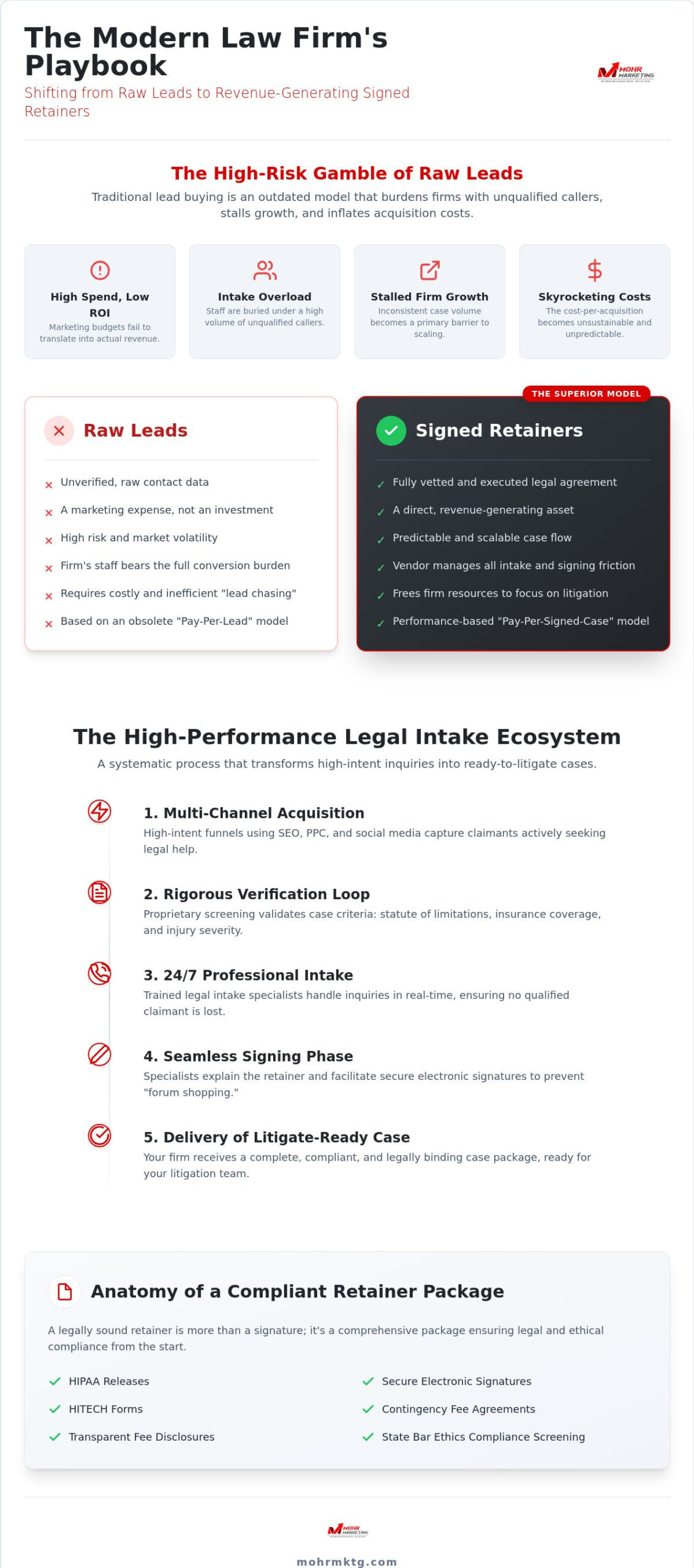
A personal injury signed retainer is a fully executed legal agreement that transforms a prospect into a client before they ever reach your desk. In the current legal market, the distinction between a lead and a case is the difference between an expense and an investment. Raw leads are often nothing more than unverified contact data. Verified transfers offer a live connection but still require your staff to close the deal. Personal injury signed retainers represent a completed intake process where the claimant has already committed to your firm’s representation.
Strategic firms are abandoning traditional lead-buying in favor of performance-based acquisition. This model ensures that you only pay for results, not possibilities. Digital marketing now utilizes high-intent search funnels to find claimants exactly when they are searching for solutions. This precision allows for the delivery of specific case types, such as truck accident signed cases, which carry significantly higher settlement potential than general inquiries.
The Evolution of Case Acquisition
The transition from “Pay-Per-Lead” to “Pay-Per-Signed-Case” marks a fundamental shift in law firm risk management. Years ago, firms relied on broad TV campaigns with massive spillover and low efficiency. Today, the focus is on intent-based digital funnels. High-volume practices recognize that the “Pay-Per-Lead” model is becoming obsolete because it places the burden of conversion on the firm’s internal intake department. By shifting to a signed retainer model, you outsource the friction of the “chase” and focus your internal resources exclusively on litigation and settlement.
Anatomy of a Valid Signed Retainer
A legally sound retainer must do more than just establish a relationship. It serves as a comprehensive package including HIPAA releases, HITECH forms, and transparent fee disclosures. Most personal injury firms utilize contingency fee arrangements to align their interests with the client’s success. In a fast-paced digital environment, the use of secure electronic signatures is mandatory. It captures the claimant’s intent immediately, preventing “forum shopping” among competing firms. Every document must also be meticulously screened to ensure compliance with specific state bar ethics mandates, protecting the firm from future regulatory challenges.
The Mechanics of the Legal Intake Ecosystem
A scalable intake engine operates through a high-performance, multi-channel funnel. It combines the high intent of search engine optimization and pay-per-click advertising with the targeted reach of social media. This isn’t a passive system; it’s an active pursuit of claimants who require immediate legal intervention. By diversifying these channels, the ecosystem maintains a steady flow of inquiries even when individual platforms fluctuate. For example, police report backed MVA cases are often sourced through specific search intent triggers that prioritize accuracy and liability clarity from the first touchpoint.
The real work begins after the initial click. Every inquiry enters a rigorous “Verification Loop.” This proprietary process screens for specific case criteria, including statute of limitations, insurance coverage, and injury severity. Professional 24/7 legal intake services handle these inquiries in real time. They ensure no opportunity is lost to a competitor. This rigorous filtering is what makes personal injury signed retainers a reliable asset for firm growth. Once a claimant passes the loop, the system transitions them immediately into the signing phase. Intake specialists explain the agreement and facilitate the electronic signature. This end-to-end management removes the burden from your staff. It ensures the cases delivered are legally binding and ready for your litigation team.
Screening for High-Intent Criteria
Dual-verification protocols are the standard for high-volume firms. You aren’t just looking for someone who was in an accident; you need a claimant with a clear path to recovery. High-intent verification is the bridge between a click and a case. This process identifies and eliminates “tire kickers” or fraudulent claimants before they ever reach your CRM. It protects your firm’s resources by focusing only on viable litigation opportunities. If you’re looking to refine your acquisition strategy, you can consult with our team to see how these protocols apply to your specific practice area.
The Speed-to-Lead Factor
Speed is the ultimate conversion metric in the digital legal market. Research indicates that responding within 5 minutes is the threshold for successful case conversion. If a claimant waits, they simply move to the next firm in the search results. Automated follow-up sequences bridge the gap for missed inquiries. They maintain momentum until a live agent connects. Once a claimant is qualified, immediate e-sign delivery secures the relationship. This prevents second-guessing and locks in the case before the claimant contacts another firm. Fast execution is the only way to maintain a high retention rate in a competitive environment.
Signed Retainers vs. Raw Leads: A Comparison
Raw leads are a liability. They represent potential, not profit. When you buy raw leads, you’re purchasing the right to work. You’re paying for the chance to chase someone who may or may not answer the phone. In contrast, personal injury signed retainers are delivered as fully executed contracts. This shift moves your firm from a sales-heavy model to a litigation-focused model. You stop managing a call center and start managing a law firm.
Conversion rates highlight the disparity between these models. A standard lead conversion rate of 7% to 10% is common for many firms. Even “excellent” performance rarely exceeds 20% for exclusive leads. When you acquire signed retainers, the conversion from lead to client is effectively 100%. While this doesn’t guarantee a 100% settlement rate, it eliminates the massive attrition that occurs during the intake phase. You’re no longer losing 90% of your marketing spend to uncontactable prospects.
Calculating Real ROI
True ROI is often obscured by hidden overhead. You must account for staff salaries, CRM licensing, and the cost of lead waste. A slow intake department creates an “Opportunity Cost” that can’t be recovered. If your team takes 30 minutes to respond to a high-value inquiry, that claimant is likely already talking to a competitor. Outsourcing this process through The ROI of Legal Intake Services provides a clear framework for understanding these costs. It allows you to trade variable, inefficient internal expenses for a fixed, predictable acquisition cost.
Scalability and Predictability
Predictability is the foundation of growth. Performance-based models allow you to forecast quarterly revenue with surgical precision. You know exactly how many cases will enter your pipeline based on your spend. This removes the “ceiling” of internal intake capacity. Your firm’s growth is no longer limited by how many calls your staff can handle in a day. Managing cash flow becomes simpler with Pay-Per-Signed-Case fees. You’re investing in verified assets like mass tort signed cases rather than gambling on unverified data. This strategic shift ensures your expansion is fueled by results, not hope.
Vetting a Personal Injury Lead Generation Company
Vetting a lead generation partner requires a shift from analyzing volume to analyzing verification. You aren’t just buying data; you’re buying a legal document that must stand up to scrutiny. Start by verifying the provider’s experience in your specific practice area. A company that excels in general personal injury may fail when tasked with the complexities of Mass Tort or high-value litigation. When you invest in personal injury signed retainers, you need to know the partner understands the specific criteria that make a case viable for your firm. Ask for case studies or proof of performance in the niches that drive your revenue.
Exclusivity is a non-negotiable requirement. Ensure your contract explicitly prohibits the reselling of cases. Some providers sell exclusive leads that are actually recycled data from previous months. True personal injury signed retainers are generated in real-time and delivered only to your firm. Ask for a detailed breakdown of their intake protocols and quality control measures. You need to know exactly how they screen for liability, insurance coverage, and statute of limitations before a retainer is ever presented to a claimant. A partner who cannot explain their screening logic is likely delivering low-quality inquiries that will only overwhelm your staff.
Compliance and Ethical Standards
The dangers of non-compliant lead generation have never been higher. Effective January 1, 2026, regulations like California’s Senate Bill 37 hold attorneys directly liable for the compliance of their marketing vendors. Stricter penalties for misleading advertising mean you must audit the transparency of the marketing funnel. If a provider cannot show you the exact ads and landing pages used to generate inquiries, they are a risk to your license. You also need to confirm their adherence to TCPA rules to avoid costly litigation. Ensure all advertising disclosures, including bona fide office locations, are present and accurate to meet modern state bar mandates.
Specialized Case Acquisition
Generic PI leads often lack the necessary detail for high-stakes litigation. In specialized niches, the source of the data is everything. For example, truck accident signed cases require specific inquiries into commercial insurance and black box data availability. Similarly, the value of MVA cases increases significantly when backed by police report data. Customizing intake scripts ensures the claimants meet your firm’s specific thresholds for injury and liability. Generic scripts fail because they miss the nuances that differentiate a nuisance claim from a high-value case. If you are ready to secure high-quality cases through a compliant, turnkey system, contact our team to discuss your acquisition goals.
Scaling Your Firm with the Mohr Marketing Method
Mohr Marketing brings over 30 years of industry experience to the table. We don’t just provide data; we deliver a turnkey ecosystem for case acquisition. Our method focuses on the elimination of inefficient intermediaries. This direct path lowers your acquisition costs and increases your firm’s stability. By utilizing personal injury signed retainers, you remove the operational burden of intake from your internal team. This allows your attorneys to focus on what they do best: litigating and winning cases. It’s a strategic shift that moves your firm from a reactive stance to a proactive growth trajectory.
Transparency is the foundation of our partnership. We provide a data-driven approach that gives you full visibility into the marketing funnel. You’ll know exactly where your cases originate and how they are verified. This reliability builds the trust necessary for long-term national expansion. We act as a strategic partner, protecting your resources while aggressively pursuing your firm’s growth. Our proprietary verification processes ensure that every case delivered is a viable litigation asset.
Mass Tort and High-Value Personal Injury
Expanding into complex litigation requires a sophisticated infrastructure. Leveraging the mass tort signed cases ecosystem allows for rapid, predictable growth in high-stakes practice areas. We utilize specialized funnels to acquire high-value cases that traditional marketing often misses. Because we own the entire intake process, we eliminate the middleman. This ensures that every dollar of your budget is working toward securing a signed retainer rather than paying for agency bloat or unverified leads. You gain access to high-intent claimants through a process that is both compliant and efficient.
Getting Started: The Onboarding Process
The transition to a performance-based model is streamlined and professional. First, we define your specific case criteria and target volume. This ensures the personal injury signed retainers we deliver meet your firm’s standards for liability and damages. Our team works with you to refine these parameters, ensuring the cases fit your firm’s ideal profile. Integration with your existing CRM, such as Litify or Filevine, is a standard part of our setup. This ensures a seamless hand-off from our intake ecosystem to your litigation team.
The launch timeline for a national campaign is designed for immediate momentum. We move briskly from the initial strategy session to the delivery of your first signed cases. This methodical approach ensures your pipeline never runs dry. Stop gambling on raw data and start investing in fully executed agreements. Transition from managing leads to managing cases. Contact Mohr Marketing to secure your firm’s future.
Secure Your Firm’s Expansion with Data-Driven Intake
Scaling a personal injury practice requires more than just marketing spend; it requires a fundamental shift in how you acquire assets. Transitioning from raw leads to personal injury signed retainers eliminates the operational waste and financial risk inherent in traditional intake models. By focusing on fully executed agreements, your firm can bypass the friction of the chase and move directly into litigation. This strategic move ensures your team’s time is spent on high-value casework rather than managing a call center.
Mohr Marketing brings 30+ years of legal marketing expertise to your acquisition strategy. We provide national scale with strict adherence to state-specific compliance mandates. Our performance-based Pay-Per-Signed-Case model aligns our success with yours, ensuring transparency and accountability at every stage of the funnel. It’s time to stop gambling on unverified inquiries and start building a predictable pipeline of ready-to-litigate cases. Take the next step in your firm’s growth by securing verified results through a partner who understands the mechanics of high-stakes expansion.
Eliminate Intake Friction: Get Signed Cases from Mohr Marketing
Frequently Asked Questions
What is the difference between a lead and a signed retainer?
A lead is raw contact data that requires your intake team to chase and close the prospect; a signed retainer is a fully executed legal agreement. While a lead represents potential, a retainer is delivered as a binding contract already signed by the claimant. This distinction allows your firm to skip the friction of the conversion phase and move directly into the litigation or settlement process.
How much does a personal injury signed retainer cost in 2026?
Market rates for signed retainers in 2026 fluctuate based on the specific practice area, injury severity, and the competitiveness of the geographical market. Highly contested markets often see higher acquisition costs due to increased digital advertising demand. You should evaluate these costs as a fixed acquisition expense that replaces the variable overhead and high attrition rates associated with buying raw data.
Are third-party signed retainers compliant with state bar ethics rules?
Third-party retainers are compliant as long as the marketing partner adheres to strict transparency and disclosure mandates. Modern regulations, such as California’s SB 37, require all legal advertisements to disclose bona fide office locations and hold attorneys directly liable for vendor content. Utilizing a partner that follows these rigorous standards ensures that your personal injury signed retainers meet all ethical and regulatory obligations.
Do I own the case exclusively once I buy a signed retainer?
Yes, cases delivered as signed retainers are provided on an exclusive basis to a single law firm. Unlike shared leads that are distributed to multiple competitors, these cases are secured with your firm’s specific agreement. This exclusivity prevents claimant shopping and ensures that your firm’s investment is protected from the moment the digital document is executed and delivered to your CRM.
How does the intake service verify the injury and liability of a claimant?
The intake ecosystem utilizes a multi-step Verification Loop to screen every inquiry against your firm’s specific criteria. This process includes reviewing police reports, verifying insurance coverage, and assessing injury severity through customized intake scripts. By establishing these high-intent protocols, the system filters out unqualified claimants and delivers only those who meet your pre-defined thresholds for a viable case.
Can I provide my own firm’s retainer agreement for the intake service to use?
Most professional intake services require you to provide your firm’s specific retainer agreement to ensure total alignment with your internal policies. This ensures that fee structures, HIPAA releases, and disclosures meet your state bar’s specific requirements. Integrating your own documents into the digital e-sign process creates a seamless transition from the initial inquiry to a formal attorney-client relationship without manual intervention.
What happens if a signed case is later found to be unqualified?
Reputable partners offer a replacement or credit policy for cases that are found to be unqualified based on pre-defined criteria. This protection ensures that your firm only pays for cases that meet the agreed-upon standards for liability and damages. While rigorous vetting at the intake stage minimizes these occurrences, having a clear resolution process in place protects your firm’s marketing budget from administrative errors or claimant misrepresentation.
How quickly can a campaign be scaled to meet my firm’s growth goals?
National campaigns for personal injury signed retainers can be scaled rapidly once your criteria and CRM integrations are established. The lead generation engine is designed to ramp up quickly, delivering a predictable volume of cases to match your firm’s capacity. This scalability allows you to expand into new practice areas or geographic markets without the typical delays associated with building an internal marketing infrastructure.

Recent Posts
- Improving Law Firm Marketing ROI: A Practical Measurement Framework
- 4 Ways to Assess Unqualified Legal Leads and Their Costs
- Real-Time Legal Leads: How to Evaluate Speed, Quality, and Fit in 2026
Categories
- AI and Lead Generation
- Business Financing
- Call Verified MVA Leads
- Car Accident Help
- Car Accident Settlements
- Claimant Funding
- Compliance Program
- EMS-EMT Reports
- Geotargeting
- Google Maps Ranking
- Healthcare Practice Growth
- Law Firm Growth
- Law Office Operations
- Lead Generation
- Lead Generation For Attorneys
- Lead Generation For Chiropractors
- Lead Generation For Criminal Attorneys
- Lead Generation For D&A Treatment Centers
- Lead Generation For DUI Attorneys
- Lead Generation For Eye Doctors
- Lead Generation For Family Law Practices
- Lead Generation For PI Law Firms
- Lead Generation For Plastic Surgeons
- Leads For Healthcare Professionals
- Leads For Insurance Industry
- Legal Leads
- Legal Marketing
- Legal Updates
- Mass Tort Leads
- Medicare and Medicaid Leads
- Merchant Funding Leads
- Mold Leads
- Online Marketing Strategies
- Pre-Settlement Funding
- Signed MVA Cases
- Tort Updates
- Truck Accident Leads and Signed Cases
- Truck Accident Settlements
- Web Design