Marketing and Consulting Fees for Inquiries: A 2026 Professional Fee Guide
July 11, 2026 by Mohr Marketing
Stop paying for marketing activity and start investing in verified intent. If your firm remains trapped in a high-retainer model with zero inquiry accountability, you’re essentially subsidizing an agency’s overhead while your intake team is pursuing unqualified leads. Understanding the current landscape of marketing and consulting fees for inquiries is the only way to protect your firm’s resources. You’ve likely seen the cost per lead for personal injury inquiries climb past $600 in competitive metros this year. Without a direct link between fees and inquiry quality, your scaling efforts will inevitably stall.
We agree that the “mistake tax” of fixing poor marketing work is too high for any serious firm to ignore. You deserve a predictable cost-per-inquiry and a clear path to signed cases. This 2026 guide provides the instructional framework you need to structure fees based on conversion performance rather than vague promises. As strategic partners at Mohr Marketing, LLC, we examine how to move away from inefficient hourly models and implement a strategic, results-oriented approach that ensures every dollar spent translates into measurable growth.
Key Takeaways
- Transition from passive hourly billing to performance-driven inquiry models that prioritize case acquisition over mere brand awareness.
- Evaluate marketing and consulting fees for inquiries by analyzing the rigorous verification processes and intent levels behind every lead.
- Determine whether a Pay-Per-Lead or Pay-Per-Signed-Retainer model best aligns with your firm’s specific risk tolerance and growth objectives.
- Identify critical intake ecosystem markers that validate a consultant’s fee structure and ensure inquiries are converted before they lose value.
- Shift from a static management fee mindset to a scalable case acquisition strategy that allows for predictable and aggressive ROI forecasting.
Understanding Inquiry-Based Marketing Fee Structures in 2026
Traditional marketing models that prioritize brand awareness over tangible acquisition are fundamentally incompatible with high-volume law firms. In 2026, the industry has shifted toward inquiry-based marketing, a strategy where fees are tethered directly to the delivery of potential claimants. This move away from the “billable hour” mindset ensures that your budget is allocated to results rather than the administrative overhead of an agency. When evaluating marketing and consulting fees for inquiries, firms must recognize that they aren’t paying for advertising activity; they’re paying for a verified opportunity to sign a case.
Hourly consulting fees often reward inefficiency. A consultant billing by the hour has no financial incentive to streamline your acquisition process or reduce your cost-per-case. High-stakes firms now demand marketing and consulting fees for inquiries that reflect the actual value of verified intent. This transition is supported by the rise of the turnkey marketing ecosystem at Mohr Marketing, LLC, which integrates lead generation and intake into a single, performance-driven fee structure. By eliminating the disconnect between marketing spend and intake performance, firms can finally achieve a predictable ROI.
The Evolution of Professional Marketing Fees
The standard monthly retainer is becoming a relic of the past. Modern fee structures rely on performance-based advertising models to align the interests of the firm and the provider. This alignment is particularly critical in high-competition sectors like mass tort lead generation, where the complexity of the litigation requires immediate, data-backed results. AI and data automation have successfully stripped away the “busy work” that once bloated marketing invoices. In 2026, you’re no longer paying for manual reporting or basic campaign management; you’re paying for the strategic advantage of a verified intake pipeline.
Defining High-Intent Inquiries
Success in case acquisition requires a clear distinction between a click and a verified inquiry. A click is merely a metric of interest, while an inquiry is a data-rich prospect ready for intake. High-intent inquiries command higher upfront fees because they undergo rigorous screening before reaching your firm. This vetting process significantly reduces the “mistake tax” paid by your intake team when chasing unqualified leads. A high-intent inquiry is a prospect who meets 100% of pre-set litigation criteria. By focusing on verified intent, firms can lower their overall cost of acquisition, even if the initial fee per inquiry appears higher than standard lead costs.
Comparing Pay-Per-Lead vs. Pay-Per-Signed-Case Models
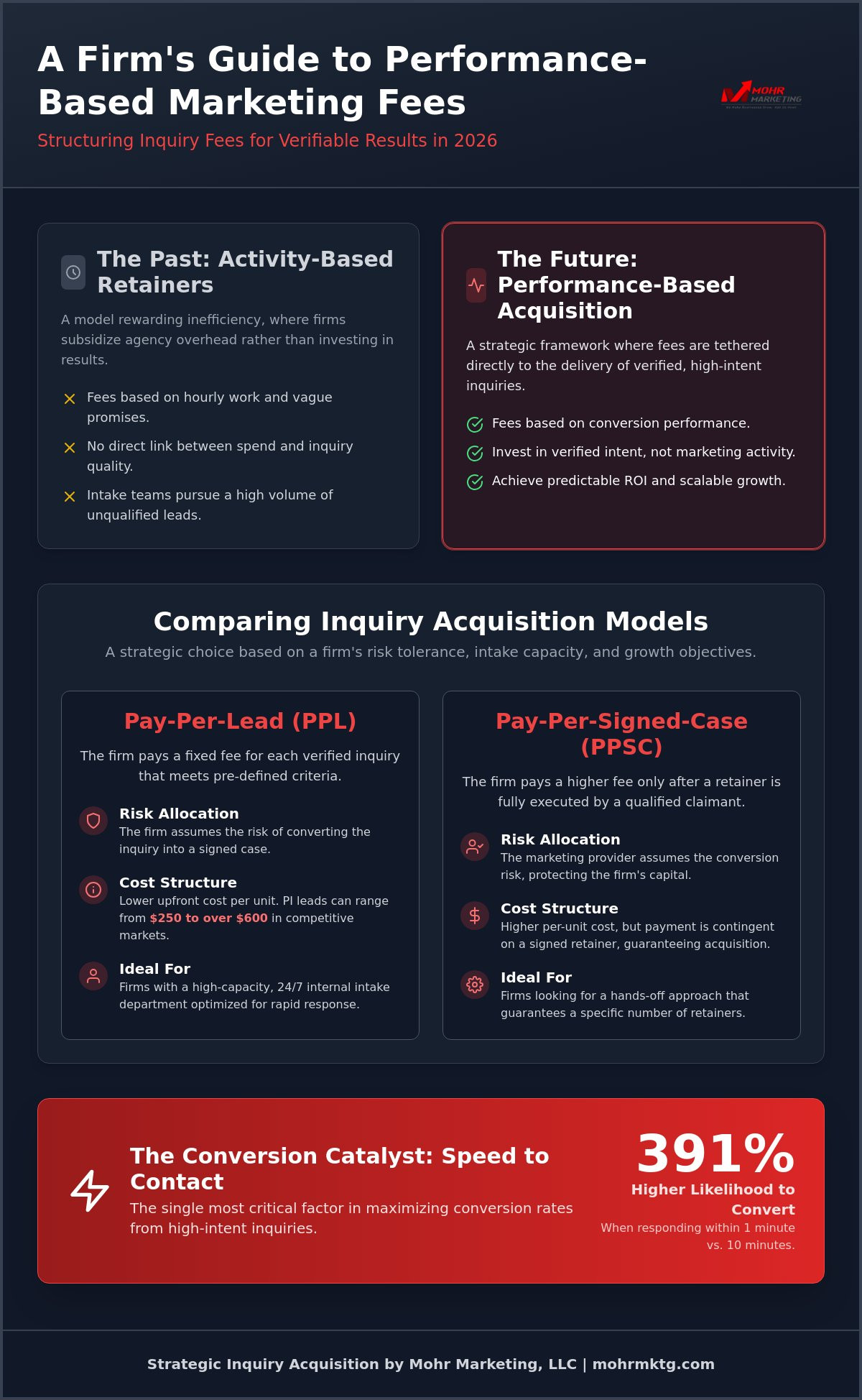
Selecting between Pay-Per-Lead (PPL) and Pay-Per-Signed-Case (PPSC) models is a strategic decision that dictates your firm’s cash flow and operational focus. Under a PPL model, you pay for verified inquiries that meet your specific criteria. This structure requires a robust internal intake team to convert those inquiries into clients. Conversely, the Pay-Per-Signed-Case (PPSC) model shifts the conversion risk to the provider. You only pay when a retainer is fully executed. In both scenarios, modern marketing and consulting fees for inquiries are typically bundled into the unit price, which eliminates the need for separate hourly strategy bills.
When evaluating these models, firms must adhere to ethical guidelines for vendor compensation to ensure compliance with state bar rules regarding fee-sharing. The choice often comes down to your firm’s infrastructure. Firms with a high-capacity, 24/7 intake department often find PPL more cost-effective for high-volume scaling. Firms looking for a hands-off approach that guarantees a specific number of retainers usually opt for the PPSC model to protect their marketing capital from conversion fluctuations.
Pay-Per-Lead (PPL): Scaling Volume
PPL fees fluctuate based on practice area competition and the strictness of your filters. For personal injury firms, the cost per lead in competitive metros ranges from $250 to over $600 as of 2026. This model is ideal for firms that have mastered the art of the 60-second response. Data from 2025 indicates that firms responding within one minute are 391% more likely to convert than those waiting ten minutes. Real-time delivery is the primary value driver here. If your team can’t handle immediate transfers, the PPL model becomes an expensive liability rather than a growth engine.
Pay-Per-Signed-Case (PPSC): Maximizing ROI
PPSC models command higher per-unit fees because they incorporate the cost of professional intake and signature services. For personal injury firms, the cost per signed case typically lands between $1,200 and $3,500. While the upfront cost is higher, it maximizes ROI by eliminating the intake waste associated with uncooperative leads or “no-shows.” This model provides the most predictable growth path for firms looking to scale without increasing management overhead or intake staff. If you’re ready to move toward a more efficient acquisition strategy, you can discuss your firm's specific needs with a strategic partner.
Factors Influencing the Cost of High-Intent Legal Inquiries
The valuation of legal inquiries depends on market saturation and the specificity of the required data. In 2026, mass tort inquiries command significantly higher fees than standard motor vehicle accident (MVA) leads because the litigation potential and case value are vastly different. While a standard MVA lead might involve a broad search for claimants, a high-intent inquiry requires rigorous verification. Strategic firms recognize that marketing and consulting fees for inquiries fluctuate based on the depth of verification required, such as securing police report backed MVA cases or preliminary medical documentation.
Case criteria strictness acts as a direct multiplier for inquiry costs. If your firm requires specific filters, such as a minimum surgery requirement or a specific date range for exposure, the labor involved in vetting those prospects increases. Geographic scope also plays a role. National campaigns often offer a lower cost-per-inquiry due to broader auction reach; however, hyper-local targeting in competitive metros like New York or Los Angeles can drive costs up significantly compared to the national average. You’re paying for the scarcity of the qualified prospect within a specific boundary.
Niche Specialization and Fee Volatility
High-value niches like mesothelioma inquiries represent the peak of fee volatility. Because these cases carry high lifetime values, the competition for search intent is fierce. When new mass torts emerge, the sudden influx of firm capital into specific keywords causes immediate price spikes in the auction environment. You should avoid “cheap” inquiries that lack strict filters. These low-cost leads often carry a hidden tax: the hundreds of hours your intake staff wastes on unqualified prospects who never had a viable case to begin with.
The Compliance and Verification Premium
Professional inquiry fees must account for the rigorous ethical rules for attorney advertising and TCPA regulations. In 2026, the risk of non-compliance can lead to devastating fines and bar sanctions. You aren’t just paying for a name and phone number. You’re paying for a documented chain of consent and a multi-step verification process. This ensures that every prospect delivered is legally reachable and contractually viable. Compliance is a non-negotiable component of professional inquiry fees in 2026.
How to Audit and Validate Marketing Consulting Proposals
Auditing a marketing proposal requires looking past the projected cost-per-lead. You must scrutinize the operational backbone supporting those numbers. When evaluating marketing and consulting fees for inquiries, the primary question is how the vendor handles the inquiry the moment it is generated. A proposal that lacks a detailed intake strategy is a liability. You aren’t just buying data; you’re buying a conversion process that must be fast and reliable.
The ROI of legal intake services is the most critical variable in your fee structure. If a consultant delivers high-intent inquiries but lacks the infrastructure to transfer them immediately, your internal team will struggle to maintain a high conversion rate. This inefficiency creates a “mistake tax” that quickly erodes your profit margins. Transparency is another non-negotiable factor. Demand access to raw data rather than curated summaries. If a consultant obscures the source of their inquiries or offers “guaranteed” low costs without explaining the verification process, they’re likely selling shared or low-quality leads that will waste your intake resources.
The Intake Efficiency Audit
The fee for an inquiry is meaningless without a high-speed intake process. Ask potential consultants for their specific speed-to-lead metrics. Data from 2025 indicates that response times exceeding ten minutes result in a massive drop in conversion. A “Turnkey” ecosystem justifies higher professional fees by removing the friction between lead generation and the signed retainer. This integrated approach ensures that your marketing spend isn’t wasted on leads that go cold before your team can reach them. It’s about securing the case, not just the contact information.
Verification Protocols
Validate that every inquiry meets your firm’s specific case criteria through a dual-verification process. This involves both digital filtering and human confirmation to ensure the prospect is legally viable and has a genuine intent to pursue litigation. Professional marketing and consulting fees for inquiries should reflect this level of labor-intensive vetting. Beware of “aggregators” who simply purchase leads from other sources and add a markup without providing additional verification. A strategic partner provides a direct path to the claimant, eliminating inefficient intermediaries and ensuring the integrity of the data. This direct path is what ultimately protects your firm’s resources.
If your current proposals lack this level of transparency, contact us for a strategic evaluation of your case acquisition model.
Scaling Your Firm with Performance-Driven Inquiry Acquisition
Scaling a law firm in a saturated market requires a fundamental shift in budget philosophy. You must abandon the outdated management fee mindset and embrace a case acquisition strategy. Traditional marketing retainers fund creative experiments with no guaranteed outcome. Performance-driven models ensure your capital is tied to the delivery of qualified prospects. Understanding the nuances of marketing and consulting fees for inquiries allows you to transform your marketing department from a cost center into a predictable growth engine. This approach removes the guesswork from your expansion plans and focuses resources on verified intent.
The transition to an acquisition-focused model demands transparency and a commitment to data. You shouldn’t subsidize an agency’s learning curve or overhead. Instead, your fees should reflect the value of the signed retainer or the verified inquiry. By aligning your financial incentives with your marketing partner, you create a system where success is the only billable event. This shift is essential for firms looking to maintain a leadership position in 2026.
Predictable Growth Models
Performance-based fees provide the financial clarity needed to build a 12-month scaling roadmap. When you know the exact cost of an inquiry, you can forecast your firm’s growth with mechanical accuracy. This transparency allows partners to allocate resources based on proven conversion data rather than optimistic projections. Building a verified inquiry pipeline creates long-term value for the firm. It ensures a consistent flow of high-intent claimants, which reduces the volatility often seen with traditional advertising campaigns. A performance-based model aligns the consultant’s incentives with your firm’s success. If they don’t deliver verified inquiries, you don’t pay. This accountability is the hallmark of a professional strategic partnership.
Next Steps for Partners and Directors
The first step toward scaling is shifting your internal budget from “marketing” to “acquisition.” This represents a commitment to paying for results rather than activity. You must also prepare your intake team for an influx of high-intent inquiries. As established in previous sections, immediate response capacity is non-negotiable for maximizing the value of these inquiries. Partnering with a 30-year industry veteran like Mohr Marketing, LLC provides the stability and insider knowledge required to navigate complex market shifts. We offer a turnkey ecosystem that eliminates inefficient intermediaries and focuses on high-intent, verified opportunities.
Requesting a data-driven proposal is the final step in securing your firm’s competitive advantage. You need a transparent analysis of marketing and consulting fees for inquiries tailored to your specific practice area and geographic goals. This analysis will allow you to evaluate your current spend against a performance-driven acquisition model. Don’t let inefficient fee structures cap your firm’s potential. Secure a roadmap built on three decades of industry experience and a commitment to tangible financial performance.
Secure Your Competitive Advantage in 2026
The shift toward inquiry-based models is no longer optional for firms targeting high-volume growth in 2026. You’ve seen how aligning your budget with verified intent, rather than administrative activity, effectively eliminates the waste inherent in traditional billing. Success in this landscape depends on a rigorous intake ecosystem that converts prospects while their intent is highest. Evaluating marketing and consulting fees for inquiries requires a focus on transparency and multi-step verification to protect your firm’s resources from inefficient intermediaries.
Mohr Marketing, LLC provides the strategic advantage of over 30 years of industry-leading experience. Our turnkey marketing and intake ecosystem ensures strict compliance with state and federal mandates while delivering high-intent opportunities directly to your team. You don’t have to settle for opaque management fees or low-quality leads that drain your intake staff. It’s time to implement a scalable acquisition roadmap built on mechanical accuracy and proven financial performance.
Contact Mohr Marketing, LLC for a Transparent Performance-Based Proposal and start scaling your firm with precision today. Your firm’s expansion is within reach when you partner with a veteran who prioritizes your ROI.
Frequently Asked Questions
How much should I expect to pay for a high-intent mass tort inquiry?
Costs for mass tort inquiries vary based on the specific litigation and the depth of the required verification. These inquiries command a premium over standard personal injury leads because they represent the highest level of search intent and undergo multi-step vetting. You’re paying for a prospect who has already been screened for medical records or specific exposure dates, which significantly reduces the labor burden on your internal intake team.
What is the difference between a marketing management fee and a pay-per-lead fee?
A management fee covers the labor of running campaigns, whereas a pay-per-lead fee is a direct investment in a specific unit of intent. Traditional management fees often reward agency activity over firm results. Performance-driven marketing and consulting fees for inquiries shift the focus to tangible acquisition, ensuring your budget is spent on results rather than administrative overhead or agency “busy work.”
Is it better to pay for leads or for signed cases?
The choice depends entirely on your internal intake capacity and risk tolerance. Paying for signed retainers eliminates conversion risk but requires a higher upfront investment per unit. Paying for leads is more cost-effective if you have a 24/7, high-speed intake team capable of closing cases within the first 60 seconds. Choose the model that best aligns with your firm’s operational infrastructure and scaling goals.
Can marketing consulting fees for inquiries be considered fee-splitting?
Flat-rate or per-unit fees are generally compliant as long as they aren’t tied to a percentage of the legal fee. You must verify that your vendor adheres to specific state bar mandates for pay-per-lead compliance in 2026. Maintaining a clear separation between marketing costs and legal fees is essential for ethical operations and avoiding regulatory sanctions. Always ensure your contract specifies a fee-for-service model.
What happens if the inquiries generated do not meet my firm’s criteria?
Professional vendors provide a clear dispute process for inquiries that fail to meet pre-set filters. You shouldn’t pay for prospects who don’t satisfy 100% of your litigation criteria, such as surgery requirements or exposure windows. Transparent reporting and access to raw data allow your team to validate criteria matches quickly. Ensure your agreement includes a documented protocol for rejecting unqualified inquiries before you commit to a campaign.
How do I know if a consultant’s inquiry fees are competitive for my niche?
Benchmark the fees against the current cost-per-acquisition in your specific practice area and geographic target. High-intent marketing and consulting fees for inquiries reflect the scarcity of qualified prospects in competitive auctions. If a fee is significantly lower than the market average, it usually indicates a lack of dual-verification or that the leads are being shared with multiple firms, which destroys your conversion potential.
What is the typical ROI for performance-based legal marketing?
A sustainable scaling model typically targets a Lifetime Value to Customer Acquisition Cost (LTV:CAC) ratio of 4:1 or 5:1. Performance-based models allow you to forecast this ROI with mechanical accuracy because your costs are fixed per inquiry or case. By removing the disconnect between spend and acquisition, you can build a more reliable growth roadmap. Most firms find this model superior to hourly consulting for long-term expansion.
How does the intake process affect the overall cost of an inquiry?
Inefficient intake increases your effective cost-per-case by wasting high-intent opportunities. Speed-to-lead is the primary driver of conversion efficiency; data shows that responding within one minute dramatically improves your chances of signing a case. A turnkey ecosystem that integrates intake with lead generation protects your marketing investment. It ensures that the inquiries you pay for actually result in signed retainers rather than cold leads that never close.

Recent Posts
- How to Reduce Client Acquisition Cost for Law Firms Without Sacrificing Case Quality
- Generating Birth Injury Inquiries: A Guide for Law Firms
- Digital Retainer Signing Guide for Law Firms
Categories
- AI and Lead Generation
- Business Financing
- Call Verified MVA Leads
- Car Accident Help
- Car Accident Settlements
- Claimant Funding
- Compliance Program
- EMS-EMT Reports
- Geotargeting
- Google Maps Ranking
- Healthcare Practice Growth
- Law Firm Growth
- Law Office Operations
- Lead Generation
- Lead Generation For Attorneys
- Lead Generation For Chiropractors
- Lead Generation For Criminal Attorneys
- Lead Generation For D&A Treatment Centers
- Lead Generation For DUI Attorneys
- Lead Generation For Eye Doctors
- Lead Generation For Family Law Practices
- Lead Generation For PI Law Firms
- Lead Generation For Plastic Surgeons
- Leads For Healthcare Professionals
- Leads For Insurance Industry
- Legal Leads
- Legal Marketing
- Legal Updates
- Mass Tort Leads
- Medicare and Medicaid Leads
- Merchant Funding Leads
- Mold Leads
- Online Marketing Strategies
- Pre-Settlement Funding
- Signed MVA Cases
- Tort Updates
- Truck Accident Leads and Signed Cases
- Truck Accident Settlements
- Web Design