HIPAA compliant marketing for law firms and penalty risks
October 27, 2026 by Mohr Marketing
A marketing campaign can expose a law firm to penalties when protected health information is used or disclosed improperly. HIPAA compliant marketing for law firms must account for how that information moves through ads, email, vendors, and website forms. A Tier one violation may result in a penalty of $120 to $30,113 per violation, while repeated violations in one calendar year can result in fines of up to $1,806,757 per violation.
It’s easy to focus on ad copy and overlook the systems behind it. A patient authorization, vendor agreement, or form that collects sensitive information can determine whether a campaign handles health data appropriately.
This article explains how HIPAA marketing violations may be penalized and what compliance requires in practice. You’ll learn when written authorization matters, how business associate agreements and safeguards fit in, and why ads, tracking technologies, and website forms need close attention. The aim is to help law firms assess risk across the entire marketing process, not just the message a prospective client sees.
Key Takeaways
- HIPAA penalties depend on the nature of a violation and the organization’s level of responsibility, so marketing risks deserve more than a copy review.
- Business associate agreements clarify how vendors handle protected health information and what happens if a potential breach is discovered.
- Patient authorizations, ad platforms, and website forms can affect whether health information is used or disclosed appropriately.
- Administrative, technical, and physical safeguards help protect information across staff workflows, systems, and records.
- Mohr Marketing, LLC offers Personal Injury Leads, Motor Vehicle Accident Leads, Signed Retainers, and Legal Intake Services for law firms seeking marketing and intake support.
Business Associate Agreements
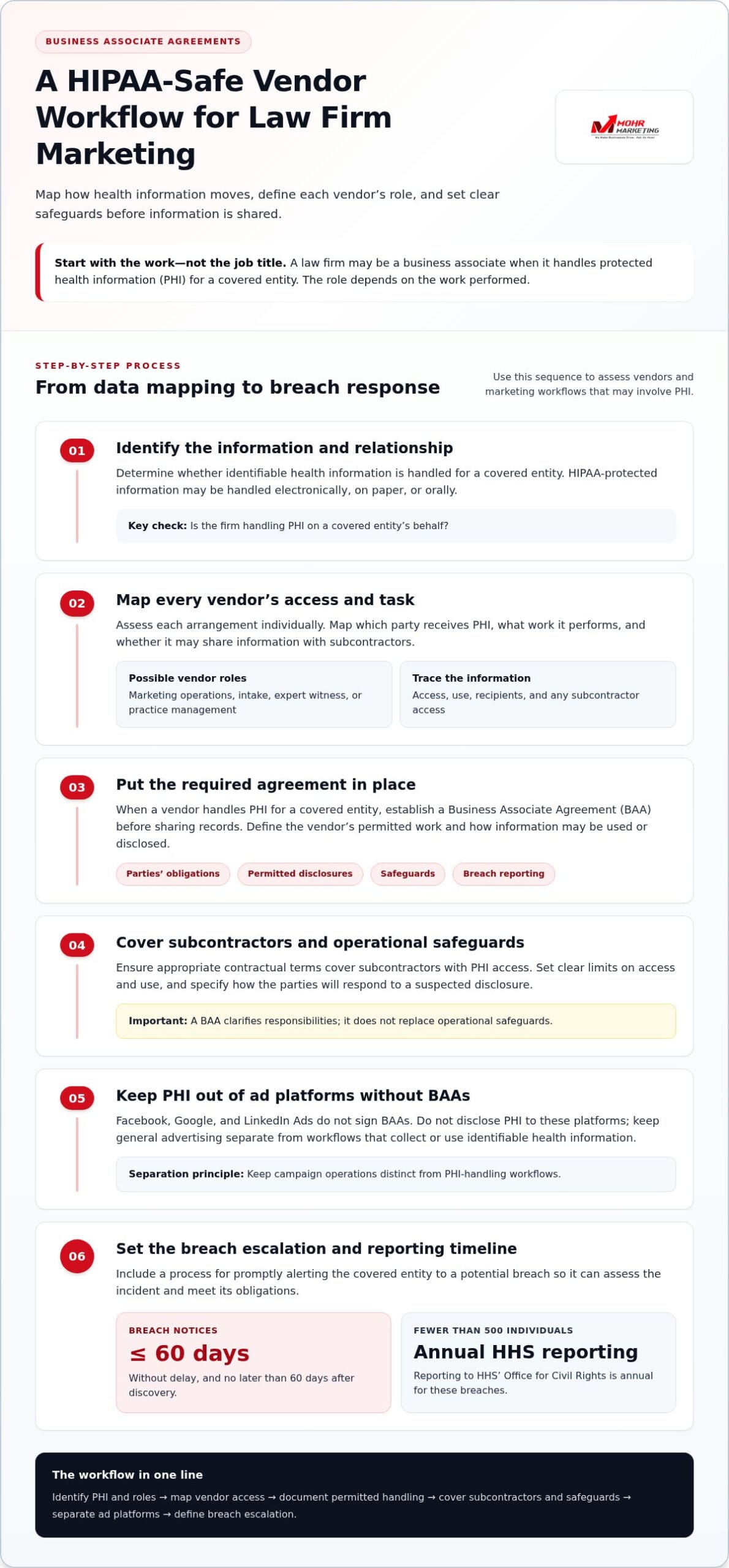
A law firm can become a business associate when it handles protected health information (PHI) for a covered entity, such as a healthcare provider or health plan. The HIPAA Omnibus Rule extends compliance requirements to business associates handling PHI on a covered entity’s behalf. The role depends on the work performed, not simply on the firm being a law firm. According to the U.S. Department of Health and Human Services, HIPAA protects identifiable health information handled electronically, on paper, or orally.
A Business Associate Agreement (BAA) sets contractual terms for using and protecting PHI. Before sharing records with a marketing vendor, intake provider, expert witness, or practice management service, determine whether that party will access PHI while working for a covered entity. If so, establish the required agreement and define the permitted work. For example, a vendor receiving intake details that include diagnoses should have clearly documented limits on access and use.
Assess each third-party arrangement individually. A law firm may use a marketing company to manage campaign operations and a separate intake service to collect prospective client information. Map which party receives PHI, what task it performs, and whether it may share information with subcontractors. A BAA should address the parties’ obligations, permitted disclosures, safeguards, and breach reporting. Ensure that appropriate contractual terms also cover subcontractors with PHI access.
What HIPAA-compliant marketing services and vendors should law firms use? Choose vendors with clearly defined roles and use a BAA when they handle PHI for a covered entity. Facebook, Google, and LinkedIn Ads do not sign BAAs, so campaigns should not disclose PHI to those platforms. Keep general advertising separate from workflows that collect or use identifiable health information.
Contract language also allocates risk. Specify who controls access, how the vendor may use information, and how the parties will respond to a suspected disclosure. A BAA cannot replace operational safeguards, but it can clarify responsibilities. Include a process for promptly alerting the covered entity to a potential breach so it can assess the incident and meet its own obligations.
Notice deadlines matter. HIPAA breach notices must be provided without delay and no later than 60 days after discovery of the breach, according to the U.S. Department of Health and Human Services. For breaches affecting fewer than 500 individuals, reporting to HHS’ Office for Civil Rights is annual, according to the U.S. Department of Health and Human Services. Clear vendor escalation terms help the covered entity act within these reporting requirements.
How do HIPAA requirements differ from state privacy laws and attorney confidentiality rules? HIPAA applies to covered entities and business associates handling PHI in the relevant relationship. State privacy laws may cover additional data, while attorney confidentiality duties govern separate professional responsibilities. Map the information, parties, and purpose involved, then assess each applicable obligation. For example, health-related data outside HIPAA’s direct scope may still fall under a state privacy law, such as Virginia’s Consumer Data Protection Act.
Patient authorization for marketing emails
Under the HIPAA Privacy Rule, covered entities generally must obtain an authorization to use or disclose PHI for marketing, subject to specified exceptions, under §164.508, according to the Office of the Federal Register, National Archives and Records Administration. This rule matters when a healthcare provider uses identifiable patient information to promote a service. A law firm working with that information should identify who controls it, the campaign’s purpose, and whether an authorization covers the proposed use.
Marketing includes communications about products or services that encourage recipients to purchase or use them. An email promoting a provider’s new service may raise different issues from a message about an existing appointment. Before launching a campaign, document its audience, content, and data sources. Confirm that any authorization covers the information and intended use. Do not assume an earlier patient contact permits every later promotion.
Apply the same care to email and social media. A patient’s name paired with an email address or cell number can identify them, especially when campaign details reveal health information. Do not upload patient lists or use identifiable patient details in posts or ads without applicable permission. For example, a case-related social post should not reveal a patient’s diagnosis or treatment simply because their name is omitted.
Email safeguards matter even after authorization. Use end-to-end encryption for messages containing PHI, restrict access to staff who need the information, and protect accounts with unique credentials. Keep diagnoses out of subject lines, where they may appear in notifications or inbox previews. Retain campaign records showing the authorization, approved message, recipient list, and any withdrawal or preference change. Clear records help staff distinguish authorized outreach from general communications.
What are HIPAA-compliant email, SMS, website, and analytics practices for law firms? Keep PHI out of ordinary promotional messages, SMS content, website fields, and analytics events unless its handling is properly authorized and protected. Encrypt sensitive submissions, collect only necessary details, and prevent advertising tools from receiving identifiable health information.
For a website form, request only the information needed to respond, then route submissions through a protected intake process. Separate general contact requests from forms that invite medical details. Review analytics tags and social pixels to ensure page activity does not transmit identifying health information. Maintain documented access controls and encrypted backups for systems containing PHI.
These safeguards work best when marketing, intake, and privacy procedures align. A firm planning new campaigns can discuss its marketing and intake goals while keeping authorization and information-handling requirements central to the workflow.
Administrative, technical, and physical safeguards
A HIPAA-conscious marketing program assigns responsibility, trains staff, and protects PHI across people, devices, and records. Start by documenting policies, mapping information flows, and addressing gaps before campaigns or intake processes use sensitive data.
Administrative Safeguards and Staff Training
Administrative safeguards are the policies, assigned responsibilities, and staff practices that govern PHI handling. They matter because even a well-designed system can fail when employees misunderstand access rules or share information through the wrong channel.
Identify who may access marketing and intake records, then limit access to those roles. Train staff on firm policies for collecting, using, and disclosing PHI, and explain how to report a suspected incident. The HIPAA Privacy Rule requires covered entities to train workforce members on relevant policies and procedures under §164.530. Keep training records and update procedures when workflows, staff duties, or systems change.
Build a review process into campaign operations. Before launch, have designated staff check audience lists, message content, and data transfers. Record the decision and any corrective action. This creates a practical compliance record and helps the firm identify recurring process failures instead of treating each concern as an isolated mistake.
Electronic PHI Safeguards
Electronic safeguards are technical controls that protect PHI stored or transmitted by computers, email, and other digital systems. They matter because a single account or shared file can expose records to people who do not need access.
Use encryption and unique usernames and passwords to protect electronic PHI. Assign individual accounts rather than shared logins, and remove access when someone’s role changes. For example, an intake employee who no longer handles a campaign should not retain access to its records. Review permissions and system activity as part of routine risk management.
HHS recommends the National Institute of Standards and Technology’s Guide for Conducting Risk Assessment for security risk assessments. Use a documented assessment to identify where campaign data enters, where it is stored, and which systems can access it. The HIPAA Security Rule’s contingency-plan standard covers data backup, emergency-mode operations, and disaster-recovery plans under §164.308. Include those elements in the firm’s response planning.
Physical safeguards apply to offices, devices, and paper files. Store paper medical records in locked, restricted-access locations, and use sign-out or access procedures for files reviewed during casework. Position screens away from public areas, secure devices when staff leave workstations, and control access to rooms containing records. A locked cabinet offers no protection for files left unattended on a desk.
For a practical program, connect each safeguard to a named owner, a written policy, and a review step. Check that staff training, access controls, encryption, locked storage, and backup plans reflect actual marketing and intake workflows. That alignment protects patient rights and helps prevent avoidable violations.
Website forms and appointment requests
A contact form can send health information through several systems before staff respond. Map each step, from the visitor’s browser to the organization’s intake team, storage platform, and analytics tools. Covered entities should document data processing and identify which vendors receive form data. This map shows where tracking technologies may access information and where safeguards need to apply.
Keep forms focused on their purpose. A general appointment request may need contact details and a preferred time, while a case intake form may invite medical history. Separate the functions, explain what each form collects, and route sensitive submissions through a protected intake process. Do not send form contents through email notifications or analytics events. Test submissions with sample data, then review each destination before publishing a changed form.
Tracking pixels require a separate review. In 2022, The Markup found Facebook pixels on websites operated by 33 of the top 100 U.S. hospitals. HHS issued a bulletin in December 2022 explaining how existing HIPAA rules apply to tracking technologies. In July 2023, the FTC and HHS sent a joint risk letter to approximately 130 hospital systems and telehealth providers. Those events underscore the need to examine what a pixel collects, where it sends data, and whether identifiers connect browsing activity to health information.
Do not assume every page visit is harmless metadata. A visit to a page about a particular condition, combined with identifying information, may reveal sensitive context. Inventory pixels, analytics tags, chat tools, and appointment widgets. Disable tools on authenticated pages where appropriate, and prevent vendor scripts from receiving form fields or other sensitive values. Document each tool’s purpose and the data it processes.
Legal developments also matter. The American Hospital Association sued the U.S. Department of Health and Human Services Office for Civil Rights in November 2023 over its online tracking guidance. In June 2024, a judge ruled for the Association and held that OCR had exceeded its authority under HIPAA. Covered entities still need to assess their actual disclosures under applicable HIPAA rules; the ruling does not make every tracking setup safe.
Encrypt form data and use an encrypted server with off-site backup for sensitive PHI. Limit access to staff who handle appointments or intake, and document retention and deletion practices. Review the website after changes to forms, plugins, or analytics tools. A vendor update can change data flows even when the visible page looks the same.
Set up recurring reviews that test a form submission, inspect its destinations, and confirm tracking tools receive only intended data. Record findings, assign corrective work, and repeat the review after material website changes. This process applies privacy standards to the real interactions among a visitor, the firm, and each technology provider.
Can law firms use client health information in advertising or case studies?
Law firms should not treat a client’s health history as ordinary marketing material. Before sharing personal health information in an advertisement or case study, obtain written consent from the patient or representative. The permission should match the planned use. A client’s agreement to discuss a case privately does not, by itself, establish whether the firm may publish details in an ad, website feature, or social post.
Define the proposed disclosure before requesting consent. Identify the channels, audience, information, and purpose. For example, a case study might identify the client, describe an injury, and report a recovery outcome. The consent process should make those intended details clear instead of relying on broad language that leaves the scope uncertain. Keep signed consent with the campaign record so staff can compare the approved use with the final material.
Review every version before publication. A graphic may add a client’s photograph, a caption may identify a diagnosis, and a testimonial may reveal treatment details. Each addition can change what the audience learns. Assign a reviewer to compare the draft, images, captions, and distribution plan with the patient’s written permission. If an agency or publisher will receive health information, include that disclosure in the review.
Removing a name does not necessarily make a story unidentifiable. Dates, locations, rare conditions, and distinctive case facts may point to a particular person when combined. The HIPAA Safe Harbor de-identification method requires removing all 18 HIPAA identifiers. Examples of identifiers include names, dates of birth, addresses, phone numbers, insurance identification numbers, Social Security numbers, and full-face photographs. A firm should assess the complete story, not just its headline.
Use a controlled approval process for case materials. Store consent records with the corresponding draft, document the approved channels, and set a review checkpoint before publication. If a client withdraws permission or the campaign changes, pause publication and assess whether the material remains within the documented scope. Limit access to consent records to staff who manage the case or campaign.
For example, a firm wants to describe a client’s medical treatment in a social post. Staff should identify the health details, confirm that written permission covers social media, and check the image and caption for additional identifiers. If permission does not cover the proposed disclosure, revise the material to exclude that information. This practice protects client confidentiality and keeps campaign claims tied to approved facts.
Mohr Marketing, LLC: Personal Injury Leads
Mohr Marketing, LLC provides Personal Injury Leads for law firms developing cases. Firms focused on motor vehicle accidents can also use Motor Vehicle Accident (MVA) Leads and Signed Retainers. Legal Intake Services support the handling of incoming inquiries.
Marketing performance and privacy controls should work together. Align intake procedures with the firm’s policies for collecting and handling health information. Limit access to appropriate staff and route sensitive details through established safeguards.
Contact Mohr Marketing, LLC to discuss its legal marketing and intake services.
Make privacy part of your growth plan
The next campaign is an opportunity to build privacy decisions into planning, rather than add them just before launch. For HIPAA compliant marketing for law firms, connect campaign goals with clear responsibility for data handling, intake, and review. This helps teams identify operational gaps while plans are still taking shape.
Set a review point at each campaign stage: planning, launch, and material changes. Decide who approves audience selection, checks how information moves, and records updates. When a campaign or intake workflow changes, revisit safeguards and staff responsibilities. A consistent process gives marketing and legal teams a shared basis for decisions.
Use this structure to pursue growth without treating privacy as a separate workstream. A focused review of your next campaign can turn compliance principles into practical operating decisions.
Build the next campaign with clarity, discipline, and confidence.
Frequently Asked Questions
What are the penalties for HIPAA marketing violations?
HIPAA penalties depend on the violation tier and the organization’s culpability. The listed civil penalty ranges are $120 to $30,113 per violation for Tier one, $1,205 to $60,226 for Tier two, and $12,045 to $60,226 for Tier three. Tier four may carry $60,226 per violation. Repeated violations in one calendar year can result in fines up to $1,806,757 per violation. Criminal penalties can include up to 10 years in prison when PHI is used for commercial advantage or malicious harm.
Does HIPAA apply to law firms and attorney marketing?
HIPAA can apply to a law firm when it handles protected health information as a business associate for a covered entity. HIPAA compliant marketing for law firms starts with determining the firm’s role and how it handles PHI in that relationship. Attorney confidentiality duties are separate, so assess both professional obligations and any HIPAA responsibilities.
What HIPAA rules apply when law firms handle protected health information?
The Privacy Rule governs permitted uses and disclosures, while the Security Rule addresses the protection of electronic PHI. The Breach Notification Rule sets requirements for notifying parties after a reportable breach. For example, a firm managing records for a healthcare provider should define staff access, document permitted uses, and establish an incident escalation process. Applicable requirements depend on the firm’s role and the information it handles.
Do law firms need business associate agreements with marketing agencies?
A BAA is needed when an agency handles PHI on behalf of a covered entity in a business associate relationship. For example, an agency managing a campaign that receives identifiable patient details may need contractual terms governing that information. First map data flows: identify what the agency receives, what it does, and whether subcontractors also access PHI. Advertising platforms that do not sign BAAs should not receive PHI through campaign data.
How can law firms collect leads and intake forms without exposing health information?
Separate initial contact capture from detailed case intake. A first form can request basic contact details and a preferred response method, then direct the person to a protected intake channel for sensitive case information. Keep diagnoses out of email alerts, page addresses, and analytics fields. Before publishing a form, submit a test entry and inspect where its contents appear, including staff notifications and connected marketing tools.
What security safeguards should law firms use to protect health information in marketing systems?
HIPAA compliant marketing for law firms also depends on safeguards such as encryption, unique user accounts, role-based access, and locked storage for paper records. Assign someone to review access when staff duties change, and remove permissions that are no longer needed. Document staff procedures for handling PHI and reporting incidents. Include backup and recovery plans for systems holding electronic records, then test whether authorized staff can restore needed information without granting broad access to campaign data.

Recent Posts
- TCPA Rules for Legal Lead Generation, Lead Quality, and Compliance
- HIPAA compliant marketing for law firms and penalty risks
- Compliance for Multi-State Legal Advertising: Rules, Claims, and Contacts
Categories
- AI and Lead Generation
- Business Financing
- Call Verified MVA Leads
- Car Accident Help
- Car Accident Settlements
- Claimant Funding
- Compliance Program
- EMS-EMT Reports
- Geotargeting
- Google Maps Ranking
- Healthcare Practice Growth
- Law Firm Growth
- Law Office Operations
- Lead Generation
- Lead Generation For Attorneys
- Lead Generation For Chiropractors
- Lead Generation For Criminal Attorneys
- Lead Generation For D&A Treatment Centers
- Lead Generation For DUI Attorneys
- Lead Generation For Eye Doctors
- Lead Generation For Family Law Practices
- Lead Generation For PI Law Firms
- Lead Generation For Plastic Surgeons
- Leads For Healthcare Professionals
- Leads For Insurance Industry
- Legal Leads
- Legal Marketing
- Legal Updates
- Mass Tort Leads
- Medicare and Medicaid Leads
- Merchant Funding Leads
- Mold Leads
- Online Marketing Strategies
- Pre-Settlement Funding
- Signed MVA Cases
- Tort Updates
- Truck Accident Leads and Signed Cases
- Truck Accident Settlements
- Web Design